
What is Mobile Ad Fraud?
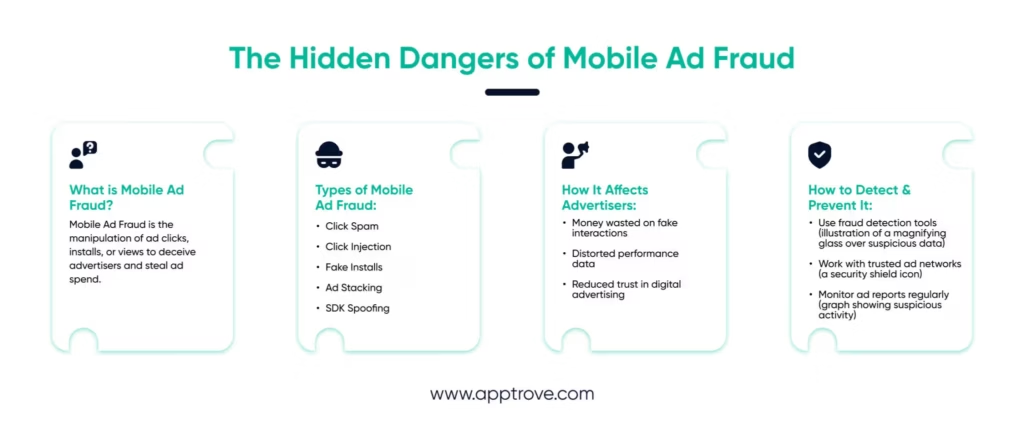
Mobile ad fraud is the act of tricking companies into believing that unauthorized clicks, downloads and views have been made on mobile ads delivered by mobile devices, such as smartphones and tablets. It’s similar to telling someone that you completed your homework when, in reality, you have just stolen someone else’s work. Companies lose money by paying for ads that don’t even get a real click from a real user.
Types of Mobile Ad Fraud
Click Spam:
Click spam is a type of Mobile Ad Scam whereby con men trick advertisers into thinking that the ad has been clicked several times even when no person clicked it. It is like making someone hit the “Like” button on a social media page without their approval for the purpose of creating fictitious fame.
Click Injection:
The Mobile Ad Scam of Click Injection occurs when con artists introduce fake clicks secretly at the last moment before the app is installed. This ensures that advertisers end up paying the scammers for a download that doesn’t belong to them. For example, a person joins the project late and claims to be a part of the work he hasn’t done.
Fake Installs:
Fake installs, in this context, refer to the fraudulent practice where individuals utilize automated bots or people to create fake app installations repeatedly. Advertisers pay for app installations from users who do not genuinely exist, which is analogous to setting up numerous fake profiles on social media platforms to boost follower count.
Ad Stacking:
Ad stacking denotes a technique of stacking several ads in one spot that is still being charged to advertisers. Consumers will only be able to see the top ad, while the advertisers pay for all the advertisements below the top ad, even though they haven’t been seen. One could compare this to the act of getting a whole pile of magazines and being able to read only the one that is on top.
SDK Spoofing:
SDK spoofing refers to mobile ad fraud whereby scammers send similar signals to the ones sent by applications to the advertisers. They report as though users clicked on and downloaded particular advertisements when, in truth, nothing happened. One can draw a similitude with hacking the school system so as to show one attended the class, even if they were absent.
What causes Mobile Ad Fraud?
Mobile Ad Frauds take advantage of the way advertisers’ systems are organized, thus making it easy for fraudsters to profit. Honest clicks or downloads are the type of data that should be of importance for the advertiser to find out their success. Fraudsters, on the contrary, are not cooperating with the criminals; they form an advertiser’s budget by using trust already earned, so the funds are directed to the wrong advertiser and the wrong audience.
What is the Process of Detecting Mobile Ad Fraud?
Identifying Mobile Ad Fraud means evaluating the following indicators closely:
- Unusual click-through rates: The occurrence or disappearance of clicks unusually quickly does not fit the normal activity of a client.
- Quick downloads: Immediately seeing unreasonable numbers of downloads in a day from just one source.
- User location is suspicious: Instances when the installations or clicks are coming not from where the target audience should be, i.e., coming from unusual locations or devices – what one can describe as “good traffic.”
How to Avoid Being Victimized by Advertising Fraud
Advertisers can avoid advertising fraud by:
- Monitoring their ad traffic by means of fraud detection technology.
- Partnering only with reputable ad networks.
- Making sure they regularly check ad reports for inconsistencies.
- Setting up clear and strict policies regarding access to advertising campaigns.
Conclusion
Mobile ad fraud has become a serious issue for advertisers. Unauthorized clicks, unconducted installations and misleading references to inaccurate sources can result in fake success of campaigns, which will ultimately waste budgets and falsify results. The loss here includes not only money but also the inability for advertisers to assess how effective their efforts in advertising were.
Solving the issue necessitates something more than just realizing suspicious behaviors after a campaign is completed. It is crucial that companies apply a preventative approach that incorporates real-time fraud detection, attribution, continuous surveillance, and full transparency when reporting. With the help of click validation, installs, and in-app events, marketers are able to find different failures, stop invalid traffic, and ensure ad budget goes to real customers.
Technology helps a lot in the process. Automated fraud detection processes and complex analytics allow advertising agencies to analyze lots of data from campaigns, search for suspicious activities, and react to dangerous situations faster than manual work does. However, it is better when automation is helped with tracking systems, conducting regular performance evaluation, and knowing how fraud affects different attribution models.
In conclusion, preventing mobile ad fraud is crucial for maintaining a marketing campaign budget. It is also about reference to the marketing data’s purity and performance measurement. Once marketers can differentiate real user activity from invalid ones, they will be able to invest the budget more wisely, optimize their ads according to trustworthy statistics, and work on strategies that achieve measurable business results.
Want to take your mobile ad fraud prevention to a new level? Get in touch with the expert team at Apptrove to learn how advanced fraud detection and mobile attribution can ensure the safety of your ad budgets, find potential fraud, and make decisions based on reliable data sources.
FAQs
1. Why is mobile ad fraud difficult to identify?
Mobile advertisement fraud often imitates genuine user activity, thus making it tough to tell fraudulent clicks, installs, and conversions apart from real ones. Fraudsters also leverage advanced methods to get around simple detection systems.
2. Who is most affected by mobile ad fraud?
Mobile advertisement fraud affects advertisement networks, mobile marketers, advertisers, and app developers. It can result in wasted money for acquiring customers, misleading performance data, and poor decision-making for the marketing investments.
3. How does mobile ad fraud affect app attribution?
Mobile advertising fraud can tamper with attribution data by claiming installations or conversions were performed by an advertising partner. Marketers will find it difficult to pinpoint the channels contributing to the growth of their applications and acquiring users.
4. Can mobile ad fraud affect in-app purchases and conversions?
Indeed, scammers can create fictitious in-app events, purchases or conversion signals, making campaigns seem to be more effective than they really are. This can lead to inaccurate revenue reporting, increased return on ad spend (ROAS), and improper campaign optimization.
5. What role does mobile measurement play in preventing ad fraud?
Advertisers can use a Mobile Measurement Platform (MMP) for verifying attribution assertions, tracking user behaviors, and discovering questionable patterns from a number of campaigns. By using attribution along with fraud prevention, marketers are able to enhance the quality of the information and safeguard their investments in advertising.