
Ad frequency indicates how many times a user is shown an ad. It is a very important metric in mobile and digital advertising, as it allows marketers to learn how often their campaigns reach the same audience. While repeated exposure can be helpful in enhancing brand awareness and driving conversions, too frequent ads can cause ad fatigue, diminish engagement, and create a negative experience for a user.
For mobile app advertisers and publishers it is important to manage ad frequency in order to reach a good compromise between the visibility of the campaigns and the satisfaction of audiences. While a person who sees the ad for the first time might not memorize the name of the brand, a user who sees the same ad many times will simply ignore it.
Understanding Ad Frequency
Ad frequency is the average number of times a device is shown an advertisement over a given amount of time. It is important for marketers to differentiate between reaching new people and showing ads to an already familiar audience.
For instance, when a mobile advertising campaign has 50,000 impressions and reaches 10,000 unique users, the average ad frequency rate is five. This shows that each user once reached, has an average of five views of an advertisement during the campaign period.
But it does not mean that the same user has seen the advertisement at least five times. Some people may have seen the advertisement two times while others may have seen it ten times or even more than ten. This is due to the average figures.
How to Calculate Ad Frequency
The measure of ad frequency is calculated by dividing the total number of ads served by the number of different users exposed to the ads over a certain period. Ad Frequency = Total Number of Ads Served / Unique Reach
For example, if from the campaign it appears that 120,000 ads were served and the unique reach was 30,000 users.
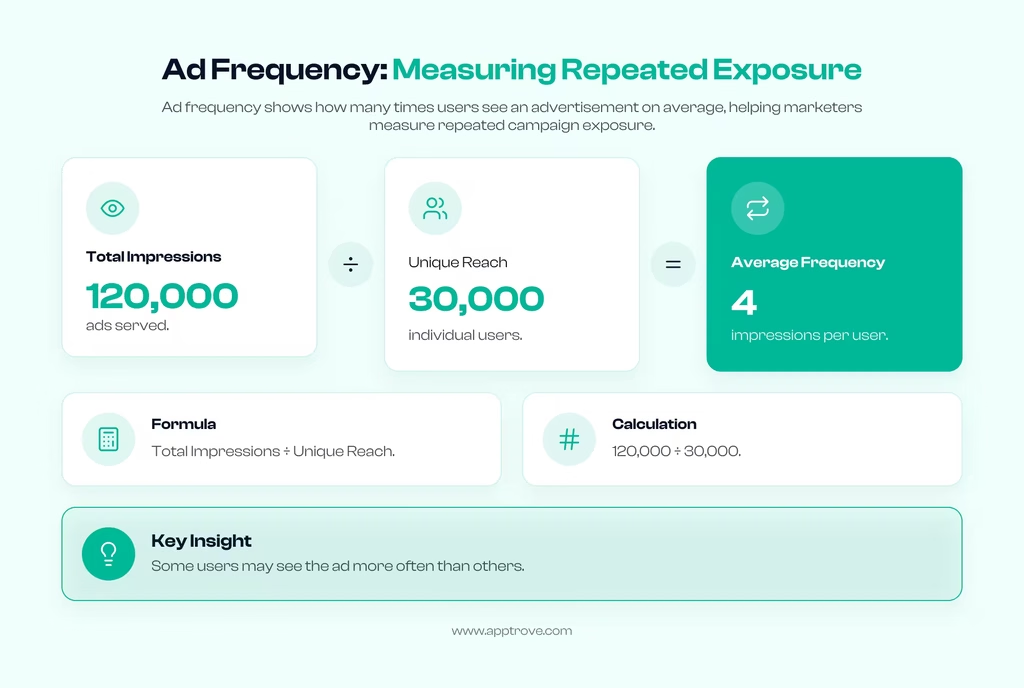
Ad Frequency = 120,000 / 30,000
Ad Frequency = 4
This means that the ad was shown an average of 4 times to each user during the reporting period.
Elements of the Ad Frequency Equation
Total Number of Ads Served: This indicates the total number of times an ad was displayed and counted as an impression. A user can be responsible for various impressions if the same ad is displayed to the same person many times.
Unique Reach: This means the number of users who were exposed to the ad at least once over the selected period of time. Reach is useful for marketers because it helps them to understand the size of the audience rather than the total number of impressions.
Both measurements must use the same campaign scope and reporting period. Differences in attribution windows, identity resolution, or reporting definitions can affect the calculation. Consistent measurement is necessary for meaningful comparisons.
Why Is Ad Frequency Important?
The rate at which advertisements appear affects how people respond to advertisements and also how well companies are able to spend their resources for advertising. Tracking it gives marketers an opportunity to see the link between repeated exposure, results from the campaign, and user experience.
Enhancing the Brand Recognition
The repeated exposure makes advertisements and messages of a brand well-known for the audience. If users see a brand for many times in different sessions/internet browsing, it makes it to be better recognized by them.
It is important for awareness campaigns while they focus on gaining knowledge of users of the brands rather than getting immediate sales.
At the same time, repeated exposure gives a great effect only if advertisements are still relevant and deliver the same message. Too frequent showing of the similar creatives can lessen its effect.
Regulating Costs for Advertising
Any advertisement costs money each time someone sees it. If a campaign campaigns too many times to the same viewers without getting engagement from them, marketers may be wasting money. Monitoring frequency of ads gives teams an opportunity to understand when there is too much exposure and use funds wisely to get new audiences.
Preventing Ad Fatigue
When users see an advertisement too many times, they will not respond as effectively as they did. Users might start ignoring the ad or seeing the product negatively.
Ad frequency measurement helps marketers identify cases of ad overexposure. If frequency numbers are high while the user interaction declines, that’s a red flag that creative changes, new audience involvement, or similar actions are required.
Retargeting campaigns are targeted at users in contact with your brand. Because of their nature, retargeting audiences could be overexposed easily due to their small size.
By comparing ad frequency with CTR, CR, or CPA, marketers see how repeated contacts influence campaign results. If the increased ad frequency leads to a rise in engagement, it may indicate that further exposure is beneficial. If CTR and CR decline, new ad delivery should be considered.
What Is Ad Frequency Capping?
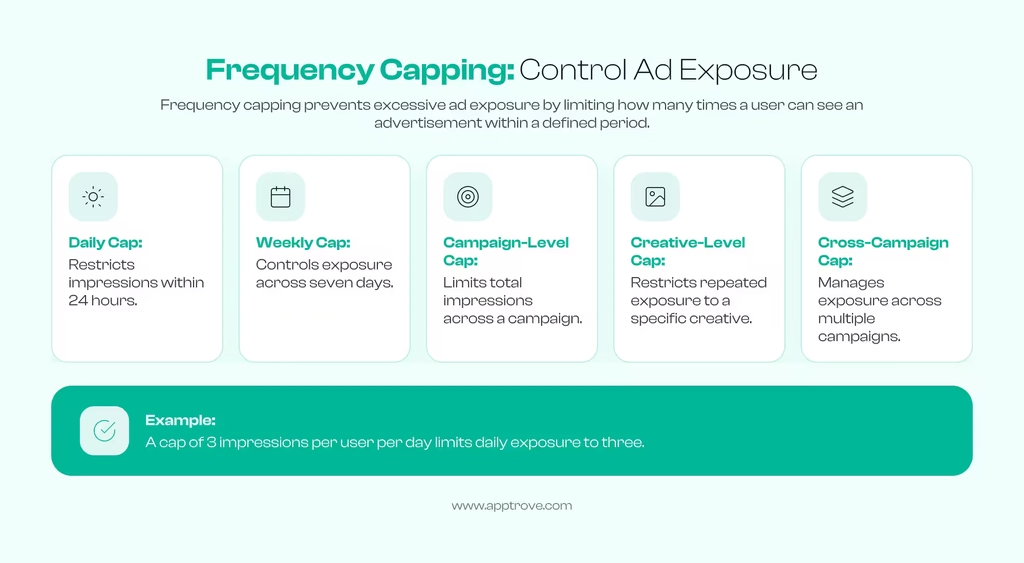
Frequency capping is a technique that keeps track of the frequency of display of an advertisement to a target audience. Basically, it allows advertisers to set certain impressions that shouldn’t be exceeded during the specified time frame. For instance, a frequency cap of 3 is a common practice where ads can be shown to the same user no more than three times a day. After reaching the established limit, no more advertisements will be shown to the user, following the delivery rules of the advertising platform.
Varying on how often an ad has been served to a user, frequency capping will help eliminate the problem of overexposure during an advertising campaign. The technique is especially important to mobile ad campaigns because mobile users interact with different apps and receive numerous ads throughout their online campaigns.
Frequency Caps Types and Their Scope
Daily Frequency Caps: This rule limits the number of ad impressions in a day and prevents consistent ad exposure due to numerous campaigns.
Weekly Frequency Caps: The rule helps control the number of impressions within seven days and allows slow ad distribution throughout the week.
Campaign frequency cap: Impressions for the entire campaign. This will help with the imposition of limits on exposure with the presence of different creatives and placements.
Creatives frequency cap: Limits the frequency of exposure of an advertisement or creative. This cap is useful when marketers want to restrict the repeated exposure of visitors to the same advertisement while allowing other campaign creatives to reach them.
Cross-campaign frequency cap: Limits exposure across campaigns instead of running the campaigns independently. The availability of this type of cap depends on the platform used for advertising and its ability to track users across different campaigns.
Various elements can affect how frequently users see ads. Knowing these factors can help marketers build better delivery methodology.
Budget of the campaign
Having a larger amount of money for the campaign can help with the number of impressions. However, if the size of the target audience is still limited, the additional spending will likely lead to higher exposure of existing users instead of reaching new ones.
Organizations have to look at changes in budgets during the evaluation of reach and frequency in order to know if the campaign has truly benefited.
Size of Audience
Due to the fact that ads are shown to fewer people, the audience may reach its maximum exposure faster in case the generated advertisement is highly targeted. This could happen due to retargeting campaigns or campaigns aimed at niche audiences.
A broader audience makes it possible to spread the impressions over the majority of users, of course, if audience targeting is done properly.
Length of Campaign
The timeline of the campaign is an essential factor when we evaluate the process of impressions collection. A short campaign may generate quite a lot of impressions a day. Thus, a long campaign may give relatively equal exposure.
It is also useful to monitor the frequency of the ads shown for a certain period of time.
Ad Distribution Features
The number of placements, marketplace situation as well as options of advertisement distribution shape the frequency the ad is being shown to the audience. For instance, the campaign taking place both in print and online can generate multiple exposures.
Marketers must analyze the performance of placements as well as delivery overlap to reduce redundancy.
Audiences Targeting
Narrow focusing can create higher relevance but limits the size of the available audience. If the same customers qualify for various targeting conditions, they are likely to see multiple ads.
By frequently reviewing audience overlap and exclusion criteria, marketers can diminish unnecessary exposure.
Optimizing Ad Frequency
Optimizing ad frequency is not about using the lowest count of impressions, but about finding the right exposure that will secure the campaign objectives while ensuring good user experience.
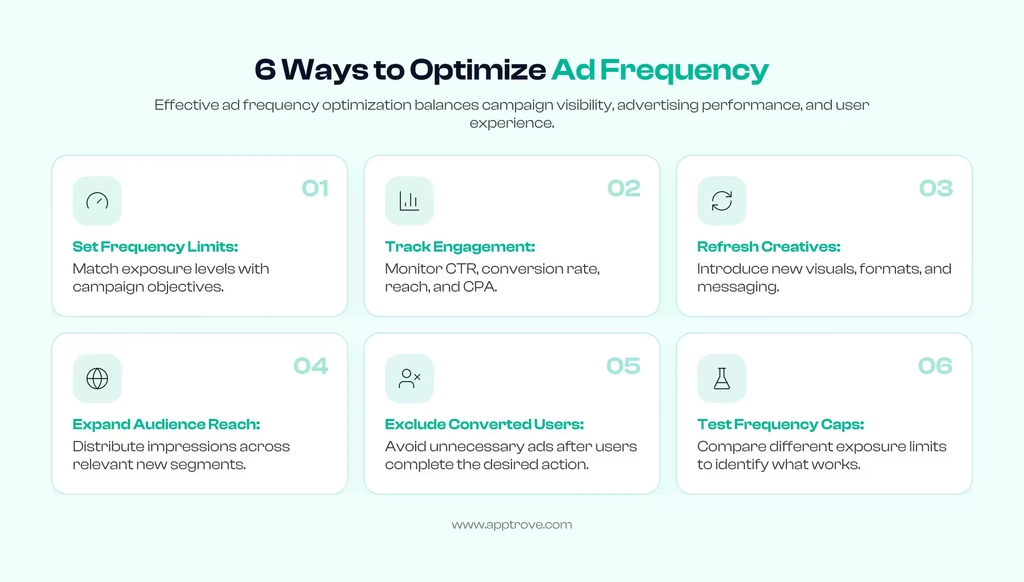
Set frequency limits based on the goals of the campaign
Different objectives require different exposure strategies. Brand awareness campaigns can benefit from repeated exposure while conversion campaigns require more careful dissemination.
Set frequency limits based on the goal of the campaign, the target audience size, the length of the campaign, and historical performance.
Allocate time for tracking engagement metrics
Make sure to track ad frequency along such metrics as click-through-rate, conversion rate, impressions, reach, and cost per acquisition (CPA).
If frequency increases while CTR and conversion rates decline, the campaign may be experiencing ad fatigue. If engagement remains consistent or improves, the existing exposure level may still be effective.
Refresh Advertising Creatives
It is important for advertisers to realize that repeatedly using the same creative can cause the advertisement to lose interest over time. New visuals, message, formats, and headlines should be added to the advertising strategy.
Creative rotation allows marketers to communicate different advantages of the product without relying on a single advertisement.
Broaden Audience Reach
If the frequency becomes too high, the only option left is to expand the eligible audience which will help to diffuse impressions more evenly. Marketers can look for new relevant segments, acquisition channels, and geographic markets.
But one should make sure that the quality of targeting is not compromised when expanding audiences.
Utilize Audience Exclusions
Exclude those users who have already been reached and completed the desired task. For instance, if the campaign intent is to encourage app installation, those who have done it already have to be excluded from the audience.
Doing so eliminates unnecessary impressions and enables budgets to focus on more reliable users.
Test Different Frequency Limits
Try different frequency restrictions with similar groups of consumers or campaigns. Keep track of the impacts of each variable on reach, interactions, purchases, and financial efficiency.
Controlled experimentation enables firms to recognize ad exposure tendencies that suit their audience instead of relying on guesses or the average frequency estimations.
How ad frequency relates to reach and impressions?
Although ad frequency, reach, and impressions are all interconnected metrics, each measures a different aspect of an ad campaign.
Ad frequency is the quantity of times an ad reaches a single user throughout a particular timeframe and helps in the evaluation of repetitive exposure.
Reach indicates the number of distinct individuals who saw the advertisement at least once and shows the extent to which the ad campaign reached the intended audience.
Impressions demonstrate the total number of times an ad was displayed, including the repeated ads shown to the same individual.
Take, for instance, a campaign with a total number of impressions equal to 40,000, while the number of distinct targets that saw the ad only equals 10,000. In this case, the frequency of the ad is 4.
Premising these three metrics together helps get a clearer understanding of ad delivery and helps marketers realize how
Challenges in Managing Ad Frequency
While ad frequency is an essential metric for optimization, determining it well may face several difficulties.
Cross-Device Tracking: Customers can see ads on mobile phones, tablets, and computers. An ad platform that can identify users will send inaccurate numbers on frequency.
Audience Overlap: Consumers can belong to multiple audience segments or campaigns. However, through poor frequency control, they can exceed the required impression level.
Platform Limitations: Different ad platforms can have different frequency-capping options; some platforms work only with one specific campaign.
Changing User Behavior: Consumer behavior continues to change. The frequency that works for one might not work for another campaign with a different audience, creative, and offer.
Measurement Differences: Platforms might calculate impressions, unique reach, and user identification differently. Therefore, comparing frequency numbers without taking into consideration these differences of reporting systems can result in misleading interpretations.
To address those issues, it takes systematic measurements, proper organization of campaigns, and constant analysis.
Conclusion
In conclusion, ad frequency is important to marketers as it provides information on how often consumers have seen the advertisements. By checking the number of impressions and unique reach a company can understand if a client saw a campaign’s ad too many times.
Ad frequency helps marketers understand how often users encounter their advertisements and whether repeated exposure is supporting campaign objectives. By analyzing impressions against unique reach, businesses can evaluate audience exposure, identify potential ad fatigue, and make more informed decisions about campaign delivery.