
What Is ARPDAU?

ARPDAU is a metric that calculates how much revenue an app has made per active user in one day. Through this metric, app developers, publishers, and marketers find out how well an app converts its daily user activity into revenue. While total earnings are usually looked at, this metric highlights the fact that revenue generation and the number of users interactively engaging with an app should be correlated.
There are instances when an app gets numerous daily users but remains less profitable. Conversely, an app with a smaller audience may earn more as its consumers are more likely to buy goods, engage in advertising, or subscribe to a paid service. Basically, ARPDAU provides insights into the average revenue earned per user.
For the companies that work in the competitive environment of mobile markets, the need to know this metric is important to assess how effective the monetization strategies are, how well the promotional campaigns have done, and where to enhance revenue generation. More importantly, ARPDAU helps gain proper insights into daily revenue generation as opposed to broader revenue metrics that do not consider user activity.
Understanding ARPDAU
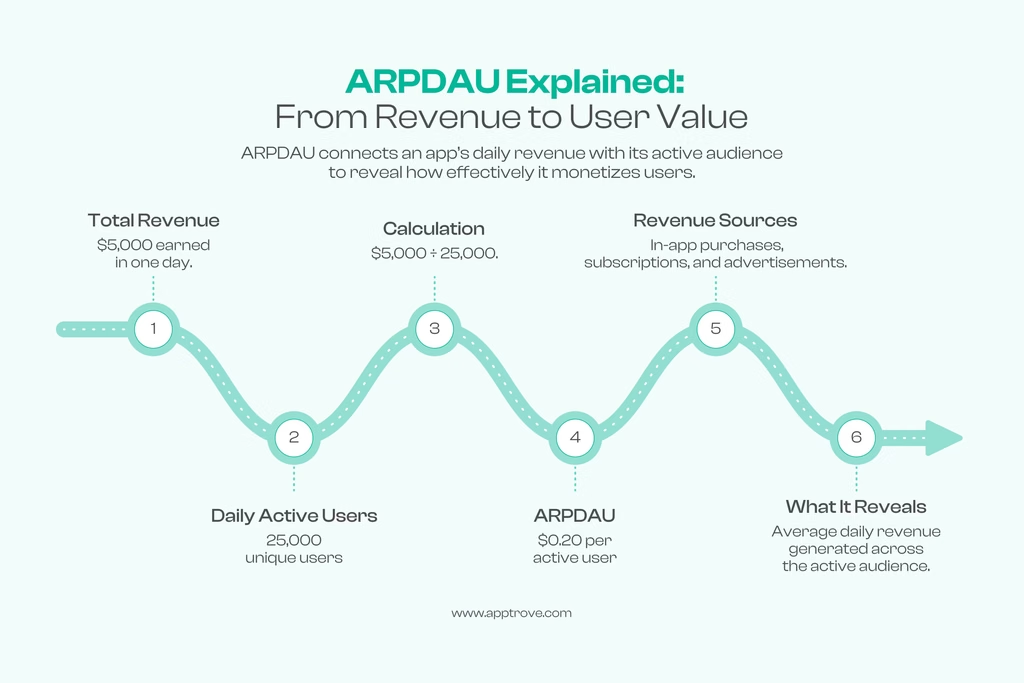
ARPDAU is an abbreviation of average revenue per daily active user on a specific day, which is a combination of two main indicators: total revenue and daily active users (DAU).
This metric indicates how well an application is able to work with its active audience from the point of view of revenue. Revenue can be obtained from various types of sources, such as in-app purchases, subscriptions, and ads. The comparison of earned revenues and the number of active users helps calculate the financial value of the daily audience.
Let’s take the case of one mobile game app that earned $2,000 in one day and attracted 10,000 DAU. Its VRPU is $0.20, meaning that each active user on average brought $0.20 of revenue.
Nonetheless, it does not mean that each user paid $0.20. Some users made purchases, some watched ads, and many of them didn’t pay anything. The metric distributes total revenue to all active users to calculate the average.
How to Calculate ARPDAU
Determining ARPDAU necessitates two figures: total income from the app for a specified day and total daily active users who were engaged during that day.
The formula is:
ARPDAU = Revenues Earned in a Day / Daily Active Users
Take, for instance, an app that earns $5,000 on Monday and has 25,000 daily users on the same day.
ARPDAU = $5,000 / 25,000
ARPDAU = $0.20
Thus, the calculation shows that the app earned $0.20 for each active user on Monday.
Parts of the ARPDAU Formula
Revenue for the Day – This is total revenue made by the application during the selected day. Depending on the method of monetization, this revenue may include advertising revenues, revenues from in-app purchases, subscriptions, and any other types of income that may be considered eligible. Organizations have to provide the definition of the sources of revenues and adhere to this definition.
Daily Active Users (DAU) – DAU is understood as the number of unique users who used the application during the day. Depending on the application’s tracking policy, the definition of active users may vary, as not every application activity qualifies as such (e.g. simply installing an app does not necessarily mean that the user will fit the definition of active user the business
Why Is ARPDAU Important for Mobile Apps?
Revenue growth cannot merely be dependent on user acquisition. Companies must also be aware of how efficiently they are generating money from their current users. ARPDAU is a metric that links user activity to daily earnings making it an important metric for app developers and publishing teams. It measures how well an app can monetize its audience.
How to Assess Effectiveness of Monetization
The metric allows companies to assess whether their monetization strategies successfully generate revenue coming from their users. An increase in ARPDAU suggests that the users are more engaged with ads, purchasing something from the app, or using the paid version of the app. Decrease in ARPDAU is a sign of negative trends in monetization performance even if the app is still retained by many users. Companies may analyze whether there were changes in advertising placements, purchasing habits, pricing strategy, or user engagement affecting revenues earned from monetization.
How to Measure Effect of Product Enhancements
App updates can cause changes in user attitudes towards monetization components. Redesigned app purchasing page, new subscription model, or changes to advertisements may also affect daily revenues from app usage. By monitoring the ARPDAU metric before and after the implementation of any update
Understanding User Monetization Patterns
The impact of revenue by active users can vary from one user to another. Some users frequently purchase things, other users interact with ads, while the rest of the users use the application without making any purchases.
By looking at ARPDAU, we can understand how the revenue differs from different types of users. When segmentation is employed, ARPDAU can assist in determining the potential impact of different user types on revenue collection.
Support for Marketing Decisions
Marketing departments have to analyze more than just installations and user engagement to figure out how successful they have been with their campaigns. An acquisition campaign could bring in a lot of users, but they are not likely to bring in decent revenues.
By using ARPDAU while analyzing different acquisition channels, campaigns, and regions, marketers can evaluate whether acquiring users would be able to bring in revenue and use this information to allocate budgets and optimize their campaigns.
ARPDAU for Various App Monetization Strategies
The monetization strategy of an app determines its ARPDAU. Different business models rely on different monetization methods so companies have to keep in mind their sources of income while interpreting the metric.
In-App Advertising
Apps earning advertising income can do so through advertising to customers in various formats like rewarded video ads, banner ads and other types of advertisements.
In these apps, ARPDAU is influenced by the advertising engagements, number of ad impressions made by a user, fill rates and effective cost per thousand impressions (eCPM). The app can increase its revenue by changing the placement of ads in the app and adding new advertising opportunities.
Showing more ads is not always a guarantee for monetization to be successful. There is a fine line between too many ads and negative user experience. Hence, companies will always need to strike a balance between the frequency of ads and achieving positive user experience.
In-app purchases enable earning money through selling digital products, virtual currencies and additional premium content.
When it comes to the apps making profits from purchase experience ARPDAU indicates how much money the app has earned from both paid users and those not willing to make purchases. A very small percentage of active users can generate most of the revenue.
Subscription-Based Apps
Applications that use subscriptions create income due to recurrent payments for special content, upgraded features, etc.
The assessment of daily revenue can differ depending on how subscription income is calculated. A company can take income into account when the payment has been performed or spread the income from subscription services over the period taken for performing analysis.
One of the methods used should be employed constantly. This allows for easier comparison of revenue performance based on subscription service usage.
Hybrid Monetization
Countless applications use a combination of advertising and in-app purchases along with subscriptions. By doing this, companies can raise money from different groups of customers.
For instance, regular users can give advertising revenue, while highly-engaged customers can pay for enhanced services or get subscriptions.
The ARPDAU metric reflects all types of revenue making it possible to provide complete revenue analysis. However, a company should analyze every direction separately to understand its contribution to the overall change.
ARPDAU vs. ARPU vs. ARPPU
ARPDAU (average revenue per daily active user), average revenue per user (ARPU), and average revenue per paying user (ARPPU) are monetization metrics that are related, although they evaluate revenue and users differently.
ARPDAU refers to the average amount of revenue earned from each daily active user. It measures app monetization on a daily basis and helps in determining how the app earns revenue from daily active users.
ARPU (average revenue per user) is the average amount of revenue earned from a user over a specified reporting period. The reporting period could be daily, monthly, quarterly, etc., depending on the reported method. Unlike ARPDAU, ARPU is not based on daily active users.
ARPPU (average revenue per paying user) refers to the average revenue earned from users who pay during a specific period. Thus, it does not include all users since the amount of non-paying users is included in the measures of revenue.
When comparing ARPDAU, ARPU, and ARPPU, it is important to note that each metric is aimed at answering a different question. ARPDAU measures daily efficiency of monetization, ARPU measures how much revenue is earned from a user during a specific time period, while ARPPU analyzes user purchases.
Factors That Influence ARPDAU
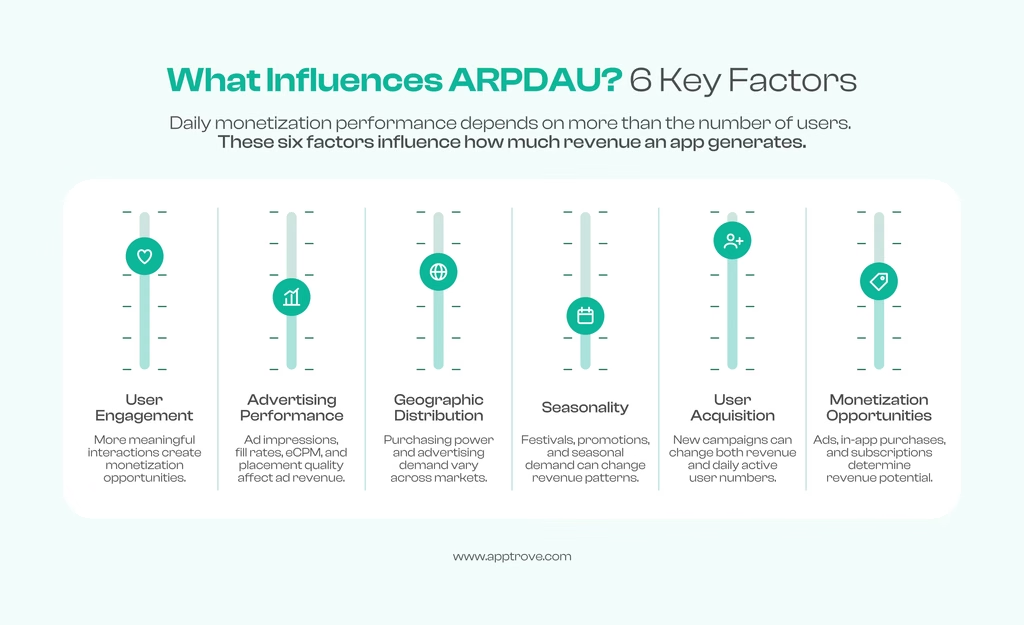
There are many factors influencing the revenue that an app can achieve from the daily active users of its audience. Knowing these variables allows businesses to understand the reasons for changes in monetization performance.
User Engagement
Users who engage highly with an app are more likely to take advantage of monetization opportunities. For instance, gamers might clear some additional levels and watch rewarded ads, while shopping app users may view more items and buy something.
However, it is worth noting that even a great engagement does not equal a high revenue. The app should present proper monetization opportunities to the users and encourage them to take financial actions.
Advertising
If an app relies on ads as a revenue source, revenue generation from the daily active users will depend on ad impressions, fill rates, eCPM, and the quality of ad placement. Poor performance of ads can lead to lower revenue numbers from the active customers.
These indicators need to be observed with ARPDAU to determine the role of advertising in making revenue changes.
Geographic Distribution
The revenue potential of any app differs in geographic locations due to the factors like purchasing capacity, advertising need, payment methods, and user habits. One app catering to a huge audience in one market might turn out to have a lower ARPDAU figure as compared to an app with a tiny audience in another market.
Differences in various market results necessitate comparison on a market or country level.
Seasonality and User Acquisition
Festivals, promotional actions, seasonality, and acquisition campaigns have a strong impact on both revenue and daily activity of users. One acquisition campaign could lead to a boom in new app users, radically changing ARPDAU in the interim. Seasonality patterns might also positively affect revenue, while the number of daily active users remains the same.
That is why one needs to analyze the metric over a longer period of time rather than rely just on the results of a single day.
Ways to Increase ARPDAU
To improve ARPDAU, one has to work on product optimization, monetization experiments, and audience analysis. The goal is to boost the value derived from active users without negatively affecting their experience.
Optimize Ad Placements
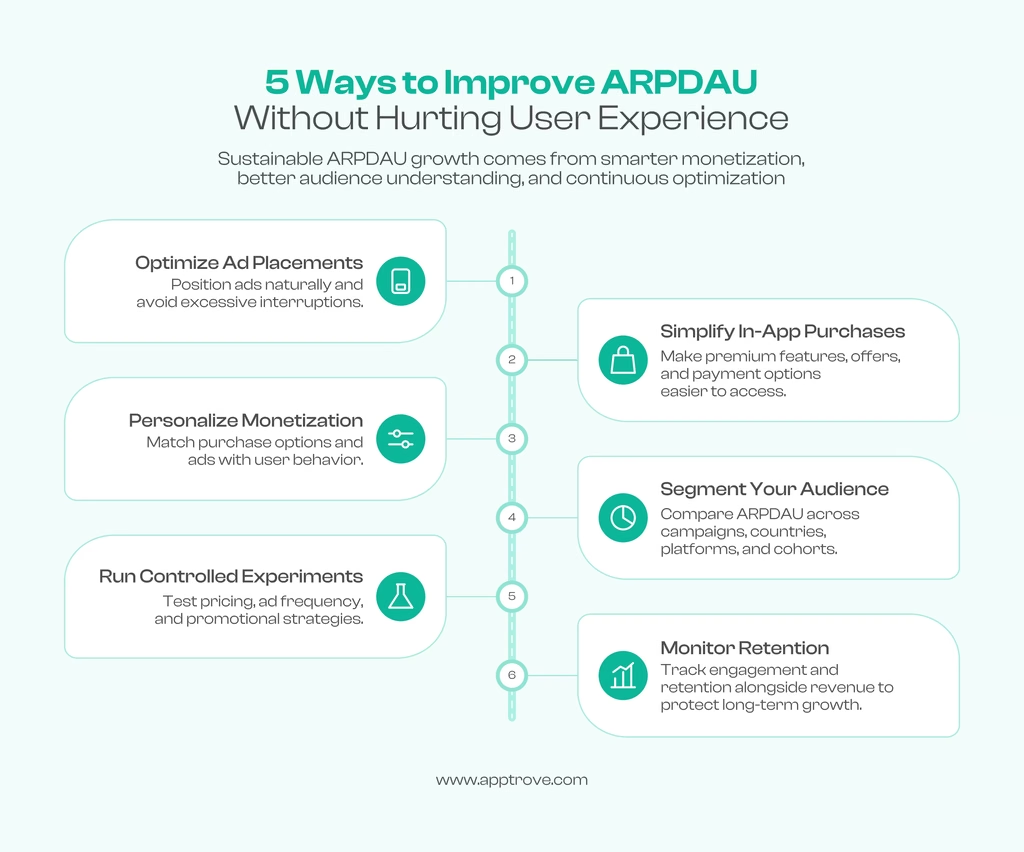
Evaluate ad placements and frequency of exposure to users. Position ads where they fit naturally into users’ experience without interrupting their work.
Rewarded ads work especially well when users see real value in watching an ad. Various placements and formats can help to find the best way of increasing revenues in a non-intrusive manner.
Make In-App Purchases Easy
Give users an easy way to find paid features, digital products, and premium upgrades. Inform them about the benefits of each payment made by them.
For example, companies may play with bundles of products, pricing schemes, offers, and the design of payment forms. It is important to evaluate the effectiveness of such changes with the help of conversion and revenue metrics.
Make Monetization Personal
It is well-known that motivations and spending behaviors of users vary greatly from one person to another. Taking into account the users’ actions gives the chance to offer the most relevant purchase options or ads.
In particular, users who play frequently may be interested in a premium subscription, while casual users may prefer optional rewarded advertising.
Analyze Performance by User Segment
An overall ARPDAU figure can mask substantial differences in performance among segments of users. Segment the measure by acquisition source, advertising campaign, country, platform, device, and user cohort where sufficiently reliable data allow such investigation.
This analysis can reveal which groups are particularly effective in monetizing an audience, and which groups need new monetization strategies.
Perform Controlled Experiments
Testing the effect of changes in advertising frequency, promotion strategies, pricing, etc., on monetization effectiveness can provide information about how to improve monetization results.
Whenever it is possible, apply controlled experiments comparing the test group to the control group. Pay attention to engagement, retention, user experience along with revenue in order to avoid short-term gains that will result in long-term issues.
Conclusion
ARPDAU is the metric used by mobile application businesses to understand how effective they are in generating revenue from the audience by correlating daily revenue with active user numbers. It provides a comprehensive picture of monetization results throughout advertisements, sales, subscriptions, and hybrid business models.