
What Is Tech Stack?
Tech stack refers to the set of programming languages, frameworks, libraries, databases, underlying technology, and tools used to create, run, and improve the digital solution. In this way, tech stack can be imagined as the technical plan of an application where each layer performs its particular function and all layers contribute to making the application work well, perform effectively, and develop over time.
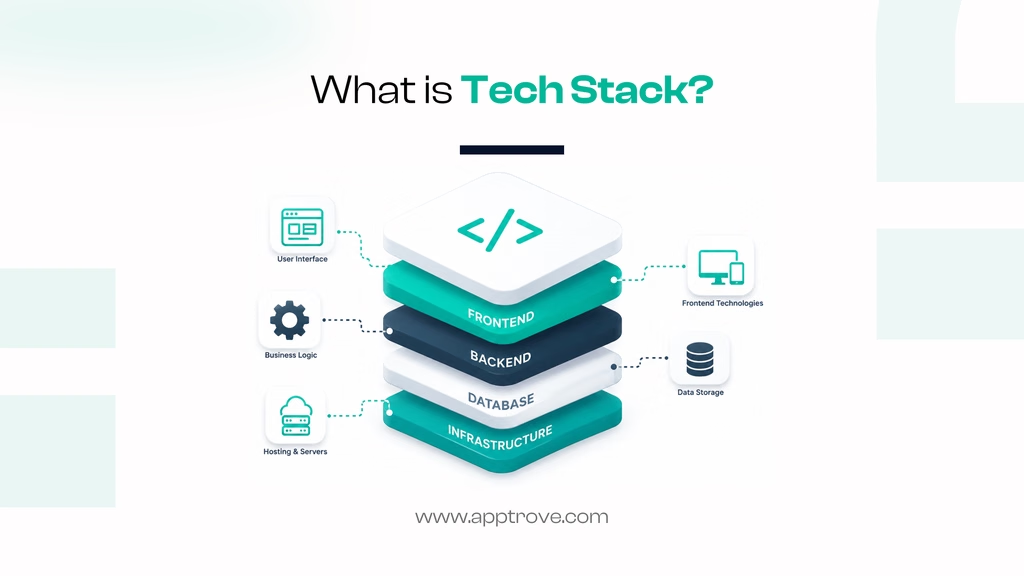
A tech stack can be represented in the simplest way with HTML, CSS, JavaScript, and some database necessary for developing a small online application or presented in a more complicated way with a distributed architecture including cloud infrastructure, containers, APIs, microservices, monitoring tools, and machine learning models. What matters the most is the need of the product, not the actual technologies that may be considered popular.
The expression software development stack is usually used to indicate this broader group of technologies, which includes everything from programming code invented by developers to the very infrastructure that allows delivering the developed application.
Why Is a Tech Stack Important?
Selecting a technology stack is among the first decisions that a company must make when developing a product, and its consequences can be long-lasting. The technologies selected will determine how quickly developers can do their work, how efficiently the applications perform, how much these applications will cost to maintain, and even the chance of finding developers to work on the product. To illustrate this point, a startup that is developing a simple content platform may look for technologies that facilitate the development process and offer a wide ecosystem of developers. In contrast to that, financial applications that process millions of transactions may focus on meeting high security and reliability standards.
As a result, choosing a technology stack requires balancing different aspects of the software development process. It should resolve current problems without imposing unnecessary restrictions in the future.
Another reason why it is particularly interesting to make a technology choice nowadays is the scale of the software solution market. In 2025, GitHub reported that it had more than 180 million developers using its service, while more than 36 million developers joined GitHub during that year alone. Developers create more than 230 repositories each minute on GitHub.
What Are the Main Components of a Tech Stack?
Generally, a tech stack is made up of a series of connected tiers that fulfil various functions relating to the architecture of the product.
1. Frontend technologies
The frontend is the portion of the product that everybody can see and interact with, including elements such as icons, menus, Buttons, forms, animations, and various other visual objects.
Some of the most typical frontend technologies are:
- HTML that structures web pages
- CSS that is responsible for visual aspects
- JavaScript that handles interactivity
- React, Angular, and Vue.js, which are used to create complicated UI
- Next.js, which is designed for modern web apps
- Frontend selections affect user experience, responsiveness, and browser performance.
2. Backend technologies
The backend is responsible for all processes not evident from the user interface. This technically consists of the code that deals with business logic and authentication, communicates with databases, and implements various server functions.
The most common backend programming languages are Node.js, Python, Java, Go, PHP, Ruby, C#, among others, with frameworks like Django, FastAPI, Spring Boot, Express, and Laravel being used in conjunction with them.
3. Databases
In order to keep the data, applications need some kind of storage, and databases are essential for most technologies. Databases can generally be classified into two main groups:
Relational databases: MySQL, Oracle, PostgreSQL, and Microsoft SQL Server are the main products which do the structuring of data by using tables and relations.
NoSQL Databases: Different types of databases like MongoDB, Cassandra, DynamoDB, and Redis are created and used for storing data of various kinds where structural flexibility, scalability, or some specific access patterns play a major role.
Notably, through Stack Overflow’s 2025 Developer Survey, PostgreSQL has occupied the top position among the databases.
4. Cloud and Infrastructure
Nowadays, applications mostly do not exist on a single server machine. So, cloud services offer services with computing, storage, networking, and databases.
Amazon Web Services, Microsoft Azure, and Google Cloud can be good examples of this technology. Besides, containers and management technologies, including Docker and Kubernetes, are also used in software development systems.
According to a survey conducted by Stack Overflow, the usage of Docker had increased by 17% compared to the previous year.
5. APIs and Integration Layers
Application Programming Interface (API) helps in integrating different software components of an application. For example, an app can employ APIs for connecting to other application services such as payment systems, social media, and others.
Two popular methods of making APIs are Representational State Transfer (REST) and Graphical Query Language (GraphQL, while webhooks enable the transfer of event-driven messages between applications.
The last item on the list is an important element of building and operating an application, although it does not belong to its runtime architecture.
These tools include source control, code repositories, integrated development environments, testing platforms, project-management systems, and CI/CD pipelines.
A few examples of development tools include GitHub, GitLab, Visual Studio, Jira, and Docker.
Types of Tech Stacks
There are different types of technology stacks since the tech stack used to produce an application will depend on its specifics.
For example,
LAMP Stack
is a tech stack that includes Linux Operating System, Apache web server, MySQL Database, and PHP programming language.
MEAN Stack
The acronym MEAN corresponds to the words MongoDB, Express.js, Angular, and Node.js. It utilizes JavaScript-based technologies throughout the application, enticing teams who want to maintain consistency in their front-end and back-end development.
The MERN Stack
The MERN Stack is another acronym. By substituting Angular with React, MERN is formed and consists of MongoDB, Express.js, React, and Node.js, providing a good choice for creating interactive web solutions.
MEVN Stack
The MEVN Stack utilizes Vue.js instead of React. MEVN combines MongoDB, Express.js, Vue.js, and Node.js.
The JAMstack
The JAMstack is an approach to architecture based on the use of JavaScript, APIs, and pre-rendered markup. This solution improves performance, security, and scalability by minimising the need for a conventional server-rendered architecture.
The Serverless Stack
The Serverless Stack is the architecture that allows developers to use the application logic approach without the need to control or manage traditional servers.
How Does a Tech Stack Work?
A tech stack serves as an integrated setup rather than just a collection of software.
For instance, you order a product through an e-commerce application. The frontend displays the product page, and upon clicking the ‘buy’ button, the frontend communicates with the backend. The backend checks for the request validity, queries the database for the product availability, consults a payment service via API, and finally sends the response back to the interface.
Cloud computing maintains the services, while monitoring and logging technologies help software developers to detect issues.
While independently performing their functions, the greatest value is achieved through the integrated work of the layers.
How to Pick a Tech Stack?
The choice of technology stack starts with identifying business and product needs instead of the developers’ preferences.
Recognize Product Requirements
Understand what needs to be done by the given application. For instance, a media website, a betting site, banking software, AI solutions, and real-time collaboration tools all require different underlying technologies.
Consider Development Pace
Some technologies allow quick and easy development because they come with numerous resources, documentation, community support networks, and reusable components.
Think About Security
Security should be put in consideration right from the beginning. Authentication, authorization, encryption, dependency management, data protection, vulnerability tracking, and secure deployment techniques have to be taken into account when choosing technology.
Think About Developer Availability
A technically advanced technology will become harder to maintain if there are not enough professionals available to support it. A robust technology ecosystem simplifies recruitment, troubleshooting, documentation, and maintenance.
Account for Overall Costs
The cheapest technology option is not necessarily the least costly one. Licensing, cloud infrastructure, development time, support, migration efforts, training, and security also contribute to the ultimate cost.
What is a Quality Tech Stack?
A quality tech stack isn’t necessarily a tech stack containing the most advanced or biggest technologies.
A strong stack usually provides:
- Dependable performance
- Robust security
- Scope for expansion
- Ease of maintenance
- Sufficient assistance from developers
- Well-developed documentation
- Integration capacity
- Cost efficiency
- Proper ecosystem
- Flexibility for future needs
The avoidance of unnecessary complexity is also essential. Introducing another framework, database, service, or platform sounds interesting, but every addition creates maintenance issues and points of possible failure.
Tech Stack vs Technology Stack: Is There a Distinction?
In everyday life, the terms tech stack and technology stack are usually recognized as synonyms, and both are used to refer to the technologies involved in application development and functioning.
The main difference between the two terms is in their usage: tech stack is a more common one, while the technology stack term can be found in technical documentation, job vacancies, and discussions on architecture.
What is the future of tech stacks?
The future tech stack will probably be more modular, cloud-native, AI-enabled, and automated. More and more developers are using a combination of traditional programming languages with cloud-managed services, containers, AI APIs, observability platforms, and deployment automation.
At the same time, the challenge of complexity will remain. While powerful tools can be used to create powerful solutions, they usually require more management.
Thus, the best piece of advice is not to follow every new technology but rather to design an architecture which can adapt in a changing technological environment without the necessity of adjusting the whole product every time.
Final Thoughts
A tech stack is simply more than a list of programming languages and software. It reflects the technical basis that determines the way a digital product is built, delivered, supported, and improved.
The best choice of technologies is not simply a choice dictated by fashion trends. It emerges from the understanding of the product, its users, the capabilities of the team, security needs, needs for scalability, and overall business strategies.
As software development involves more and more cloud computing, automation, AI, containers, and specialized tools, the modern tech stack will continue to evolve. There is no ultimate goal to acquire as many technologies as possible; what is important is to choose the suitable ones, connect them wisely, and provide the space for the product to grow.
FAQs
1. In simple terms, what does tech stack mean?
Tech stack means a set of software delivered to make and run an application, including programming languages, frameworks, databases, cloud services, APIs, and other software tools.
2. What is a specific example of a tech stack?
Some tech stacks can contain React for the front end, Node.js for the back end, PostgreSQL for data storage, Docker for creating containers and AWS for keeping the infrastructure in the cloud.
3. How can companies in modern times benefit from the use of a tech stack?
The technology stack creates a framework that shows how the company’s electronic products will be created, used, and secured.
4. Is it possible to change a tech stack?
Indeed. Companies can sometimes take an entirely different stack instead of only replacing certain technologies. This will require substantial work and expenses for security, development, infrastructure, and operations.
5. Is it important for young companies in the market?
Definitely, as startups might really need to minimize expenditure and build the right development stack for this purpose.