Introduction
The holiday season is not solely linked to increased sales numbers: it revolves around feelings, beats, and moments that can be experienced together, thus making brands and people to bond with one another. Whether it is Diwali, Christmas, or Black Friday, every holiday evokes emotions and encourages people to be more open, curious and willing to speak with brands. In fact, it is estimated that the holiday sales in November and December make up about 19% of total retail sales.
Yet, cutting through the noise of holiday marketing takes much more than just decorations and discounts; it takes a sound strategy. An app marketer does not only fight for the number of clicks; he/she fights for consumers’ attention, trust, and memory. The challenge is to develop a campaign that will win consumers’ hearts and be measurable at the same time.
This guide will equip you with seven time-tested tactics to impeccably run Holiday Marketing —from user psychology to creatives, to what to measure with them. You will learn how to turn holiday browsing users into loyal holiday followers, and how the data, time, and neglect create a narrative that makes every campaign meaningful.
Unlike the holidays, success during the holidays comes about because of deliberate design.
Unlike the holidays, success during the holidays comes about because of deliberate design-and Apptrove just amplifies that design with the right tools.
The Continued Importance of Holiday Marketing
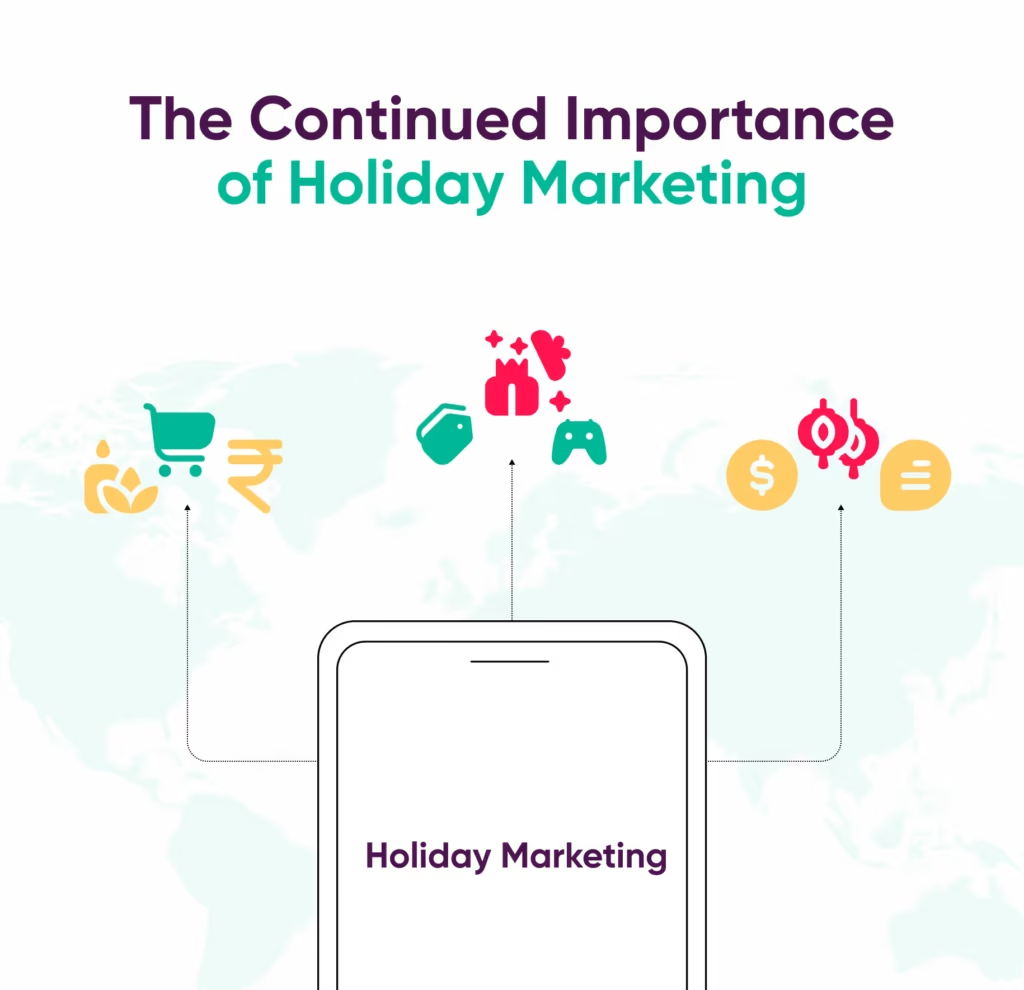
Each year brings new chances for brands to reach the target audiences with the help of holiday marketing. The holidays include Diwali, New Year, and Christmas and help unite consumers and make them ready to listen to marketing information. In addition, app marketers can use the holiday season to gain profits in engagement, conversions, and customer relations in the long run.
This type of marketing is still popular since it combines the consumer needs of the time with the current changes in shopping behavior affected by digital trends and modern customer demands.
Here are the aspects that make the holiday season special for app marketers:
- Regional shopping patterns: Diwali results in a lot of activity for e-commerce, travel, and fintech apps in India. Christmas and Black Friday create opportunities in the field of retail and gaming apps in Western countries. The Lunar New Year is another occasion for Asian markets.
- Emotional connection: Customers are not buying things for themselves; they are taking part in holiday traditions and spending time with each other.
- Behavior driven by mobile usage: Customers are using their mobile phones to accomplish a variety of tasks during the holidays, including shopping for gifts, selecting vacations, and searching for holiday food. Brands are able to promote their offerings through various means such as creating short videos, sending push notifications, developing coupons that use location services, and providing quick and efficient checkout processes.
- Increased online transactions: In the festive season, three out of four purchases were made using mobile phones, and as a result, activities on social media and e-commerce applications increased by 30-40% compared to regular days.
- Greater readiness to buy: Customers tend to search for many options when purchasing during holidays, and this gives advertisers an opportunity to inform consumers about their brands at the moment of purchase.
Mobile app marketers need to pay attention to the above-mentioned trends because this shows why holiday campaigns do not only need attractive creatives and short-term discounts. In order to be successful, mobile app marketers have to plan their actions in advance, know their regions, and reach the audience with the right message at the proper time.
Grasp The Psychology Behind Holiday Marketing Campaigns

Effective holiday marketing starts with the human factor and not only with the research of data. It is known that emotions, memories, traditions, and the wish to unite with others play a big role in the process of buying decisions that people make during the holidays. Understanding the reasons for such behavior allows companies to build campaigns that look like personal interaction rather than pure advertisement.
Below are four psychological triggers that allow making holiday campaigns more relevant and effective:
- Nostalgia and shared memories. Holidays remind us of the sights, sounds, and traditions, from the smell of cooked meals to the joy of gift-giving. The campaigns that represent such events help create positive associations between the brand and its customers.
- Belonging and connection. People tend to look for ways to connect to their families and friends during the festive season. Therefore, brands can address such needs by using culturally appropriate greetings, sharing scenarios, and messages that reflect local traditions.
- Sense of urgency: Limited-time offers, countdown timers, and early-bird specials can create a sense of urgency for customers to take action in order to not miss out. When done right, this can boost excitement for the campaign and move customers from looking to buying without making them feel pushed.
- Generosity: Gift giving, service projects, holiday bundles, and thank you messages show the spirit of generosity during the holiday season. Campaigns that reflect the ideas of generosity will encourage customers to spend money on purchases while building a positive image of the brand.
Emotional triggers have a direct impact on how consumers react to the creative aspects of campaigns, meaning that emotional engagement of advertisements is an important consideration for app marketers.
Research shows that advertisements that trigger emotions are 3.5× times more likely to be viewed again and 2.35× times more likely to motivate a purchase in comparison with neutral ones.
For application marketers, this is more than just a mere click or app download, as campaigns that create an impression can help promote engagement in the future and build loyalty in the long run.
Ultimately, holiday marketing is not only about selling or promoting an offer but also about creating narratives consumers feel connected to.
Think Ahead — Designing a Successful Holiday Marketing Plan
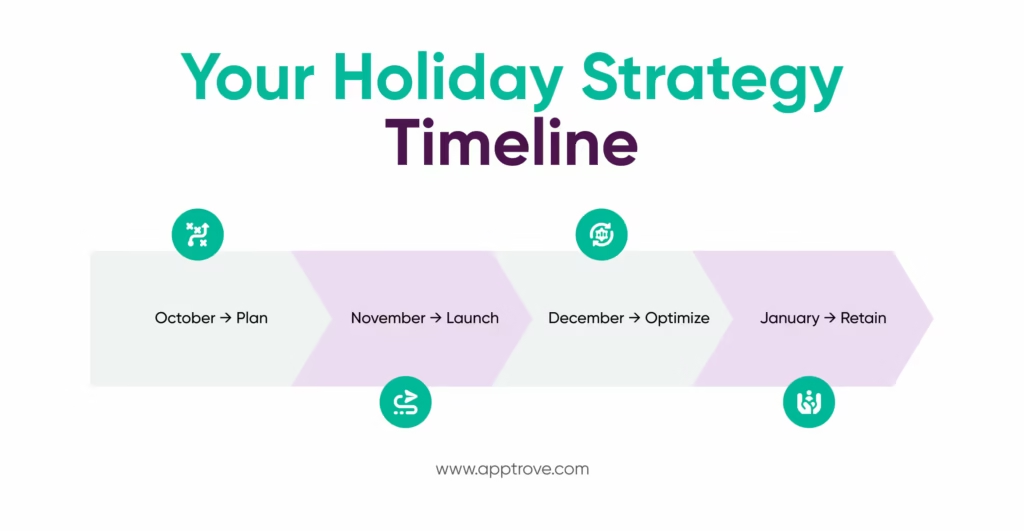
Every successful holiday marketing campaign starts with very detailed planning – the type of planning that’s done months prior to the holiday lights being hung up. During the holiday season, those marketers who plan, know their audience, and can act quickly when demand surges are the ones who win. You cannot ad lib your way through the most competitive quarter of the year; it needs to be planned for.
Begin with audience segmentation – early. The core element of any strong holiday strategy is to know who you’re speaking to. Instead of broadly messaging holiday items, peel back and really explore your audience clusters. Determine first-time buyers, loyal customers, lapsed customers, and season browsers. Each of these segments has different motivators, spending power, and engagement patterns. For example, loyal users of your product may respond well to early bird specials or exclusive first-look notifications, while new users may be further activated by a free trial or a gift bundle. By using behavioral data, you can create personalized creative and messaging flows that fit with the user journey rather than just creating generic and mass holiday sale notifications. Indeed, personalised content has been shown to create an average 20% increase in sales opportunities during the holiday season.
Once you’ve identified your audience, you can move to creative and performance stress-testing. This is not the time of year to experiment blindly; be sure to test creative variations, ad formats, and calls to action several weeks ahead of peak holiday performance. A/B test your visuals, tones of voice, and placements to find what resonates with your audience. You may find that what worked for you in July might not work in December, and, for example, festive emotion might require a festive design temporarily. Take your findings into consideration and pre-select the best performers, so you can make a quality scaling of campaigns once you allocate increased spend.
Then, consider how you’re going to plan your budget. During the holiday season, you’ll see an even higher cost of media, and the biggest increase will be around media restrictions, since your competitors are competing for the same user attention. To ensure you are getting good value for your dollar, you want to consider spacing your spend, allocating more in early November to awareness, and once early November is over, moving toward conversions. It’s also a best practice to ensure an overall budget cap for each stage, so you do not overbid but can remain engaging and visible with your audience. Organic engagement and paid engagement also play a factor in comparative cost and appeal.
Yet creativity and budget are not enough; success in the present day requires an omnichannel to support your efforts. The best holiday marketing initiatives rely on orchestrated use of multiple touchpoints, such as paid social, display, influencer content, email, and in-app experiences, to be presented as one cohesive story. To put it simply, a user may see your advertisement on Instagram, click a link to your app store page, and then be converted through a personalized in-app message. Making that transition between platforms seamless builds trust and continuity. Make sure to keep the messaging similar wherever users are operating.
Marketers want this to happen smoothly and should consider whether you are attribution- and privacy-ready, especially as it relates to Apple’s SKAdNetwork (SKAN), as well as a number of other emerging privacy frameworks. Given the fact that the holiday spikes will cause massive levels of data inflow, measuring and ensuring attribution are key, while still respecting user consent. Measurement solutions from the likes of Apptrove provide a way forward in order to understand the true performance outcomes through SKAN-compliant or, in some cases, other aggregated insights, without sacrificing compliance. As such, you can still make decisions driven by data, even if limited to user-level tracking.
And don’t forget about timing, either. Holidays are not a single point in time; they are a nearly constantly shifting series of peaks in different regions and cultures. For example, Diwali in India happens weeks before Black Friday happens in the U.S., which in turn happens before Christmas in Europe and the Lunar New Year in East Asia. If you’re able to reset your marketing calendar with these cycles, you can achieve sustainable momentum across markets as you peak once and then fade away quickly. As you plan more closely around these local trends, paydays, and shopping traditions, you’ll see an effective increase in your retail outcomes.
In conclusion, the best holiday marketing campaigns can be built similarly to orchestras — with each channel, creative, and metric working in harmony with the others. The line between a good campaign and a great campaign is frequently about timing, coordination, and insight. The earlier you plan and adapt, the more adaptable you can be to a shifting trend — and it will shift.
The holiday rush feels more like a sprint, but in reality, it is a marathon that requires preparation. If you are able to give yourself enough time and measure often, while remaining nimble, you will not only be ready to succeed during this holiday, but also many holidays ahead.
Inventive Optimization — The Secret Sauce behind Holiday Campaigns
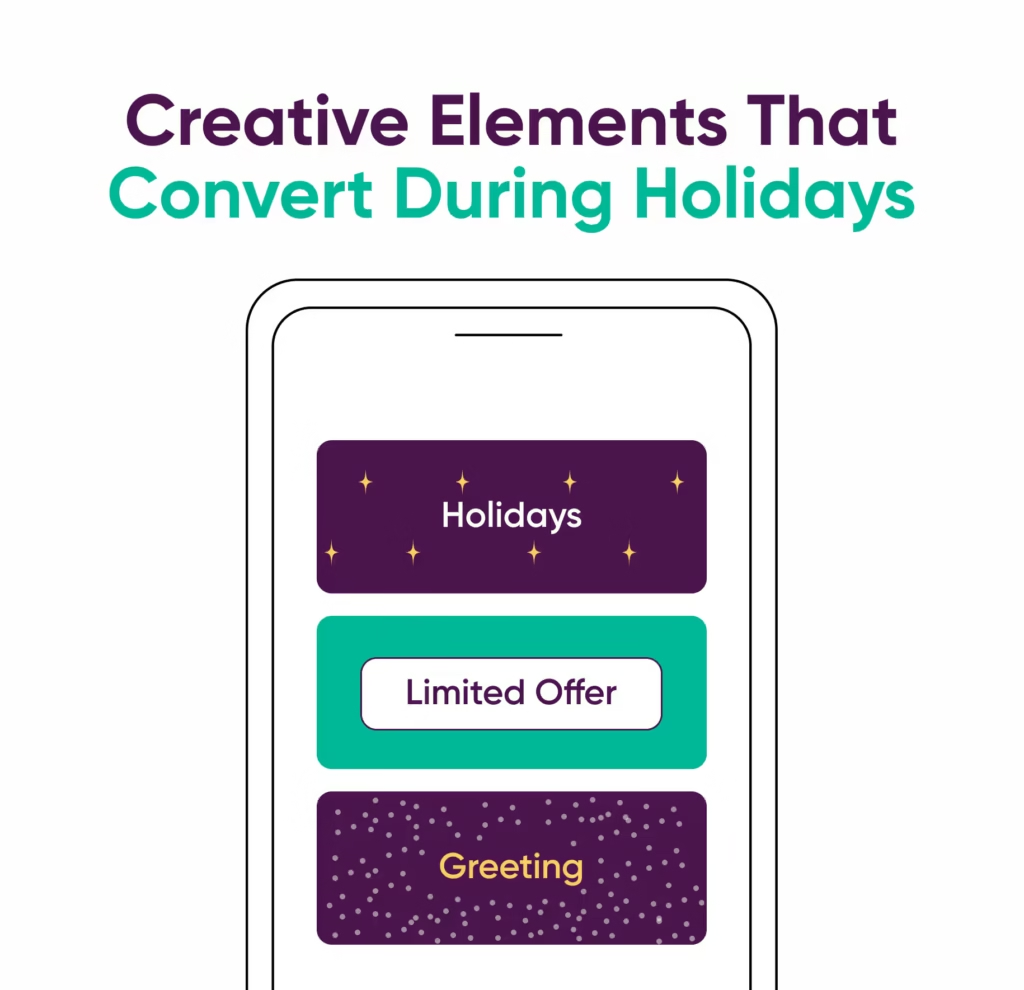
In a space filled with glimmering discounts, eye-catching ads, and festive noise, creativity can be your silent superpower! The most effective holiday marketing campaigns don’t just do the loudest talking — they do the talking the fastest. And that talk happens first and foremost through creative optimization: making the visuals, copy, and experiences feel personal, timely, and emotionally right.
Let’s start with the obvious — visuals sell the story before the words do! During the holiday season, your creative assets need to evoke emotion and meaning in that moment. The visuals used should reflect whatever sentiment your audience is already experiencing — joy, togetherness, anticipation. Use warm tones if the holiday season is comfort-based, bright experiences and contrasts if the holiday season is exciting, and warm requested gradients if your experience is more elegant. Even include elements of the theme with a holiday identification point — using fairy lights/snowflakes/diyas/red envelopes creates instant recognition, so use those elements — but only subtly. You’re not looking to decorate your ad — you want to design an emotion to have people immediately feel it with seconds.
Next is cultural personalization, which converts a festive campaign into a human campaign. The way holidays look and feel are different in every culture, and therefore, so should your marketing. For instance, a user in India during Diwali will connect with marigold colors and family around a gift-giving experience, versus a user in Japan during the New Year, who might resonate more with minimalism and reflection. When you adapt symbols of holidays, greetings, and experience verbal sounds and even background sounds to local cultures, you are telling your users, “We see you”. This level of thoughtfulness equals higher engagement and increased trust, because personalization is more than strategy; it’s respect in action.
However, visuals alone cannot carry the campaign. You must leverage copywriting to ignite action while perpetuating the emotional state. A holiday call to action, or CTA, works best when they sound more human, meaning warm, direct, and tied to a timeframe. Instead of “Shop Now,” use “unwrap your offer” or “Celebrate the savings”. When doing so, you are replacing the notion of transaction with experience. Similarly, using a time-sensitive night or day, like “Ends Tonight” or “This Week Only,” is excitement, not forced urgency. This notion can and should be paired with an emotional anchor, like “Share the joy,” “Gift happiness,” “Make this season yours,” to use your copy not just to convert, but to create a connection.
The next layer of optimization is through testing and iteration. Your design may be polished, but it won’t matter if it doesn’t result in an effective response. Implement A/B tests for various creative variations such as images, colors, headlines, and CTAs to see what resonates with each audience segment. For example, a holiday image with family moments may resonate better with existing users, while a bright image with discounts may draw in new users. The insight here is not just winning creatives, but actually learning about user intent – as it relates to creative performance.
Modern campaigns can also benefit from Dynamic Creative Optimization (DCO) – where your ads adjust automatically to the user’s real-time context. During the holiday rush, DCO will make personalization scalable – helping your campaign remain relevant during a busy time when your audience can be disparate across regions, time zones, and devices.
Above all, maintain message consistency across every touchpoint. Whether in an in-app banner, an email header, or a push notification, your festive tone should be cohesive. This is how users recognize you amid the noise — the fact that your creative voice remains consistent becomes your brand’s calling card. Whether users are scrolling, tapping, or shopping, they should feel as though they are experiencing a campaign, not just a series of messages.
When it comes to holiday marketing, creativity is more than just design — it is strategy. It is how you take data and turn it into delight; how you take performance and turn it into personality. From a sales perspective, when everyone is holding a sale, the only way a brand can stand out is if it can tell a story. And that story begins with how you make users feel the moment they experience your ad.
Measure What Matters — Assessing Holiday Campaign Performance
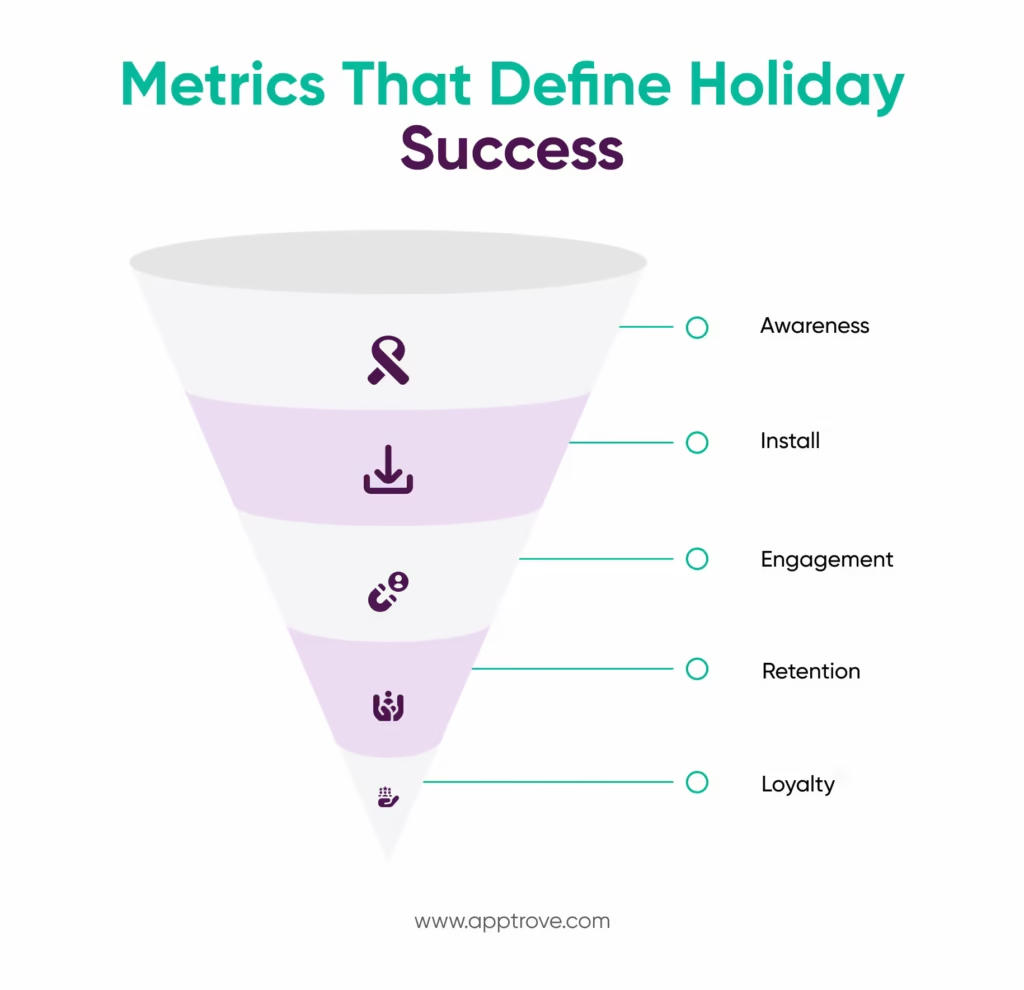
You cannot improve what you cannot measure.
That is the marketer’s mantra and, during the holidays, a must. When every impression is a highly contested one, the ability to measure what is or isn’t working is the differentiator between smart optimizations and wasted dollars.
Let us start with the most critical metrics: ROAS (Return on Ad Spend), retention, LTV (Lifetime Value), & attribution.
Installs and clicks may be popular numbers in dashboards, but they are only the tip of the iceberg. The story happens after the install; the install is where users become your loyal customers or seasonal customers. ROAS indicates whether your ad spend is leading to profitable conversions vs. a short-lived traffic boost. Retention rate indicates how many of those users are still with you after the holiday season. If January shows a dip in retention after the holiday rush, your acquisition-based holiday campaign worked, but your actual engagement did not.
Next, we have LTV – short for Life-Time Value – an invaluable north-star metric that captures the full value of your holiday users. Even if you had success with a spike in users during the peak, be mindful that seasonal spikes tend to throw off averages. It is imperative to measure not just how much these users pay you immediately, but how much value over time you can generate from the users you acquired over the holiday season. A user obtained during Black Friday who was still engaging with your app in the spring is far more valuable than someone who installed your app, paid you $4.99 during the holiday, then disappeared.
This leads us to attribution, the invisible thread tying together all of the performance data throughout the user’s journey. Knowing the points of attribution is critical; without clear attribution, even the best metrics become meaningless. The challenge is that in this privacy-first era, where user tracking is not an option, it can be challenging to know which channel, campaign, or asset drove actual conversion, and there are actually smarter measurement frameworks – like SKAN (StoreKit Ad Network) for users on iOS – that present a framework to attribute installs and post-install actions through group given user privacy. This isn’t just about compliance; it’s to give clarity about a new marketing framework.
Certainly, SKAN has its limitations, such as delayed data, fewer postbacks, and a drawback in granular data. This is why many brands will also use probabilistic modeling and aggregated measurement techniques. These methods utilize anonymized signals and statistics to estimate conversions when tracking isn’t available. When done properly, it will enable you to bridge the gap between privacy and precision, and help you inspect trends and variations without violating the trust your consumers place in you.
Equally important is the analysis post-install. Your work does not end at the install- it starts there. Map user journeys; what behavior do they exhibit, when do they churn, and what brings them back to you? Event-level analysis tools (purchases, sessions, shares, etc) that track behavior off install reveal what your campaign truly returns value to. In the case that users from the same creative demonstrate better retention or in-app purchases than others, that is a creative insight repeating as data.
Holiday strategies also create a special challenge when it comes to measurement. Shorter conversion windows, overlapping promotions, and intense remarketing all detract from easily attributing conversions. Additionally, many consumers will browse on one device, install later on another, or see several ads before converting — all of which complicate your ability to accurately track conversions. In these cases, taking clean attribution practices is crucial. Think about consistent conversion windows, deduplication of overlapping touchpoints, and trustworthy data sources.
In summary, holiday marketing success is not about volume — it’s about validating value. When you track in a smart way, every number tells a story of where they came from, why they engaged, and what drove the conversion.
If you’re reconsidering if and how you might measure conversions in this changing landscape, take a step back and return to the foundations — your Attribution Window is the definition of what you write as every result. Because when measurement meets meaning, optimization is easy.
Convert Holiday Shoppers to Customers that Last

The marketing campaign may have come to an end, but the relationship doesn’t have to.
The holidays feel like an all-out sprint — a race to capture eyeballs, clicks, and installs before time runs out. But in all honesty, the real growth occurs after the holidays are over. Each install during your holiday marketing program stands for more than a single sale — it’s the starting point of a potential long-term relationship.
To make that happen, you’ll have to move your mindset from conversion to connection.
- Lifecycle Messages: Relevant communication following adoption is effective for connecting with new customers. For instance, sending a personal reminder about a purchase or a friendly “Hope to see you again” message in January can lead users back to your app. Use in-app messages, notifications, and reminders to engage users without overwhelming them.
- Re-engagement Campaigns: Reconnect the users who have disconnected using valuable incentives instead of relying on discounts. Think of incentives such as milestone achievements, exclusive content, or early access to new features to remind users why they engaged earlier.
- Referral Campaigns: Ask your customers to share their experience, recommendations, and the products they like with their family and friends. Referrals can help you grow naturally during the holiday season while offering existing patients something in return.
- Personalization based on data: Use information obtained from seasonal campaigns to define user behavior and develop the most relevant follow-up communication. For instance, users who ordered Christmas gifts in December might be interested in self-care products in January, while those who were looking for travel offers might want spring vacation packages.
- Loyal customers through meaningful moments: Create long-term relationships through small but meaningful actions rather than discounts. Acknowledge purchases made by customers, celebrate special moments, and thank users for engaging with the application. The importance of gratitude cannot be underestimated.
The main point is to treat the holiday season as the beginning of a long-term relationship with customers rather than a one-off sales event. With the help of personalized marketing communications, reactivation efforts, and loyalty-building experiences, brands can convert seasonal bursts of engagement into long-term growth.
The Future of Holiday Marketing — What 2026 and Beyond Will Bring
Each holiday season has its own magic, but also its own disruption. As user expectations shift and digital behavior becomes more fluid, the future of holiday marketing will rely less on tradition and more on intelligent, ethical innovation. The holiday campaigns that win the next few years won’t be the loudest or the flashiest; they will be the campaigns that simplify choices, respect user boundaries, and create value that has a personalized feel.
One of the greatest shifts on the horizon will be AI-led ad creatives. Rather than guessing what resonates, AI will be predicting it. From developing festive visuals to crafting contextual copy, AI enables you to create campaign and creative projects that evolve in real-time with users’ behavior. Predictive personalization will move from “nice-to-have” to “non-negotiable” in short order. Picture creatives that switch themes based on previous user actions automatically—winter styles for colder areas, gifting ideas for those who bought early, or festive greetings based on cultural themes. This level of contextual relevancy is what will define efficient holiday campaigns.
Voice search is another emerging influence. With smart speakers and voice assistants becoming commonplace, more people will be discovering brands through voice queries, such as “Find me the best deals for New Year’s” or “show me holiday app offers around me!” Marketers should plan for this; a request like this will soon be commonplace. Marketers will need to be ready to optimize their apps and content around a more intuitive, conversational search mechanism, simply due to the new search experience.
Meanwhile, the future of holiday marketing is intertwined with ideas of sustainability and ethics. Users today are no longer thinking only about offers; they will start to care about impact. Campaigns encouraging thoughtful giving, reducing digital junk, or cost-effective campaigns where proceeds support social causes tend to create deeper emotional connections for brands. Not focusing on ethical marketing is affecting a growing number of consumers. With data use, a clear value exchange, and responsible targeting, brands will be facilitated in deciding which brands they do and do not trust.
In fact, trust is becoming the new currency in marketing. As privacy regulations change, the expectation of consumers is for brands to be transparent, guard their data, and give them authentic control. The holiday season is usually an amplification of digital noise, and transparency will have the ability to cut through that noise as a differentiator. If your campaign is safe, helps the user, and feels human, consumers will lean in.
The future of holiday marketing campaign thinking is not just about the tools of the future, but the mindset of the future. It is about meeting the user, emotionally, behaviorally, and ethically, where they are. If you can create that thoughtfulness, not only will you win for the season, you will win loyalty well past the tree comes down.
Your Holiday Playbook for 2026: Critical Lessons to Keep in Mind
As you move toward the next holiday upcycle, think of your playbook not as a prescriptive checklist but as a continuing narrative — one that gets sharper with every season. The best holiday marketing campaigns do not spring up by happenstance; they have been redesigned and iterated long before you put up the lights. Those campaigns emerge from strong planning in advance of the holidays, an understanding of your audience and their motivation to act, and a willingness to test and iterate (before the lights go up). When you have planned for a head start, the audience experience feels intentional to them instead of rushed, and they feel guided instead of being sold.
Emotion will always be at the core of the holiday experience. It is what fuels all of the instinct to share, shop, connect, and return. When your campaigns tap into joy, nostalgia, belonging, or urgency, they are not only seen but are meaningful. However, you cannot rely on emotion alone; you need the measurement to ground those emotional moments. Every metric we track, all of the possible ROAS you are tracking to retention, is a window into how users behave, what users value, and where your message resonates the most. The data allows emotion to have an objective target.
And maybe one of the key points to remember is that retention is actually the true ROI of the holidays. The spikes you see during a special season are temporary, but loyal users, built from carefully crafted onboarding, personalized post-holiday classic events, and ongoing engagement, will take you much further than the season.
The holidays come every year, but the connections you make can last a lifetime.
“The holidays are a story your brand gets to tell once a year; make it worth remembering.”
If you’re ready to turn these insights into action, let’s talk. Connect with our experts at Apptrove to craft your next holiday strategy — one that blends data, creativity, and emotion into campaigns people remember long after the season ends.
FAQs
1. What role does user-generated content play in holiday marketing?
By highlighting actual user experiences, user-generated content brings an element of authenticity to holiday marketing. User-generated content, such as reviews, pictures, and postings on social media, helps to create trust and promote community involvement, as well as affect your purchase decision at least as much as marketing materials from brands themselves.
2. Why should brands align holiday marketing with customer service strategies?
Often, holiday marketing brings about a substantial volume of requests for support and inquiries from customers. When marketing and customer service can work hand-in-hand, it gives quicker response times, less friction in the consumer experience, and greater customer satisfaction – allowing businesses to create and keep a positive impression on consumers during these peak demand milestones.
3. When should businesses begin collecting insights for their next holiday marketing campaign?
Business owners and managers need to begin analysis of customer experiences right after the completion of the holidays. When you have the data from customers, customer service, advertising, and advertising feedback, and their patronage is recent, you can develop more effective holiday marketing strategies, budget amounts appropriately, and target your customers more effectively.
4. How can small businesses compete with larger brands in holiday marketing?
Niche markets, personalized messages, your local community, and unique brand stories are ways small businesses can compete. Smaller brands can often create a stronger emotional bond with consumers than larger competitors due to their ability to be agile and authentic.
5. What emerging technologies could reshape holiday marketing in the coming years?
The holiday marketing landscape is evolving due to advancements in augmented reality, predictive analytics, conversational artificial intelligence, and immersive shopping. Through the implementation of these cutting-edge technologies, brands can start creating experiences that are interactive, tailored to each customer’s specific needs, and convenient for them to access.