
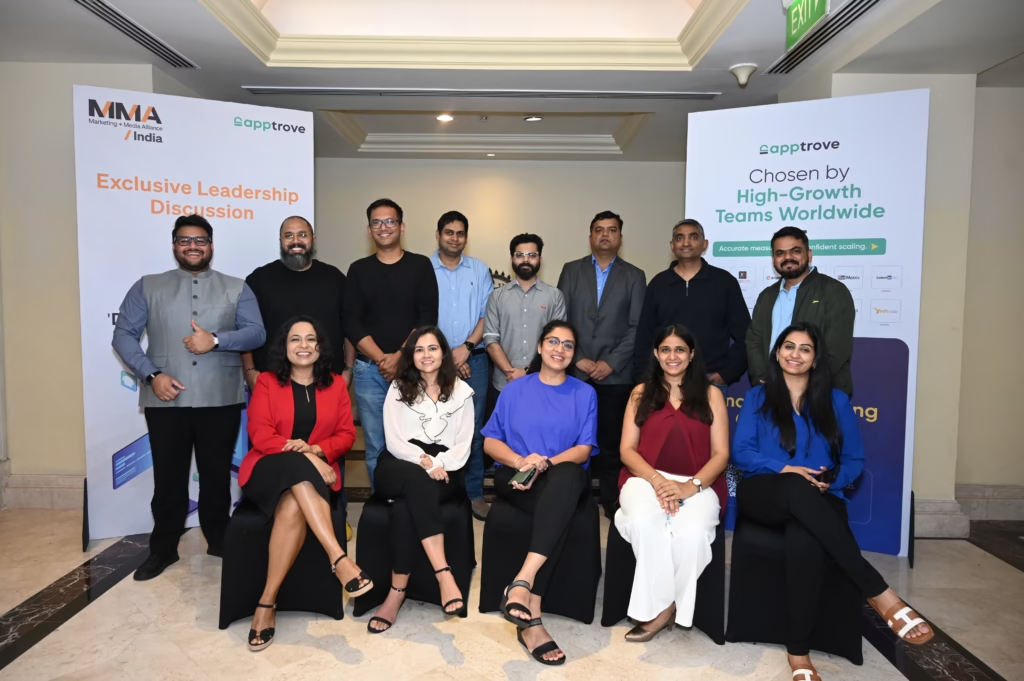
Bengaluru, India – The leadership roundtable “The Power of Cohorts: Turning Seasonal Shoppers into Lifetime Customers,” an exclusive closed-door session organized by Apptrove in association with MMA, saw the participation of leading executives from the digital-first industries. This strategic roundtable discussion aimed at providing an opportunity for the free flow of opinions on the applications of the science surrounding customer cohorts and retention in the current competitive market where discounts have become the norm.
As consumer journeys are becoming ever more fragmented and attention is becoming more selective, the dialogue centered on the need to go beyond the surface level to understand the true drivers of loyalty in the current context.
High-Value Cohorts: What Exactly Are They
The roundtable kicked off with a fundamental question: How does one define a high-value cohort in the current market scenario? It was agreed upon by most delegates that current models of segmentation based on revenue alone do not offer much value. Instead, one should focus on behavioral cues such as engagement level, decisiveness, intent, and ownership.
One of the most pervasive beliefs was that an educated, deliberate kind of customer—a proactive value shopper—is, by definition, more precious than a reactive one. More than a few of the interviewed managers believed that loyalty cannot be gained through forced behaviors, but through those that are already naturally exhibited by the customers. High-value segments, from such a viewpoint, have a tendency toward deliberate, educated, and habitual behavior, and not just those with frequent purchases.
Discount Psychology: Lever, Crutch, or Accelerator?
The normalization of discount-led acquisition was another big takeaway, with all leaders agreeing that it is now accepted as part of the industry norm, as opposed to a point of differentiation. The point of contention, however, is how the post-discounting relationship is managed. Some leaders believed clients acquired through discounts would switch loyalties if taken care of, while others felt there is only so much one can do.
One of the insights that came forward during the discussion is that, if the customer is not able to convert beyond the discount phase, the problem might not always lie in the customer’s intention, but also in the inability of the brand itself. Advanced ways of performing discounts were discussed, which involve time-bound discounts, tiered loyalty discounts, urgency, and discounts that are community-established. When the discounts are used for onboarding, the results of retention are the highest.
From Festive Surge to Year-Round Demand: Spotting Loyalists Early
With the continued influence of festivals and sales periods on first-time buyers, there were opinions on strategic segmentation of shoppers who are merely seasonal and those who are here for the longer term during the early stages of the journey. Segmentation techniques that included discount and navigation were noted to yield good results.
These companies also reiterated the significance of complementing measurable analytics with experience-driven activities. These included targeted CRM experiences, strategic offline or online events, recognition based on milestones within a community, and human-touch activities like the writing and sending of physical copies of messages or previews. Another trend that this study observed is the validation of emotional recognition and responses to habits forming at a faster rate than rewards.
Behavioural Shifts: From Discovery to Habit to Advocacy
Another important topic was how consumers move from discovery to habit and finally to advocacy. In almost all categories, from media and education to sports and e-commerce, speakers said the moment loyalty is felt is not after the first click, the first exercise class, the first online lesson, or the first purchase but after the second one: after the second click, exercise class, lesson, or purchase.
The participants analyzed the frameworks of habit formation: the use of customized progress trackers, milestone rewards, micro-communities, subscription-first designs, and challenge loops. In some of the brands, the key to loyalty was not the digital property, but the sense of belonging to the group, which represents progress and shares common culture.
Reactivating Dormant Customers: Context, Time, and Relevance
This discussion also covered methods to win back inactive or paused customers. According to leaders, inactivity has often been affected by real-life circumstances such as moving, changing jobs, or shifts in priorities due to seasons or financial cycles. The best retention strategies should therefore take these pause periods into account rather than viewing inactivity as abandon rates.
Examples included: timing-based nudges, dynamic reactivation pathways, reminders triggered by milestones, and relevance-drive messaging aided by insights from data analysis. Generally, it was agreed that how brands react to pause behavior by customers is important in determining their potential return.
Looking Ahead: Cohorts as a Competitive Advantage
The roundtable ended with a consensus view of a “future of loyalty” in micro-cohorts, behavioral intelligence, and culture-driven personalization, especially in tiered and vernacular markets where motivations are sharply different from one-size-fits-all approaches. Cohorts are becoming increasingly sophisticated, transcending demographic segmentation definition by culture identity, life stage, platform behavior, and intent modeling approaches.
What they thought was that the trend would change from the mass acquisition to the incubation of small, highly relevant, habit-driven micro-communities beyond the seasonal commitment.
The leadership roundtable hosted by Apptrove ended with this integrating conclusion: Cohorts are really all about building ecosystems where customers grow, identity fosters loyalty, and the most important currency happens to be experience.
FAQs
What are customer cohorts and why are they important?
Customer cohorts are groups of users segmented based on shared behaviours, timing, or engagement patterns rather than demographics alone. They are important because they help brands understand retention trends, lifecycle value, and long-term loyalty more accurately.
Are discounts effective for building long-term customer retention?
Discounts can be effective when used as onboarding tools, but long-term retention depends on value-driven experiences, relevance, and trust. Successful brands use discounts strategically rather than as ongoing acquisition crutches.
How can brands identify loyal customers early in the lifecycle?
Brands can spot early loyalists by tracking indicators like browsing depth, time to second interaction, repeat purchase velocity, and responsiveness to personalized experiences shortly after the first conversion.

