
What is VTA (View-through Attribution)?
To determine how users interact with advertising, digital advertisers must do more than just count clicks; that’s where view-through attribution is needed for digital advertising’s success. Marketers can use view-through attribution to determine how many conversions resulted from an ad impression, even if the user doesn’t click on the ad. This allows them to create better insights into how their impressions drive performance.
Users may view multiple ads throughout the day or over a week, but they are sometimes more inclined to convert later, possibly after searching in an app store or making a direct visit. Without view through attribution, all of these conversions will likely be shown as a natural visit from a user or may be credited to another marketing channel.
What Is View Through Attribution?
Most digital advertisers don’t just utilise view-through attribution; they need to understand how to look at all of the data to provide them with an overall performance report. In other words, advertisers need to look at the entire breadth of the data and insights given to them by view through attribution in order to be able to identify true upper-funnel influence and brand lift as a result of these impressions that ultimately lead to purchase.
In summary, view-through attribution enables marketers to measure the actual upper funnel influence provided by advertising. By measuring the amount of time users are seeing the ads on their screens to purchase, marketers can gain better insights into the complete user experience.
How Does Mobile View Through Attribution Work?
Mechanics of the Attribution Window
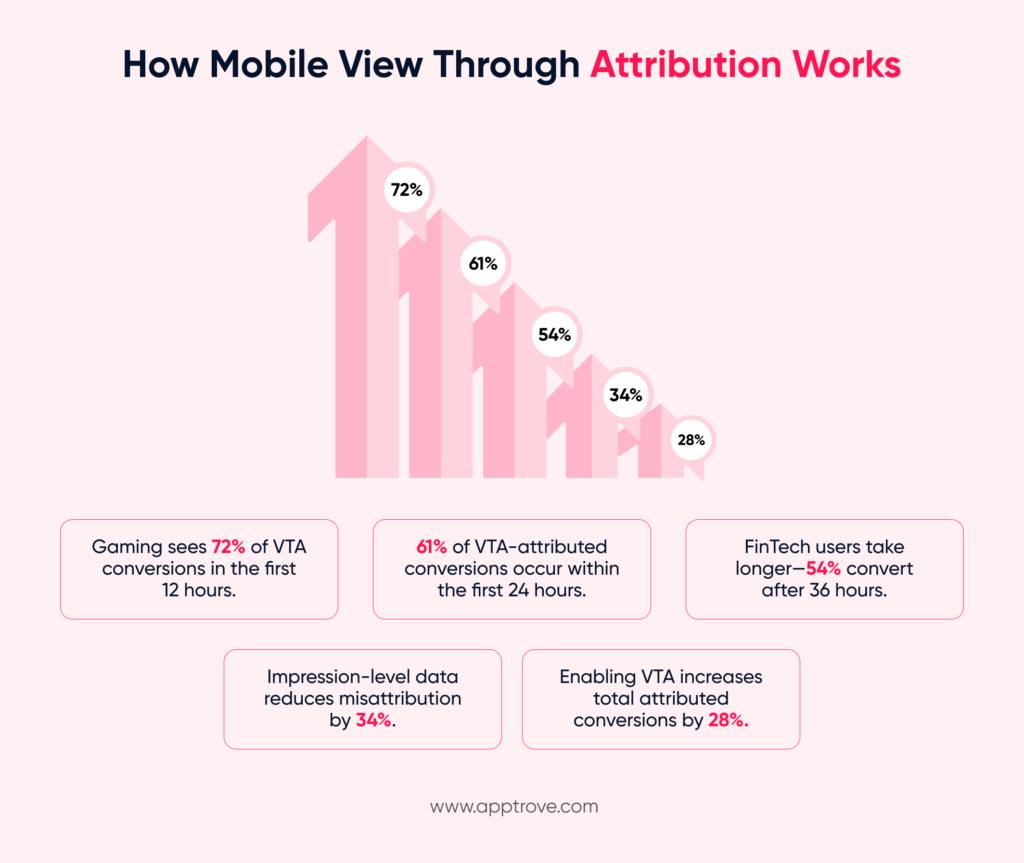
To better appreciate how mobile view through attribution functions, it’s necessary first to comprehend how the attribution system operates within a lookback period. A typical lookback period will vary from 24 to 72 hours, with shorter or longer lookback periods being used by some industries based on the behaviour of their consumers.
When consumers view ads and subsequently convert within the lookback period, the conversion is attributable to the specific impression in which they viewed the ad. The length of the lookback period affects the attribution. Too short a period affords too few credits for impressions; whereas too long of a period affords too many credits for impressions.
For multiple industries, view-through attribution can vary widely based on the nature of their respective product lines. Examples include:
- Gaming – Typically 12 to 24 hours from the time that a user views an ad until he or she converts because most users make their purchase decisions quickly.
- E-commerce – Generally a 24 to 48-hour window for users who are currently browsing products online.
- FinTech (Short-term financial) – Approximately 48 to 72 hours for users due to the need for them to establish trust and verify their identity before making any form of financial commitment.
- Education (College, university, vocational) – Approximately 48 to 72 hours to allow users sufficient time to thoroughly research their opportunities. Marketers can use these differences as a means to maximise their campaign effectiveness and interpret the performance of their mobile view through attribution for their given vertical.
The Role of Impression Data
Impression-level data is a key component of how mobile view-through attribution functions. The ad networks and measurement providers must send their timestamps and identifiers to each other in order for them to be able to attribute the impressions to the eventual conversions.
The expectation that these organizations will work together on the technical level creates an environment where the accuracy of mobile view through attribution is established and allows for the consistency of reporting across all of the channels involved in the conversion process. Without the sharing of this data between ad networks and measurement providers, view-through attribution would not be possible to validate.
How Does View Through Attribution Have Relevance to An Advertiser in 2021?
Provides an Advertiser with a True Picture of Performance in the Upper Funnel
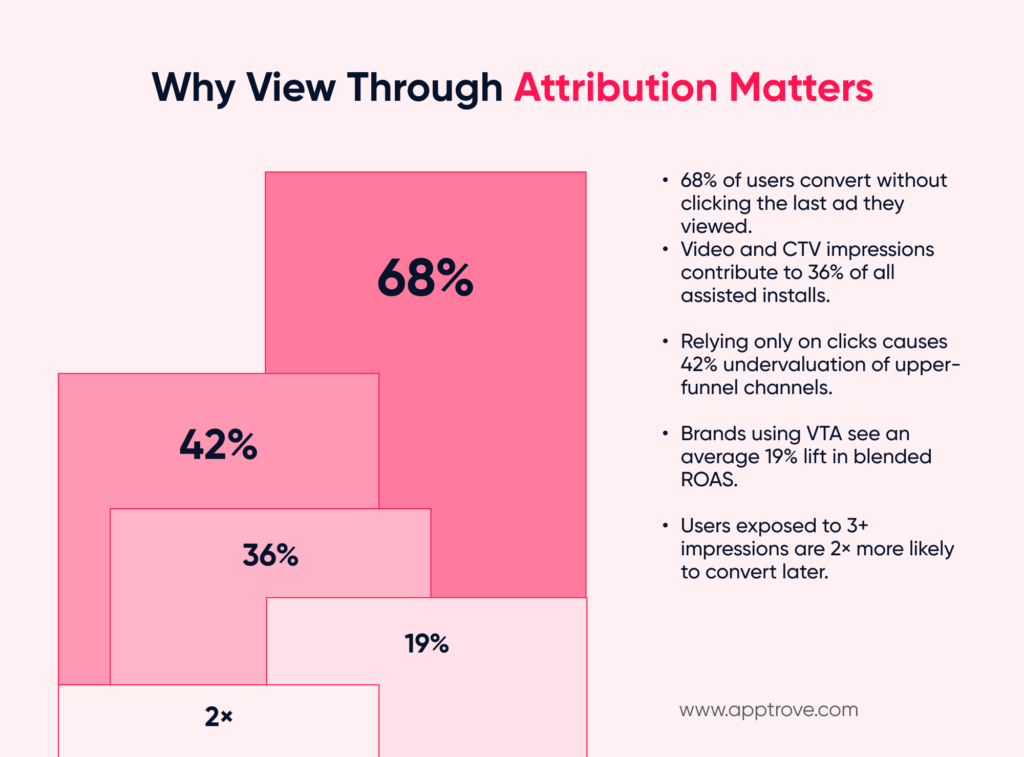
View through attribution allows advertisers to measure and evaluate all of the influences of advertisements that lead to a purchase decision. Many channels, such as video, CTV, display, and social media, are strong contributors to the upper funnel (i.e., they may not directly generate a click or conversion) during the early stages of decision-making. In addition to recognizing these channels for their contribution, view-through attribution allows advertisers to have a better understanding of how budgets should be allocated. This is particularly true when budgets are migrated from those channels towards a focus on click-based (i.e., bottom funnel) channels.
Creates Less Reliance on Click-Based Measurement
Since many conversions occur without previous clicks, using click-only attribution alone would not provide a true representation of what is actually happening. Marketers must fully understand what view through attribution means in order to know how to use it effectively. Since impressions may influence a consumer’s decision many hours later, the concept of view through attribution provides an overall view of how consumers are influenced and how they make their purchase decisions.
Allocating Budgets More Effectively
This view through attribution helps identify:
– which impressions contribute to conversions
– How ad format influences the audience’s behaviour
– When an audience will respond best to creative types
With this broader understanding of the audience and how impressions affect conversion rates, advertisers can confidently reallocate budget dollars in the highest-impact channels.
Key Benefits of View Through Attribution
Mapping User Journeys Holistically
View-through attribution helps marketers understand the entire consumer journey and how different ads influence that journey, from ad exposure to conversion. Ads may have had an indirect influence on consumers who converted, so analyzing multiple platforms together through view through attribution provides a richer picture of the interplay between the various channels.
More Accurate ROAS & Performance Calculation
View through attribution gives marketers access to information about how ads influenced conversions prior to being able to measure it, resulting in much more accurate ROAS calculations. Many marketers may have concluded, based on earlier measurements, that some channels were underperforming when, in fact, they produced a significant amount of assisted conversions when view-through attribution was enabled. By using view-through attribution, it is possible to improve the optimization loop process and the outcome of campaigns based on actual performance.
Improved Optimization Strategy
When marketers understand the concept of view-through attribution and how the resulting data can inform their overall strategy for campaigns, this will allow them greater accuracy in refining their creative testing, frequency capping, and audience segmentation.
Challenges of View Through Attribution
Pick the Best Length of Time to Measure Attributed Activity
With respect to the time level of attributions made for activity attributed via view through methods, the biggest obstacle is the selection of a look-back period. If a look-back period is too long, you may overestimate an impression’s contribution, whereas a period that is too short will underestimate the impact of an impression. Through ongoing testing, a properly balanced look-back period can be established.
View through Methods Are More Likely to Be Cheated/Defrauded
Because impressions can be easily replicated by bots or hidden ad units, view-through methods are at greater risk of being subject to fraud. Marketers using view-through methods to determine activity are required to utilize a variety of fraud detection techniques to preserve data accuracy and reliability.
Click and View Through Detection Models Provide a Different Level of Granularity of Data
Inherently, view-through methods provide less granularity of information than click-through methods due to the lack of an explicit user action. The association between the conversion and the impression is assumed or inferred, and therefore, combining both click and view-through methods provides a more comprehensive measurement methodology.
Best Practices for Using View Through Attribution
By combining both view-through and click-through attribution into a single strategy, we have created a comprehensive view of the marketing funnel. Click-through attribution is certainly based on direct intent, while view-through is based on interest, based on creating impressions. By combining both, you will be able to see all the data from top to bottom.
Marketers need to experiment with various look-back periods to pinpoint the optimal time frame for their marketing efforts, at which point incremental growth reaches stability. Finding this ideal optimization period is critical to maximizing the effectiveness of view-through attribution.
Exposure to an adequate number of impressions across multiple campaigns without overly saturating customers is critical in managing the overall frequency of view through attribution. Therefore, frequency management of your impressions is a critical component of this type of attribution, as well.
The attribution landscape is fluid, and marketers must frequently educate themselves on the changes occurring in privacy legislation (GDPR and others), emerging technologies (i.e., new ad platforms), and what consumers are doing with their devices. By continually educating themselves on how view through attribution and mobile attribution function and provide value to the consumer, marketers will be able to make necessary adjustments.
FAQs
1. What is view through attribution in advertising?
View-through attribution is one way an advertiser can track conversions that originated from advertisement views but did not generate a click-through.
2. Why should marketers use view-through attribution?
View-through attribution offers additional insight into the influence of an ad impression functionally and provides greater accuracy of measurement for the effect of impressions on direct response conversions.
3. How long is the typical VTA window?
Standard time frame used for view-through attribution is typically between 24 and 72 hours depending on user behavior and the type of industry in which the advertiser operates.
4. Does VTA replace click attribution?
View-Through attribution is not a replacement for traditional click-through-based attribution; both types of tracking must be used in conjunction to measure advertising performance properly.
5. Is VTA useful for video ads?
View through attribution is a valuable tool for evaluating the effectiveness of videos, as it is the most accurate way to quantify video-driven impact.