Introduction to Earned Media
Media earned through reputation and to differentiate yourself and build long-term brand trust through earn media will be the most effective way to utilize the media rights today because as audiences are becoming more selective in what they engage with, Use of earn media rights will allow brands in saturated markets to leverage earn media to change their perception, compress authority, and gain substantial visibility without an increase in advertisement spending.
This guide is provided to aid in understanding how earned media operates, how it correlates with your marketing program, and how you can operationalize these efforts repetitively and in a disciplined manner. In addition to presenting the tools, strategies, and processes utilized by high-performing earned media teams, this guide will demonstrate the level of impact Earned Media can create when working hand-in-hand with quality content, authentic connections, and ethical storytelling methods.
With goals to increase media coverage, build brand recognition, and create a more robust reputation engine, this guide will help develop the mindset and methodology required to do so.
What you’ll learn by the end
At the end, you’ll have the ability to establish goals for earned media, develop a sorted list of media contacts, prepare relevant message angles, and assess the impact of your media results. You’ll learn a systematic approach for finding proof, pitching it, and utilizing your success through many channels.
The training will provide you with the specifics of how media works in conjunction with existing paid and owned media, as well as how to predict the success of your earned media efforts and operationally control the risks associated with those efforts. You’ll leave the training with tools to help scale your earned media efforts, achieve greater brand visibility, and continue to generate positive media coverage. You will also be more confident in transforming your earned media efforts from “a fluke” into a sustainable, compounding force.
What Is Earned Media?
Earned Media (the type of Exposure that was earned by a Brand) is a way Brands can be exposed to an audience organically by getting Media/Press/Secondhand compared to what a Company buys through Advertising (Paid Media) and owned by the Company (Owned Media) to control it. In addition, earned Media is seen as Building Credibility, Value and Relevance, all equate to Trust and Authenticity by Customers. Compared to traditional forms of Advertisements, Earned Media tends to Create Greater engagement Long long-lasting impacts and serve as to reliable On, creating Brand Awareness and Generating Greater Media Exposure.
Brief history and evolution of earned vs. owned/paid
The history of Earned Media dates back as far as Print Media (Articles/Interviews/Editorials) but with the growth of Digital Media/Electronic Media/Online Media, the significance of Earned Media has Evolved/Expanded to Social Sharing/Social Networking/Influencer Sources or Channels/User Generated Content/Third Party Product Reviews/Every day Consumers Amplifying a Product or Service in some manner (via Social Media Platforms).
While the Digital World has grown, the Owned Media (Company Website/Blogs/Newsletters) and Paid Media Channels (Paid Advertising/Increased Costs/Sponsorships) are now more widely available to today’s Companies with the increased use of Companies using All Three Types for a Comprehensive Strategy for Communication.
In today’s world, Earned Media has now become the Main Source of Building Credibility/ complementary owned Media/Cost-Effective Alternative to the Rising Costs of Paid Media.
Why earned media matters right now
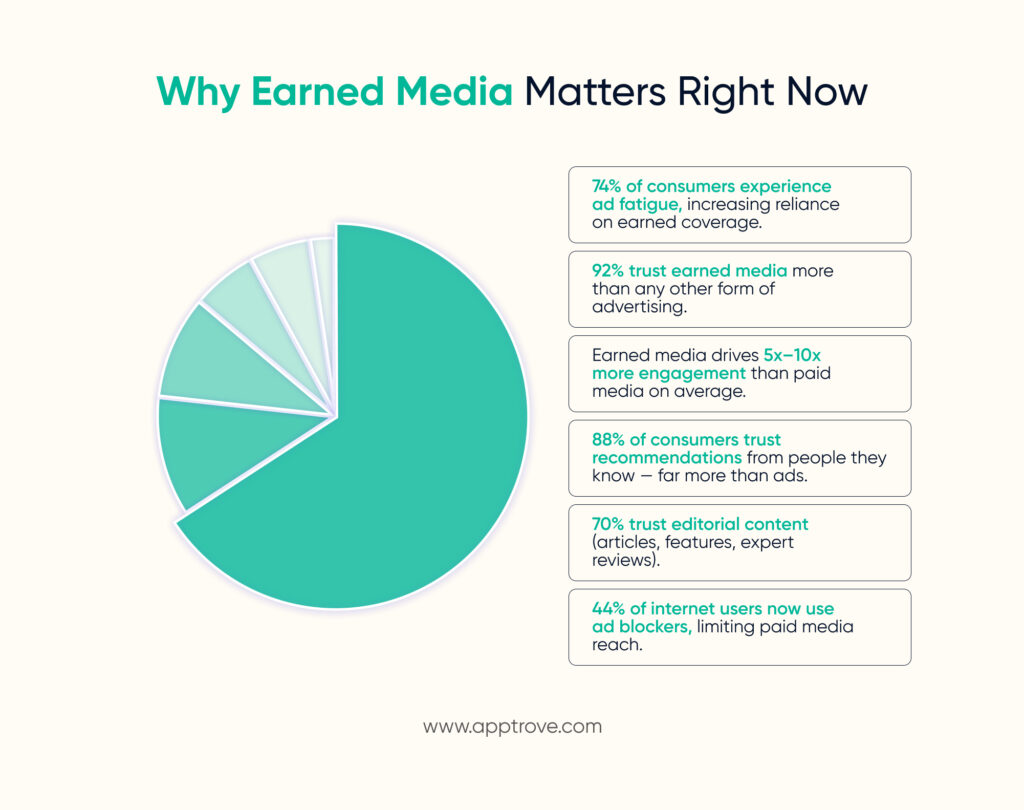
The increase in consumer trust towards independent sources of information is an ongoing trend that has resulted in higher levels of media coverage through earned media. This has occurred as a result of the growing number of consumers experiencing ad fatigue from brands. The growing number of consumers experiencing ad fatigue from brands has also helped drive algorithmic focus on more authentic forms of consumer engagement, and independent source validation of a product or service results in greater brand recognition, brand reach and brand retention for businesses attempting to compete in a crowded marketplace.
The compounding nature of earned media, wherein the media success produces additional media successes through referrals or word of mouth, helps organisations establish long-term authority and reputation as a result of earned media that cannot be achieved through the use of paid media only.
Core Concepts & Terminology in Earned Media
An understanding of measurement and metrics will help you work well with Earned Media. One of the key measurements is “share of voice,” which measures how many times your brand has been mentioned compared with competitors. The next important measurement, “sentiment,” tells you whether the coverage was positive, neutral or negative and shows your company’s reputation in the eyes of the public. Another measurement is “reach,” which estimates the total number of people who might have viewed your mention.
In addition to share of voice, sentiment and reach, you will also come across other important terms: Impressions, Authority Signals; and Amplification Rate. All of the above are used together to measure the success of your Earned Media Activities, understand how well you are being covered in the media and develop game-changing strategic decisions to maximise your Brand Awareness and Communications outcomes.
How PR, content, and community fuel earned media
Collaboration among strategic content, public relations, and engaged audiences maximizes the possibility of earned media. A PR team can develop an effective narrative for storytelling and successfully pitch it to journalists and content creators to gain third-party validation of the story.
Investing in high-quality content (i.e., reports on data, customer success stories, and thought leadership) increases the value of assets worth sharing, thus providing increased opportunities for media placements of earned Media. Engaging communities also builds credibility, providing opportunities for conversation, advocacy, and user-generated content. When these three elements work together as one, they create a sustainable mechanism for generating earned media. Furthermore, as media coverage of your brand increases, your Brand’s awareness continues to strengthen over time.
Common misconceptions to avoid
People often think of earned media as a “free” form of publicity; however, earned media requires time, resources, and strategic planning. Another misconception is that earned media is unpredictable. A well-structured and managed system allows earned media to become routine. People often believe that earned media replaces paid or owned Channels. In fact, it should complement both.
Many people think of earned media as something that is delivered immediately; however, the significance of earned media grows over time through consistency, credibility, and value-based storytelling.
Benefits and the Business Case for Earned Media
Tangible outcomes (traffic, pipeline, CAC impact)
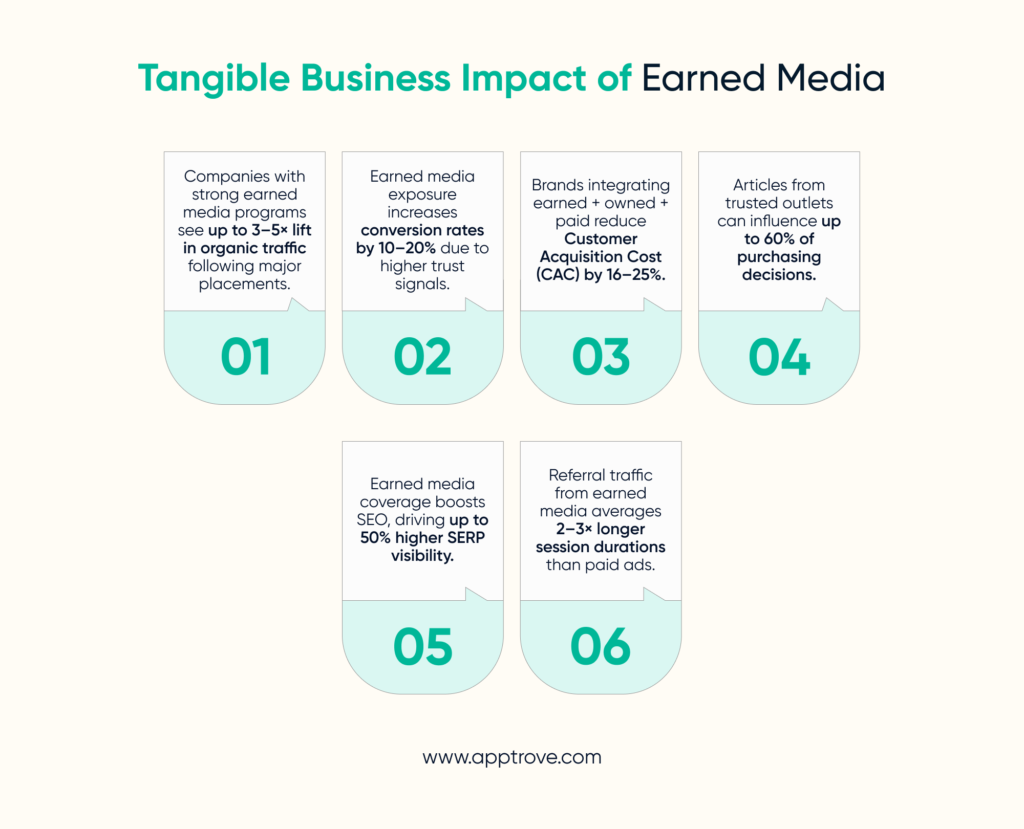
Measurable and tangible benefits gained from earned media make it an excellent investment for growth-oriented teams due to the measurable bottom-line benefits it generates. Qualified traffic, enhanced demand, and increased conversion rates result from media placements from trusted third-party sources. Furthermore, integrating media into a broader marketing program can shorten the sales cycle and increase pipeline velocity by building familiarity with prospects before outreach.
In addition, significant decreases in customer acquisition costs are seen by the company. Regularly placed content on both media and paid channels builds ongoing visibility while requiring no additional costs for ongoing paid advertisements. Over a period, the total amount of placement from media builds into amplifying both brand’s awareness and total media exposure.
Intangible outcomes (brand trust, credibility, authority)
Beyond measurable outcomes, earned media generates intangible benefits that are difficult for competitors to replicate. Third-party endorsements of brands increase trust, reinforce the credibility of brands and position an organisation as a thought leader and reliable source of information in their industry.
These signals are key to building executive visibility and developing the long-term authority of an organization within the market. With independent sources increasingly relied upon by audiences, the continued production of content through earned media represents a major factor in building the reputation of the brand, which increases the ability of brands to create perception, influence public opinion and quickly adapt to changes and growth in environments with high levels of competition.
Quick ROI framework for stakeholders
By providing stakeholders with a clear ROI (Return On Investment) framework, it allows them to quickly grasp the value of their investment into earned media; this can be achieved through an evaluation of performance by aligning visibility-related metrics with tangible business outcomes such as traffic lift, conversion influence, sales velocity and cost efficiency, along with qualitative gains including trust signals and authority growth.
The combination of these two categories serves to illustrate how strategically managed earned media improves efficiencies, increases brand awareness and builds long-standing media coverage, thereby strengthening the entire marketing ecosystem.
Challenges & Risks of Earned Media
Typical pitfalls teams hit first
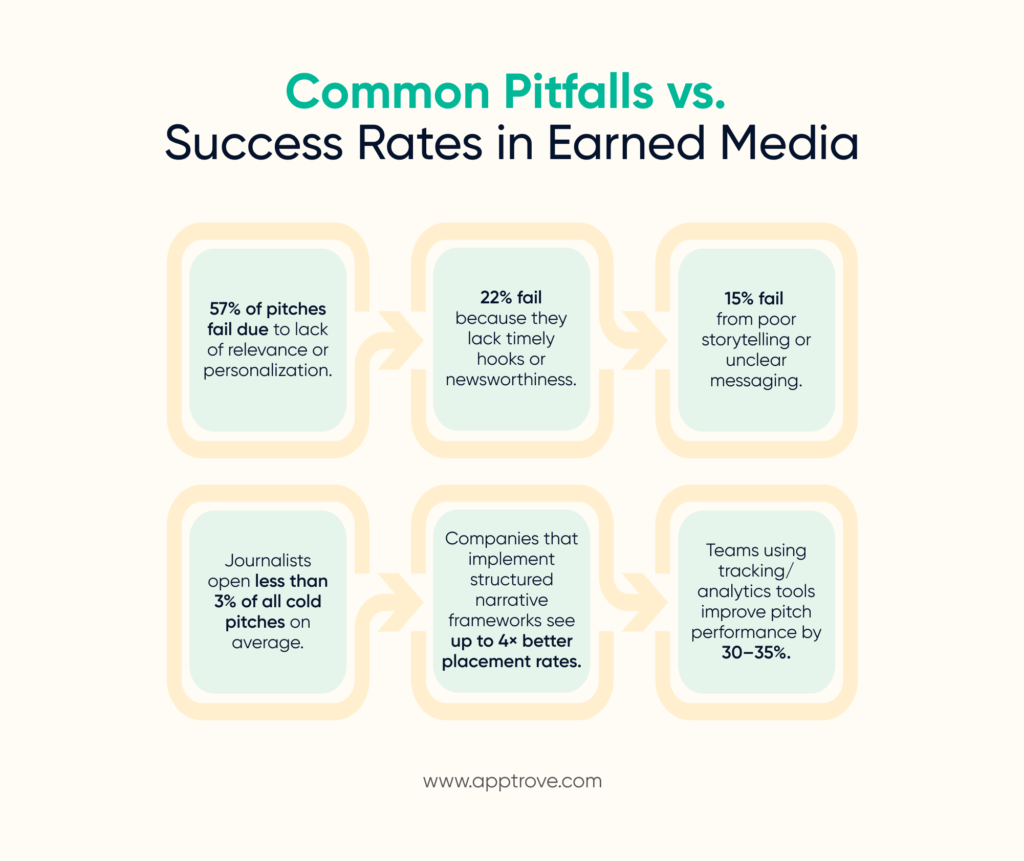
Many teams are excited to pursue earned media until they run into predictable obstacles. A common pitfall is forming generic pitches that lack value, which leads to low response rates from the media or content creators. Another challenge is the inconsistent storytelling where they create fragmented stories that dilute the brand’s message.
Timing is also an obstacle; the PR team sends out pitches when the news cycle is full or when the subject is no longer relevant. Lastly, without proper tracking, organizations are unable to connect earned media success to business outcomes, e.g., brand awareness / qualified demand, making it difficult to maintain momentum for the long haul.
Hidden risks and how to mitigate them
Some issues arise only after the earned media program is up and running. For example, if the messaging is not under control or if there are no crisis plans in place, then negative and/or inaccurate coverage can spread very quickly. Additionally, if teams become too dependent on a small number of spokespeople or specific channels, there may be bottlenecks in the process.
To mitigate these problems, teams should invest in training for their spokespeople, establish an organized review process, and use monitoring tools to keep track of coverage. Finally, building solid relationships with reputable voices can help prevent misinterpretation of the story. By proactively managing their earned media efforts, teams can make their earned media campaigns more predictable, scalable, and in line with their overall media objectives.
When earned media is not a good fit
Brands without a defined story (or narrative), established evidence and insights on their strengths have less opportunity to generate earned media. Also, because developing the level of trust necessary for earned media takes time, brands seeking to generate immediate, short-term impact of their products and services will have difficulty achieving success via earned media.
As a result, brands should develop a strong foundation of assets prior to generating and implementing earned media efforts to create an environment that is conducive to future earned media success and increased brand awareness.
Prerequisites & Readiness Checklist for Earned Media
People/skills you need on day one
A successful earned media programme will require a team that can be strategic, creative and have the ability to perform analytical functions. At the fundamental level, you need individuals with the skills to create the narratives, manage outreach and build relationships, as well as create measurement.
You should also have strong writers/researchers who understand industry trends; you should have one or more spokespersons who will convey insights clearly and effectively. These are the basic skills needed to ensure that your brand is positioned to create valuable earned media opportunities and build long-term growth of media coverage.
Tools, data, and infrastructure requirements
A company’s staffing and supporting system must be in place before they launch a complete earned media strategy. Research and media databases are available to help identify reputable journalists and influencers. Listening tools are useful for tracking the conversation surrounding your brand, its tone (positive or negative), and any new angles that could be explored. Analytics solutions will help evaluate how successful an earned media campaign was, including connecting these efforts to an increase in awareness of your brand, creating demand for your product or service, etc.
The creation of a central repository for messaging documents, data, press kits, spokesperson bios, etc., will help ensure consistency and allow for the efficient utilization of these resources. Collectively, these tools will support and expedite the scaling of an earned media campaign by creating a reliable, insight-based operating system.
Budget and timeline expectations
Even though earned media cannot be purchased, it does require resources to produce positive results. You should plan to invest in the use of research tools, creating valuable and helpful resources for your audience, and preparing your spokespersons with appropriate training before launching your campaign.
Media placements for earned media typically take several months to develop and accumulate as the media builds credibility for your brand through consistent messaging and placement of your content. Brands that are committed to investing in an earned media strategy will earn the best media placements and will create the most lasting brand awareness for their audience over time.
Step-by-Step Earned Media Implementation
Step 1: Discovery and goal-setting
The first step of creating a complete Earned Media Program is to develop clear alignment around goals and intentions regarding outcomes; knowing your desired objectives and what you want your team to achieve will assist in developing what your team’s goal is.
It is important to identify the individuals you want to reach and their specific information needs and to create a relevant business case showing how your earned media strategy will support your overall business objectives; SMART goals (create SMART Goals – Specific, Measurable, Attainable, Relevant, Timely) will assist in ensuring you remain focused on the main objectives while avoiding having multiple directions to follow.
While doing your research, you should clarify expectations from the internal team, available resources, and which key narratives each team involves; if you create this structure from the beginning, you ensure that your earned media strategy is intentional, aligned, consistent, and located where it is connected to your brand’s growth in terms of credibility and brand recognition through measurable results.
Step 2: Auditing the current brand and narrative
Before outreach can begin, it is vital to assess your current brand position to understand the potential competitor’s perception of you within the marketplace. Are they accurately representing your messaging within your messaging documents, website, customer comments, comments from your executives and past news stories?
You should assess any inconsistencies between what they say and how you would like your brand to be viewed. You want to locate areas of weakness in terms of credibility or evidence that may be required.
The audit also allows you to identify what would be useful content (e.g., case studies, unique data) and/or any potential areas of expertise that you could use to create interest in your brand. A thorough Narrative Audit allows you to start your Earned Media efforts from a solid foundation.
Step 3: Designing your angles, hooks, and proof
Begin strengthening the narrative by connecting your expertise with relevant, timely information and unique insights. Great hooks are created through the use of tension, novelty, and relevance of the information presented in the story.
Pitches should always include data that provides proof of the premise of your story, such as customer examples, product innovations, proprietary research or executive expertise that provides you with authority in your space.
By ensuring that your earned media pitches are built on both value and relevance, you will increase the chances of receiving coverage. By developing angles thoughtfully, you build further authority for your brand and reinforce the overall level of brand awareness across multiple channels.
Step 4: Building target lists (press, creators, communities)
Next, segment your target lists according to audience alignment, topic relevance and publication/platform influence. The target list you create must be broken down by the type of story they typically report on.
You will want to use monitoring tools to follow the writers’ or publications’ interests, recent articles, and the ways they engage. By building a well-structured target list, you eliminate wasted outreach opportunities, which results in higher-quality media coverage, plus a greater likelihood of building long-lasting relationships with the targeted audience, which is vital to maintaining media momentum over time.
Step 5: Outreach & pitching (email, social, events)
When reaching out, you must first create a strategy and then use that to execute. Every outreach will be unique to the recipient, so include context about the recipient as well as their audience. You will need to tell the recipient why this is an important pitch for them to respond to right now. Present your proof clearly and concisely. Outreach doesn’t have to be limited to email. There are plenty of other ways to engage with journalists and creators via social media. Some common methods are commenting on posts, sharing informational links or articles, and joining in conversations.
Step 6: Measurement loops and iteration
Consistency is very important when following up and maintaining professionalism. A successful pitch will provide earned media for you and create a more robust pipeline of media coverage.
Once you receive media coverage, you should implement a measurement cycle to analyze both the quantitative and qualitative results of your outreach efforts. To do this, you can measure reach, sentiment, share of voice, referral traffic, and influence on your marketing pipeline. You should then evaluate how the media story supports your business objectives and if it helped increase brand awareness for your organization.
After evaluating your media coverage metrics, you can use that data to adjust your outreach angles, refine your target list(s), and improve your outreach timing. By continually improving your outreach through iterations, you will create efficiencies and predictability where earned media dollars maximizes your effort.
Step 7: Scaling and operationalizing wins
As your earned media program grows, focus on optimizing and scaling processes that have proven successful. Establish repeatable workflows focused on developing narratives, creating pitches, outreach cycles, and measuring results. Repurpose earned media wins through various marketing channels such as social media, emailing, sales enablement, and website pages so they can endure longer, build authority and expand.
Train additional spokespeople to alleviate congestion in messaging, and add diversity to expert voices. Ultimately, as these activities are consistently operationalised, earned media will no longer be episodic victories, but rather become a continuous process driving brand reputation enhancement, increasing influence and strengthening market visibility.
Earned Media Tools & Platforms Landscape
Monitoring, social listening, and journalist databases
A successful earned media program depends on tools to help manage opportunities, monitor conversations, and analyze how audiences feel about a brand. Monitoring services track mentions of brands, competitors, or products in real-time and allow companies to stay on top of news and trends.
Social listening products disclose which topics are currently trending, and where to insert a brand’s voice to add value to the topic being talked about. Media databases enable researchers to quickly find out details about journalists, editors, or content creators, including what beats they cover, example reports, and how to pitch them. Combined, these tools will improve the effectiveness and accuracy of your earned media outreach and assist in monitoring ongoing media coverage.
Integration considerations and data flow
To scale earned media, organisations must integrate their earned media tools with their broader marketing and analytics stacks to ensure the data collected is able to be synced with dashboards, CRM systems, and attribution platforms, as this is how earned media results can be connected to the business results that happen downstream. Insights can be collated and centralised to enable better decision-making, to identify trends in the reporting of stories about the organisation and to help create better forecasts for the organisation’s earned media results.
Also, the flow of data in the organisation will help to make it easier for different teams to replicate the success of their own strategies and improve the way they target their audience, as well as help to develop a long-term framework for measuring improvements in the organisation’s brand reach and efficiency in its earned media programme.
Best Practices & Pro Tips for Earned Media
Newsworthiness: timing, tension, and takeaway
Strong earned media campaigns should begin by understanding what makes a newsworthy story. Reporters will always look for three main components when deciding whether or not to write about a story: relevance, differentiation, and immediacy. Studies show that over 50% of stories that are engaged with at a high level by reporters or readers contain at least one point of tension (e.g. an unexpected insight, market change, or dilemma that hasn’t been resolved). Also, timing is important; stories are approximately 40% more likely to be published when they are pitched during active discussions in the industry. Each angle within an organisation should offer readers a clear takeaway.
Therefore, by placing an emphasis on how timely and relevant the story is and how it creates tension within the overall narrative, it is possible to increase the probability of obtaining high levels of engagement with earned media and, consequently, generate a greater number of media placements.
Compliance, Ethics & Security in Earned Media
To ensure transparency and maintain brand integrity, successful earned media programs must adhere to strict regulations and disclosure guidelines. In recent years, requirements for claims substantiation, sponsored content and spokesperson clarity have become stricter, with increasing numbers of regulatory investigations into misleading messaging occurring every year. Brands should make sure that all statements included in their earned media programs are accurate, do not promote their products or services, and do not contain unproven claims. When collaborating with product endorsers, experts or creators, brands should disclose any material relationship to prevent misperception about those relationships. By following these best practices, brands reduce legal liability while improving the trustworthiness and credibility of their earned media through open, honest and transparent communication.
Due to the growing concern among audiences respecting how companies use data, it is critical that organizations establish strong privacy and ethical restrictions. Frequent surveys indicate that over 70% of consumers expect companies to demonstrate a commitment to responsible data practices before placing complete confidence in their brand. Additionally, media should not use sensitive information, all customer references should be de-identified when appropriate, and all insights should be aggregated rather than individually identifiable records.
An organized risk-based approach enables teams to recognize the likelihood of a problem and to take preemptive actions. The risk management process comprises key actions that include the following: review of the claims for accuracy, alignment with the internal company’s legal guidelines, preparing the spokespeople through media training, and monitoring for any issues that may develop or arise in videos or content as they are being released.”
Advanced Strategies & Future Trends in Earned Media
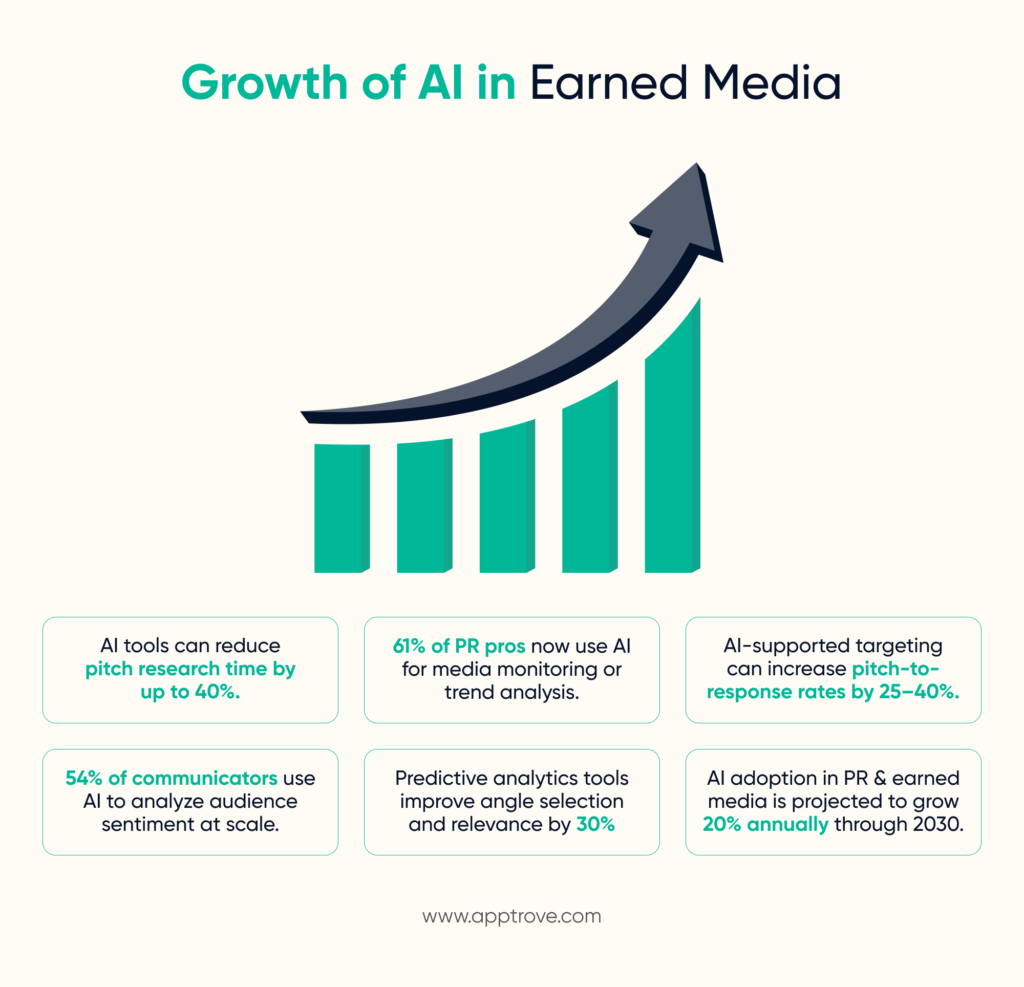
Artificial intelligence has revolutionised earned media opportunities for teams through the use of advanced language models to analyze large amounts of conversation data and allow teams to identify new topics much earlier. In addition, they will quickly surface stories or angles that may have been missed before. Observations from the industry suggest that AI-supported research can cut down on almost 40% of the time it takes to develop an effective Pitch that allows teams to create more effective narratives and thus perform much quicker than before. Artificial Intelligence’s ability to personalise also continues to grow.
AI can help teams by rapidly identifying areas where there is a significant overlap between journalists’ interests in a particular topic and an organisation’s brand insight. By responsibly using these tools, teams will be able to increase productivity and the amount of media generated from their earned media efforts, as well as increase the accuracy of targeting their efforts, without reducing the importance of human judgment or authenticity.
Conclusion & Next Steps for Earned Media
Recap of key takeaways
To develop a strong earned media program, you must:
Create a narrative to match your communications. Provide proof that your story matches your narrative, and remain consistent and disciplined in your execution.
A successful media program is based on the premise that earned media is a long-term engine for your brand rather than a one-time effort. A successful media strategy combines media with your Content, Community, and Strategic Outreach efforts.
30, 60, 90 Day Roadmap
Your 30-day planning process should include auditing your narrative and your messaging as well as collecting the foundational collateral, developing your monitoring system, and gathering the necessary research. In your 60 days, you should begin to test the angles and messages assigned to earned media and develop the outreach workflows. By 90 days, begin evaluating the results to see what works and doesn’t work, begin to grow your media base and involve more spokespersons to increase your coverage. Following this phased-in methodology helps build momentum and ensures long-term growth.
FAQs
1. In what timeframe can I expect to see results from my earned media strategy?
Most media initiatives typically exhibit the greatest level of early traction at six to ten weeks post-launch (many initiatives will continue to exhibit stronger organic beacons of earned media as time progresses).
2. Is there an expense associated with earned media?
Earned media is an ad-free method of promoting your product or company through third parties, but requires a strategy to execute your earned media program, as well as additional assets to be available that will assist in building brand equity.
3. What features of a pitch make the most impact on a journalist?
To create an impactful pitch, journalists generally respond well to timely hooks with a clear value proposition and use of relevant proof points aligned with current media trends.
4. Do small brands stand a chance at attaining earned media?
Yes! Small brands can leverage unique insights and a strong storytelling approach to create opportunities to attain impactful earned media for their products and services without having to spend large amounts on advertising.
5. When is the best time to pitch?
Depending on the quality of the pitch, weekly outreach to media partners is effective for sustaining media coverage and maintaining and building brand equity.
6. What does success look like in earned media?
Steps taken to measure success in earned media include monitoring audience sentiment and reach, tracking overall engagement (share of voice) in the marketplace, and examining the effect of earned media on a brand’s overall growth in awareness and demand.
7. Will earned media replace paid advertising?
No. While earned media enhances a company’s reputation through earned media channels, the combined effects of paid advertising and earned media channels will create a significantly larger audience effect.|