
What is CPM (Cost Per Mile)?
CPM (Cost Per Mille) is used to measure the cost of 1000 viewers of an advertisement. CPM helps advertisers measure the cost of their advertising (i.e., to increase awareness) rather than engagement or conversions. CPM is an essential component of evolving digital advertising and a brand reach strategy.
Definition and Purpose
Cost Per Mille is commonly used by marketers across multiple channels of advertising for three main reasons:
- CPM provides a consistent way to measure the performance of ads across various channels, regardless of where the ad is being served.
- The cost-per-mille metric is used by marketers to gauge the effectiveness of their advertising strategy to compare the cost of various placements.
- The fact that CPM is so widely accepted means that when a marketer wants to compare two different advertising channels, he or she only has to use one number (the CPM). Therefore, marketers can easily determine which advertising channel has the best return on investment (ROI) by simply evaluating their average CPM across those channels.
Advertisers rely on CPM when the main objective is scale: maximising exposure, reaching wide audiences, and saturating the market during specific periods. For top-funnel strategies, CPM is one of the most referenced metrics due to its simplicity and consistency.
How CPM Works
Cost Per Mille (CPM) is a simple concept with an equally simple formula:
Cost Per Mille = Total Cost of Campaign/Total Impressions Delivered*1000
Because it is so straightforward, CPM is an effective tool during the planning and budgeting stages for campaigns. Advertisers can run various spending assumptions to help predict impressions, optimize budget allocations, and assess the expected reach of their campaigns.
While impressions do not require user engagement to count, CPM’s measurement of engagement quality is limited. CPM makes sense from a distribution standpoint, and therefore, advertisers typically view it as one of several indicators of cost associated with visibility and evaluate it in conjunction with other metrics such as viewability rates, click-through rates, and conversion rates.
Factors Affecting Cost Per Mille
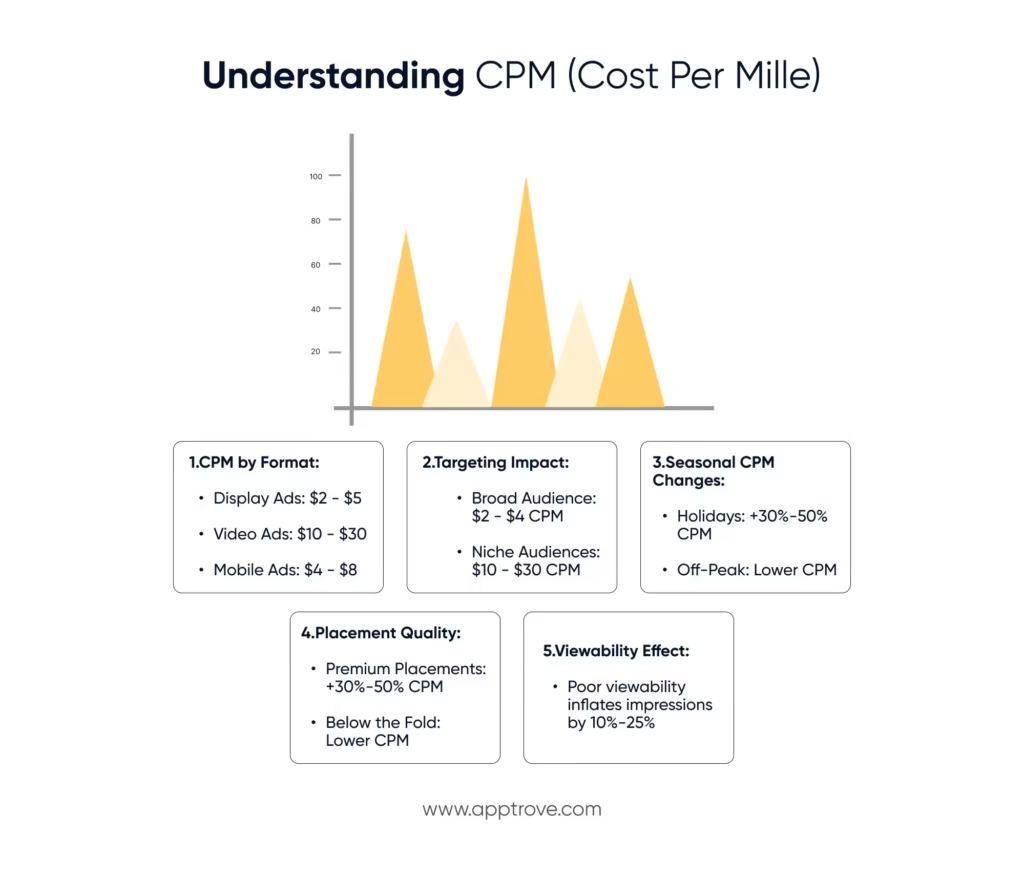
Numerous factors will impact a given CPM price:
Target Audience
The more delineated a target audience, the higher the CPM price for that audience, as the higher level of precision means there will be an increase in the number of advertisers competing for access to those users.
Medium
Generally, static display ads have lower CPMs than rich media and video ads, as rich media and video ads offer a higher level of engagement potential and therefore have a higher CPM value.
Quality of Placement
Higher-quality CPM placements, such as those that are above the fold, larger and located in premium environments, generally have higher CPMs due to the expected higher level of visibility.
Device Used
The CPM price for mobile inventory is often quite different from that of desktop and connected TV inventory, due to the difference in user behaviour and content consumption patterns.
Seasonality
The impact of seasonality on CPM is that, during high-demand months (i.e., year-end holidays, major cultural events), advertisers compete for inventory, thus, effectively increasing CPM for the period.
Markets with greater commercial value tend to have higher Cost Per Mille averages; on the other hand, emerging Markets typically have lower baselines.
Typical Industry Benchmarks
General industry research findings indicate that Cost Per Mille can differ greatly by channel and by format:
- Display Ad CPMs are generally considered on the lower end of the average range for untargeted inventory; however, for niche segments and premium content environments, Display ad CPMs can be significantly higher than average.
- Video placement CPMs typically are higher than any other format, as video receives greater attention and is also considered “high-impact” inventory.
- Traditional media, such as print, television, and radio, historically have among the highest Cost Per Mille worldwide due to the constraints of producing and distributing these formats and the large audience reach that they historically enjoy.
- The benchmarks are used to help Media Planners identify whether the Cost Per Mille to be paid on a campaign is a good investment, or not, based on the Planners’ knowledge of potential performance metrics.
The major operational benefits of CPM
The major operational benefits of CPM are:
- Consistency: It is a common metric for comparison across formats and platforms, enabling easy comparisons of performance against different publishers or placements.
- Predictability: The simplicity of the formula aids in creating a more accurate forecast of what will occur as a result of CPM.
- Scalability: CPM metrics can provide information about how quickly the campaign will gain broad-scale audience reach.
- Alignment with Awareness: In the context of brand awareness, CPM is directly tied to visibility and is an integral metric for measuring effectiveness in the upper portion of the funnel.
With these benefits in mind, CPM is frequently selected as the predominant metric used for large-scale awareness-building activities.
Limitations of CPM
Although CPM has many advantages, it has some limitations as well:
- There is no way to determine whether or not there was actual engagement with the advertisement. Having a high volume of impressions does not guarantee user engagement.
- Impression inflation: When advertisements are not viewable, there is a risk that the number of impressions will be inflated and may lead to inaccurate CPM calculations.
- CPM alone does not provide sufficient information to analyze the overall effectiveness of a campaign, and must be analyzed in conjunction with additional performance metrics.
- Based on the current marketplace and seasonal and competitive demands, it is common for CPMs to fluctuate dramatically from month to month or week to week without a change in CPM’s visibility quality.
Thus, using CPM alone to evaluate the success of a performance-driven campaign may result in incorrect conclusions about how effective the campaign was.
Comparison With Other Models
Cost Per Click (CPC)
CPC is about how a user interacts with a website, making CPC the preferred measurement for driven behaviours, and CPM ideal for reaching the widest audience possible.
Cost Per Acquisition (CPA)
CPA establishes a completed action, such as a purchase or sign-up. The CPA is a completed action metric. Whereas, CPM provides visibility with no completed action from the user.
Each of these items provides marketers with guidance in targeting Cost Per Mille.
Practical Use Cases
- When there is a broad audience for a brand’s message.
- Entering a new market and building baseline visibility.
- Running campaigns to gain awareness without requiring user interaction.
- Promoting visual or video ads that need repeatedly exposing.
- Comparing costs against the entire audience.
As Cost Per Mille scales quickly, the CPM metric plays an important part in strategies developed to reach millions of users.
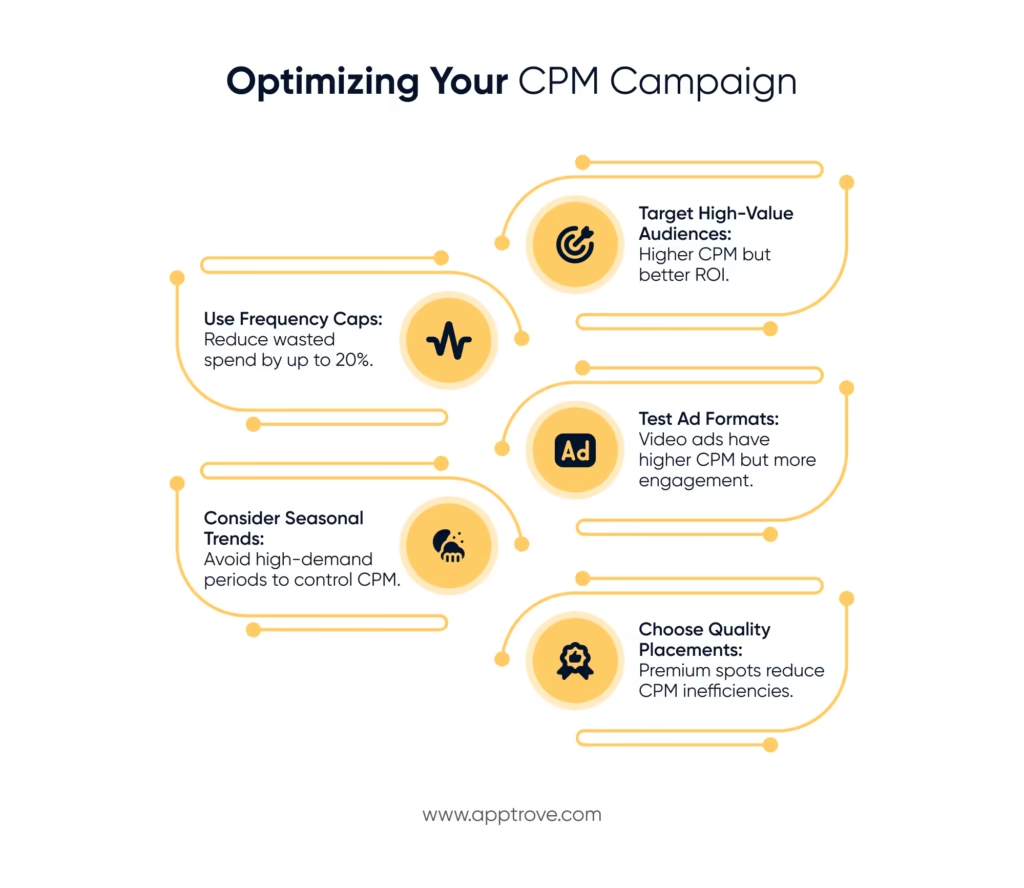
Strategies to Improve CPM Efficiency
To optimize ad campaigns, advertisers should consider the following approaches:
– Adjusting targeting based on the trade-off between precision and scale
– Testing several ad formats to find the most cost-effective options
– Increasing the quality of advertisements to improve viewability
– Monitoring the transparency and performance of inventory sources
– Utilizing frequency caps to lessen the amount of wasted impressions
Conclusion
Through continuous analysis of CPM trends, advertisers can make improvements to the cost efficiency of their campaigns and the overall value of their impression-based campaigns.
In conclusion, Cost Per Mille is still one of the top metrics for determining the cost of advertising visibility. CPM does not give an accurate assessment of engagement or conversion, but does give an accurate reflection of cost efficiency and reach. CPM, when evaluated along with other performance metrics, will allow advertisers to plan strategically and allocate budgets based on CPM’s implications.
FAQs
1. What does Cost Per Mille measure?
Cost Per Mille is used to determine how much it costs an advertiser to deliver 1,000 advertising impressions.
2. Is a lower Cost Per Mille always better?
No; in some cases, a lower Cost Per Mille might suggest inferior advertising placement or a broader audience base with less relevance to the advertiser.
3. How does viewability affect Cost Per Mille?
Viewability can affect the effective Cost Per Mille because non-viewable impressions tend to inflate reported reach.
4. When should advertisers prioritize CPM over other metrics?
CPM should be a priority metric for campaigns focused on increasing awareness because the primary objective of these campaigns is visibility.
5. Can Cost Per Mille be used for both digital and traditional ads?
Cost Per Mille can apply to all forms of advertising, including online display and video ads, as well as print and broadcast media.