There is an abundance of data available to most eCommerce marketing teams today, however, not a lot of certainty.
Dashboards have high volumes of data, from channels reporting conversions to spend trends moving. Yet when it comes time to make a real decision, whether to scale a campaign, double down on a channel, or justify performance to leadership, hesitation creeps in. The reason is not that the data isn’t enough, but that the final answer has uncertainty built into it due to the way that the numbers do not fully agree with each other.
Modern growth is being determined by modern realities that aren’t clean, linear, or reliable in the way most eCommerce marketing strategy frameworks were designed for.
The path customers take to a purchase spans between many different devices, platforms, sessions, and intent states. Privacy-first changes are also creating an even greater challenge to identify the customer’s journey. Yet, many strategies are still built upon the assumption that if they just look hard enough there will be enough information to determine the attribution.
Unfortunately, this will not happen.
In order for eCommerce brands to re-evaluate their growth strategies, they must go beyond tactical changes to make foundational changes around how they define, measure, and ultimately sustain their growth. For app-first brands, these foundational changes will usually mean building a more resilient measurement model, frequently utilizing platforms such as Apptrove, where attribution, lifecycle, and retention can all be viewed as a complete set of data as opposed to separate pieces of data.
What Is an eCommerce Marketing Strategy Today
An eCommerce marketing strategy used to be easier to explain. You acquired traffic, converted users, and optimised channels based on what drove the most sales at the lowest cost. The funnel felt linear and the metrics felt trustworthy. However, that world no longer exists.
Today, an eCommerce marketing strategy is less about controlling the funnel and more about interpreting behaviour across a fragmented journey. It is a long-term framework that defines how a brand attracts the right customers, moves them toward meaningful actions, and builds repeat behaviour that compounds over time.
Customers do not experience brands through the lens of channels, even though teams still organise themselves that way. What they experience instead is a sequence of moments that may begin with discovery on one platform, continue through validation on another, and only later translate into conversion in an entirely different environment. These moments are connected, but not always visible in a single place.
A modern eCommerce Marketing Strategy is built around these connections, even when they are incomplete.
For app-first brands, this becomes even more significant, because the app is not merely a destination where conversion happens, but a behavioural environment that reveals patterns over time, showing which users engage, which disengage, and which gradually become valuable.
Any strategy that does not account for that layer is, by definition, operating with an incomplete understanding of growth.
Why Attribution Broke and Why Strategy Failed to Adapt
Attribution did not break suddenly. It eroded gradually, as customer behaviour outpaced the models designed to measure it, and they journeys became non-linear.
A user might see a product on Instagram, search for reviews days later, install the app after a retargeting ad, and finally convert after receiving a push notification. The answer to which touchpoint deseves the credit for it depends on the model you choose, and that is precisely the problem.
At the same time, privacy-first platform changes reduced deterministic tracking. Signals that once felt reliable became probabilistic. As a result, different tools began telling different stories about the same user.
The strategic mistake many teams made was continuing to treat attribution as a single source of truth. Instead of adapting strategy to uncertainty, they doubled down on familiar models, often last-click or near-last-touch, because those were easier to explain internally.
Over time, this created distortions. Channels closer to conversion appeared disproportionately valuable, and the ones responsible for early intent creation were undervalued or cut. Growth became reactive rather than deliberate.
Rethinking eCommerce marketing strategy starts with a simple but uncomfortable acceptance that attribution will remain imperfect. Strategy must be strong enough to operate without relying on it as absolute truth.
The Real Cost of Broken Attribution for eCommerce Teams
The most damaging impact of broken attribution is not reporting inaccuracy. It is decision paralysis.
When teams cannot confidently link spend to outcomes, they hesitate to scale. When attribution models disagree, internal trust erodes. Marketing leaders spend more time defending numbers than improving performance.
This has downstream effects. Budgets are allocated conservatively. Experimentation slows. Teams optimise for metrics that look defensible rather than outcomes that drive long-term value.
Over time, growth begins to feel fragile. Even when revenue increases, confidence does not. And when conditions change, such as rising CAC or platform volatility, the strategy struggles to adapt.
This is not a tooling problem alone but a strategic one. The fix lies in redefining what signals matter most and building systems that prioritise those signals.
Rethinking eCommerce Customer Acquisition When Data Is Incomplete
Customer acquisition remains essential, but the way it is evaluated must change.
Traditional acquisition metrics focus on immediacy. The CPA, CPI or even CPP metrics are useful, but they are still incomplete. They definitely tell you what happened, but not what will happen next.
A modern eCommerce customer acquisition strategy looks beyond the first conversion. It makes you ask harder questions, such as if the users acquired from this channel return, or if they purchase again without heavy incentives and become profitable over time.
When acquisition is evaluated through retained cohorts rather than raw volume, priorities shift. Channels that appear expensive upfront often prove more valuable long-term. Others that look efficient at first quietly underperform once retention is factored in.
This is where cohort analysis becomes a strategic necessity. By tracking user behaviour over time, across app and web, teams can identify which acquisition sources actually contribute to sustainable growth. Platforms like Apptrove make this possible by connecting acquisition data with downstream behaviour, allowing marketers to see beyond the first transaction.
Conversion Is Now a System
Conversion is often treated as a single event, like a completed purchase or a checkout success. However, in reality, conversion is a sequence of decisions that begins with relevance. For a few instances, whether the landing experience matches the intent behind the click, or if the user understands the value being offered, and more.
For mobile-first users, these questions become necessary. The reason is that attention is fragmented and context is easily lost.
A strong eCommerce marketing strategy treats conversion as a system rather than a step. Deep linking becomes a key part of this system and ensures that users land exactly where they expect to, preserving intent across transitions from ads to app experiences.
This reduces friction. And reduced friction improves both conversion and retention.
Retention as the Anchor of a Modern eCommerce Marketing Strategy
As attribution becomes less reliable, retention becomes more valuable. Repeat behaviour provides clarity where attribution cannot. A user who returns, engages, and purchases again signals something real, measurable, and meaningful.
This is why retention has become central to any effective eCommerce marketing strategy.
Retention changes how growth is evaluated. It shifts focus from acquisition volume to customer quality. It reduces reliance on constant spend and stabilises revenue.
However, retention is not built through incentives alone but is built through relevance.
Timely communication, frictionless experiences, and lifecycle messaging that reflects behaviour are the elements that turn one-time buyers into repeat customers.
For app-first brands, this requires visibility into user behaviour beyond the first purchase. Apptrove enables this by surfacing patterns that help teams understand when users disengage and how to bring them back.
Lifecycle Marketing as the Missing Layer in Most eCommerce Marketing Strategy
One of the most common gaps in an eCommerce marketing strategy is the disconnect between acquisition and retention.
Users are acquired with one message, then onboarded with another, and retained with something entirely different. There is no continuity. Lifecycle marketing closes this gap.
It ensures that the experience after acquisition reflects the context in which the user arrived. It adapts messaging based on behaviour. It recognises that not all users are the same. A discount-driven user behaves differently from an organic one. A first-time buyer behaves differently from a repeat customer.
A strong lifecycle approach ensures that the eCommerce marketing strategy evolves with the user, rather than treating all users as static segments.
Conversion as a Continuous System Within an eCommerce Marketing Strategy
Conversion is often framed as a single event, typically represented by a completed transaction, but in practice, it is the result of a series of decisions that unfold across multiple interactions.
These decisions are influenced by relevance, clarity, trust, and continuity, all of which must be maintained across transitions between platforms and devices.
For mobile-first users, this continuity becomes especially important, as interruptions are more frequent and attention is more fragmented. A user who loses context even briefly is more likely to disengage, and once disengagement occurs, the probability of conversion decreases significantly.
A strong eCommerce Marketing Strategy recognises this and focuses not just on optimising individual steps, but on maintaining coherence across the entire journey. Deep linking plays a major role in this process by ensuring that users are directed to the most relevant in-app or on-site experience based on their intent, thereby reducing friction and preserving context.
This does not just improve conversion rates, it also improves the overall experience, which in turn supports retention.
Measurement as a Strategic Layer in an eCommerce Marketing Strategy
Measurement should not be treated as a retrospective activity that simply reports on performance, but as a strategic layer that shapes how performance is understood and acted upon.
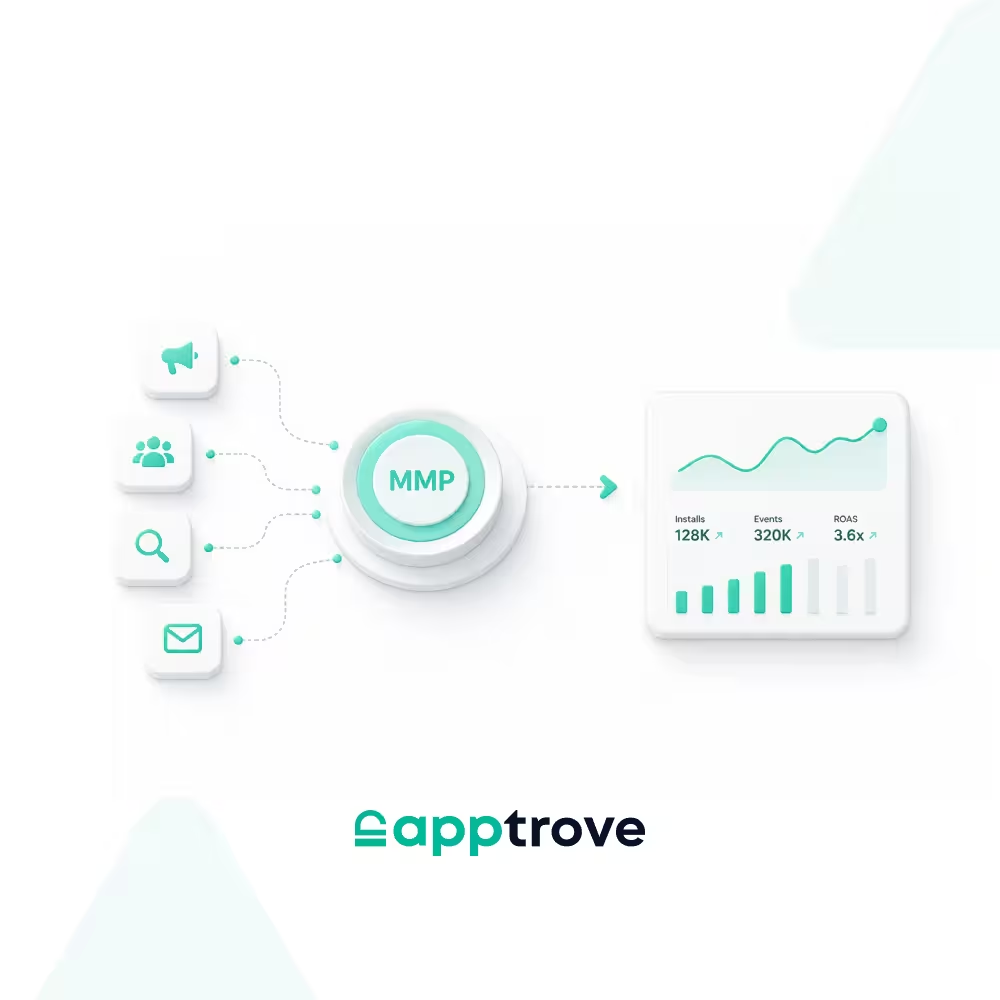
A mature eCommerce Marketing Strategy does not rely on a single metric or model, but instead uses a combination of approaches to build a more complete picture. Attribution provides directional insight, cohort analysis reveals long-term trends, and incrementality testing helps isolate true impact.
Together, these approaches allow teams to make more informed decisions, even in the presence of uncertainty. Apptrove supports this by providing a unified view of user behaviour, enabling marketers to interpret performance in a way that aligns with how growth actually occurs.
Summing Up
The challenge facing modern eCommerce brands is not a lack of data, but a lack of clarity.
An effective eCommerce marketing strategy does not attempt to eliminate uncertainty, but to operate effectively within it by prioritising reliable signals, building cohesive systems, and focusing on long-term value.
So the shift we need to make is towards signals we can trust more, things like retention, repeat behaviour, and cohort performance, and start treating attribution as directional rather than definitive.
For app-first brands, this means investing in a deeper understanding of user behaviour, connecting data across platforms, and using tools like Apptrove to create a more complete view of growth.
If we get this right, we move from defending numbers to actually understanding what’s driving them.
Frequently Asked Questions (FAQs)
1. What is an eCommerce marketing strategy?
An eCommerce marketing strategy is a long-term framework that defines how a brand acquires, converts, and retains customers profitably across digital touchpoints.
2. Why is attribution a challenge in eCommerce marketing?
Attribution is challenging due to fragmented customer journeys, privacy-first changes, and cross-device behaviour that limits deterministic tracking.
3. How should eCommerce brands measure marketing success today?
Brands should combine attribution data with cohort analysis, retention metrics, and incrementality testing to make informed decisions.
4. How do app-first eCommerce brands track performance accurately?
App-first brands rely on unified app and web analytics, behavioural segmentation, and lifecycle analysis to understand performance beyond last-click metrics.