Introduction
Every engagement, touch, and app download tells something, but without proper tools, it is very hard to tell which campaign played its role. This is where MMP advertising comes into play. As mobile users are spending more than 4.5 hours a day on their phones and global mobile advertising spending is already over $400 billion per year, marketing specialists cannot make assumptions about the effectiveness of their campaigns.
They need accurate attribution, actionable insights, and real-time visibility into each customer journey. At the heart of MMP advertising lies a clear understanding of where the app users come from, which campaigns initiate customers’ actions and how the advertising budget is transformed into long-term growth. Instead of working with reports from different ad networks, marketers will have insight into all installations, in-app activities, retention, and revenues.
But the mobile world is no longer as simple as it used to be. Privacy updates, lack of device identifiers, divided user journeys, and growing ad fraud have all made measuring campaigns increasingly complicated. In fact, mobile ad fraud leads to losses of billions of dollars every year for marketers, while the lack of attribution results in wasted budgets and erroneous performance numbers. That is why MMP advertising is something that everyone should integrate into their app marketing strategy today.
If you are engaged in any kind of user acquisition campaigns, app installation campaigns, or using LTV optimisation, it is crucial to understand what MMP advertising is in order to be competitive in the market. This document will provide you with information about the MMP advertising process and its significance, features to find in any modern mobile measurement partner, and practices that will allow marketers to make use of their money effectively.
What Is MMP Advertising?
Understanding Mobile Measurement Partner (MMP) Advertising
MMP advertising is the measurement, tracking, and optimising of mobile advertising campaigns by a mobile measurement partner (MMP). The MMP acts as an independent measurement platform to report campaign performance, rather than relying on advertisers from individual ad networks. The MMP will track the interaction that a user has with a particular ad with the right attribution. In this way, you will be able to trace back to which marketing campaigns lead to the acquisition of users.
As mobile marketing is getting more fragmented, it is important to have a common attribution source. With MMP advertising technology, marketers can obtain a unified report on their campaigns.
Why MMP Advertising Has Become Essential
The mobile advertising environment has changed significantly in recent years. Privacy regulations, Apple’s App Tracking Transparency (ATT), Google’s changing Privacy Sandbox, and the continuing decrease in device identifiers have made it increasingly difficult to achieve accurate attribution. At the same time, mobile app downloads have surpassed 250 billion a year, and companies continue spending hundreds of billions of dollars on app advertising to gain and retain customers.
Due to the absence of reliable attribution, marketers do not know which campaigns actually lead to positive financial returns. Hence, it becomes easy for them to waste ad budget, misreport data, and miss out on opportunities to optimize their campaigns further. MMP advertising answers these questions with the help of transparent attribution, cross-channel measurement, fraud-sensing, and GDPR-compliance analytics.
Modern MMPs go further than just measuring installations since they allow marketers to analyse the whole customer lifecycle beginning from the first interaction with the advertisement and finishing with post-install activity, retention, and lifetime value (LTV) calculations.
How MMP Advertising Differs from Traditional Mobile Advertising
Conventional mobile advertising platforms simply deliver ads and measure performance within their ecosystems. For example, a social network may report conversions resulting from its ad campaigns, and a search advertising platform may measure only users it has measured. This creates isolated data silos and does not allow for fair comparison of performance among channels.
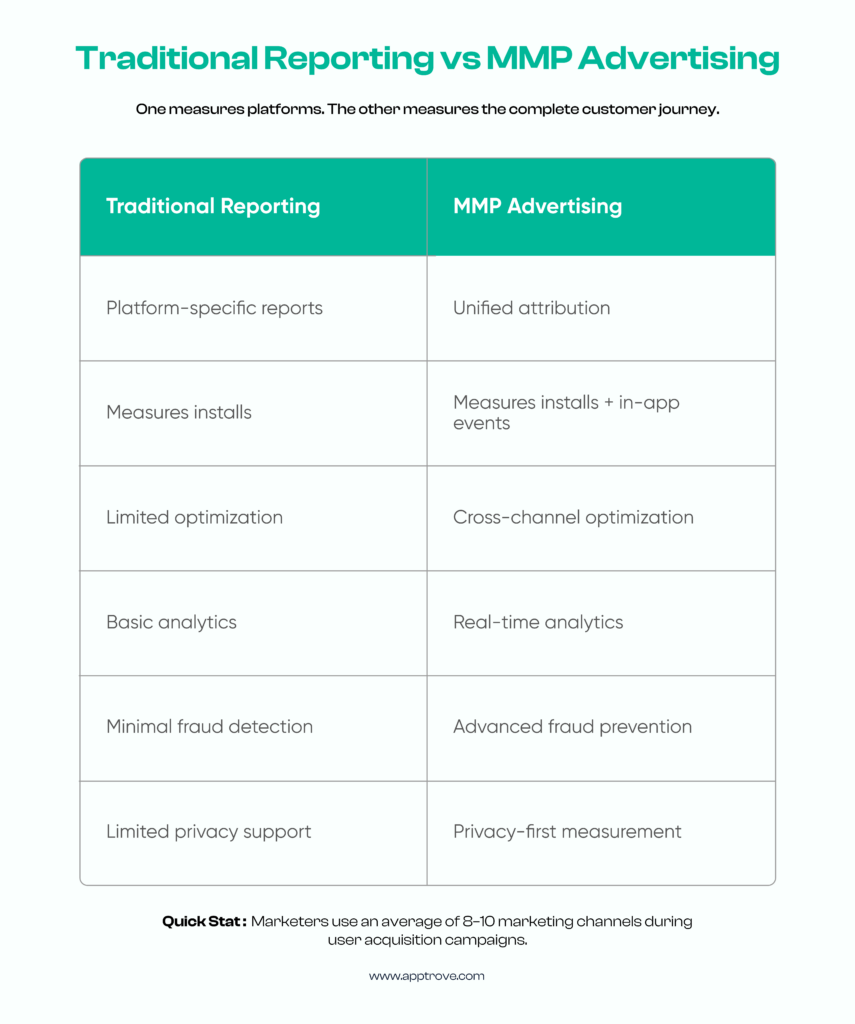
Contrary to that, MMP advertising makes it possible to have an independent and unified measurement solution. Instead of relying on various self-delivered dashboards, marketers get standardized information from all integrated advertising partners. This creates a common understanding of installs, in-app events, revenue, retention, and performance regardless of the source of a user.
Another important distinction is in optimizing capabilities. Traditional reporting usually stops at clicks and installs, while MMP continues to follow post-install activity, which allows marketers to assess campaign performance based on real business results rather than vanity metrics. Advanced functions such as deep linking, cohort analysis, fraud prevention, multi-touch attribution, and privacy-first measurement give businesses even more tools to optimise campaigns more effectively. In the modern multi-channel environment, users interact with many brand touchpoints to convert, which allows MMP advertising to offer a level of visibility and accuracy
How MMP Advertising Works
Campaign Launch and Attribution Links
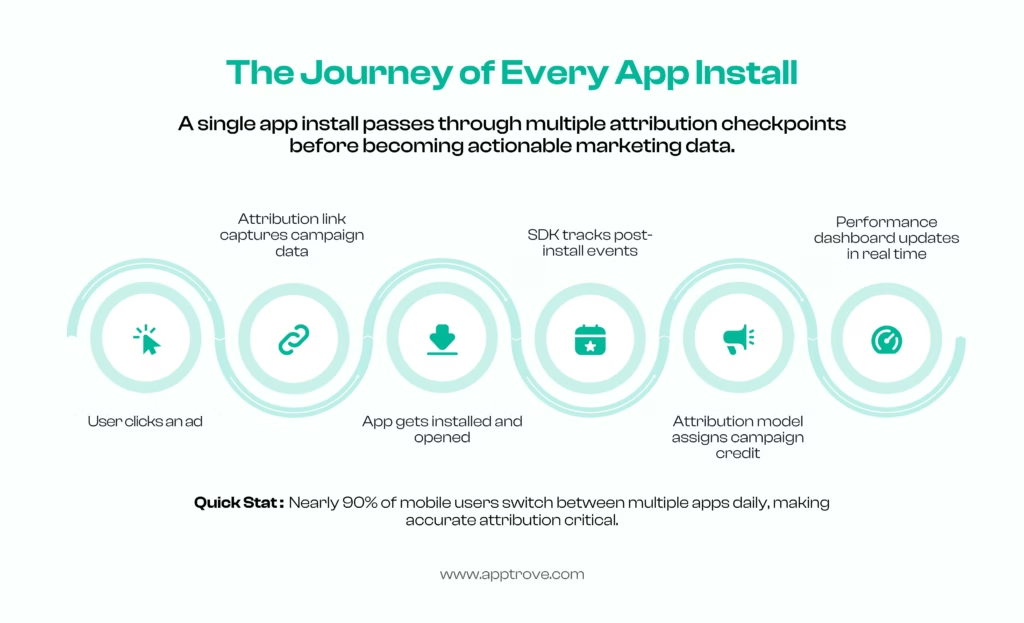
Every effective campaign through an MMP has to start with a tracking link. Before running ads on platforms like Google Ads, Meta, TikTok, or other advertising networks, marketers have to create unique attribution links through their Mobile Measurement Partner (MMP). Then, this link has all the parameters related to specific campaigns, like the source, campaign name, ad set, or creative ID, which help track every user interaction.
When a user clicks on the ad, the attribution link collects essential information about the campaign before sending the user to the app store or any designated place. This is a prerequisite for effective attribution, which allows marketers to understand the exact campaign that has started the user’s journey.
Attribution Of App Install
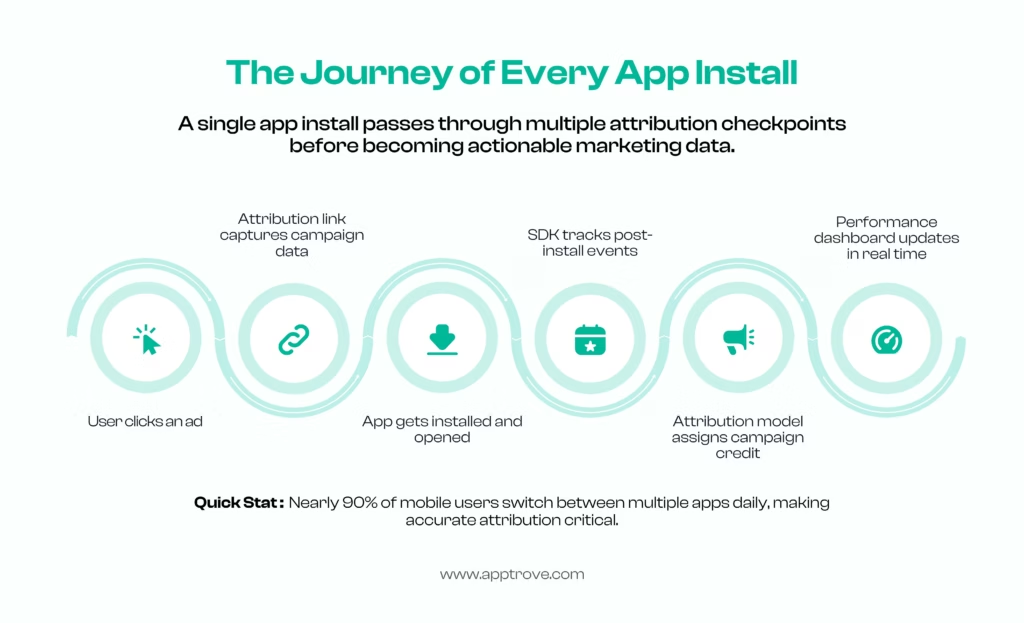
As soon as the user installs and runs the application for the first time, the MMP SDK incorporated into the app begins collecting attribution data. The data is processed and compared with previously collected information about ads to reveal the attribution campaign.
The process, known as attribution of app install, allows marketers to understand the effectiveness of advertising channels in attracting new users. Instead of relying only on numbers provided by different advertising platforms, companies have authentic and reliable attribution
In-App Event Tracking
Installing an application marks just the start of the user journey. To evaluate the effectiveness of their marketing campaign, companies need to figure out what their clients do after they install the application. This is where in-app event tracking comes in handy.
A Mobile Measurement Partner tracks important actions performed by users, e.g., registrations, purchases, subscriptions, product views, completed tutorials, adding items to the cart, or other user-defined events as per business requirements. This helps evaluate the quality of users acquired rather than only assessing the number of downloads.
The link between user actions and the source of the marketing campaign allows marketers to establish efficient advertising channels, target their audience, and increase their return on advertising spend (ROAS) by relying on actual results instead of mere install figures.
Attribution Models and Matching
Connecting the install with the relevant marketing campaign is not a straightforward process. Usually, users get in contact with many advertisements from different platforms before they download the application. Various attribution models are utilized by Mobile Measurement Partners to measure the impact of each advertisement on the potential customer.
Last-click attribution is the most popular method for attribution and involves attributing credit to the final advertisement click before the installation happens. However, other types of attribution techniques are supported by MMPs, such as view-through attribution, which captures the ad impressions of users who did not click on the ad. The newer and more complex methods like multi-touch attribution are used by advanced platforms for attribution.
The methods used by MMPs for tracking the installation-to-advertising interactions depend upon the availability of identifiers and privacy compliance. Due to the emergence of privacy-related frameworks such as Apple’s App Tracking Transparency (ATT), SKAdNetwork (SKAN), and Android’s Privacy Sandbox, modern-day MMPs are required to keep up with the changing privacy-related requirements.
Performance Reporting and Optimization
When the attribution process is over, all the data from the marketing campaign is gathered in one place through a centralized reporting dashboard. The marketers don’t have to log in to multiple reporting dashboards of different advertising networks to see things like installations, revenue, retention rate, engagement rate, conversion rate, customer lifetime value (CLV), and return on ad spend (ROAS).
With the help of modern MMPs, businesses can analyze cohorts, customise dashboards, detect fraud, and automate reporting processes. Instead of asking only simple questions such as ‘Which marketing campaign really impressed users?‘ marketers may now ask more significant questions like, ‘Which marketing campaign got customers who stayed with our brand longer and paid more during their entire lifetime?’
Core Features That Make MMP Advertising Effective
Mobile Attribution
The process of mobile attribution is at the centre of mobile measurement partner (MMP) advertising. Mobile attribution refers to finding out which marketing campaign, ad network, or channel brought in a user. Instead of relying on self-reported information from the separate ad platforms, MMP gives a fair attribution from different sources. This allows marketers to know how to make a good quality user out of a customer, save money, and accurately measure their return on ad spend (ROAS).
Multi-Touch Attribution
Modern-day customers do not install an application after seeing one advertisement. They can spot an app thanks to social media advertising, first search for the required information, and only then finish the conversion process after watching a video campaign. Multi-touch attribution distributes the credits for the tests among all the interactions instead of just the last touchpoint.
Deep Linking and Deferred Deep Linking
The key to obtaining higher conversion rates is providing users with a great user experience, and with the help of deep linking, users experience just that. Instead of directing users to a single landing page, deep linking takes users directly to the specific content inside of the app, like the product page, the offer page, or the subscription screen. Deferred deep linking extends this experience to users who are new by ensuring that the destination is preserved even in the case when the application was downloaded first. The result of being able to avoid all these friction points is a shortened conversion path as well as improved engagement and retention rates.
Cross-Platform Attribution
People usually move between different devices like smartphones, tablets, websites, and even connected devices before accomplishing any desired action today. Cross-platform attribution makes it easier for marketers to connect these different touchpoints and provide a unified picture of the customer’s journey. By measuring the performance of campaigns on different platforms, companies get insight into the overall effectiveness of their marketing campaigns instead of viewing the performance of every particular platform individually.
Real-Time Analytics
Mobile advertising is happening very swiftly, which means marketers can’t afford to wait for their campaign reports. Real-time analytics can give all the information on installs, in-app events, revenue, retention, and user engagement right at the moment of the campaign progress. The advantage of such an analytics solution is that marketing teams find out which campaigns perform well without any delays, and the campaigns that do not bring great results are stopped immediately. It gives a chance to prevent spending money on inefficient advertising campaigns.
Fraud Detection and Prevention
Fraud is one of the key issues in mobile advertising today, as every year it costs millions of dollars. The different types of fraud, such as click spam, click injection, install farms, SDK spoofing, and false installs, greatly influence the whole campaign. To track all the suspicious activities before any attribution takes place, the companies that work in the advertising sphere implement sophisticated fraud detection systems.
Privacy-First Measurement
As the landscape of digital advertising is being shaped by privacy rules and regulations, marketers are required to maintain that fine balance between accurate measurement and ethical data collection. A new generation of MMP has been conceived with privacy-first measurement in mind and is compliant with such concepts as Apple’s App Tracking Transparency (ATT), SKAdNetwork (SKAN), and Android Privacy Sandbox. MMPs do not rely solely on device identifiers, but utilize privacy-compliant attribution systems in combination with aggregated reporting and consent-based data collection approaches. Companies are enabled to keep measuring their campaign performance, make adjustments to user acquisition processes, and remain compliant without losing the loyalty of their clients.
Benefits of MMP Advertising
Measure Campaign Performance Accurately
One of the key benefits of MMP advertising is its accurate campaign measurement. Rather than relying on separate reports from individual ad networks, MMPs consolidate the campaign’s data in one unbiased place. This allows marketers to see all the data related to installs, conversions, in-app events, or revenue across all marketing channels. With reliable attribution, companies can determine which of their campaigns performed best and reduce measurement uncertainty.
Increase ROAS
Every dollar spent on advertising should have a positive impact on business performance. MMP advertising can improve the ROAS by identifying which marketing campaigns are responsible for obtaining users who will continue to engage, make purchases, or subscribe after installation. Instead of focusing solely on the number of installs, marketers will be able to select campaigns associated with revenue-generating users and increase budgets of those channels that are proven to possess the most long-term value.
Optimize User Acquisition
Bringing in new users does not matter unless they are actively using the app. The mobile measurement partners help marketers determine how good the acquisition campaign is by analyzing user’s behavior right after installing the app. Such data can include statistics concerning the number of registrations, sales numbers, retention level, and LTV. By interpreting this information, one can see which audiences are most likely to become loyal clients. With this knowledge, marketers can enhance targeting, audience segmentation, and user attraction.
Know the Whole User Journey
Modern clients do not convert in just one instance. Users can discover the app online, find out about it through other methods, and finally download it after seeing some ads. MMP advertising allows tracking these interactions and getting a thorough picture of the user journey, and using the knowledge gained to offer users a personalised experience, optimize campaigns, and find the most efficient marketing channels to affect conversions.
Reduce Ad Fraud
The threat of ad fraud has a substantial impact on mobile advertising, taking away a large amount of funds allocated to digital marketing every year. Some fraudulent methods include the following: fake installations, click fraud, bot traffic, and click injection. The performance of ad campaigns suffers the most and can result in wrong reports. The best mobile measurement partners (MMPs) are vigilant about campaign activities and can identify invalid traffic. They make sure that media spending is not wasted by counting only real user interactions.
Better Budgeting Decisions
The marketers who remain aware of which particular campaigns and advertising approaches result in actual business payoffs can make sound budgeting decisions. With the help of MMP in advertising, businesses can invest money in campaigns that allow for attaining the goals of the clients.
MMP Advertising in the Privacy-First Era
Impact of Apple’s App Tracking Transparency (ATT)
Apple’s ATT (App Tracking Transparency) has changed the game for mobile advertising. This innovative framework was created to provide consumers with more control over their personal information. ATT requires any app to get user consent before it can retrieve IDFA or Identifier for Advertisers. Consequently, advertising has been much less effective because of the increasing disparity of opt-in rates between users within apps and geographical regions. In view of this decline in user attribution data, traditional attribution has become obsolete. Advertisers have been forced to opt for privacy-compliant measurement solutions. At present, the importance of Mobile Measurement Partners lies in allowing businesses to deal with these changes by utilizing alternatives for traditional attribution, along with the usage of consent-based tracking.
Understanding SKAdNetwork (SKAN)
In order to make attribution more effective in terms of privacy preservation, Apple released SKAdNetwork (SKAN), which makes it possible for marketers to get app install reports without exposing users’ identities. Instead of providing a detailed report based on user data, SKAN offers comprehensive attribution reports that inform marketers about the number of installs that were brought about as a result of using some campaign. Nevertheless, this method is not without its downsides
Android Privacy Sandbox
Google is changing the nature of mobile advertising through the Android Privacy Sandbox, a series of solutions aimed at minimizing dependence on identifiers that cross applications and enabling campaigns to use effective measurement. Instead of relying on identifiers, the system works with the aid of APIs that respect users’ privacy to perform attribution. As Android gradually shifts towards the new system, advertisers will need measurement frameworks that can evolve with the nature of measurement. Mobile Measurement Partners assist brands in adapting their strategies to the new realities.
Privacy-Friendly Attribution Strategies
When dealing with the new data collection realities that are changing all around the globe, marketers should now reconsider their approach to measuring the effectiveness of advertising campaigns. Instead of the device-identifier-based approach, present-day MMP campaigns use a combination of consent-based measurement systems, aggregated reports, SKAN measurement, and first-party data to build a more resilient attribution strategy. The right balance helps advertisers optimize their campaigns as well as to get relevant information about users’ behaviour.
Best Practices for Running Successful MMP Advertising Campaigns
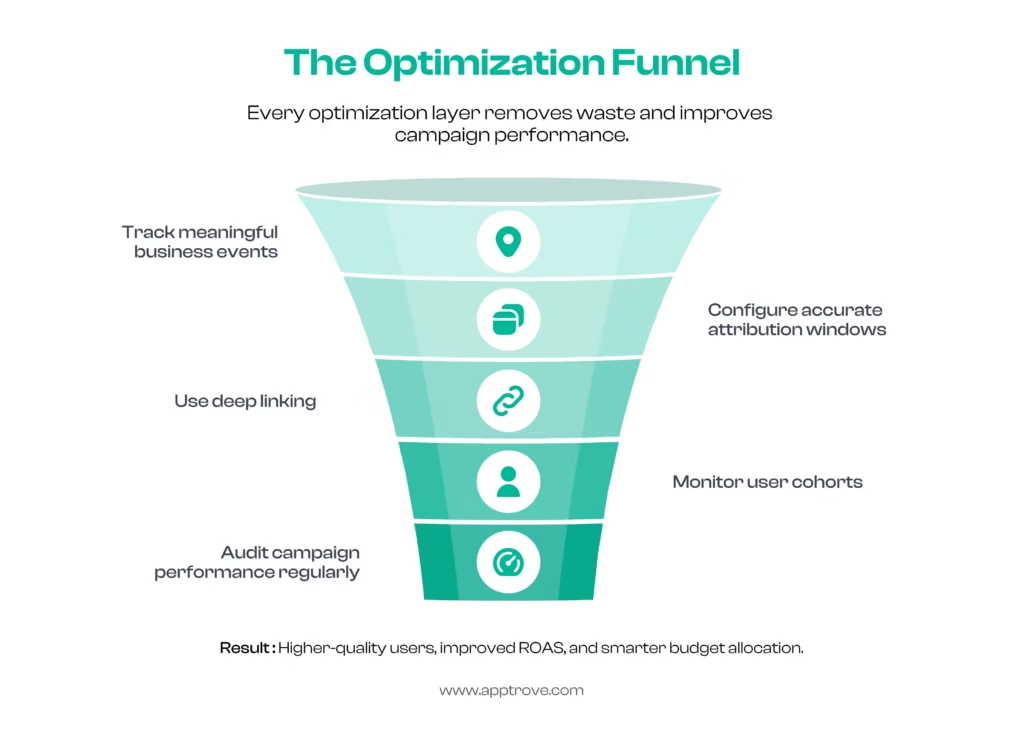
Track Business Events Instead of Vanity Metrics
Install and click metrics indicate how far a campaign has spread but do not signify the business’s success. Instead of paying attention to such indicators, monitoring occurrences within an app such as registrations, purchases, subscriptions, repeated sessions, and LTV metrics is much more effective in viewing business performance and measuring the efficiency of campaigns. In order to succeed in working with MMP advertising, it is important to consider business success rather than just the connection between marketing and business results.
Properly Configured Attribution Window
An attribution window is the length of the time in which an interaction can count as a conversion. Choosing the right window length is key to accurate campaign performance. If the window is too short, important conversions might be missed, whereas if it is too long, the total interactions made by the user might not be attributed properly. To ensure the correct interpretation of performance, the length of the attribution window should be discussed according to the app category, type of users, and sales cycle.
Use Deep Linking for Better Conversions
Each additional step between an advertisement and the desired response increases the risk of users abandoning. Deep linking brings the audience to particular content in the app, rather than just the app’s home page, making the experience much more customized and simple. With deferred deep linking, the experience may also be applied to new users, as they will still be able to reach the needed screen after downloading the app. The incorporation of deep links in advertising strategy for MMP is beneficial because it enhances user interaction with ads and minimizes the loss of users.
Analyzing Cohorts Instead of Particular Campaigns
Although a campaign can bring thousands of users, it may prove irrelevant as far as the long-term results are concerned. Cohort analysis is a method of grouping users with similar behaviours and keeping track of their actions over time. It thus allows marketers to see the reasons for attracting loyal users instead of focusing on the immediate success of a particular campaign only.
Audit Campaign Performance Regularly
Mobile advertising is a field that is always evolving, which means that you need to conduct performance evaluations regularly. Make sure that you schedule regular audits so you can assess the effectiveness of attribution, tracking of in-app events, conversion rates, audience engagement, effectiveness of creative messaging, and return on ad spend (ROAS). The regular review of performance data will help you identify any tracking issues, fraudulent behaviour, and explore new optimization possibilities before they affect your results.
How to Choose the Right Mobile Measurement Partner?
Attribution Accuracy
A Mobile Measurement Partner (MMP) should serve the main role of providing effective and dependable attribution; therefore, it is necessary to consider its importance in choosing an appropriate MMP. It is advisable to choose a service that ensures high accuracy of attribution, offers multiple methods of attribution and provides consistent measurement of campaigns across advertising channels. Reliable attribution guarantees the use of relevant data in decision-making processes.
Integrations with Other Services
An appropriate MMP should be equipped with necessary integrations with the ad platforms used by businesses. Whether running campaigns on social media platforms or using programmatic networks or affiliate channels, proper integrations would result in relevant and effective ad campaigns.
Analytics and Reporting
Google’s MMP allows you to transform raw data into actionable insights via comprehensive analytics. Select a platform that provides you with real-time dashboards, customizable reports, cohort analysis, in-app tracking and performance metrics (ROAS, retention, lifetime value). Having all your campaign data in one place can help you identify useful trends, compare channels, and efficiently optimize your marketing activities.
Privacy Compliance
As we witness changes in data privacy regulations, this resulting state of affairs would require MMP to also ensure privacy-driven measurements without compromising the visibility of the campaigns. The platform should be compatible with Apple’s App Tracking Transparency (ATT), SKAdNetwork (SKAN), and Android Privacy Sandbox. Compliance guarantees that the business can maintain its accuracy in attribution while respecting user consent and regulations.
Scalability
Your attribution needs will increase in line with your growing business. Make sure that the MMP you choose can grow from managing a few campaigns to managing numerous apps, countries, ad networks, and users. The scalable platform should be able to manage growing amounts of data without reducing the quality of reporting, accuracy of attribution, and level of operations, thus allowing your business to develop.
Customer Support and Simplicity of Integration
Grants and the most sophisticated MMP will still cause some problems if technical support is not good and implementation is difficult. That’s why it is better to find a solution that cares about its clients and offers complete manuals, customer support, SDK implementation support, and adaptability of API integration. A fast start means less time spent on setting up and fewer mistakes in implementation since marketing specialists will start to measure their activities.
Why Modern Marketers Choose Apptrove for MMP Advertising
Every business has its own distinct marketing objectives, yet the issues remain almost identical: accurate attribution, privacy compliance, campaign optimization, and profitability measurement. Apptrove is a contemporary mobile measurement partner (MMP), offering a solution for these issues by combining the functions of attribution, analytics, fraud prevention, and privacy-first measurement into one product. Apptrove does not replace marketing techniques; instead, it assists marketers in making more informed decisions using precise data.
A Unique Attribution System
Modern users navigate through various stages; their journey can include social networks and search engines, as well as OEMs, influencer campaigns, and programmatic advertising. With the help of Apptrove, attribution is unified: marketers can observe the results of their campaigns in a single source. This way, they no longer have to deal with fragmented reports and can find out what channels bring the greatest contribution to user acquisition and further growth.
Effective Analytics in Real Time
While optimising their campaigns, marketers need to receive insights on time. Apptrove enables them to have real-time reporting on the number of installations and events performed in apps, as well as retention, revenues, and customer lifetime value (LTV). Using this tool, marketers can adjust targeting in real time
Built-In Fraud Protection
The presence of illegal traffic is known to affect ad campaigns and budgets negatively. Apptrove uses tools to help discover false installations, spam clicks, injection clicks, and other malpractice from happening even before the attribution reports are compromised. Thus, the marketers receive cleaned data and can make smarter decisions based on what is happening with real users.
Ready for Privacy Measurement
Marketers now have to look for the technologies that will keep the balance of measurement and compliance given the fact that privacy regulations are changing the mobile advertising landscape. Apptrove supports privacy-based attribution, having implemented frameworks like Apple’s App Tracking Transparency (ATT), SKAdNetwork (SKAN), and Android’s privacy initiatives.
Manageable Integrations for Rapid Growth
Representatives of a mobile marketing platform (MMP) know that their solution should be integrated easily into the existing marketing ecosystem. Apptrove integrates with the leading advertising networks, analytics, and marketing tools, helping businesses to gather all of their campaign data without disturbing their work.
Conclusion
As the mobile advertisement landscape keeps changing, assessing the results of the campaigns is as crucial as developing the campaigns themselves. Through Mobile Measurement Partners (MMP), advertisers can track the sources of traffic to users, their behaviour inside the applications, and how effective their marketing effort is in terms of the return on investment. Replacing fragmented reports with consolidated information allows those businesses that utilise MMPs to make more educated decisions throughout the campaign process.
As marketers as well as consumers become more concerned with privacy, the process of obtaining the data also becomes more complicated. Methods introduced by the likes of Apple, such as App Tracking Transparency and SKAdNetwork, pose challenges for businesses, who will have to strike a balance between privacy and the effectiveness of measuring campaign results.
Ultimately, the right MMP service is not just important in terms of measuring the number of installations, but also ensures constant growth. MMPs help advertisers in most aspects of the advertising process, from improving the effectiveness of the campaigns and reducing the impact of ad fraud to offering great returns on advertising campaigns.
FAQs
1. What is MMP advertisement?
MMP advertisement is a technique of mobile app marketing that makes use of a Mobile Measurement Partner (MMP) to monitor and evaluate various mobile app advertising campaigns on various promotional platforms, helping companies figure out which advertisements result in downloads and conversions.
2. Why does MMP advertising matter to mobile marketers?
MMP advertisement is important because it allows marketers to have constant access to up-to-date information, preventing fraud in the advertising industry while measuring users’ actions after download and return on ad investments (ROAI).
3. How does MMP function?
MMP works by tracking strategies for meeting customers through the use of SDKs and links for attribution, thus connecting downloads with advertising campaigns used to promote the application.
4. What characteristics to look for in an MMP?
When looking for a partner in MMP, it is important to choose one that provides correct attribution, offers analytical functions, realizes deep linking, has mechanisms to fight fraud and operates in accordance with privacy regulations.