What is Linear Attribution?
Linear attribution is a process of measuring marketing effectiveness in which the credit for a conversion is given evenly to all relevant interactions that happen during the customer’s journey, and instead of assigning all credit to the first or the last activity in the process, linear attribution counts every relevant interaction leading to the conversion.
For instance, if a customer learns about a company because of an organic search result, reads a blog post, sees an ad on a social network, receives an email promoting a company’s product and finally purchases the product, then all five interactions will receive their share of the credit.
This method can tell a lot about the ways marketing channels participate in a conversion process, as it implies that customers often act with multiple marketing activities before making a decision.
Unlike other models, a linear attribution model does not imply that all interactions had the same degree of influence when it comes to the conversion, though it accepts that all relevant interactions have the same weight in this particular case.
How Does Linear Attribution Work?
To begin with Linear Attribution, you need to find out what touchpoints took place prior to any given conversion. The touchpoints can be any kind of advertisement like paid ads, or through organic search as well as through email connection, social media, content downloads, and webinars.
After the conversion path has been determined, using the Linear Attribution Model, we can assign The same amount of credit to each of the previously mentioned touchpoints.
Linear Attribution Formula is given by:
Credit earned per touchpoint = Total Conversion Credit / Number of Eligible Touchpoints.
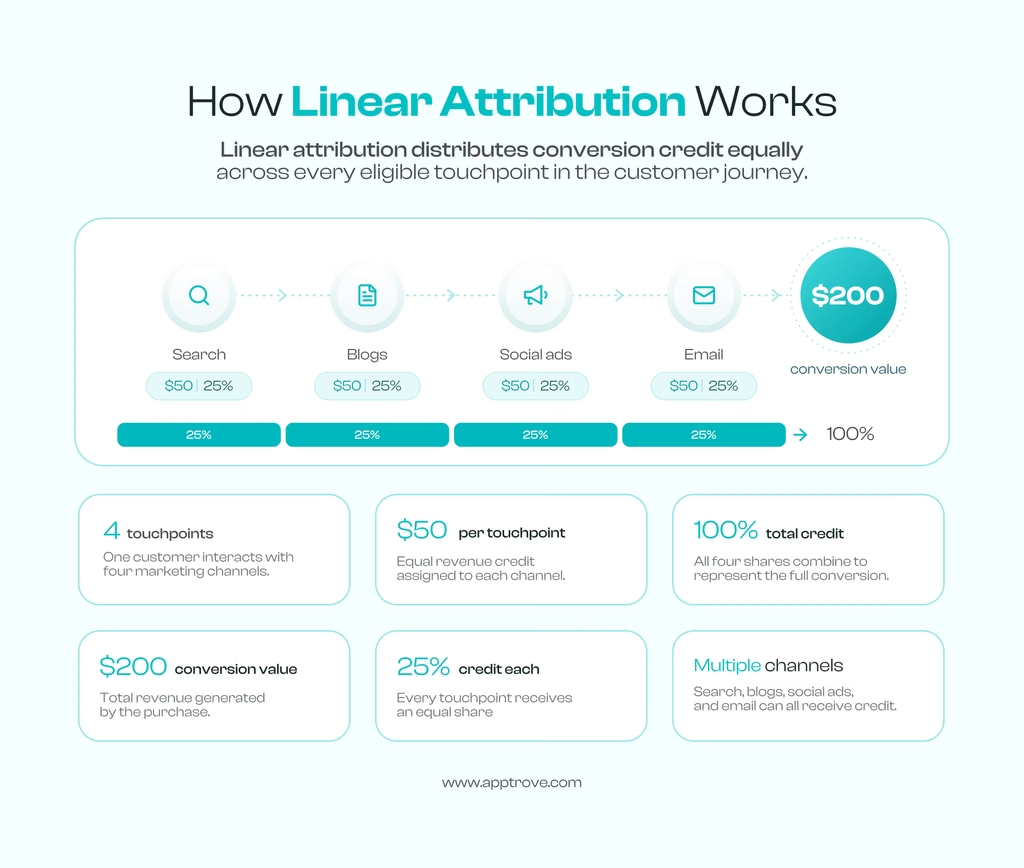
For example, the customer interacts with 4 different marketing methods to make a purchase. The total conversion value is 200 dollars and all four methods of marketing qualify.
Mathematically, Total conversion value = 200 dollars.
Number of touchpoints = 4.
Credit earned by each touchpoint = 200 / 4 = 50 dollars.
The contribution of each marketing method = 25 %.
Thus each marketing method gets $50 attributed to it.
It is important to note that this calculation, Applied equally in the case of conversions than in revenue. If one conversion emerges from 4 eligible touchpoints, then each is attributed with 0.25 conversion credit.
Example of a Customer Conversion Journey
Consider a B2B software company whose prospect completes a demo request after interacting with several campaigns.
| Touchpoint | Interaction | Attributed credit |
| 1 | Organic search visit | 20% |
| 2 | Educational blog | 20% |
| 3 | LinkedIn advertisement | 20% |
| 4 | Email campaign | 20% |
| 5 | Product webinar | 20% |
| Total | Five touchpoints | 100% |
In this case, the linear attribution model assigns credit equally to all five of the interactions that have occurred. The attribution model does not differentiate between actions that brought about awareness and trust, or the ones that prompted consumers to request a demo. Rather, the attribution model merely assigns equal credit for any conversion across the entire process.
Why is Linear Attribution Important?
1. Takes into Account Multiple Touchpoints
Customers hardly ever take the very same path when converting. One customer will find a brand thanks to a search, while others will stumble upon it through social media or word of mouth.
Linear attribution allows companies to analyze these varied encounters and evaluate their performance simultaneously. Instead of concentrating solely on the last click, marketers are given the chance to look at different channels used to reach conversion goals.
This general perspective is highly beneficial, as it allows marketers to come up with marketing campaigns that target potential customers multiple times with the help of information, products or promotions necessary for making the final decision.
2. Makes Possible Cross-Channel Advertising Analysis
Marketing campaigns use various media, including search, paid media, email, social networks, webinars, and website content. A linear attribution method enables an organization to equally allocate credit and thus helps the organization identify the communication channels most likely to lead to conversion even if these channels themselves do not generate final clicks.
However, the credits assigned should not be interpreted as a reason to ascertain that a certain channel has caused a conversion and other pieces of evidence such as A/B experiments or incremental lift analysis might be necessary to determine the cause of conversion.
3. Increases the Quality of Marketing Budget Discussions
Budget decisions must be intelligent and based on the analysis of the entire conversion path rather than just relying on some single event. Some channels might not convert very often but are present many times in paths leading to leads or completed sales.
Linear attribution assists in understanding this involvement and supporting budget discussions. However, it is vital for marketers to see if revenues attributed to certain channels fit with expenses, profit margins, etc.
Unlike models that use complex algorithms or different weights for particular interactions, this method applies a consistent rule across the selected conversion path.
A Broader View of Marketing Contributions
A linear attribution system minimizes the role of a particular engagement. It allows marketers to learn about the overall effect of campaigns running awareness, consideration, and conversion phases.
This method can be especially beneficial for firms that use content marketing and email drip campaigns, paid advertising, and various events to achieve their objectives.
Benign to long buying cycles
In cases with B2B software services or high-consideration purchases, it can take multiple engagements prior to making a decision. Potential consumers can study a problem, learn about vendors, take part in a webinar, collaborate with peers, and request demonstrations.
The linear attribution method enables making an account of the critical touchpoints on these extended journeys.
Easy to compare across campaigns
As long as the same measuring principle is employed, marketers are able to compare the conversion paths in other campaigns, channels, or audience quadrants.
Comparison data is exceptionally helpful for those marketers who stick to the same definitions of touchpoints, conversion events, identity resolution, and attribution windows.
Limitations of Linear Attribution
It Presumes Uniform Influence
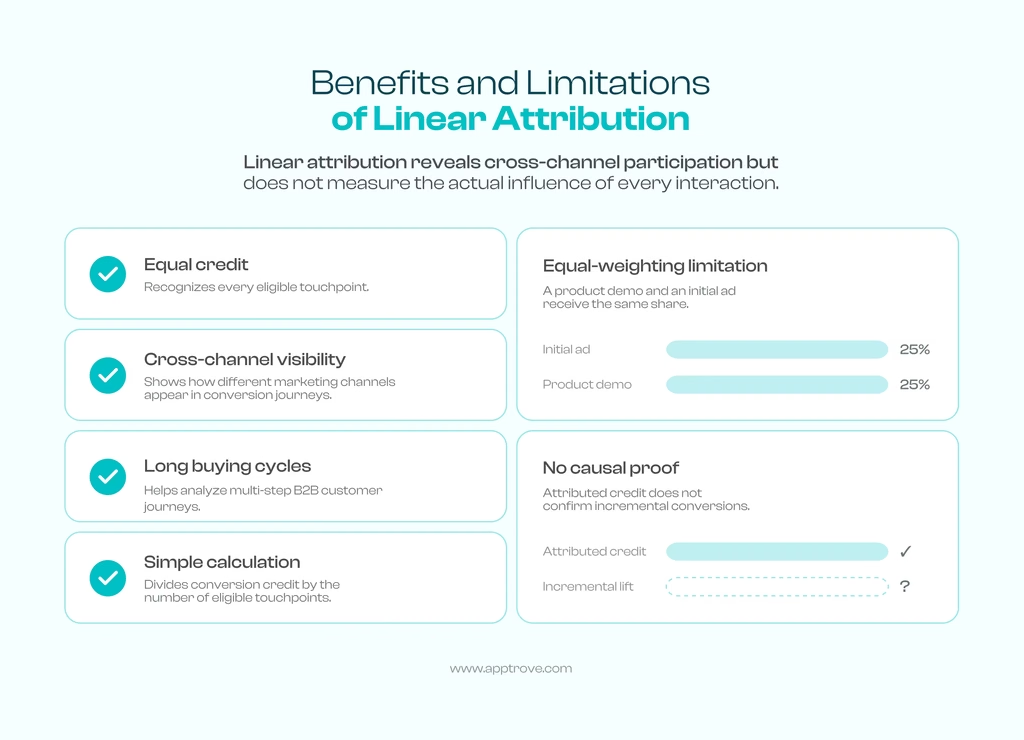
One of the drawbacks of linear attribution is that it operates under the premise that any touchpoint can be ascribed an equal amount of credit. In real life, some touchpoints might be more critical than others.
For instance, a product demo could address the specific concerns of a customer, whereas the first advertisement may have simply attracted that customer’s attention. Therefore, overlooking the difference in how important touchpoints were in a customer’s decision process may result in incorrect assumptions regarding the influence of interactions.
It Fails to Show Causality
The presence of a touchpoint in the conversion path does not imply that it was instrumental in the conversion. The customer could have bought the product even without a specific advertising campaign.
Linear attribution relies on credits being given according to a certain formula rather than conducting a cause-and-effect analysis. Thus, companies shouldn’t treat the measured conversions as genuine incremental conversions.
It Relies on Accurate Tracking
The effectiveness of conversion tracking can be compromised due to lost touchpoints, duplicated events, inconsistent identifiers for campaigns, and broken identities in the course of interactions. If a customer uses one device to do research and
The Overinflation of Unimportant Touchpoints
The customer might visit several pages before converting. If every interaction is regarded as equal, channels which yield many low-value touchpoints will seem more effective than they really are. The teams should be careful to decide on meaningful touchpoints and contrast attribution data with the conversion quality, client behavior, and results of the business.
How to Implement Linear Attribution
Step 1: Outline Conversion
Identify what is being measured. The measurement could involve purchases, demo requests, qualified lead generation, subscriptions, or app installations based on the nature of the business.
Ensure the same definition is used consistently so that the findings would be comparable in the future.
Step 2: Find Relevant Touchpoints
Items that qualify for the purpose of attribution analysis should be enlisted. Such activities as ad clicks, emails, content engagements, advertising, or events can be included.
Clarify whether the inclusive model will take into consideration impressions, direct visits, repeat actions, etc. Different inclusion rules may produce different results.
Step 3: Determine Attribution Timeframe
Decide on a time point for determining backward for the achievement of conversion. Short timeframes can omit the very first stages of making a purchase whereas lengthy ones might include irrelevant actions.
Exactly how far the timeframe should extend will determine the type of purchase cycle and relevant conversion being measured.
Step 4: Set Up Conversion Tracking
Make sure to use identical parameters, event names, timestamps, id numbers for every campaign. Moreover, check that the conversions are being correctly counted and assigned to the right transformation.
Step 5: Calculate and Review Credit
To determine the average conversion credit per touchpoint, businesses should divide the total conversion credit by the number of eligible touchpoints. It is also advisable to analyze the results by campaign, audience, channel, and conversion type before evaluating the preliminary findings against spending, conversion rates, lead quality, and revenue. All in all, attribution must serve a purpose of informing performance measurement instead of replacing it.
When to Utilize Linear Attribution
Linear attribution is beneficial when businesses are seeking to have a clear understanding of the way multiple channels contribute to conversion processes. This type of attribution may be suitable for evaluations of content marketing, e-mail nurturing, paid media, or event campaigns, where in most cases such conversions consist of multiple interactions.
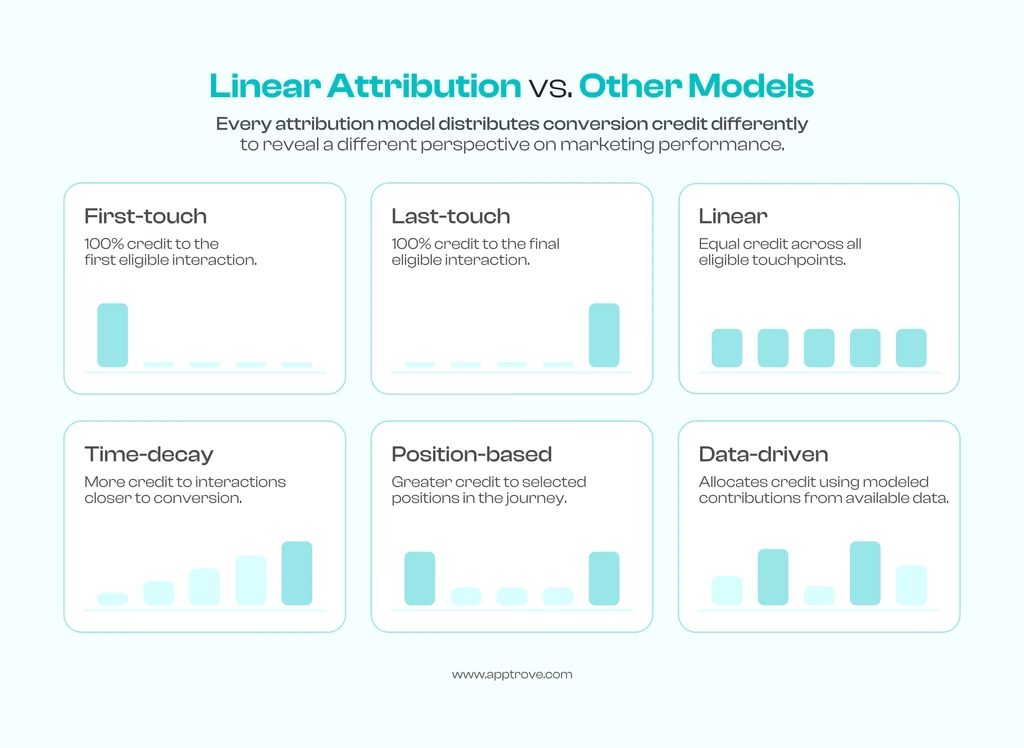
It can also be utilized for comparison purposes, allowing teams to form comparisons with results produced by first touch, last touch, or data-driven models, and analyze how various models affect the performance results.
At the same time, it has to be mentioned that linear attribution can be inappropriate where the main objective is to determine the most influential interaction or figure out the incremental impact.
The significance of tools use cannot be underrated. Google Analytics 4 has excluded linear attribution from its in November 2023, while allowing data-driven and last-click. Despite this development, companies can still work with linear attribution via third-party platforms equipped with primary functionality or analytic systems.
Conclusion
Linear attribution is a clear way of allocating credit for the transaction benefits among different boundaries of customer interaction. By assigning equal weight to all transitions involved in the process, marketing specialists are able to research the role played by the channels of promotion in the transaction process without putting undue weight on either the first or the last transition in the picture.
Simplicity, however, is the main drawback of linear attribution method. Just because the weight is equal, it does not mean that the effects are of equal importance. The methodology has to be followed strictly based on the method of measuring outcomes and needs the results to be interpreted correctly. In case the business process is complicated, linear attribution can be used as a crucial tool for analysis if applied together with thorough investigation and industry experiments.
FAQs
1. What is linear attribution in marketing?
Linear attribution is a model that distributes conversion credit equally among all eligible touchpoints recorded in a customer’s journey before conversion.
2. How is linear attribution calculated?
Divide the total conversion credit by the number of eligible touchpoints. If a conversion includes four qualifying interactions, each receives 25% of the credit.
3. What is the main advantage of linear attribution?
Its main advantage is simplicity. It recognizes multiple interactions and provides a transparent way to review channel participation across a conversion path.
4. What is the biggest limitation of linear attribution?
It assumes that every eligible interaction contributes equally, even though some touchpoints may have a greater influence on a customer’s decision than others.
5. Is linear attribution available in Google Analytics 4?
No. Google Analytics 4 removed linear attribution from its selectable reporting models in November 2023. Businesses can explore alternative models or use compatible external analytics and reporting solutions.