
Mobile marketing has revolutionised how brands acquire customers. Users see ads, click on them, download an app, try out your product and maybe convert into a paying customer. However, the reality is that there are complicated processes in place to ensure this happens with marketers, publishers, ad networks, measurement platforms, apps, devices, operating systems and billions of individual interactions.
Money always makes people want to cheat the system.
With almost all actions capable of generating revenue, fraud has become a huge issue. Whether it be clicks, installs, sign-ups or purchases, fraudsters have numerous opportunities to create fake, yet seemingly legitimate, activities that will drain your marketing budget.
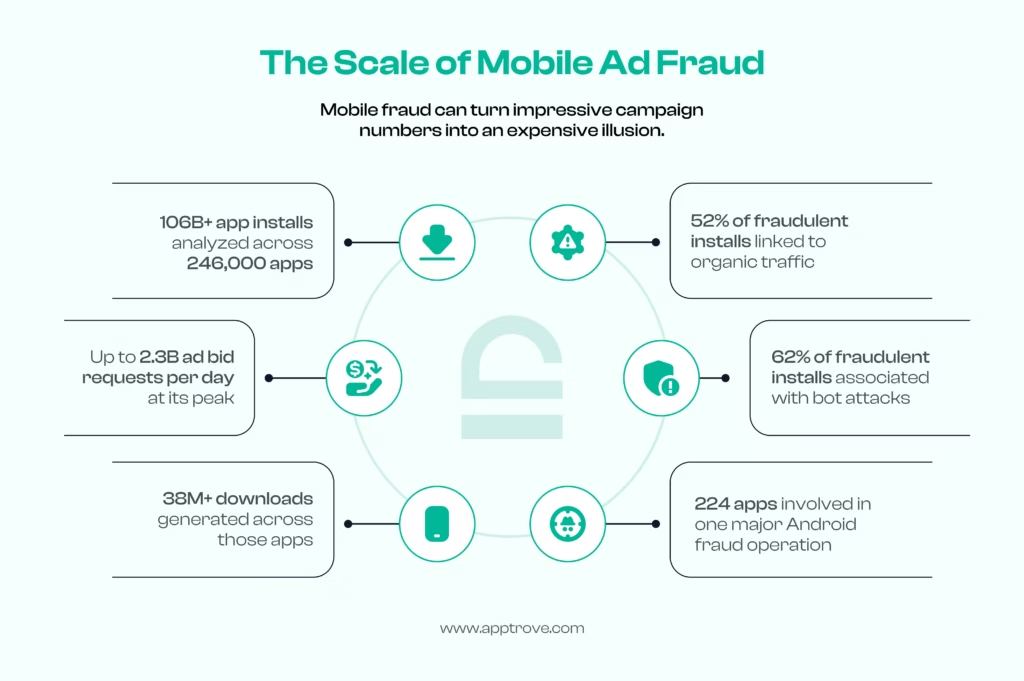
Industry analysis has shown us that fraud can happen across vast quantities of data. With over 106 billion app installs analysed across 246,000 apps, they have shown how prevalent fraud can be. In one large analysis, 52% of fraudulent installs came from organic sources.
Modern anti-fraud solutions work to ensure your marketing data remains clean, you can attribute correctly, you aren’t wasting budget, identify fraudulent activities and understand what is truly bringing value to your marketing.
Whilst having 1 million installs can sound great, if most of your users aren’t behaving as real customers then it means very little.
What Is Anti-Fraud?
Anti-fraud is the technologies, processes, systems and strategies used to identify, prevent, detect and reduce fraudulent activity. Within mobile marketing it ensures your advertising and measurement are protected.
There are numerous ways fraud can occur throughout the customer journey. Fake impressions, clicks, installations, false attribution, signups, fake in-app events and even fake purchases can all occur.Whilst they may differ in how they occur, the main aim is to create fake valuable user activity.
They’re basically trying to create fake traffic. Much like fake currency, they’re trying to create fake customers.
Why Anti-Fraud Matters in Mobile Marketing
Let’s say you have spent $100,000 on mobile user acquisition. Your dashboard shows millions of impressions, hundreds of thousands of clicks, tens of thousands of installs and a great CPA. So far so good.
Imagine finding out that a significant portion of this traffic was coming from bots, device farms, click farms and false attribution.
The biggest problem with advertising fraud is that it can make it look like you are doing incredibly well. Whether it be increasing your installs by creating fake installs, increasing conversions by creating fake conversions, misleading your attribution or making certain advertising partners look more effective.
Not only will you be wasting money, fraud can affect your decisions going forwards. You may increase budget on fraudulent sources, reduce budget on valid sources, create incorrect audience segments or make incorrect assumptions.
As they say, “Garbage in, garbage out.” Once fraud has entered your marketing data, your decisions won’t be reliable.
Why Is Mobile Advertising Vulnerable to Fraud?
Mobile advertising is one of the most appealing areas for fraudsters. Due to the sheer volume of data being created on billions of devices and numerous companies and technologies involved in tracking and attributing.
This creates plenty of opportunity for fraud to occur.
The Scale of Mobile Advertising
There is an incredible amount of activity within mobile advertising. Every second there are ads being shown, clicked, loaded, interacted with and attributed across thousands of apps and websites.
Humans simply can’t manually check this traffic.
Fraudsters know this. By using automation they can create vast amounts of activity. Whether it be bots creating clicks, scripts creating events, device farms creating users or sophisticated systems imitating human behaviour.
In one large Android fraud scheme there were 224 apps involved with over 38 million downloads and up to 2.3 billion ad bids per day.
This shows you the issue. Fraud is no longer being done by a few people clicking on ads repeatedly. It can be a fully automated industrial process.
Financial Incentives Drive Fraud
It’s simple, if you’re paying for clicks then they have value. If you’re paying for installs then they have value. If you’re getting a higher commission for conversions then the incentive to create fake conversions increases.
The higher the value of the customer acquisition the more appealing it is to fraudsters.
This is especially true for industries with a high LTV. A fraudster doesn’t need to steal a huge amount from each campaign. By manipulating thousands or millions of events across the ecosystem they can gain a huge amount of value. Fraud isn’t random noise, it is a business model.
Common Types of Mobile Ad Fraud
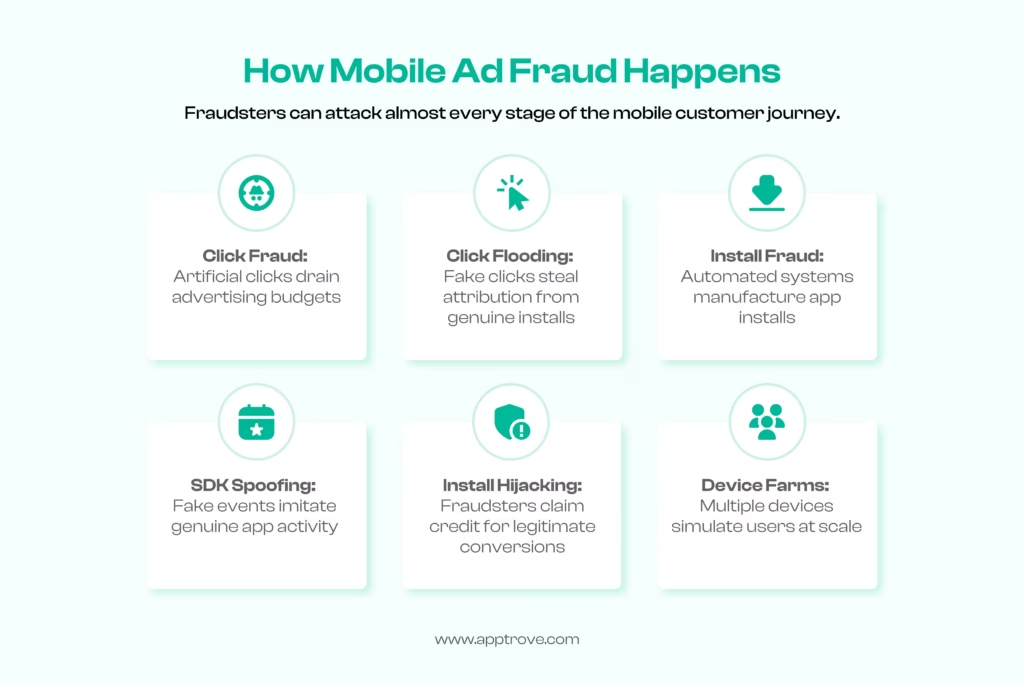
There isn’t one universal formula for fraud. There are numerous ways fraud can occur throughout the mobile advertising and attribution. Knowing what they are can help you understand why simply looking at installs isn’t enough to know if your campaign is good.
Click Fraud
Click fraud is when ads are clicked on unnaturally. This could be through bots, scripts, infected devices or even coordinated humans.
This can cause immediate issues with you paying for traffic that has no real value. However, there are secondary issues.
Advertising platforms will look at signals to optimise your campaign. If your clicks are coming from a source that looks like they are performing well due to the fraudulent clicks, your algorithms will think they are valuable and give them more budget.
Click Flooding
Click flooding is a more subtle form of fraud. Whilst the end user could be completely genuine, fraudsters will create a large amount of clicks and wait for genuine users to install. If your attribution looks at the last eligible click then the install could be attributed to the fraudulent source.
What’s interesting to note is that there is nothing to indicate that the end customer is fake. The user is genuine and they installed. The issue is with the attribution. This is why it is so important to look at attribution.
Install Fraud
Install fraud is when fake installs are created to generate a payout. Fraudsters may use automation, emulators, scripts or large groups of devices to create fake installs.
The issue becomes more complex when they also create fake events. The device may instal the app, open it, complete fake actions and create a journey that looks genuine.
SDK Spoofing
SDK spoofing attacks the measurement. The fraudster will attempt to mimic the signals that would be sent from an app’s SDK. Instead of genuine installs and journeys happening, fake signals are created.
This can look genuine within your attribution. This is why it is important to have advanced anti-fraud solutions.
Install Hijacking
Install hijacking tries to take credit for genuine installs. Instead of creating fake journeys, the fraudster will attempt to hijack or manipulate the attribution to give them credit for users they haven’t acquired.
This can be very costly for marketers. The fraudulent source may look like they are providing high quality users. If they’re performing well in your performance report then you may increase your budgets. This can allow fraud to continue.
Device Farms
Device farms use a large amount of physical or virtual devices. Each device could look like they are representing a different customer. This allows fraudulent activity to be created.
They can be used for installs, clicks, signups, reviews, engagement and more.
Whilst an individual device may not look suspicious, with thousands of devices doing similar things it can be easily spotted.
Bot Fraud
Bots can create activity at an incredible scale. In one large analysis 62% of fraudulent installs were linked to bot attacks.
Older bots tended to be very predictable and easy to spot. Modern bots can be highly advanced. They can mimic human timing, create fake interactions, create seemingly unique activity and adjust their behaviour to avoid being caught out.
The more human like fraudulent activity is, the more behavioural analysis becomes important.
How Does Mobile Anti-Fraud Work?
Anti-fraud within mobile marketing isn’t just a simple box to tick. It works as a multi-layered solution looking for numerous signals.
A strong solution may look at real time detection, behavioural analysis, device intelligence, attribution validation, anomaly detection and post install.
Real-Time Fraud Detection
Real-time detection focuses on identifying suspicious activity as it happens. It can look at signals from clicks, installs, devices, times, IPs, campaigns, publishers and behaviour. If certain thresholds are reached then the activity can be blocked, rejected, flagged or excluded. It’s important to detect this quickly.
If you’re detecting fraud weeks after your campaign has finished then you’ve already spent your money and allowed your data to be polluted. Real time detection can ensure suspicious activity is picked up before it affects your campaign.
Behavioural Analysis
Fraud often has behavioural clues. A genuine user may browse an app, look around a few features, pause, come back later, search for products and eventually make a purchase. Whereas fraudulent activity may have odd patterns, repeated patterns, identical patterns, impossible timings, excessive activity or no meaningful engagement.
This looks at behaviour. Whilst a click or install may look genuine, looking at the behaviour can show you something isn’t right.
Device And Network Signals
Looking at device and network signals can help detect fraud. Anti-fraud may look at device details, OS information, emulator signs, IP behaviour, repeated patterns and more.
However, no individual signal should automatically indicate that the interaction is fraudulent. Having the same IP address doesn’t necessarily mean you have multiple users being fraudulent. Public networks, offices, universities and households will naturally have multiple users.
Attribution Validation
Attribution is one of the most important areas to look at when trying to prevent fraud. It determines what source gets credit for installs or conversions.
Anti-fraud can look at whether the interaction actually happened, whether it makes sense and whether the source had a genuine role in creating the conversion.
You want to ensure you’re giving the right source credit.
Post-Install Detection
Fraud may not stop once the app has been installed.
Sometimes the suspicious activity can only be seen after install. The fraudulent source may have created thousands of installs but almost no meaningful sessions. Or may have created signups that don’t lead to any real engagement. Or may have strange purchasing patterns.
By looking at post install behaviour you can see if the users are actually behaving like customers.
This is crucial as you can see the true quality of your acquisition source.
The Role of Machine Learning in Anti-Fraud
Fraudsters are constantly evolving, meaning it can be difficult to keep up with static rules. Machine learning can help analyse large amounts of historical and real time data to pick up patterns.
Anomaly Detection
Machine learning can help detect what normal behaviour looks like for your campaigns. If suddenly one source starts getting thousands of installs but retention and revenue are extremely low.
This can act as a red flag. Whilst it may not be picking up on any obvious fraudulent activity, it can pick up that the pattern doesn’t fit with normal customer behaviour.
Pattern Detection
Machine learning can look at numerous signals to understand the relationship between them. Device, IP, times, publishers, attribution events, engagement and post install.
This can move away from simple rules based approaches.
Instead of asking ‘does this event match a known fraud rule?’ it can ask ‘how similar is this behaviour compared to previous patterns associated with fraud?’.
Adapting to New Techniques
Fraud evolves because fraudsters adapt. Often, when one type of fraud becomes harder to exploit, another type arises. Using machine learning can help identify new patterns that may not have been specifically coded.
The future of mobile fraud will rely on being able to detect known fraud and behaviour that looks like it could be the start of a new pattern.
Building an Anti-Fraud Strategy That Actually Protects Mobile Growth
Having fraud detection is only useful if it helps you make better decisions. Whilst it is important to know if you have suspicious traffic, a strong anti-fraud strategy will ensure you’re preventing fraud where possible, detecting suspicious activity quickly, understanding the impact and constantly improving.
Due to the scale of the issue this is becoming increasingly important. Recent industry analysis has shown that across over 100 billion app installs (over 246,000 apps) fraud is constantly moving between channels. Invalid traffic rates have been recorded at nearly 29% for mobile app inventory in some recent benchmarks. This means you can’t assume that high volume traffic in mobile will be high quality.
The good news is that there are things you can do as a marketer. By using the right combination of data, technology, monitoring and process you can make it much harder for fraud to happen.
Anti-Fraud vs. Fraud Prevention
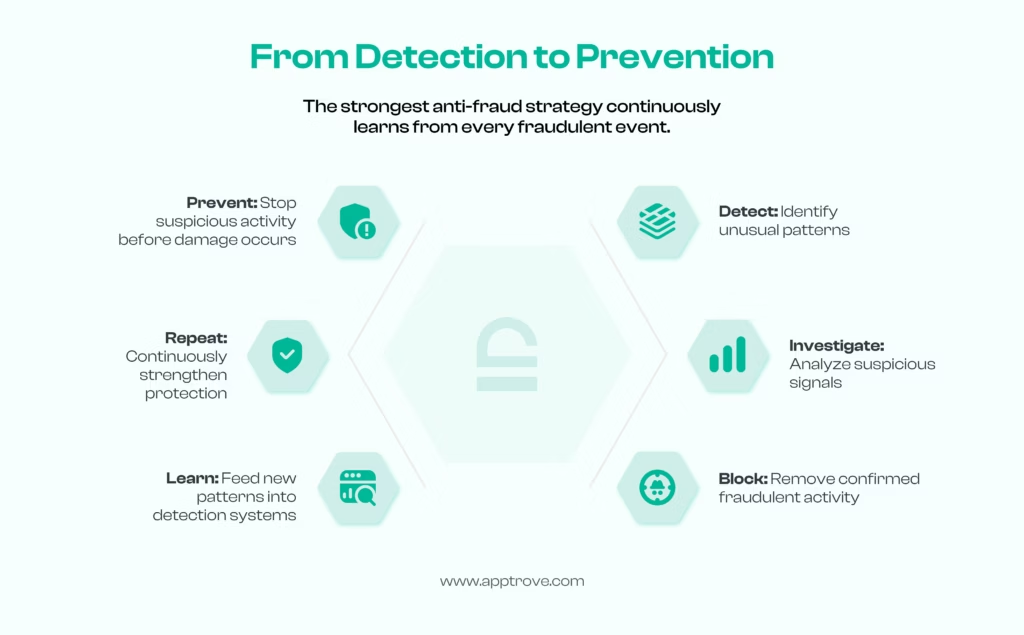
Many people use the terms anti-fraud and fraud prevention interchangeably. Fraud prevention looks at preventing suspicious activity from occurring. Fraud detection looks for activity that has occurred or is currently occurring. Fraud mitigation looks at reducing the impact once fraud has been identified. A mature strategy will utilise all three. It is impossible to prevent everything, unrealistic to detect everything instantly and expensive to ignore confirmed fraud.
Prevention
This is your first line of defence. You may have validation, vetting processes, campaign controls, authentications, device intelligence and real-time blocking. The aim is to make it hard for fraud to occur. This is especially important within mobile advertising as every piece of fraudulent activity could affect not only your current campaign but also your algorithms and decisions going forward.
Detection
Despite having strong prevention processes some fraud will still occur. Detection looks at behavioural patterns, attribution, device, network, conversion quality and campaign anomalies to determine if the traffic looks suspicious. A good way to think about this is whilst prevention asks ‘can we prevent this?’, detection asks ‘if this happened, can we identify it?’.
Mitigation
Once fraud has been confirmed mitigation becomes the priority. You may need to exclude invalid events, reject fraudulent attribution, investigate affected partners and adjust budgets on campaigns. In some cases you may also want to pursue refunds. Once you’ve completed this you should feed the information back into your detection so you can easily identify this pattern in the future.
How Fraud Impacts Marketing Performance
Fraud does not simply take money from an advertising budget. It can quietly damage the entire decision-making system surrounding that budget. This is what makes it particularly dangerous.
Inflated Acquisition Numbers
Fake installs can make a campaign appear dramatically more successful than it really is. A marketer may see a low cost per install and assume that the campaign is efficient, but that calculation becomes meaningless if a significant percentage of the installs are fraudulent. The actual cost of acquiring a genuine customer could be several times higher.
The same problem applies to clicks. A high click-through rate may initially look like a sign of strong creative performance, but if those clicks are generated by bots or click farms, the metric provides little insight into actual customer interest.
Distorted Attribution
Attribution is designed to answer a critical question: which marketing source contributed to the conversion? Fraudsters know how valuable that answer is, which makes attribution a major target.
Imagine a user discovers an app organically, searches for it, installs it, and becomes a paying customer. If a fraudulent source manages to insert itself into the attribution chain and claim credit for that install, the advertiser may end up paying for a conversion it never actually generated.
The financial loss is only part of the problem. The bigger issue is what happens next. If the marketer sees that source delivering conversions, they may increase its budget. Fraudulent attribution can therefore influence future spending decisions and create an artificial growth loop.
Corrupted Customer Data
Fraudulent users can also contaminate customer intelligence. Marketing teams increasingly depend on behavioral data to build segments, personalize experiences, predict churn, calculate customer lifetime value, and optimize campaigns. If artificial users enter those datasets, the models begin learning from behavior that does not represent genuine customers.
That can create surprisingly subtle problems. A campaign might appear to have attracted users with a particular engagement pattern, when in reality that pattern was generated by automated activity. Marketers may then design future campaigns around a behavior that does not actually exist among their customers.
Wasted Advertising Spend
The most obvious impact of fraud is wasted money. Estimates vary significantly by methodology and market, but industry research has placed global ad-fraud losses in the tens of billions of dollars annually, while some estimates put fraudulent activity at more than one-fifth of digital advertising spend in certain measurements.
The important point is not one universal fraud number. Fraud levels vary dramatically by channel, geography, format, traffic source, and methodology. The important point is that even a relatively small percentage can become financially significant when applied to a large advertising budget.
That is why anti-fraud should be viewed as both a financial protection mechanism and a data-quality function.
Anti-Fraud Best Practices for Mobile Marketers
A strong anti-fraud strategy does not require marketers to become cybersecurity experts. It requires them to ask better questions about the quality of their acquisition data and establish processes that make suspicious behavior easier to identify.
Monitor Beyond Installs
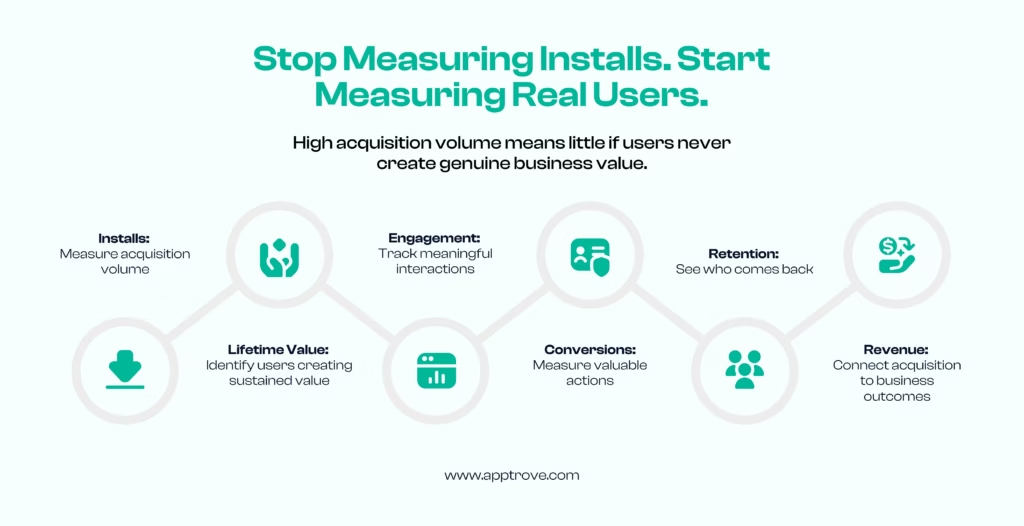
An install is only the beginning of the customer journey. Instead of evaluating acquisition sources purely on install volume, examine what those users do afterward.
Look at registration rates, sessions, engagement, purchases, retention, subscription activity, and revenue. A source that generates 100,000 installs but produces almost no meaningful post-install activity should immediately raise questions.
The same principle applies to every performance metric. Volume tells you how much happened. Quality tells you whether it mattered.
Establish Performance Baselines
An anomaly cannot be identified without a baseline.
Establish normal ranges for important metrics such as click-to-install rate, install-to-registration rate, registration-to-purchase rate, retention, average session behavior, and revenue per user. Once those patterns are established, unusual changes become easier to spot.
For example, if a source normally generates a 5% install-to-purchase rate and suddenly produces 50,000 installs with almost zero purchases, that discrepancy deserves investigation. It does not automatically prove fraud, but it is a strong reason to look closer.
Watch for Sudden Spikes
Fraud frequently creates unnatural bursts of activity. A sudden increase in clicks, installs, conversions, or post-install events from one publisher, campaign, device cluster, or geographic region should be examined.
However, marketers should avoid treating every spike as fraud. Successful campaigns can create genuine spikes too. The question is whether the increase is supported by normal customer behavior.
A legitimate campaign spike may bring more users, engagement, purchases, and revenue. A fraudulent spike may bring huge volumes of activity with strangely weak downstream behavior.
Use Multiple Fraud Signals
One of the biggest mistakes marketers can make is relying on a single indicator.
A shared IP address does not automatically mean fraud. An unusual device does not automatically mean fraud. A high click rate does not automatically mean fraud.
But when multiple suspicious signals appear together, the probability becomes more meaningful.
A strong anti-fraud system may combine device information, attribution data, behavioral patterns, timestamps, network signals, conversion quality, and post-install activity. The more complete the picture becomes, the easier it is to distinguish genuine anomalies from fraudulent behavior.
Evaluate Partners Regularly
Fraud can enter through advertising networks, publishers, affiliates, agencies, and other intermediaries. Partner evaluation should therefore be an ongoing process rather than something that happens only when a campaign goes wrong.
Look for sudden changes in traffic quality, unusual conversion patterns, suspicious geographic distribution, unexplained volume increases, and differences between reported performance and downstream business outcomes.
A partner delivering 50,000 installs is not necessarily better than one delivering 10,000. The real question is which partner delivers more valuable, retained, revenue-generating users.
Separate Volume From Quality
High volume can be seductive.
Large numbers look good in presentations. They make dashboards feel healthy. They create the impression that growth is accelerating.
But acquisition volume without customer quality can become an expensive illusion.
A campaign producing 20,000 genuine users with strong retention and revenue may be considerably more valuable than one producing 100,000 low-quality or fraudulent installs.
That is why metrics such as retention, customer lifetime value, revenue per user, and return on advertising spend should sit alongside acquisition metrics.
How AI Is Changing Anti-Fraud
Artificial intelligence is creating an interesting paradox in the fraud ecosystem. The same technology that allows marketers to identify suspicious patterns can also help fraudsters create more convincing artificial activity.
Automation has already made fraud faster and more scalable. AI can potentially make it more adaptive.
AI-Powered Fraud Detection
Machine learning can process enormous volumes of data much faster than human teams. Instead of manually examining millions of interactions, models can identify patterns across devices, campaigns, publishers, timestamps, locations, and user journeys.
This makes it possible to detect subtle relationships that may otherwise remain hidden.
For example, a single device may appear normal. A single click may appear normal. A single installation may appear normal. But when the behavior of thousands of related events is analyzed together, a pattern may emerge.
Predictive Fraud Detection
Traditional detection often asks whether an event is fraudulent.
Predictive systems can go one step further by asking whether an event is likely to become fraudulent or suspicious.
That creates an opportunity to intervene earlier. Instead of waiting for a campaign to accumulate enough evidence to prove fraud, systems can assign risk scores and prioritize questionable activity for further investigation.
AI-Powered Fraud Attacks
The defensive side is only half the story.
AI-powered automation can help fraudsters generate content, create accounts, simulate interactions, modify behavior, and adapt their techniques. Recent bot research has shown how automation is becoming easier to deploy, with simple high-volume attacks accounting for a growing share of bot activity.
That means anti-fraud systems cannot remain static.
As attackers become more adaptive, defensive systems need to become more adaptive too.
Anti-Fraud and Privacy
Fraud detection requires data, but more data does not automatically mean better protection.
Mobile marketers need to strike a balance between effective fraud detection and responsible data handling.
Collect Relevant Signals
The objective should be to collect the signals necessary to understand whether an interaction is legitimate, rather than collecting every possible piece of information.
Relevant signals can include behavioral, device, attribution, and campaign-level information, depending on the specific use case and applicable privacy requirements.
Protect Customer Information
Fraud detection systems can contain valuable information, which means access controls, security practices, retention policies, and governance become important.
A company should know what information it collects, why it collects it, who can access it, and how long it needs to retain it.
Fraud prevention should strengthen customer trust, not become an excuse to ignore it.
Avoid False Positives
There is another side to aggressive fraud detection: legitimate users can sometimes look unusual.
A traveler may suddenly log in from another country. A family may share a network. A business may have hundreds of users behind one IP address. A new customer may behave differently from the average customer.
If an anti-fraud system blocks every unusual event, it can end up hurting genuine customers. The objective is therefore not to eliminate every anomaly. It is to identify meaningful patterns of suspicious behavior while minimizing false positives.
The Future of Anti-Fraud
Mobile fraud is unlikely to disappear. The economics are simply too attractive, and the advertising ecosystem continues to grow.
What will change is the sophistication of the fight.
Recent industry analysis has examined more than 100 billion installs across more than 246,000 apps, showing just how much data is now available to study the movement of fraudulent activity. At the same time, mobile-app advertising has recorded invalid-traffic rates around 29% in some recent global benchmarks, reinforcing the need for continuous monitoring.
Real-Time Detection Will Become the Standard
Waiting until the end of a campaign to identify fraud wastes both money and data.
Real-time detection will become increasingly important because marketers need to stop suspicious activity before it influences campaign optimization.
The faster a system can identify a pattern, the smaller the potential damage.
Predictive Fraud Detection Will Grow
The next evolution will be moving from reactive detection toward prediction.
Instead of simply saying, “This event looks fraudulent,” systems will increasingly estimate the likelihood that an event, source, device, or user journey is suspicious.
This will allow marketers to prioritize investigations and potentially stop problematic traffic before it scales.
Cross-Channel Intelligence Will Matter More
Fraud does not respect marketing-channel boundaries.
A fraudulent operation may interact with advertising networks, apps, websites, attribution systems, and affiliate platforms simultaneously.
That means the strongest defences will increasingly connect signals across the entire customer journey instead of examining every channel in isolation.
Customer Quality Will Become the Real KPI
For years, mobile marketing has celebrated installs, clicks, and conversions.
The future will increasingly focus on what happens after those events. Did the user return? Did they engage? Did they purchase? Did they subscribe? Did they remain active? Did they generate revenue?
These questions are much harder for fraudulent traffic to answer convincingly.
How Businesses Can Build a Strong Anti-Fraud Framework
Building a robust anti-fraud strategy does not mean implementing every possible technology at once. The better approach is to create a structured framework that grows with the business.
Start by mapping the entire acquisition journey, from impression and click through installation, onboarding, engagement, conversion, and retention. Identify where money changes hands and where attribution is assigned. Those are often the areas where fraud can create the greatest financial impact.
Next, define the signals that matter at each stage. For acquisition, this might include click quality and install patterns. For engagement, it could include session behavior and event sequences. For conversion, it might include purchase patterns and revenue quality. Looking at the entire funnel makes it easier to distinguish isolated anomalies from coordinated manipulation.
The next step is establishing clear thresholds and investigation processes. Not every suspicious event needs to be blocked immediately. Some should be monitored, some should be investigated, and some should be rejected automatically. A tiered approach can reduce false positives while still allowing marketers to respond quickly to serious threats.
Finally, treat every confirmed fraud incident as a learning opportunity. Document what happened, identify which signals could have exposed it earlier, and update the detection process accordingly.
The strongest anti-fraud programs do not simply ask, “How do we stop this fraud?”
They also ask, “How do we make sure the next version of this fraud becomes harder to execute?”
Conclusion: Protecting the Truth Behind Your Marketing Data
Mobile marketing depends on measurement. Advertisers need to know where users came from, what they did, which campaigns influenced them, and how much value they generated. Fraud attacks that measurement system by replacing genuine customer behavior with artificial activity.
That is why anti-fraud is much bigger than a technical security feature. It is a core part of responsible growth. The numbers show why. Fraud can affect billions of advertising interactions, and recent mobile-app benchmarks have recorded invalid traffic rates close to 29% in some periods. Meanwhile, large-scale research covering more than 100 billion installs demonstrates how extensively fraud can move across the mobile ecosystem.
But the solution is not to distrust every unusual customer or chase every suspicious number. It is to build better systems. Monitor activity in real time. Look beyond installs. Analyze post-install behavior. Validate attribution. Establish performance baselines. Evaluate partners continuously. Combine multiple fraud signals. Use machine learning where it adds genuine value. Protect customer data. And always measure acquisition quality against real business outcomes.
Because a campaign can generate a million clicks and still fail. It can generate hundreds of thousands of installs and still fail. It can even produce impressive conversion numbers and still fail if those conversions do not represent genuine customers. The real measure of mobile growth is not how much activity a campaign can manufacture. It is how much real value it can create.
That is ultimately what a strong anti-fraud strategy protects: not just the advertising budget, but the credibility of the data behind every marketing decision.
FAQs
1. What is anti-fraud in mobile marketing?
Anti-fraud refers to the technologies, processes and strategies used to detect, prevent and reduce fraudulent activities in mobile advertising, including fake clicks, installs, conversions and attribution manipulation.
2. What are anti-fraud solutions?
Anti-fraud solutions are tools and technologies that help businesses identify suspicious traffic, detect fraudulent installs, validate attribution, analyse user behaviour and protect advertising budgets from fraudulent activity.
3. What are the common types of mobile ad fraud?
Common types include click fraud, click flooding, install fraud, SDK spoofing, install hijacking, device farm fraud and bot fraud. These techniques manipulate advertising interactions and attribution to generate fraudulent payouts.
4. How do anti-fraud solutions detect fraudulent activity?
Anti-fraud solutions analyse multiple signals, including device information, IP behaviour, timestamps, click patterns, attribution data and post-install activity. They use real-time monitoring, behavioural analysis and machine learning to identify suspicious patterns.
5. Why are anti-fraud solutions important for mobile marketers?
Anti-fraud solutions help mobile marketers prevent budget wastage, maintain accurate attribution, protect customer data, identify low-quality traffic and make better campaign optimisation decisions based on genuine user activity.