
What Is an Ad Creative?
“Ad Creative” encompasses every visible and interactive aspect of advertising. It includes not only graphic design, but it is also the overall brand representation for your ad.
Because it is ultimately what users will see, experience, and hopefully react to, Ad Creative must be appealing to capture attention and convey an intended message.
In addition to that, Ad Creative is an essential part of brand awareness and creates a call-to-action opportunity (for example: to buy something or register for an account).
So when someone asks “what is an ad creative,” it is very important to remember that an Ad Creative is much more than just a design; it helps to express your brand’s identity through the various elements of graphic communication.
Core Components & Common Formats
Components of Ad Creative
An effective Ad Creative will typically contain the following components:
- Visual Assets – The visual components of an advertisement, including images, photographs, illustrations, and video clips, are what catch the viewer’s eye.
- Ad Copy/Text: This refers to the written content of the advertisement, including the Headline (Bold), Subheadlines (Italic), and Body text, which inform the potential customer of the product being advertised and give them a reason for purchasing.
- Call to Action (CTA): A Call to action is a text or button that tells the viewer what to do (e.g. Buy Now, Learn More).
- Brand Elements: This can take the form of colours, fonts, a logo, or any other type of branding. Dots that help identify the brand.
- Design/Layout Structure: The Design/Layout Structure of the advertisement is its visual form, which will provide a visual path through the advertisement for the viewer to follow. If a viewer does not understand the Design/Layout Structure, he/she will not be able to experience the advertisement successfully.
Creatives can also include Interactive and Animated elements depending on Campaign Goals and platforms used. These may consist of Animated Banners, Video, and Interactive Ads.
Formats & Types of Ad Creative
There are many different formats of ad creative depending on the types of medium, channel(s), and your goal. Some common types of ad creative may include the following:
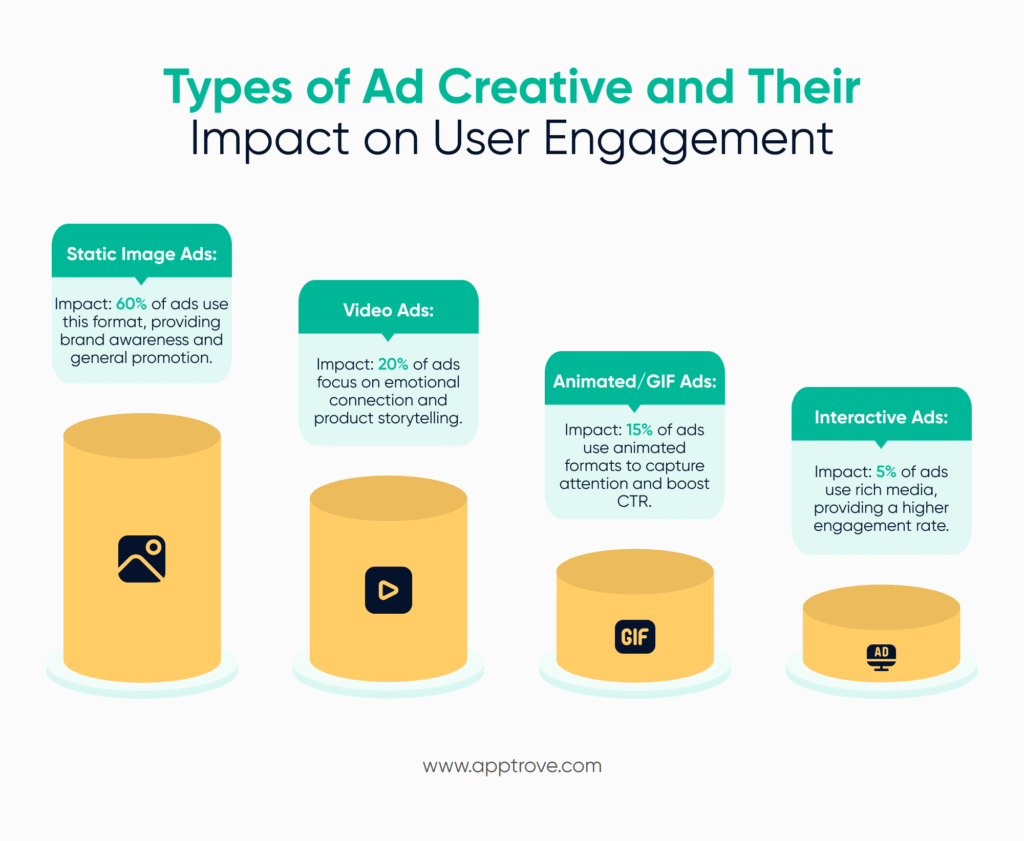
- Static Image Ads:
These are the vast majority of digital ads, either banner or single-image ad. They are also known as digital or online advertising and are typically used for brand awareness, testing and as general promotional items.
- Video Ads:
Video ads can vary from Short Form to Long Form (20 sec to 10 min) and typically tell a story or demonstrate/explain a product with the intent of building an emotional connection between the brand and its customers/target prospects.
- Animated or GIF-based Ads:
Like Static Image Ads, these ads have the advantage of being eye-catching and simple while being less resource-intensive than a full video ad. They offer a lightweight alternative to a full video ad and have proven very effective for capturing user attention and increasing click-through rates when used effectively.
- Text-based Ads:
Text ads are primarily composed of text in the form of Google Ads search engine ads and display ads. These ads are also referred to as “text link” advertising.
- Interactive or Rich Media Ads:
Interactive or Rich Media ads are the opposite of static ads in that they enable the viewer to interact, engage or play with the ad, providing a more immersive experience and higher engagement than a standard static ad would provide.
The format you select for any specific ad campaign will be determined, in large part, by your campaign objectives, target audience, and what you intend to achieve by running the ad.
Why Ad Creative Matters — Importance & Impact
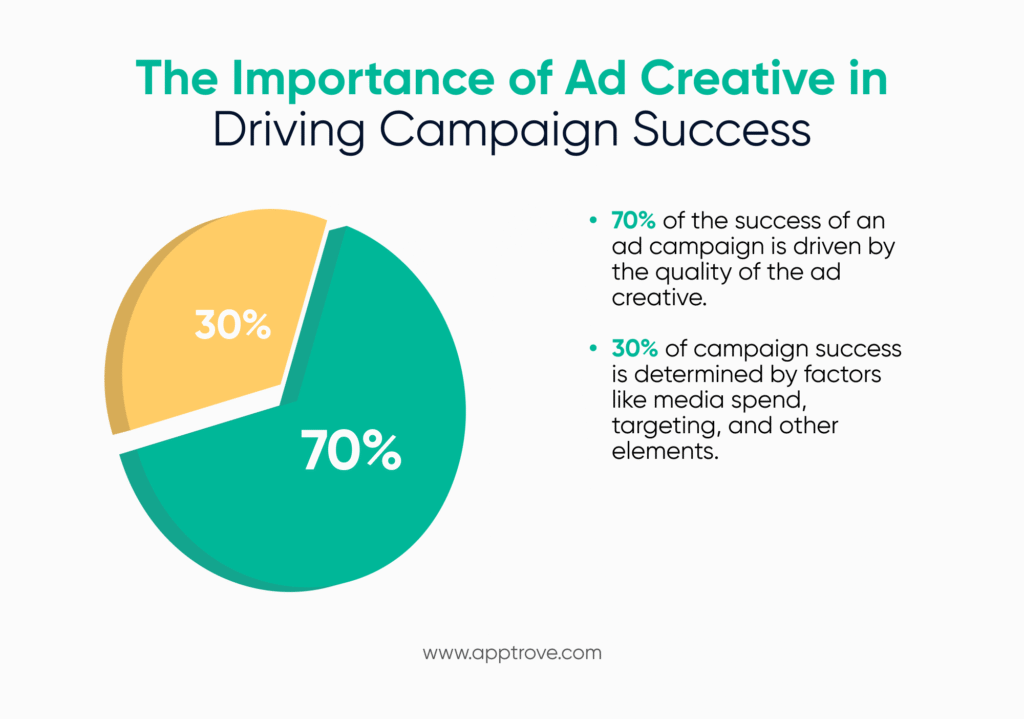
Creative advertisements serve as the single most important aspect of creating a successful advertising campaign.
- Ad Creatives Help Stand Out In An Increasingly Noisy Digital Marketplace. Each day, consumers receive thousands upon thousands of advertisements and news articles via their smartphones. A well-created advertisement helps cut through all this clutter and get someone’s attention, and entices consumers to learn more about your product and/or service.
- Ad Creatives Have A Major Impact On Building Brand Image. An ad that is executed professionally helps establish credibility for your brand and provides the first introduction to a prospect. On the other hand, if you use poor ad creative (design), you lose credibility.
- Creative advertisements can help increase revenue by guiding user behaviour toward desired conversion actions (e.g., click on your ad, sign up, purchase a product).
The combination of visual elements, message content, and call to action (CTA) shown in an ad provides users with a pathway to take an action, such as clicking on the ad, signing up for a service, and purchasing a product.
- The quality of your ad creative is a major factor in how effectively you will leverage the dollars you spend on advertising. Creative ad solutions that are well written, designed, and optimized will yield a better return than merely increasing your media budget.
- Recent statistics state that in over 70% of cases the quality of the creative will determine the overall success of a campaign. Furthermore, the creative with the greatest deterioration of sales lift, regardless of media spend, is the creative that is the weakest.
Ad Creative Performance — Metrics, Measurement & Industry Trends
Key Metrics & Analytics
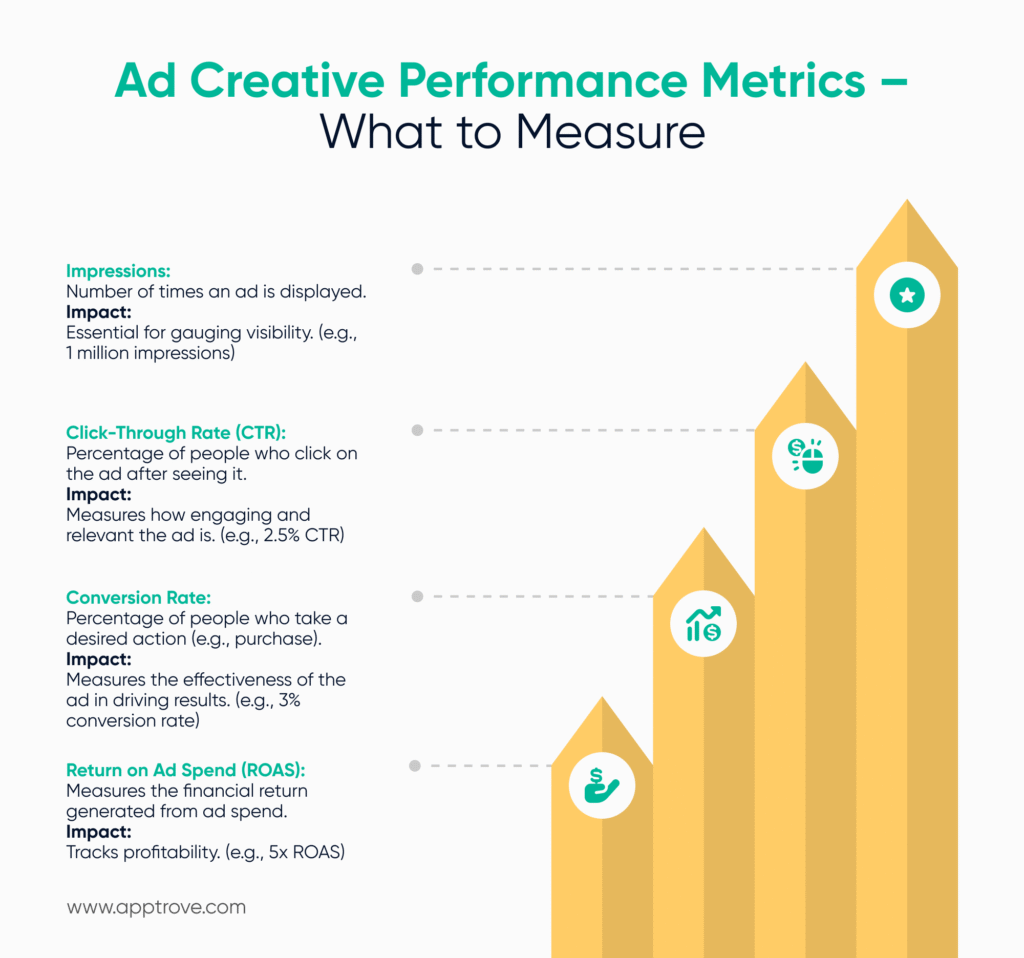
Marketers typically measure the success of advertising creatives by tracking the following:
- Impressions- The total number of times an advertisement has appeared to an individual.
- Click-Through Rate (CTR)- The number of clicks on the advertisement versus the impression number, therefore measuring how impactful the creative is in getting the user to click on the ad.
- Conversion Rate / Actions- The Percentage of viewers who completed the desired action after viewing the ad (i.e. purchase, signup, download, etc.).
- Return on Advertising Spend (ROAS) / Return on Investment (ROI) – The Financial analysis of the profits generated from the ad, as compared to what was spent on the advertisement and gives the marketer an indication of how successful their advertisement has performed overall.
- Ad Fatigue Metrics / Frequency / Viewability- The measurement of how often the ad the user has seen the same creative, thus, needing more engagement. Too many exposures to the same creative can produce Ad Fatigue and lower the user’s engagement level.
As digital advertising continues to grow and become smarter, most marketers also utilize creative analytics to systematically measure the performance of each creative. Based on the creative’s image, copy, Call-to-Action, and Ad Format, creative analytics helps a marketer optimise each creative asset over time.
Industry Trends & Evolving Role of Ad Creative
Creativity and Versatility: Display Advertising’s New Future
As display advertising is becoming more prevalent, it needs more creative diversity and flexibility. The transition to a more widespread application of performance-based creative development has become a major focus as advertisers are now encouraged to take data-driven measures and implement ongoing testing and personalization strategies to optimize advertisers’ creative assets for business success.
As digital advertising becomes increasingly fragmented due to multiple platforms, advertisers will be forced to continuously adapt their creatives to a new collection of formats, including static banners, video-based ads, and other interactive media. Therefore, the emphasis on creative versatility and flexibility is paramount to advertisers’ success.
Best Practices — How to Create Effective Ad Creative
Marketers must adhere to certain guidelines when designing effective advertisement creatives:
Know your audience:
Get familiar with your target market’s desires, pain points, and motivations. This is instrumental in developing the right visual design & copy that resonates with them.
Quality visual images/ design matter more than quantity:
Use stunning imagery or video, and create clean, uncluttered designs. The clearer the creative is to display, the better chance it has of conveying the intended message clearly.
Focus on compelling copy, call-to-action(CA) buttons and concise messaging:
The title should capture attention quickly and the body copy should emphasise the benefits of your product(s). A strong CA should lead the viewer directly to their desired actions.
Branding/creative consistency
It is key at all levels, starting with the advertisement itself and ending with the landing page/product offer. The user’s initial expectation of what they see when they click through their advertisement needs to align with what they actually see once they reach the landing page to maximise chances of converting.
Conduct iterative testing, analysis and refinement
A good practice is to perform A/B Testing to measure how creative variations simultaneously compare against each other. Testing will allow marketers to learn which elements work consistently better and the ways in which customers respond positively to these campaigns.
Creatives should be tailored and developed for the environment(ft), platform(s), and form factor (for instance…Desktop vs mobile).
Although what works on one platform/environment may not be effective elsewhere for the same audience or product offer, there is still an opportunity to create relevant advertisements based upon audience insights.
Challenges & Considerations
- While ad creative is an important aspect of a company’s advertising strategy, creative quality can be subjective; what may be an attractive ad to some consumers may not resonate with others, thus making the measurement of creative effectiveness by data and testing very important.
- Ad fatigue and diminishing returns are also considerations when it comes to the use of the same creative repeatedly. Therefore, it is important to continuously refresh and improve the performance of the creative product.
- Creatives must be developed with respect to the target audience, platform and creative format; creating a one-size-fits-all creative is ineffective.
- Optimizing creatives continuously is necessary; the effectiveness of any ad creative is limited in time because of changes in the market, consumer preferences, and technology, thus it is critical to have an active optimization process to keep ad creatives relevant and effective.
Summary — The Role of Ad Creative in Modern Advertising
Ad creative can be defined as all the various components of advertising, including visuals, copy/text, interactivity, etc. Everything used to make up an ad is part of its ad creative. It is a part of the advertising that will create a connection between an advertiser and an audience.
Creative designs are paramount to an advertising program; they help pull in an audience, convey a message for a brand, and then prompt the audience to act in response. Different types of ad creatives may be produced based on the type of campaign and the intended audience that will be targeted.
Quality and creativity can be responsible for as much as 70% of an ad’s total effectiveness. Just having an attractive ad is not sufficient; high-quality creatives must show quantifiable business results. It is critical to produce creative material that can be modified and adjusted over time. Though today’s marketing industry is very fragmented, by leveraging creativity as necessary for success in digital advertising, marketers have a better chance of achieving successful results.
To achieve maximum success, marketers should combine creativity with analytics, leveraging data to inform all facets of marketing, while continuously testing and improving creatives for greater engagement and higher ROI.