
What is an AVOD (Advertising-Based Video on Demand)?
In this era where mobile technology reigns supreme, the world of content consumption and revenue generation is changing quickly. The growth of the AVOD (Advertising-Based Video on Demand) model is of utmost significance since this service allows users to access video content at no cost while using advertisements to generate revenue.
As a mobile marketer, app developer, growth marketer, or publisher, it is important to understand the meaning of AVOD and how this ad-based business model works, especially in terms of similarities and differences between AVOD and other similar revenue-generating models such as SVOD, TVOD, and PVOD for the development of successful growth strategies.
This glossary will give you a better understanding of the AVOD definition, its role in revenue generation, and the relationship between the AVOD business model and app monetization, user acquisition, attribution, and analysis.
What is AVOD?
The term “AVOD” stands for “Advertising-Based Video on Demand”. The term AVOD refers to a business model that allows users to watch video content for free, with advertisements being displayed before, during, or after the video. The users are not required to pay for the service with money, but the payment to the service is made in the form of attention and time.
This monetization method is widely used by free video streaming services, news websites, social networks, or OTT applications. In those markets, where users are reluctant to pay for different subscriptions, AVOD makes it possible to monetize activities by advertising based on impressions, clicks, completed views, or any measurable interactions of the users with the advertisement, while the users are not charged for the service.
In some sense, AVOD can be regarded as a digital transformation of traditional linear television with its adaptation to mobile and connected TV audiences.
How AVOD Works
Below is a brief explanation regarding the mode of operation of the Advertising-Based Video on Demand system:
Users start an application or stream service. They select a video to watch. Afterwards, they may be requested to watch a few advertisements. Different methods may be utilized to show ads to users based on criteria such as user behavior, location, preference, device type, audience group, or time.
Advertisers pay platforms or publishers to run these ads or work as intermediaries. After receiving payment, the platforms can create revenues that would allow them to create content, provide licenses, develop technology, and perform the operations.
This offers an opportunity for app marketers, publishers, and content owners to earn money from advertising, especially in cost-driven markets where free access stimulates demand for their products.
When combined with data-driven targeting and mobile app analytics, AVOD becomes a good model for attracting users and obtaining revenue.
AVOD vs SVOD, TVOD, and PVOD
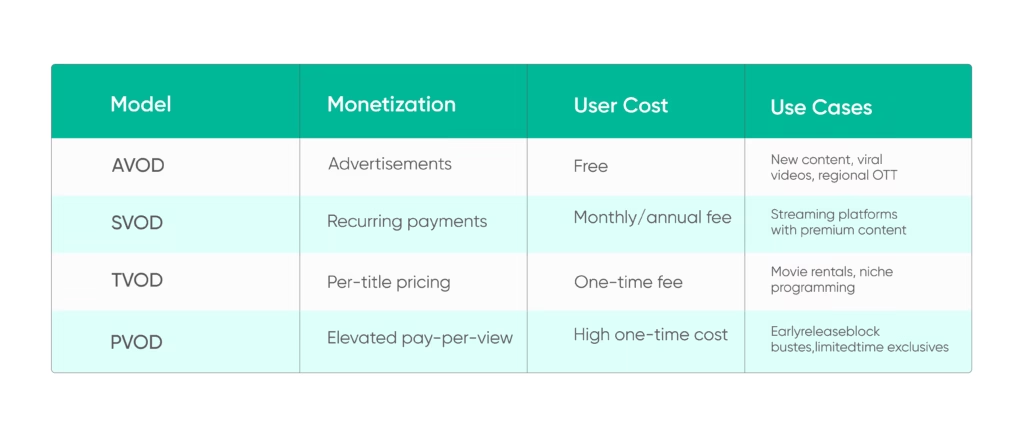
To understand the significance of advertisement-based video on demand (AVOD), it can be compared to other types of video on demand (VOD):
- AVOD allows viewers to enjoy content for free with ads.
- SVOD users pay a subscription to use a library of content.
- TVOD charges viewers for watching specific content.
- PVOD is the latest form of VOD that enables customers to get access to the latest content by paying higher prices.
AVOD removes the direct paywall from its operations and is considered extremely user-friendly compared to other video monetization options. SVOD requires a subscription payment to access content, whereas TVOD and PVOD operate on a pay-per-unit basis. The best model will depend on a number of factors including content differentiation, audience profile, pricing, and monetization objectives.
For example, publishers and application shops are able to come up with hybrid models combining advertising, subscriptions, or premium content to create multiple revenue streams.
Why AVOD is on the Rise
The rise of ad-supported streaming goes beyond just convenience for viewers. It signifies a comprehensive change in the consumption behavior of the consumers and subscription fatigue and the new trends in digital advertising.
With more consumers being fussy about the number of paid subscriptions they hold, ad-supported access has emerged as an alternative that lets consumers enjoy content without incurring another expense. In addition, advertisers and agencies continue to move their budgets to the streaming environments where consumers spend much of their time.
The latest statistics demonstrate that AVOD is still holding sway in India. The number of people watching OTT (over-the-top) content in India has grown to 547.3 million, according to the Ormax OTT Audience Report 2024, of which the AVOD viewership has increased by 21%. The AVOD audience represents 72.5% of the total OTT audience in India.
The AVOD sector continues to grow across the world as well. In 2024, the global AVOD market is valued at almost $49 billion and is expected to witness substantial growth in the coming years, reaching new heights in 2030.
There will be more opportunities to capitalize on advertising-based free video content, particularly with an increase in mobile penetration and expected availability of appealing on-demand entertainment for the audience.
AVOD in the Mobile App Ecosystem
AVOD not only provides app marketers and content owners with an opportunity for monetization. It can help with user acquisition and engagement, audience expansion, and attribution.
Free video content reduces the barrier for users to download the app when marketers can draw users to the platform with well-thought-out advertising campaigns. Irrespective of whether the users pay for the premium subscription or not, users can still contribute to value creation by interacting with ads.
In this case, if the users watch a video ad before receiving access to free content, the platform gets another chance to communicate a brand message, provide promotions, recommend products, or present a call to action.
However, in order to be successful in overcoming the challenges associated with AVOD, proper measurement is needed. The owners of apps must know metrics such as impressions, clicks, video completion, conversion view-through, and revenue.
This is why reliable mobile measurement and attribution systems become significant. Solutions adhering to privacy policies such as SKAN analytics can help app marketers conduct performance assessment while operating in a privacy-first environment.
Challenges of AVOD and How to Address Them
While ad-supported video-on-demand has enormous scale and accessibility, it also poses its own unique challenges.
One of the most common issues is ad overload. When users see too many ads or irrelevant creatives, it is likely that they churn quickly. Companies can mitigate ad loads and irrelevancy by adhering to ideal ad frequency and personalized delivery; e.g., ads must be aligned with user interest and/or type of content.
Attribution complexity is another headache that Advertising-Based Video on Demand presents when journeys occur across both devices or platforms. In comparison to a direct-purchase model, AVOD ad interactions can be very hard to trace back to specific ad campaigns. View-through attribution (VTA) and impression-level insights can help understand how and where ads inspire user behaviors.
Revenue predictability in AVOD can fluctuate due to ad demand, fill/empty rates, and pricing variations, with seasonality considered. It is therefore prudent to track ad performance continuously while experimenting with hybrid monetization modeled on user control (i.e., optional SVOD tiers for ad-free content).
Building an Effective AVOD Strategy
A successful AVOD strategy is achievable through more than sheer volume – it requires smart design, engaging content, and accurate measurement.
Having a solid Advertising-Based Video on Demand model starts with understanding your audience: Who are they? What type of content do they typically engage with, and how do they respond to various ad formats? Content should be created for mobile first, short, engaging, and high-quality.
It’s also crucial to have solid attribution tools that will allow you to track impressions, participate in deep linking, and then run post-install analysis. Tools like Apptrove can provide this level of measurement, so marketers are able to optimize their campaigns without funding invasive tracking.
As privacy regulations continue to change, so should your AVOD strategy. Transitioning towards SKAN-native analytics, using contextual targeting and cookieless detection methods will help your monetization strategy be both efficient and compliant.
The Future of AVOD: Contextual, Privacy-Aware, and Intelligent
Free-with-ads video platforms are trading cookie-based targeting for contextual signals, without compromising user privacy.
The next phase of Advertising-Based Video on Demand will include new interactive formats, AI-powered playlists, brand integrations with video, and others, creating a richer advertising experience not just during an ad break but also next to content.
For app marketers, it’s time to rethink how to define and measure performance. Success in AVOD will depend on much more than total ad views; it will depend on how well it leads to actual user engagement, user retention, and conversion.
Conclusion
Ad-supported video is not to be viewed merely as an alternative to paid content; rather, it is a key strategy to broaden your reach, enhance monetization, and respond to the behaviors of users today.
It offers value to non-paying users and monetization potential for publishers when done right. But success requires planning, consistent measurement, and a focus on user experience.
Whether you’re running a streaming app, a content-rich mobile platform, or experimenting with hybrid models, this approach gives you the scale, flexibility, and insights needed to grow sustainably. And with platforms like Apptrove supporting privacy-safe measurement and deep attribution, you’re set up for long-term success.
FAQs
1. What makes AVOD different from other video monetization models?
Unlike SVOD, AVOD eliminates the need for subscribers to pay any type of subscription fee and allows users to watch video content for free, while the video platform is compensated for the advertising displayed on the videos. This makes AVOD the best choice for regions with highly price-sensitive consumers and mobile-first users.
2. Why is AVOD important for today’s mobile video audience?
AVOD is important because it allows users to choose free and flexible access instead of buying multiple subscriptions, creating an opportunity for publishers to increase both reach and revenue through ad-support on their platforms and provide users with the ability to access video on-demand.
3. When does AVOD deliver the highest value for app marketers?
AVOD is typically most effective when there is a large user base with an engagement rate that is high and the availability of a wide range of content. In a well-functioning AVOD ecosystem, monetization opportunities are maximized by the combined factors of a high amount of daily viewing hours and consistent advertiser demand.
4. What challenges should platforms expect when implementing AVOD?
The most common AVOD challenges are ad fatigue, inconsistent ad fill rates, and complex device-specific attribution. You can enhance the user experience by managing frequency, improving relevancy, and utilizing reliable measurement tools.
5. How can apps optimize revenue within an Advertising-Based Video on Demand model?
By proactively managing ad placement frequency, deploying targeted advertisements, utilizing a view-through conversion framework, offering tiered subscription models, and analysing view-through conversion rates, apps can maximize their potential to achieve long-term revenue growth.