
The churn rate is a metric that keeps you up at night if you are in the subscription or recurring revenue business, especially if you are in the SaaS or mobile app business like Apptrove’s audience. If you want to survive and be successful financially over the long run, it is vital that you understand, calculate, and, most importantly, reduce your churn rate.
What is Churn Rate?
Churn rate is one of those key mobile app metrics that shows the percentage of customers or subscribers that have uninstalled an app, or have stopped using the service during a specified time period. This means you now have users who have stopped engaging with your product or service.
Churn is a direct reflection of your customers’ satisfaction with your product and market fit. High churn rate will create a leaking bucket where your cost of acquiring users (Customer Acquisition Cost, or CAC) greatly outweighs the losses of your customers and they severely diminish the Customer Lifetime Value (CLV or LTV) for the time they have been with you.
The Churn Rate Formula (Customer Churn)
The most basic and essential formula is for Customer Churn Rate, which focuses on the number of people lost.
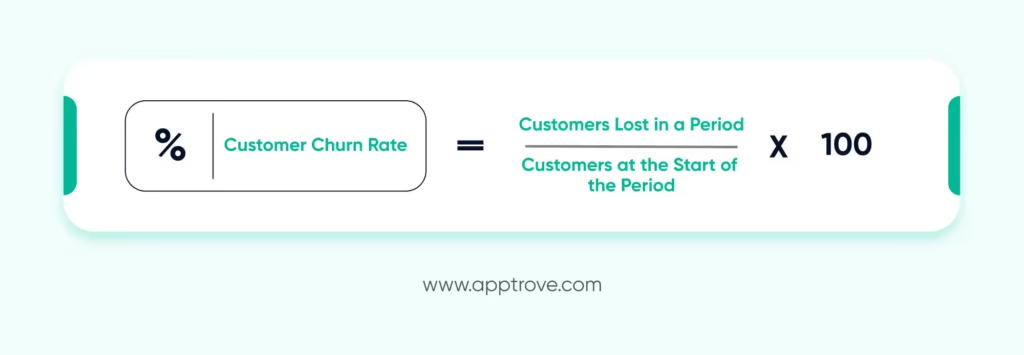
If your app started the month with 1,000 active subscribers and lost 50 by the end of the month, your monthly Customer Churn Rate is (50/1000) X 100 = 5%.
Churn Rate Benchmarks and Related Retention Signals
Churn rates reflect the rate at which users stop using an application. To understand churn rates properly, it is crucial to look at user behaviour in conjunction with other behaviours that help us gauge app performance, particularly during the early stages of a user’s journey within an application.
The app abandonment rate is one of the best indicators of what future churn may look like. The app abandonment rate refers to the percentage of users that download, install and subsequently open the application only once, and never return to it. The app abandonment rate is a very harsh yet honest assessment of your app’s first impression on your users.
According to 2019 industry studies, approximately 25% of users abandoned their app download immediately upon installation. One in every four users that downloaded your application will abandon it after just one usage. This statistic illustrates how important user onboarding, clearly communicating value, and providing a smooth user experience are to reducing churn from day one.
After users move past the first interaction phase, you should then monitor your churn rates as an ongoing measure of app performance. While the abandonment rate tells you the number of users that left your application immediately after opening it, the churn rate indicates the number of users who did remain engaged with your app, but later left. Churning also indicates larger gaps in user perceived value, engagement, or price.
Types of Churn: Customer vs. Revenue
While customer count is crucial, not all customers are created equal. High-value customers leaving can be far more damaging than losing lower-tier users. This is why you must track two main types of churn.
1. Customer Churn Rate
As defined above, this measures the percentage of individual users or accounts lost. It provides insight into the appeal and usability of your product to your customer base as a whole.
2. Revenue Churn Rate
This measures the percentage of recurring revenue lost over a specific period. It is calculated by focusing on the monetary value of lost subscriptions, factoring in downgrades but excluding new revenue from upsells or new customers.
Why Does Churn Rate Matter?
Churn rate matters so much because it hits the three most important business levers, that are revenue stability, customer lifetime value (CLV), and acquisition ROI. For instance, if your customer acquisition cost (CAC) increases but your churn rate remains high, you burn through budgets without building loyal users.
Thus, reducing churn is cheaper than acquiring new users, and it compounds positively over time.
Strategies to Reduce Churn
Tracking is useful, but reducing churn is transformational. Some effective ways to reduce churn include:
1. Improve Onboarding
First impressions define retention. If users experience friction or confusion early, churn rises.
2. Personalize Experiences
App personalization using behavioral and cohort analytics can reduce churn significantly by delivering relevant messaging, content, offers, or product flows.
3. Track User Behavior with Analytics
Mobile measurement partners like Apptrove help app teams identify drop-off patterns, high-risk users, and friction points in the user journey.
4. Strengthen Support and Feedback Loops
Live chat, in-app help centers, and automated nudges reduce frustration and keep users engaged.
5. Introduce Win-Back Automation
Emails, push notifications, or in-app offers can re-activate silent users before they fully churn.
Summing Up
Churn rate is a signal that is telling you whether your product is meeting expectations, offering value, and consistently delivering experience users want to stick with. You can grow user acquisition endlessly, but without retention discipline, growth doesn’t translate to revenue.
Understanding churn, analyzing it frequently, and aligning product decisions with real user behavior helps turn passive users into loyal advocates. When churn decreases, retention increases, and retention is where the compounding magic happens.