
If you plan on using digital advertising as an investment to scale your app, the most important actionable metric we suggest using is return on advertising spend (roas). Successful, data-driven advertising begins with an understanding of how each dollar spent translates into measurable results. ROAS explains the revenue you are receiving for each dollar spent on ads, therefore informing both the overall campaign performance of your advertising campaigns and the effectiveness of any one campaign. It can also help inform your decision-making if you’re launching an entirely new campaign, or if you are reflecting on a past campaign.
If you know the return on ad spend for your advertising campaign, you’re making data-backed decisions to yield smarter outcomes. Understanding what works and what doesn’t, enables you to scale your app in the most efficient way possible. This is the essence of ROAS marketing, where every advertising dollar is directly tied to measurable revenue outcomes and campaign efficiency. At that point, ROAS becomes one of your core key performance indicators (kpis) alongside signals like conversion rate, engagement rate, and customer retention rate.
What Is Return on Ad Spend?
Return on ad spend functions as your advertising campaigns’ essential performance metric that determines their achievement level. Your revenue generated from advertising investments is directly revealed through this calculation. In short, return on ad spend metric helps evaluation of marketing campaigns to determine if existing strategies yield satisfactory financial outcomes.
It stands as an essential element for app owners and marketers because they need it to determine budgets and assess performance and decide when to expand their operations. The mobile marketplace demands that organizations understand financial impacts from their marketing actions through relationship measures which you cannot bypass. ROAS is especially useful when you want to connect upper-funnel visibility like impressions and ad impressions to lower-funnel outcomes like purchases, subscriptions, or sales volume.
Why Measure Return on Ad Spend?
Return on ad spend measurement lets you ensure your advertising financial investment produces returns. Mobile marketing now demands every single impression, click and install from users since both costs and attention-keeping abilities in this space have risen. It’s also where metrics like click-through rate (ctr) and bounce rate help you diagnose why a campaign is getting traffic but not turning into revenue.
If you’re still wondering “why measure return on ad spend?”, because it is an absolute necessity in your business strategy:
- It demonstrates real campaign success. A lot of installs don’t mean anything if those users don’t convert or pay money. Return on ad spend focuses on outcomes, not activity.
- It helps you optimize how to allocate your budget. That’s it. Once you know where and in what campaigns you will make the best ROAS, you can put the right resources in those places through smarter budget allocation.
- It empowers smarter decisions. With real-time ROAS data, you are free to change bids, creative, and targeting to get the best return. This is especially effective when you tie ROAS to platform levers like ad quality score, quality score, impression share, and ad frequency.
Before you can uncover sustainable growth and maximize your marketing roi, you need to understand why measure return on ad spend.
ROAS Formula
Evaluating return on ad spend provides easy to understand results for brands. The formula is:
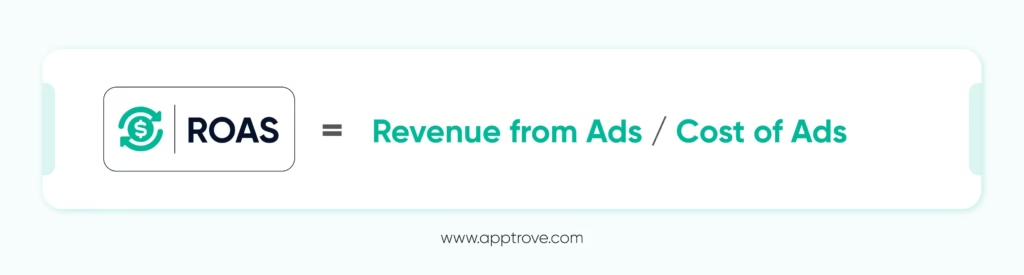
Let’s break it down:
Revenue from Ads: Revenue from Ads: All the money coming in from your paid ads (includes in-app purchases, subscriptions, e-commerce sales, etc.). In commerce-led models, average order value (aov) can heavily influence how quickly ROAS improves.
Cost of Ads: Your total ad spend (includes media buying, creative production, and platform fees). This can include auction costs like cost per click (cpc) or cost per click, and reach-based pricing like cost per mille (cpm).
Example:
If you spent $1,000 on a Facebook campaign and you earned $4,000 in revenue, your ROAS calculation is:
ROAS = $4,000 / $1,000 = 4.0
This calculation means you earned $4 for every $1 you spent – this is great performance in most industries. Your ROAS formula helps you understand both how well your campaign performs and if it can expand.
How to Calculate Return on Ad Spend
Business leaders and marketers use ‘return on ad spend’ as their main metric to measure if their advertising investments create sufficient revenue results. Knowing how to calculate return on ad spend, allows you to identify high-performing campaigns, reallocate budgets strategically, and ultimately increase profitability.
Step 1: Measure Total Advertising Spend
To determine ROAS you must know all advertising expenses. Besides media expenses this calculation needs to include all costs that directly support the execution of your campaign like production fees, development spend and agency retainers. Maintain a single controlling system to monitor all expenses going toward your advertisements regardless of the platform. When your cost data is precise it gives you better results in ROAS measurements.
Step 2: Track Revenue and Attribute It to Ad Spend
After tracking your ad spending you need to identify what money was generated from these advertisements. The data tracking system here depends on attribution to be successful. Your Mobile Measurement Partner (MMP) tracking tool links user actions directly to the advertising campaigns that led to the activities like purchases, app utilization, or subscriber registrations. The more detailed your tracking setup, the better. A helpful attribution system separates between multiple channels driving results to show you which ones bring value.
This is where attribution models matter. Different platforms may report results differently depending on the attribution model, which is why having consistent measurement across traffic sources is so important.
Step 3: Calculate Your ROAS
Now that you have the spend and revenue data, calculating your return on ad spend is simple. You just take the revenue generated divided by the cost of ads that generated it. For instance, if you spent $5,000 on ads and then made $20,000 in total revenue from that campaign your ROAS would be 4.0, or 400%. Your earn four dollars for every one dollar spent.

You can calculate roas at different levels based on what you want to know: campaign-level, channel-level, by region, by audience, etc. This will allow you to see not only if your ads worked, but to see where they worked best. For example, ROAS may look strong even when cost per acquisition (cpa) is rising, depending on purchase behavior and monetization.
Step 4: Analyze and Visualize ROAS Data
To get the most value out of your ROAS data, it helps to visualize it. Real-time dashboards enable you to detect performance changes and locate weak spots while assessing different campaign or market results. A single dashboard available to everyone enables everyone in marketing operations to see and use ROAS insights.
Viewing ROAS results together with CAC, LTV, and customer churn rates gives you full detail about your campaign performance. Using complete data helps decision makers update both their creative direction and their customer selection plans. In particular, pairing ROAS with customer acquisition cost (cac) or customer acquisition cost, and customer lifetime value (clv) or customer lifetime value, helps you understand whether today’s returns translate into sustainable growth.
Step 5: Act on Your Insights
Return on advertising spend is only useful if you act on it. Look at results to see which marketing projects produce good outcomes and which deliver weak results before making your next choices. You might redistribute advertising funds between underperforming and successful platforms based on your ROAS results.
Beyond manual adjustments, many advertising platforms now allow you to set automation rules based on ROAS thresholds. For example, when ROAS declines you can set the system to suspend ads while it automatically boosts bids when your campaigns achieve above-expectations results. Setting automatic rules can help you improve results directly as you do not need to watch campaigns continuously.
What Is a Good Return on Ad Spend?
There’s no universal benchmark for ROAS. It differs from one business sector to another plus depend on unique market and target objectives. However, marketers generally want their return on advertising investment to reach 3:1 or higher, meaning $3 earned for every $1 spent.
Factors that influence what is a good return on ad spend include:
User Lifetime Value (LTV): If your product has strong retention and monetization (e.g., subscriptions, repeat purchases), a lower ROAS may still be profitable over time.
Acquisition Costs: High competition or poor targeting can drive up costs, requiring a higher ROAS to stay profitable.
Timeframe: Profitability also depends on your unit economics, especially your profit margin and resulting net profit after ad costs.
How to Improve Your ROAS
Better ROAS results come from effective process changes throughout the complete advertising campaign. Key strategies include:
Precise Audience Segmentation: Users who show specific behavioral signs should take priority for ads rather than relying only on basic demographic information.
Deep Funnel Tracking: Look into specific user actions after installs instead of just monitoring installation numbers. Check the effects of the app installation that show user reactions such as signing up, buying, and retention to understand their worth. This is where mapping the marketing funnel and improving conversion rate stage-by-stage can materially increase ROAS.
Real-Time Campaign Optimization: Adjust your campaigns automatically through ROAS-based rules immediately. Focus advertising spending on successful parts of your campaign while ending support for sections that underdeliver.
Contextual Targeting: Use contextual information to reach specific users when they need it most for greater engagement return. This supports both monetization outcomes and wider objectives like brand awareness.
Fraud Prevention: Keep out detected fraudulent traffic and invalid installs to measure performance correctly. Advertising costs increases when a user installs illegally without making any purchases.
ROAS vs. Other Metrics: Why ROAS Matters Most
Marketers typically leverage metrics like CPI (Cost Per Install), CTR (Click-Through Rate), and CPA (Cost Per Action). These are good, but not the total picture.
Here’s what makes ROAS stand out:
- CPI reveals the acquisition cost, but not its worth.
- CTR shows interest, but not conversion.
- CPA counts actions, but ignores revenue.
ROAS shows the direct connection of your ad spend to revenue. ROAS shows not only how much you spent, but how much you earned.
It is more than just a metric, it’s a compass in performance marketing. Whether you are introducing a new campaign, optimizing an existing campaign, or analyzing results in the aggregate, understanding and improving ROAS is important to growing sustainably. It also gives you cleaner decision-making for priorities like lead generation, sales growth, and scaling efficiently across channels and geos.
If you are wondering how to calculate return on ad spend, looking for the ROAS formula, or asking what is a good return on ad spend, this guide gives you everything you need to be successful. For teams operating in competitive categories, ROAS insight can even support strategic decisions tied to market share.
FAQs
Q: Can I have a high ROAS and still lose money?
Yes, it’s possible to have a high ROAS and have very low profits in absolute terms if your advertising revenue base is small. That’s why pairing ROAS with total revenue and profit performance metrics is so important.
Q: Should I measure ROAS by campaign or channel?
Both. Apptrove allows you to analyze ROAS by individual campaigns, ad networks, platforms, and user segments. The layered view will help you sharpen your marketing strategy for each individual level.
Q: Is ROAS better than ROI?
ROAS is more specific. ROI includes all costs (Salaries, Infrastructure, etc.), whereas ROAS only accounts for ad spend. ROAS is a little more actionable when analyzing campaigns.
Q: What is a good ROAS benchmark for my industry?
There is no one-size-fits all benchmark. An e-commerce brand may aim for a ROAS of 4:1 or higher, while a subscription app of high customer lifetime value can be profitable with as low as 2:1. The most helpful ROAS benchmarks are contingent on your margins, user retention, and other business model factors.
Q: How often should I evaluate ROAS?
ROAS should continuously be reviewed especially while campaigns are active. Weekly or even daily reviews will allow you to identify trends, optimize your ad spend, and respond with urgency to changes in ad creative, audience impressions, and overall user behavior.