A few years ago, the idea of being able to purchase furniture without stepping into a shop or train staff without investing in expensive technologies would have seemed far-fetched. Today, augmented reality (AR) and virtual reality (VR) make it possible. The technologies have already gone beyond gaming and made it possible for brands to enhance their customer experiences, as well as optimize training, design, and collaboration.
Experts from PwC state that AR and VR technologies will create up to $1.5 trillion of value in the global economy by 2030, which proves the rising significance of these technologies across industries.
The rapid progress of artificial intelligence (AI), computer vision, and spatial computing has contributed to making the technologies easy to access. As the technologies are gaining popularity, companies and marketers should understand how they work and create value for them.
What is Virtual Augmented Reality?
Even though the phrase “virtual augmented reality” gets thrown around often, this technology is not an independent one, actually. In the vast majority of cases, it is a convenient way to combine the terms augmented reality (AR) and virtual reality (VR) which, even though they work differently, are usually considered together due to their common goal of creating immersive experiences.
When we speak about Virtual Reality (VR), we mean a technology that replaces users’ real-life environments with a computer-generated one. Using a VR headset, users can immerse themselves in the virtual world for entertainment or training purposes.
Augmented reality (AR) technology complements the real world by overlaying digital images, objects, or information onto the real world using smartphones, tablets, or smart glasses. Thus, the users are able to interact with the virtual/real world.
These technologies used to be classified as Extended Reality (XR), which is also an umbrella term for Mixed Reality (MR).
Virtual Reality vs Augmented Reality: What’s the Difference
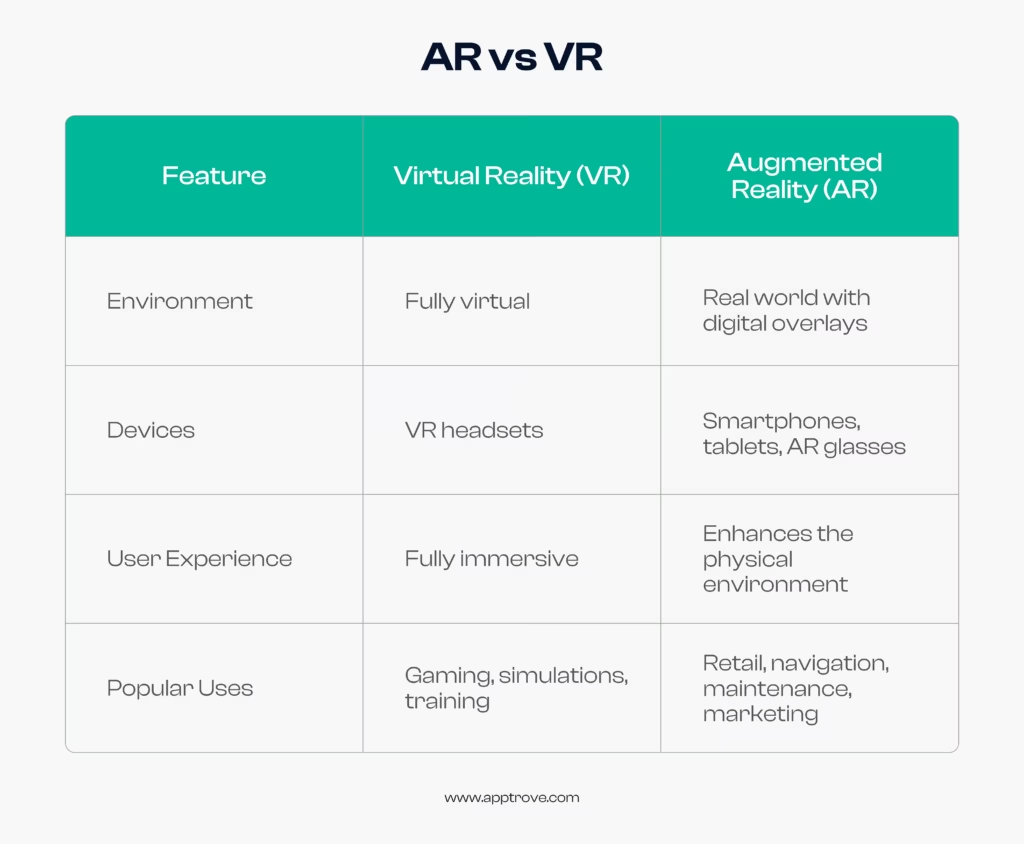
Virtual reality provides a fully virtual environment, allowing individuals to interact with its parts while keeping the ability to sense the surroundings. Various industries apply VR in employee training and simulation scenarios for medical training and education purposes as well as for entertainment.
On the contrary, augmented reality adds digital to the surroundings through the use of software technology, allowing users to have real-world experiences. The technology is widely employed in such processes as virtual cigarette testing, 3D visualizations, and advertising.
While VR impacts the way people perceive reality greatly, AR is preferable in case users still want to experience the real world around them.
Modern examples of AR and VR devices can bring some insights into what these technologies have evolved into.
How Virtual Augmented Reality Works
Virtual augmented reality integrates both software and hardware to deliver immersive digital experiences.
There are certain devices including VR headsets, AR smart glasses, tablets, and smartphones, that contain sensors such as GPS, depth sensors, gyroscopes, and accelerometers; which track motion and orientation at all times.
Moreover, by using the cameras available on the device, the surrounding environment is being analyzed for recognizing objects and surfaces, with the aid of computer vision technologies that interpret this data and provide the interaction of digital content with the real-world.
Moreover, there is motion tracking that helps in tracking head, hands, and body movements; and using AI; object detection, gesture recognition, and voice interaction is executed as well as recommendations are provided.
Ultimately, using modern rendering engines, the graphics created are of 3D nature and ultra-low latency is maintained during the creation of such graphics.
Real-World Applications of Virtual Augmented Reality
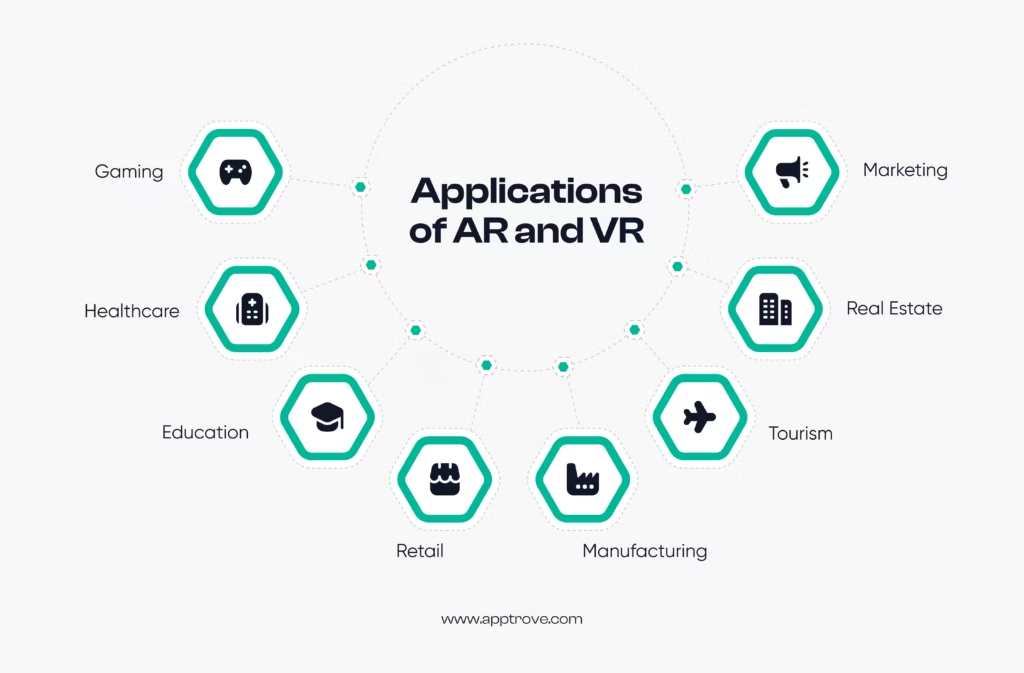
The use of augmented reality is no longer confined to gaming, but is also used in businesses across various industries in order to improve customer experiences and solve real-world problems.
Gaming
The gaming field is still at the forefront of the use of immersive technology. With the help of VR devices such as the Meta Quest and PlayStation VR, gamers can fully immerse themselves in a virtual world in a real-time manner. Moreover, AR games such as Pokémon GO enable players to engage in digital gaming with the real world.
Healthcare
Hospitals, for example, are using VR for simulating surgeries, while AR can show relevant information about the patient during the surgical intervention.
Retail
Shopify argues that stores using 3D models and AR solutions are experiencing an increase of 94% in the number of purchases made by customers thanks to a more complex visualization of products.
Although augmented reality can help increase both product searches and consumer confidence, marketers still have to find out whether those searches lead to the installation of a new app.
Education
Nowadays, educational institutions have leveraged the power of both AR and VR technology to form more immersive educational experiences. This new level of experience includes virtual labs, recreation of historical events, and interactive classrooms.
Manufacturing
In the manufacturing industry, AR is highly useful in assisting workers in complex assembly processes, equipment maintenance, and providing technicians with remote access.
Real Estate & Tourism
Through virtual tours of properties, buyers have access to homes from wherever they are. At the same time, museums, tourist attractions, and tourism companies rely on AR to promote their attractions.
Marketing
Companies have started using AR-based augmented product previews, virtual fitting rooms, and advertising campaigns to boost engagement and bring in customers.
Benefits of Virtual Augmented Reality for Businesses
Reducing uncertainties is one of the main benefits of AR and VR. Clients are able to observe products prior to purchasing them, workers can hone their skills ahead of actually performing them, and companies can try out their concepts prior to spending a fortune on production.
Accordingly, AR and VR facilitate the collaboration of distributed teams and contribute to saving on travel, training, and prototype development.
The technology also simplifies the visualization process and allows organizations to develop products, designs, and production technologies in advance, leading to quick and accurate decisions.
Driven by immersive experiences, companies can increase customer satisfaction, boost productivity, and foster innovation.
Apart from being able to provide users with exciting experiences, organizations need proper analytics for the evaluation of ROI.
Measuring the Success of AR and VR Campaigns
Launching an immersive augmented reality or virtual reality experience is just one part of the strategy. Businesses must also understand how users learn about, interact with, and convert from immersive experiences. Different metrics like installs, session length and retention can be used to measure the success of campaigns. Mobile measurement partners, such as Apptrove help marketers accurately ascribe installs to the right campaigns, analyze user behavior, and optimize campaigns through a number of channels. By utilizing impressive technologies and solid measurements, marketers can get the best of both worlds as far as engagement and marketing ROI are concerned.
Challenges and Limitations
The expense of hardware is high which makes it difficult for businesses to implement the solutions easily, especially for those implementing complete solutions. High-quality AR and VR experiences require technological investments.
Concerns with privacy and security are growing due to the increasing amount of data collected by devices. Users may experience nausea and other issues while using the devices.
Although technology is evolving, the adoption of the solutions will depend on affordable prices and the availability of quality processes and solutions.
The Future of Virtual Augmented Reality
In the coming years, the rapid growth of virtual reality & augmented reality (AR & VR) technologies will be influenced by the emergence of AI, spatial computing, and portable gadgets. With the development of these technologies, discussions have shifted from “How can technology be used?” to “How can technology be effectively used?” Companies are looking for ways to utilize these technologies so they can have measurable results, i.e., better training or improved engagement of consumers.
Companies also find value in the creation of virtual digital copies or digital twins, which makes it possible to monitor equipment, simulate user scenarios, and predict failures. As businesses invest more in AR and VR solutions in fields such as healthcare, manufacturing, retail, or education, they expect advanced immersive technologies to bring more benefits to digital transformation processes.
Best Practices for Businesses Adopting Virtual Augmented Reality
It is crucial for organizations to establish their goals before investing in AR or VR solutions. This should provide clarity on whether the goal is to achieve high customer satisfaction, employee engagement, or operational efficiency.
Secondly, organizations should begin with pilot projects or MVPs, select platforms that suit their requirements, and constantly monitor the results and impact. By obtaining feedback and using analytics throughout the entire experience, the business will be able to improve its performance over time.
Conclusion
In recent times, virtual augmented reality has changed from a new technology to practical business use. From better customer engagement and employee training to improved visualization and operational efficiency, augmented and virtual reality have made it easier for businesses to create digital experiences that involve media. The increase in the use of those technologies has resulted in companies that combine immersive technology with data being prepared for innovations and easy optimization of user journeys and customer experience. Platforms like Apptrove can also assist marketers with tracking user activity, optimizing campaigns, and making smart decisions related to growth.
FAQs
What is the difference between augmented reality and virtual reality?
Augmented reality (AR) enhances the real world by overlaying digital content onto physical surroundings, while virtual reality (VR) creates a fully immersive digital environment that replaces the user’s real-world view. AR typically works on smartphones or smart glasses, whereas VR requires dedicated headsets.
What are the applications of virtual augmented reality?
Virtual augmented reality is used across industries including gaming, healthcare, education, retail, manufacturing, real estate, tourism and marketing. Common applications include employee training, virtual product demonstrations, property tours, interactive learning, product visualization, and immersive customer experiences.
Is virtual augmented reality the same as mixed reality?
No. Virtual augmented reality generally refers to the combined discussion of AR and VR technologies, while Mixed Reality (MR) is a specific type of immersive technology that blends physical and digital objects, allowing them to interact with one another in real time.
What industries use AR and VR?
AR and VR are widely used in gaming, healthcare, retail, education, manufacturing, real estate, tourism, automotive, architecture and marketing. Businesses use these technologies to improve training, visualization, customer engagement and operational efficiency.
What is the future of virtual augmented reality?
The future of virtual augmented reality is expected to be driven by artificial intelligence, spatial computing, wearable devices, digital twins, and enterprise adoption. As hardware becomes more affordable and software continues to improve, immersive technologies are likely to become a standard part of business operations and customer experiences.