
What is GAID (Google Advertising ID)?
GAID (Google Advertising ID) is a unique ID given by Google Play services to enable services related to advertising purposes on Android (like attribution, measurement, targeting, and conversion tracking).
GAID differs from other hardware identifiers because it is meant to ensure control over advertising measurement by users. The user is given the chance to either reset it or remove it from the android settings on their device, thus leaving developers with no other choice but to accept people’s privacy decisions and preferences.
For mobile advertisers and analytics platforms, GAID allows them to link advertising actions taken by users with the app installations and subsequent conversion actions in case it is used according to Google’s policies.
GAID: Technical Foundation
The Google Advertising ID (GAID) is an advertising feature that’s available through Google Play Services. Developers can use GAID in a wide variety of advertising-related applications where a privacy-compliant identifier is required for purposes such as advertiser measurement, conversion tracking, and ad personalization.
However, this advertising ID should not be used as any general-purpose identifier for devices. Instead, Android recommends using other identifiers such as Firebase Installation ID and private identifiers to use in other non-advertising-related applications.
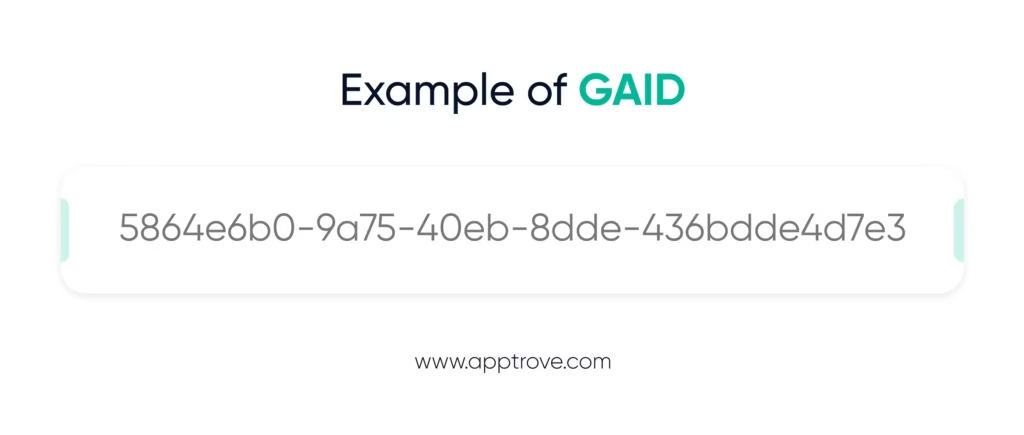
GAID Implementation and Compliance
The Google Advertising ID standard is Google’s full-service solution to mobile advertising identity. Launched as part of Google Play Services 4.0 in 2013, it implemented a slight deviation from previously using Android ID (hardware-based identifier) to a more privacy-aware identifier. The decision to implement Google Advertising ID structured an advertising identity-controlled framework that acknowledges measurement demands while meeting user privacy concerns.
Apps that use Google Advertising ID should follow Google’s current identifier and privacy requirements:
- Use GAID for advertising-related purposes: Advertising ID should be used for use cases such as advertising, measurement, conversion tracking, and ads-related profiling.
- Respect user choices: Developers must respect user preferences related to advertising tracking.
- Do not bridge GAID resets: If a user resets their Advertising ID, developers should not use another identifier to reconnect the new ID with the previous one without explicit user consent.
- Avoid linking GAID with personally identifiable information without consent: Google’s guidance restricts connecting Advertising ID with personally identifiable information unless appropriate explicit consent has been obtained.
- Declare the required permission: Apps targeting Android 13 or higher and using Google Play services Advertising ID must declare the
AD_IDpermission in their manifest.- Review Data safety disclosures: Apps collecting identifiers for advertising purposes should ensure their Google Play Data safety declarations accurately reflect their data practices.
Can Users Delete Their Google Advertising ID?
Absolutely. Besides resetting their Advertising ID, Android users have the option to remove it as well. When the Advertising ID is reset, the existing one will be replaced by a new one. As for deleting the Advertising ID, it involves the removal of the identifier from the Google Play Services library. As a result, any applications that aim to access it will receive zeros instead.
The importance of this difference lies in the significance it has for the platforms conducting mobile measurement and marketers in general.
Advertising ID: Cross-Platform Strategy
Advertising ID covers the larger landscape of mobile identifiers for campaign measurement and audience targeting. In contrast, while competitors tend to speak about advertising IDs unilaterally, the effective integration presupposes an acquaintance to the collusion between Google Advertising ID and other platform IDs:
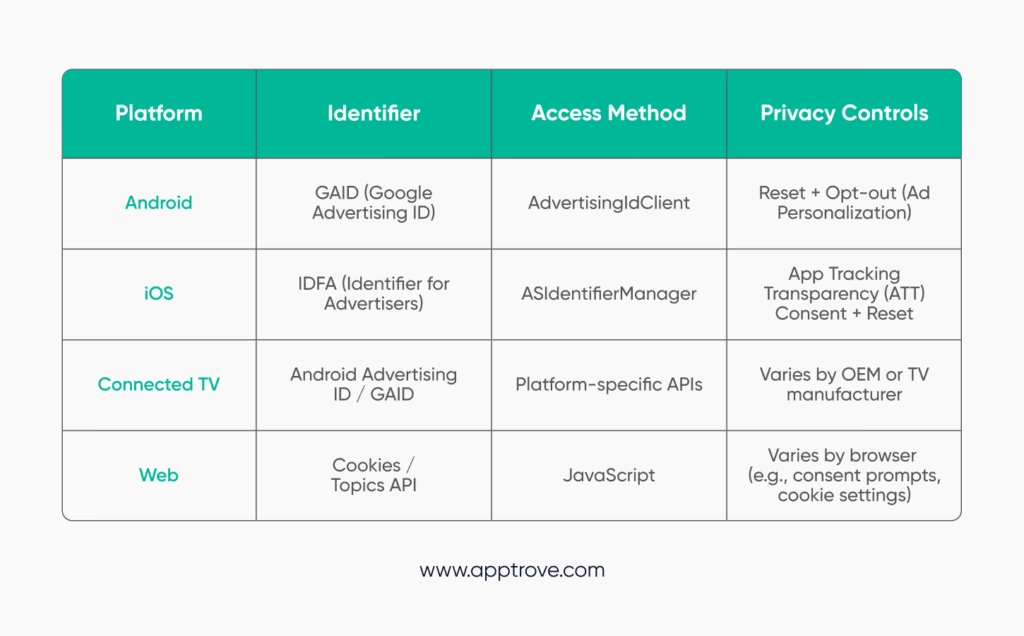
Strategic implementation calls for constructing identity graphs that can correlate these conflicting identifiers while adhering to the privacy shackles that the respective platforms lay out. In contrast to other platforms that regard advertising IDs as straight technical parameters, we acknowledge their primary role in the context of attribution modeling and audience strategy.
Android Advertising ID: Technical Implementation
The Android Advertising ID (the technical alias of GAID) reflects the implementation-specific details of Google’s advertising identity schema. Its retrieval, storage, and consumption have their technical concerns, which affect attribution accuracy and compliance:
Retrieval Best Practices:
Thread Management
- For Google Advertising ID retrieval operations, always apply background threading to avoid UI freeze.
- Deploy either the dedicated worker threads or the modern concurrency frameworks typical of Kotlin (Coroutines).
- Do not call AdvertisingIdClient.getAdvertisingIdInfo() directly on the main thread.
- Consider using WorkManager for GAID operations that can be deferred.
Error Handling
- Enact exhaustive exception handling to smoothly deal with retrieval failures
- Define clear contingency strategies for situations where Google Advertising ID is unavailable.
- Errors in log retrieval with the necessary context to debug.
- Process specific exceptions individually (GooglePlayServicesNotAvailableException, IOException, etc.)
Privacy Compliance
- Ensure that limit ad tracking is enabled prior to use of the GAID for tracking purposes
- Do not respect user opt-out preferences without exception.
- Do not try to fingerprint the devices if Google Advertising ID access is restricted.
- Provide clear disclosure in your privacy policy as to how GAID is accessed.
Handling Advertising ID Changes
Developers should design their measurement systems to handle changes in Advertising ID availability and user privacy preferences. Applications should avoid assuming that an Advertising ID will always remain available or unchanged.
Performance Optimization
- Introduce retrieval timeout controls to avoid indefinite waiting.
- Use batch operations when a large number of advertising IDs require processing.
- Think about lazy loading patterns to delay GAID retrieval until its usage.
- Focus on app initialization rather than Google Advertising ID retrieval, this will help to achieve faster launch times.
This pattern of implementation avoids frequent pitfalls, including:
- UI thread block while retrieving GAID
- ANR (Application Not Responding) errors
- Failure to handle retrieval exceptions
- Failure to comply with Limit Ad Tracking settings.
Even if other measurement partners offer SDK wrappers, knowing implementation details allows for better performance and accurate attribution.
Android Ad ID: Attribution Mechanics
Android Ad ID is simply used to describe the Google Advertising ID and how it works in the attribution flow. The Android Advertising ID is the deterministic matching key that links:
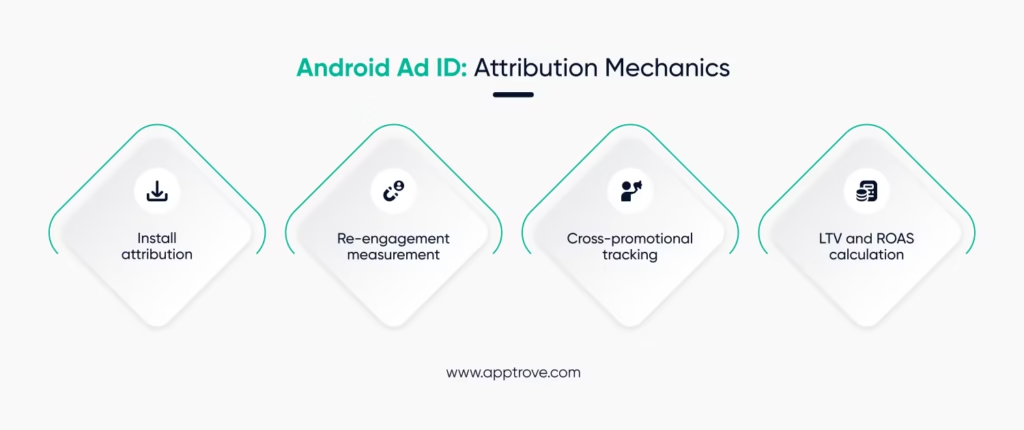
- Install attribution: matching pre-install ad interactions to post-install app opens
- Re-engagement measurement: linking re-engagement campaigns to app re-open
- Cross-promotional tracking: measuring user acquisition across app portfolios
- LTV and ROAS calculation: linking downstream revenue events back to acquisition sources
The attribution flow broadly follows the approximate sequence of:
- Ad Network captures GAID during an ad impression/click
- Measurement Partner receives GAID during app installation/open
- Deterministic matching between advertising touchpoints and app behaviour takes place
- Attribution is established based on attribution windows and attribution logic configured
This attribution flow provides the basis for robust measurement, enabling campaign optimization, compared to the superficial narratives that undersell the technical detail of attribution mechanics.
Android Advertising ID Reset: Measurement Implications
The Android ID reset ability is an important privacy control option, with remarkable technical ramifications for attribution models. When the user resets through their device settings (Settings → Google → Ads → Reset advertising ID), this will happen:
- A new UUID is created, replacing the previous value
- The historical device profile is disassociated with future activity.
- Pre-reset and post-reset event attribution chains are severed.
- Frequency capping and targeting audience data are reset
The advanced measurement solutions used need to include reset behavior through:
- Probabilistic modeling where probable resets have been identified.
- Models for conversion in order to address gaps in attribution.
- Incrementality testing for the validation of the overall campaign effect.
- Cohort-based analysis compared to single deterministic user journeys.
This reset ability shows why simple last-click attribution models are inadequate in today’s privacy environment.
Ad Identification: Advanced Techniques & Privacy-Safe Alternatives
Ad identification involves the full body of technical infrastructure to correlate advertising touchpoints with measurable outcomes. With the development of privacy regulations and platforms’ policies, complex marketers need to learn deterministic and probabilistic identification techniques as well:
Deterministic Methods:
- GAID-based matching (direct identifier matching)
- Server-to-server integrations with direct parameter passing
- Correlation between AI and impression ID and click ID.
Privacy-Preserving Alternatives:
- Google’s Privacy Sandbox for Android (Topics API, Attribution Reporting API)
- Aggregated conversion modeling
- On-device processing and attribution
- Cohort-based analytics with differential privacy
Contrary to other competitors that keep traditional guidance that is preset for the solely identifier-based tracking, prospective measurement would require preparations for the post-Google Advertising ID landscape as follows:
- Consent management infrastructure that adapts the way it measures things to changing measures for each user based on consent.
- Hybrid (deterministic/probabilistic) models of attribution between the two.
- Machine learning conversion modeling for attribution gaps coverage
- First-party data approaches that minimize dependency on advertising identifiers
Privacy Innovation & Future-Proofing Your Measurement Strategy
Google’s ongoing Privacy Sandbox initiative signals the eventual evolution beyond the current Google Advertising ID implementation. Forward-thinking marketers must prepare for this transition through:
- Server-side implementation of the conversion, to minimize client-side identification dependencies.
- Amplified conversion modeling to operate with aggregated and anonymized data elements.
- Incrementality testing frameworks whose verifications of performance go beyond deterministic attribution
- First-party data activation strategies that have used consented user relationships to drive the same activity.
Differing from competitors who respond to such changes, such a proactive approach guarantees continuity of measurement capabilities irrespective of the changes in platform.
Conclusion
If other measurement partners provide shallow explanations of GAID then actual competitive advantage comes in the technical depth and strategic insight presented in this guide. With the mastery of both the current implementation details, and anticipation of privacy-centric evolution, marketers preserve measurement continuity with user privacy expectations intact.
The Google Advertising ID is not simply a technical parameter, but one of the key elements of mobile measurement strategy that needs continuous modification as the privacy landscape changes. This holistic grasp of the topic has delivered attribution accuracy in the present but is constructing resilience for the privacy first ecosystem of tomorrow.
FAQs
1. What is the Google Identifier for Advertisers (GAID), and what are its advantages for mandating Android analytics?
The Google Identifier for Advertisers (GAID) is a unique identifier generated using Google Play Services on Android devices that has user-reset capabilities, among many advantages, such as determining attribution, campaign audiences, frequency limits of displays, performance tracking across applications, and privacy controls for users.
2. What are the key guidelines when using GAID in app development?
Using GAID requires accessing the unique ID in the app through a background thread, not the app’s UI main thread. All instances of exceptions to receiving the GAID must be handled properly. Respecting the Limit Ad Tracking settings, applications must include statements about their use of the GAID in their privacy policy and may not create an association between the GAID and any persistent identifier without obtaining consent first from the user who owns both identifiers.
3. What will happen if the user resets their unique GAID?
When the user resets their GAID, a new unique identifier replaces the current unique identifier, breaking the historical attribution link, deleting all members from the audience, and resetting all frequency capping data. This change invalidates any attribution made using a previous GAID, as it relates to making any adjustments when modelling has occurred.
4. How do the attribution mechanics supported by GAID work?
The GAID allows for deterministic connections between how an ad was displayed and how it was subsequently clicked (e.g. displayed via impression) and provides post-install event measurement options; therefore, third-party data providers use the GAID to link daily customer acquisitions from advertising to the quarter available, including further analysis towards the average return of any advertising placement based on purchase or repeat purchases with their purchasing customers.