
The mobile marketing landscape moves fast, but the technologies and identifiers that inform this movement often constrain its speed in the same way as a physical road. One of the most significant identifiers is the IDFA (Identifier for Advertisers), particularly if you are in the iOS ecosystem.
For so many years, IDFA allowed advertisers, marketers, and developers to derive understanding about which campaigns, creatives, and other channels were driving results for their business overall. However, as the data privacy landscape continues to shift, the Identifier for Advertisers is no longer the universal pass it once was. It is critical for any mobile growth strategy to understand its current context, its limitations, and its ongoing importance, if only to stay ahead of the game in a post-ATT world.
What is IDFA, and why was it so Important?
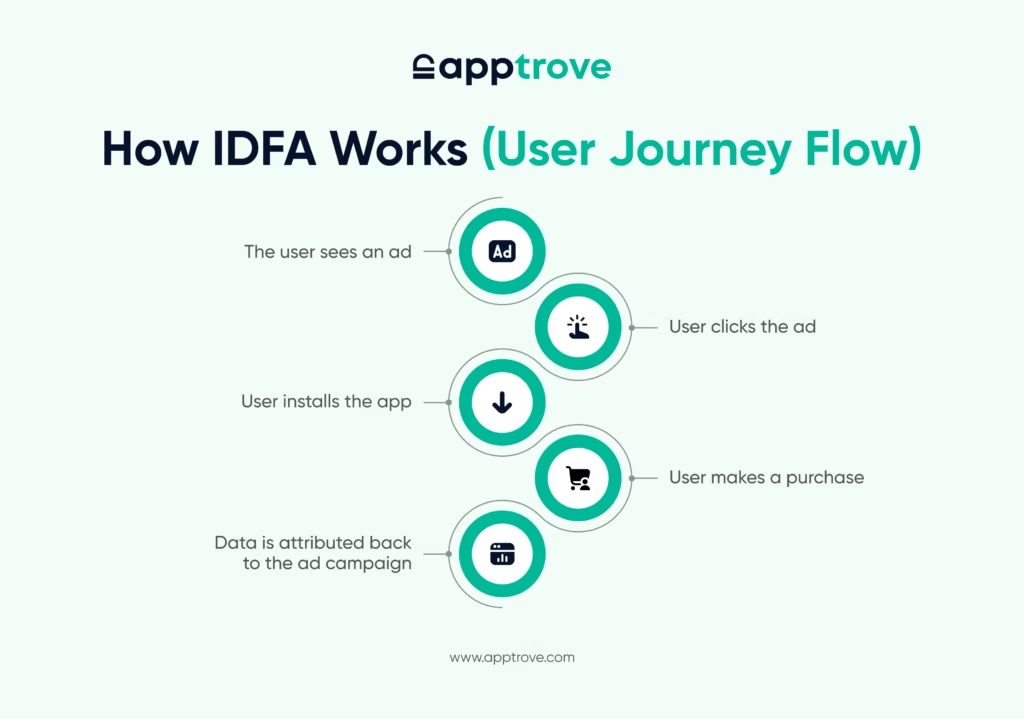
The Identifier for Advertisers (IDFA) is a unique, device-level string of numbers and letters assigned by Apple to every single iOS device. You may think of it like a tag- a tag that does not give away who you are personally, but allows marketers to follow you on your journey from ad interaction to app install to post-install behavior.
With this identifier, advertisers could connect clicks and impression actions with downstream activity. If a user clicked an ad and later installed an app or made a purchase, Identifier for Advertisers could help attribute that action back to the ad. This fueled increasingly sophisticated targeting, improved creative optimization, and the ability to document ROAS with accuracy.
IDFA was a standard attribution tool on iOS before Apple’s significant privacy change. All users had it, and advertisers could do so without compromise unless a user specifically opted out of ad tracking in their settings, which, pre 2021, was a very small number of users. Doing this made deterministic attribution on a user-level not only a possibility, but the expectation.
A Watershed Moment: App Tracking Transparency (ATT) and the Limitation of IDFA
In 2021, Apple introduced a pivotal change in mobile advertising and user privacy: App Tracking Transparency (ATT). The app tracking transparency framework requires apps to gain explicit user approval to access their Identifier for Advertisers, so the prompt is simple, generally asking: “Pay no attention to their apps or other companies’ apps and websites track your activity? [App Name]” The prompt and its answer have redefined mobile advertising, and today, most users will not approve. In fact, some recent reports claim that only roughly 25% of users globally allow it to track them if prompted. This means that nearly three-quarters of app users will not approve tracking and, hence, their Identifier for Advertisers is either disabled or rendered to an unusable string of zeros.
This change affects everything about advertising and attribution. Without the ability to access the Identifier for Advertisers, advertisers lose the ability to deterministically connect ads closed loop to in-app action. No more retargeting appropriately. They lose the ability to personalize messaging. They lost real-time optimization to a great degree; this optimization was always powered by granular user-level data.
The Identifier for Advertisers was a default signal for mobile measurement, but now it is a privilege given to the app by some small percentage of users. In turn, marketers will need to find a way to adopt a new way of thinking by separating themselves from deterministically identifiable things and using privacy-safe, aggregated measurements that meet today’s user expectations and platform guidelines.
Post-IDFA World: Is IDFA Still Relevant?
Even with the restrictions enforced by ATT, Identifier for Advertisers is not dead yet. It remains an ongoing player in various scenarios, especially when consumers allow tracking.
With some recent data showing 25-30% of iOS users globally are still opting into tracking, this opt-in pool is a great opportunity for marketers to still manage accuracy in their campaign strategies for a group of app-users on the opt-in subset, and be a little less reliant on the probabilistic or aggregated data.
However, Identifier for Advertisers is still available for use in:
- Internal Analytics (with ATT granted consent)
- Cross-device attribution via the same user ID
- A baseline for developing models about SKAN (SKAdNetwork) performance for comparing deterministic and aggregate data.
So, Identifier for Advertisers is still not the foundation of mobile measurement, but still a useful signal, especially when used alongside other tools such as SKAN, unified deep linking, and privacy-first cohort analysis.
The Role of IDFA in Privacy-First Attribution
Attribution is one of the biggest headaches post-ATT. When deterministic signals like Identifier for Advertisers are restricted, marketers have to rely on aggregated frameworks like SKAdNetwork, contextual signals, and predictive modeling to plan media spends, ad creatives, and optimizations.
But for opt-in users, IDFA makes possible:
- Direct click-through and view-through attribution
- Fully-tracked funnel event
- Real-time retargeting and audience segmentation
This is especially appreciated in situations like:
- Subscription-based apps want to track behaviour for renewals
- eCommerce apps want to track repeated purchases
- Gaming apps want to track lifetime value (LTV) and session stickiness
At Apptrove, we provide an identifier for Advertisers-based attribution (for opt-in users) with privacy-safe modelling for ATT restribution audience in a way that ensures you don’t miss the forest for the trees.
How IDFA Works with SKAdNetwork and Probabilistic Attribution
During the Identifier for Advertisers era, many app marketers see IDFA and SKAN as one or the other. The reality? They do best when combined.
Identifier for Advertisers provides precise user-level data (when it exists), and SKAdNetwork provides a set of aggregated data across broad audiences. By combining:
- Confirm SKAN postbacks against deterministic benchmarks
- Optimize your SKAN configuration based on the Identifier for Advertisers confirmed signals
- Evaluate benchmark LTV expectations or engagement rates
Probabilistic attribution also could be useful and uses inferred signals such as IP address, user agent, and timestamp as estimates of conversions. While the information won’t be as accurate, probabilistic attribution can fill the gaps of Identifier for Advertisers and obtain information within the bounds of the changing regulations.
The Future of IDFA: What Marketers Should Expect
As we look toward the future, Apple is likely to continue tightening its privacy framework. But Identifier for Advertisers isn’t going away tomorrow, and it’s still a valuable tool when considering its legacy as a foundational ad tech tool.
To future-proof your strategies:
- Prioritize building user trust to increase ATT opt-in rates.
- Use creative testing and contextual targeting to expand audiences,
- Implement measurement partners like Apptrove that support blended attribution.
- Monitor Apple’s ongoing privacy changes to its policies and APIs.
Most importantly, use Identifier for Advertisers not as your only source of truth, but as one of many aligned with privacy signals in your stack.
Conclusion
We’ve moved beyond the era of IDFA dependence, but its role in mobile marketing is not over yet. When used appropriately – in combination with App Tracking Transparency, SKAdNetwork, and compliant probabilistic models – Identifier for Advertisers can still deliver value.
An understanding of this identifier is fundamental for anyone serious about responsibly growing an app in a mobile-first world.
Want clearer guidance on attribution in a world where privacy regulations exist? Download our View Through Attribution guide for insight on how you can still track post-install impact, all while being privacy compliant.
FAQs
1. What is IDFA?
Apple provides a unique identifier per device called IDFA (Identifier for Advertisers) to all iOS devices. Advertisers can use IDFA to analyze advertising performance and attribute app downloads or actions (in-app) after gaining permission from users to track their usage of the app via ATT.
2. Does App Tracking Transparency (ATT) affect IDFA?
App Tracking Transparency (ATT) requires explicit consent from users for the app to use IDFA, and now many users deny permission to track their usage. This has made it much harder to track users using IDFA, limiting the availability of deterministic attribution and forcing marketers to focus more on aggregated frameworks, such as SKAdNetwork.
3. Is IDFA still useful after ATT?
Yes, IDFA is still valuable for the many users who opt in to being tracked. For these users, IDFA will continue to provide a level of precision in attribution, real-time retargeting, and accuracy in measuring the effectiveness of advertising campaigns that will not be achieved with aggregate data alone.
4. How do IDFA and SKAdNetwork work together?
IDFA provides deterministic user-level insights where it exists, while SKAdNetwork provides aggregated and privacy-compliant attribution against those users. Many marketers use IDFA as a benchmark for validating and optimizing the performance of SKAdNetwork.