
The field of digital advertising has changed considerably over the past years. Companies and brands now function in a world where every impression counts, every click is essential, and every second matters. In this context, programmatic media buying appears as a solution. It utilizes AI technologies to automate and simplify what is usually a lengthy negotiation process for buying ad spaces.
The possibilities offered by programmatic media buying appear to redefine the rules of the game, allowing companies to advance their mobile apps, e-commerce stores, and SaaS services more effectively than ever. Nowadays, it is believed that 90% of all digital display ads are bought via programmatic technology, and therefore, businesses that apply programmatic techniques for their campaigns see a considerable improvement in their conversion rates and their cost of acquiring new customers.
The tendency discussed above might be especially relevant for those working in the field of mobile app marketing where the task of acquiring customers is particularly challenging. Thus, precise targeting of the audience and the possibility of real-time campaign adjustments prove to be advantageous for marketers. Having the chance to make use of both automation and audience intelligence, programmatic media buying helps advertisers achieve successful results.
What Is Programmatic Media Buying?
Programmatic media buying is simply the name given to the process whereby marketers use technology to buy ads automatically rather than negotiating with the publishers on an individual basis. It provides the best solution for handling advertising expenditure as advertisers use the ad platforms that allow them to buy the desired ad impressions.
This whole process takes place in split seconds. As soon as the user opens an application or a website, advertisers take part in a real-time auction to buy the ad impression. The advertiser who wins the auction displays its ad immediately.
When comparing this to the conventional media buying process, we can see that the latter is followed by long negotiations and fixed prices, while the programmatic method is based on data and analytics.
How Does Programmatic Media Buying Work?
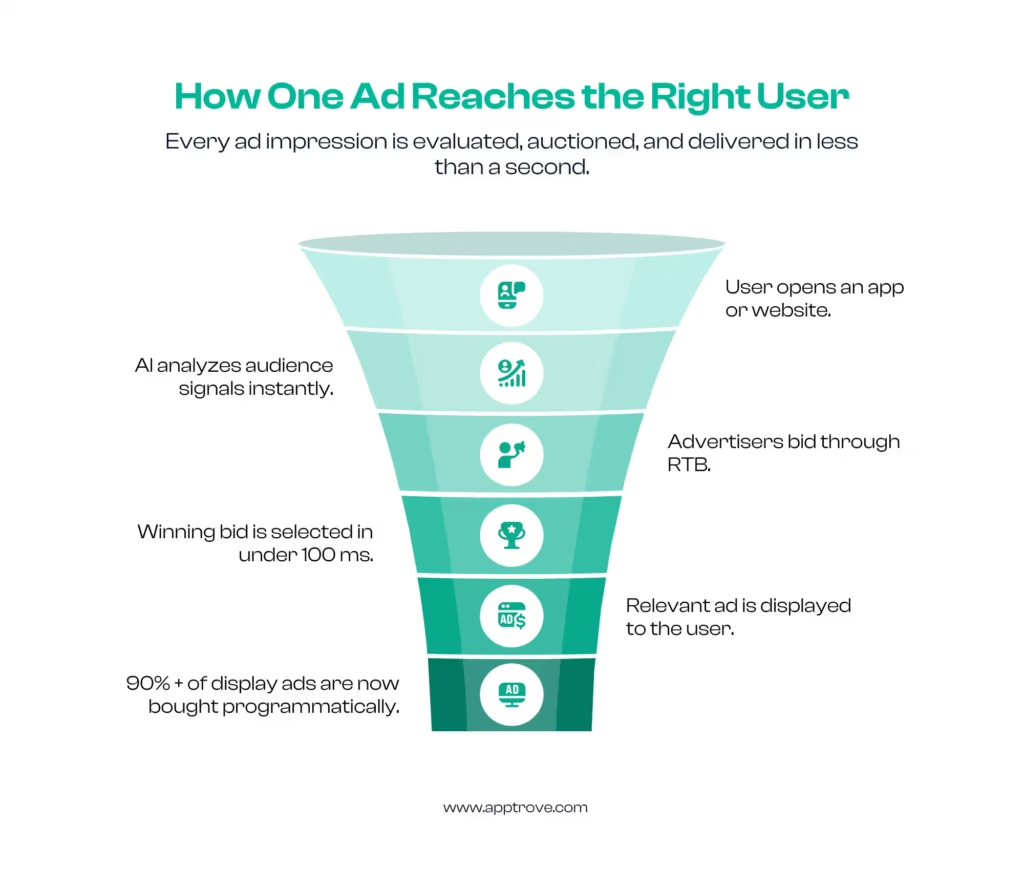
Programmatic media buying is a complicated process in nature but straightforward in execution.
Step 1: A User Reaches a Digital Platform
One starts using a mobile application, surfing an online site, or accessing a smart television program in which advertising slots are present.
Step 2: Evaluation of User Information
Anonymous audience data is efficiently examined.
Step 3: Bids from Advertisers
Demand-Side Platforms (DSPs) are used by advertisers to automatically define the price set for a bid, taking into consideration the goals of the campaign and the quality of the audience.
Step 4: Implementation of Real-Time Bidding
Within approximately 100 milliseconds, real-time auctions among advertisers take place.
Step 5: Display of the Winning Advertisement
The winning advertisement is displayed to the user.
Why Programmatic Media Buying Matters for App Marketers?
The mobile advertising sector evolves rapidly. A plethora of applications with equal opportunities in targeting niches makes advertising processes work
Below are some of the reasons for implementing programmatic media in application advertising
Target Audience with Enhanced Accuracy
Programmatic advertising ensures that marketers can reach any requested audience based on:
- User interests
- Device type
- Location
- Behavior pattern in using applications
- Shopping history
- Operating system in use
- Signals
- Data based on first-party audience
This makes advertising campaigns effective as well as cost-saving
Real-Time Adjustment of the Campaigns
One of the most important characteristics of the programmatic media service is that you will be able to make constant adjustments to campaigns
- Quick Charges Adjustment Process
- The process of autonomous bidding helps to achieve:
- Lower costs of acquisition of consumers (up to 30%)
- Higher efficiency (nearly 50%)
- Higher percentage of conversions and less amount of behalf impressions
Massive Reach Across Channels
Now modern programmatic media buying lets advertisers place their ads on mobile apps, websites, video platforms, connected televisions, digital audio, native advertising, digital out of home (DOOH), and gaming environments. Everything combined means that marketers will be able to provide customers with a consistent shopping experience over multiple devices.
Important Elements That Compose Programmatic Advertising Ecosystem
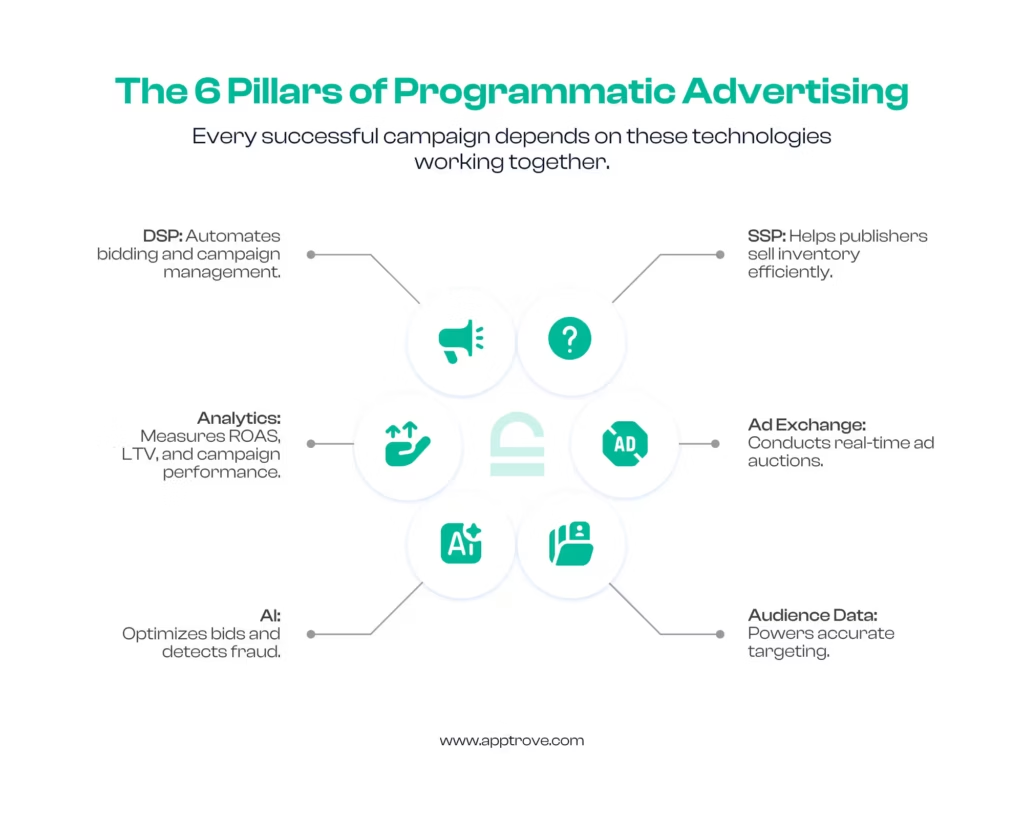
All campaign processes in programmatic advertising depend on a developed technological ecosystem.
Demand-Side Platform (DSP)
The demand-side platform is the tool for advertisers to acquire ad volumes automatically. Its tasks can be described as follows:
- Campaign management activity
- Budget setting
- Targeting audiences
- Automated bidding
- Performance improvement
- Frequency control
Supply-Side Platform (SSP)
Publishers actively use supply-side platforms to control their ad volumes. The functions of an SSP should include the following:
- Lists of amounts of impressions to sell
- Connecting different publishers to numerous ad exchanges
Together, DSPs and SSPs create an efficient digital advertising marketplace.
Ad Exchange
The ad exchange acts as the marketplace where buyers and sellers meet.
Its primary functions include:
- Conducting auctions
- Matching advertisers with publishers
- Processing bids instantly
- Delivering winning advertisements
Without ad exchanges, real-time advertising at today’s scale wouldn’t be possible.
Data Management Platforms (DMPs)
Although many organizations are transitioning toward Customer Data Platforms (CDPs), DMPs still help advertisers organize audience information for smarter targeting.
They combine:
- First-party data
- Third-party data
- Behavioral insights
- Interest segments
These insights improve programmatic media buying decisions by helping advertisers identify high-value users.
Types of Programmatic Media Buying
Not every advertising campaign uses the same buying method. Different campaign objectives require different purchasing models.
Real-Time Bidding (RTB)
RTB is the most common form of programmatic media buying.
Every available impression enters an open auction where advertisers compete in real time.
Best for:
- Performance marketing
- User acquisition
- Brand awareness
- Retargeting
Private Marketplace (PMP)
Private marketplaces invite selected advertisers to access premium publisher inventory.
Benefits include:
- Higher-quality inventory
- Brand-safe environments
- Better audience quality
- Premium publisher relationships
Preferred Deals
Preferred Deals allow advertisers to purchase impressions before they become available through auctions while maintaining negotiated pricing.
They provide predictable inventory without full auction competition.
Programmatic Guaranteed
This model combines automation with guaranteed inventory.
Advertisers secure premium placements before campaigns begin while still benefiting from automated delivery.
It is commonly used by enterprise brands running large-scale awareness campaigns.
How AI Is Transforming Programmatic Media Buying
Advanced technologies that drive modern programmatic media buying are artificial intelligence. AI helps to answer questions about which impressions are the best for conversion on the basis of enormous data processing, bypassing the manual route.
Machine learning helps to improve the effectiveness of marketing campaigns thanks to the acquired knowledge and experience and by acquiring data about user behavior and reactions.
Among the important features of AI, it is necessary to mention:
Predictive Audience Targeting
AI can find out the users who will download an app, buy a product, subscribe to a service, or do something else that is profitable for advertisers instead of acting according to the traditional approach of targeting particular groups of people.
Dynamic Bid Optimization
Each impression has its own worth, and AI determines what among user’s movements, the kind of equipment, location and the time of the day was the suitable one to offer the optimal price for the impression. Therefore, AI makes programmatic advertising much cheaper compared to fixed advertising.
Creative Optimization
With the help of the newest advertising technologies, it is possible to test automatically many versions of headlines, visuals, CTAs, and ad formats in order to understand which of them gets
Fraud Detection
Advertising fraud costs businesses billions of dollars every year. AI helps detect suspicious traffic patterns, fake installs, click farms, bot traffic, and invalid impressions before they consume valuable advertising budgets.
Benefits of Programmatic Media Buying
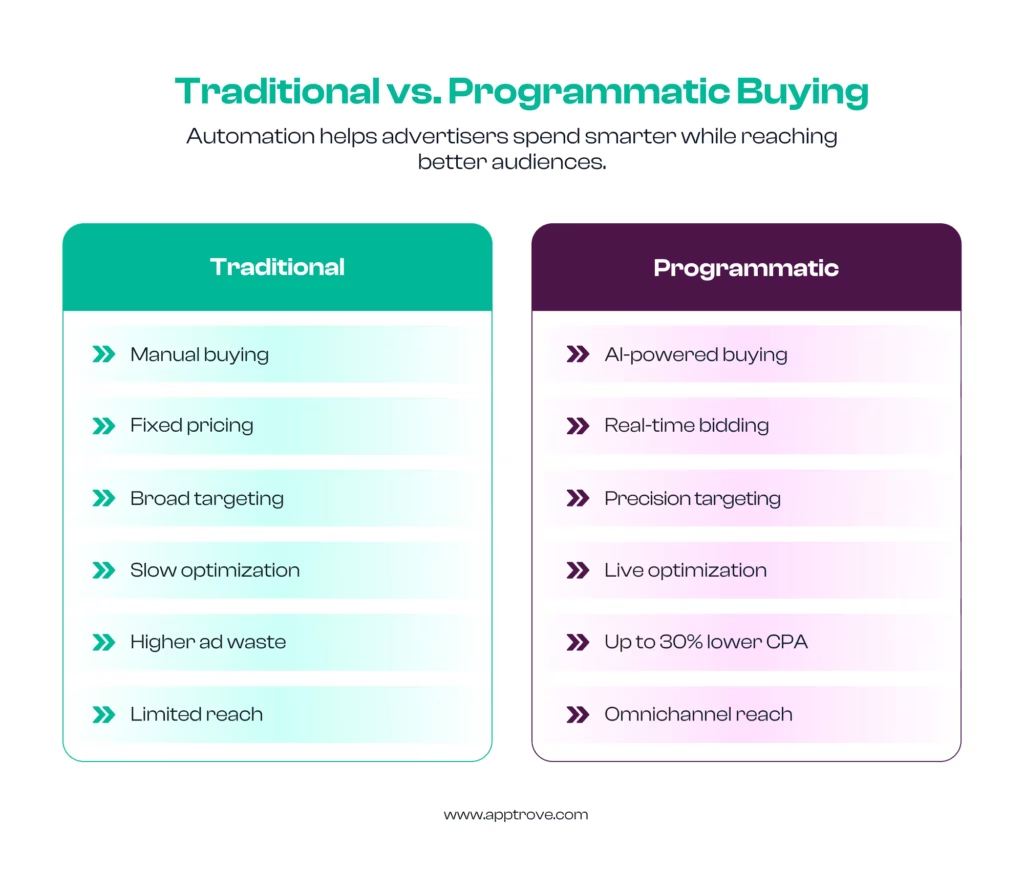
Organizations across industries continue investing in programmatic media buying because it delivers measurable improvements in efficiency, scalability, and campaign performance.
Better Audience Precision
Advertisers can target audiences using hundreds of signals, including:
- Device type
- Geographic location
- Operating system
- Browsing behavior
- App activity
- Purchase intent
- Interests
- Contextual relevance
- First-party customer data
This level of personalization increases engagement while minimizing wasted impressions.
Faster Campaign Management
In traditional media buying, negotiations take time and orders need manual processing, unlike in programmatic media buying, where campaigns can be up and running in a few minutes and be optimised based on real-time results.
Best Return on Investment
Companies that make use of automated bidding often enjoy:
- Savings of up to thirty per cent of acquisition costs
- Better than fifty per cent advertising efficiency
- More than twenty per cent increase in conversions
- Higher click rates due to right targeting
It means efficiency of each dollar spent on advertising.
Omni-Channel Advertising
One campaign can create the same message on different platforms:
- Mobile applications
- Web-sites
- Video services
- Connected TV
- Digital audio
- Native advertising
- Gamer’s environment
Challenges of Programmatic Media Buying
Programmatic advertising has a lot of benefits, but marketers have to understand also the difficulties associated with it.
Fraud
The issue of ad fraud such as bot traffic, fake clicks, illegitimate installs, and invalid impressions is still a problem for marketers. Investing in anti-fraud technologies and consistent monitoring is important to secure the campaign budget.
Data Protection Requirements
The data regulation requirements are continuously changing the digital market. The decrease in the use of third-party cookies and stricter data protection legislation is making first-party data usage more important than ever, as well as consent management practices and audience targeting compliant with data protection regulations.
Brand Safety
With no control measures in place, ads might be placed next to inappropriate or low-quality content. Advertisers must guarantee that they use brand safety measures, safe publishers, and curated marketplaces so that their brand does not suffer.
Competition
The rising number of advertisers using automation in their activities is increasing competition for audience acquisition. Hence, marketers have to implement smart bidding, catchy creatives, and optimization processes in order to succeed.
Programmatic media buying is not just about automation. It requires personal involvement, high-quality data and optimization.
Establish Clear Campaign Goals
Start by establishing measurable targets such as:
– App downloads
– Customer acquisition
– Sales
– Brand recognition
– Customer loyalty
– Return on Ad Spend (ROAS)
When there are clear goals, AI can start optimizing for the most useful outcomes.
Collect Solid First Party Data
First-party data is progressively becoming one of the most precious assets in digital advertising. Data collected from customers includes information from apps, websites, CRMs, etc.
Test Multiple Creatives
The best-performing bidding strategy in the world could never compensate for ineffective creative assets.
Constantly experiment with different:
- Ad Headlines
- Ad images
- Ad videos
- CTAs
- Ad formats
Creative testing is known for improving the click-through and conversion rates.
Track Campaign Results regularly
Track the important KPIs, such as:
- Impressions
- CTR
- CPI
- CPA
- ROAS
- LTV
- Conversion Rate
- Retention Rate
- The ongoing optimization ensures the campaign’s success.
Combine Attribution with Campaign Data
For marketers, rather than simply measuring installs, mobile attribution gives insight into the campaigns attracting valuable users who would create revenue and engagement in the future. Using attribution analytics allows making smart programmatic media buying decisions for sustainable growth instead of chasing short-term results.
The Future of Programmatic Media Buying
The advancement of algorithms in purchasing media programmatically will lead to media buying in the years to come becoming more intelligent, from the viewpoint of the audience’s interest, and operating through multiple channels. Innovations in artificial intelligence are supposed to develop predictive bidding, audience segmentation, and creativity optimization. Moreover, it is expected that contextual targeting technologies will develop even stronger thanks to the diminishing third-party identifiers. New technologies like Connected TV, Digital Out-Of-Home media, retail media networks, and advertising in games will extend the application of programmatic advertising beyond display advertising only.
Privacy-centric metrics, first-party data utilization, and the latest machine learning technologies will define the evolution of digital advertising further.
How Apptrove Supports Smarter Programmatic Advertising
The success of programmatic campaigns begins not only with the purchase of ad placements; it is also about understanding which campaigns lead to key business results.
In this regard, Apptrove offers app marketers the attribution and analytics tools that provide insights into the value of campaigns in terms of outcomes beyond installations. Thanks to the evaluation of the source of user acquisition, in-app events, retention, revenue, and campaign effectiveness, marketers can easily determine which programmatic channels yield top customers.
Thus, such knowledge allows advertisers to manage their budgets, improve targeting, minimize wasted costs, and optimize their actions at every step of the campaign.
Ultimately, by combining media purchasing and attribution, marketers manage to achieve a holistic view of the campaign results.
Conclusion
The world of digital marketing is changing all the time and the trend of automation is dominating in successful marketing campaigns. Automated media buying allows firms to send their messages at the right time and thus ensures effective marketing performance.
However, programmatic media buying is more than just automatic placing ads in the right place for marketers. It provides a possibility to specify the target audience for marketers and ensures the opportunity to carry out ads on various platforms which allows them to achieve their customer acquisition goals.
Since regulations concerning personal data are constantly changing together with the emergence of AI technologies, it is clear that marketers who use first-party optimization will have an advantage over their rivals.
FAQs
1. What is the meaning of Programmatic media buying?
Programmatic media buying is the automated process of acquiring digital advertising inventory using algorithms, technologies of machine learning, and real-time bidding instead of making manual inquiries.
2. What differentiates programmatic media buying from traditional media buying?
While traditional media buying mainly relies on manual methods of negotiation and approval, programmatic media buying deploys algorithms, real-time auctions, and audience data for instantaneous purchase of impressions.
3. Does programmatic media buying work for app marketing?
Sure. Programmatic media buying performs well in app marketing as it provides app marketers with reliable, high-quality customers through automation and precision of audience targeting, real-time bidding, and optimization.
4. What is the technology involved in programmatic media buying?
The requirement of the ecosystem involves the use of Demand-Side Platforms (DSP), Supply-Side Platforms (SSP), ad exchanges, real-time bidding (RTB), mobile attribution platforms, and artificial intelligence.
5. What are the essential metrics for marketers?
The key metrics needed by marketers include impressions, click-through-rate (CTR), cost-per-install (CPI), cost-per-action (CPA), return-on-ad-spend (ROAS), retention rate, lifetime value of the customers acquired, conversion rate, and the revenue achieved from them.