What is Direct Response Marketing?
When launching a campaign, have you ever asked yourself, “Did this truly work?” If so, you’re already thinking in terms of what is Direct Response Marketing. At its core, what is Direct Response Marketing comes down to is one simple principle: when someone sees your message, they should be able to take immediate action—and that action should be measurable.
Understanding what is Direct Response Marketing also means understanding how it differs from traditional brand marketing. Brand marketing focuses on long-term perception, recall, and awareness. It plants seeds and waits for results. In contrast, what is Direct Response Marketing is centered on prompting a clear, immediate response and using measurable data to refine future campaigns.
In fact, studies show that 80% of consumers expect brands to respond within 24 hours, reinforcing the growing demand for immediacy and accountability. That expectation is exactly why what is Direct Response Marketing has become more relevant than ever.
From the perspective of a measurement-focused organization like Apptrove, marketers today want more than surface-level results. They want to understand how, when, and why outcomes occur. At the same time, user expectations have evolved. If your message doesn’t align with intent in the moment, it’s ignored.
In this guide, you’ll explore what is Direct Response Marketing in today’s performance-driven environment, how it fits within a broader strategy, and why it remains one of the most reliable approaches to accountable growth—without chasing vanity metrics or sacrificing long-term value.
The Effects of Direct Response Marketing as it Relates to a Performance First World
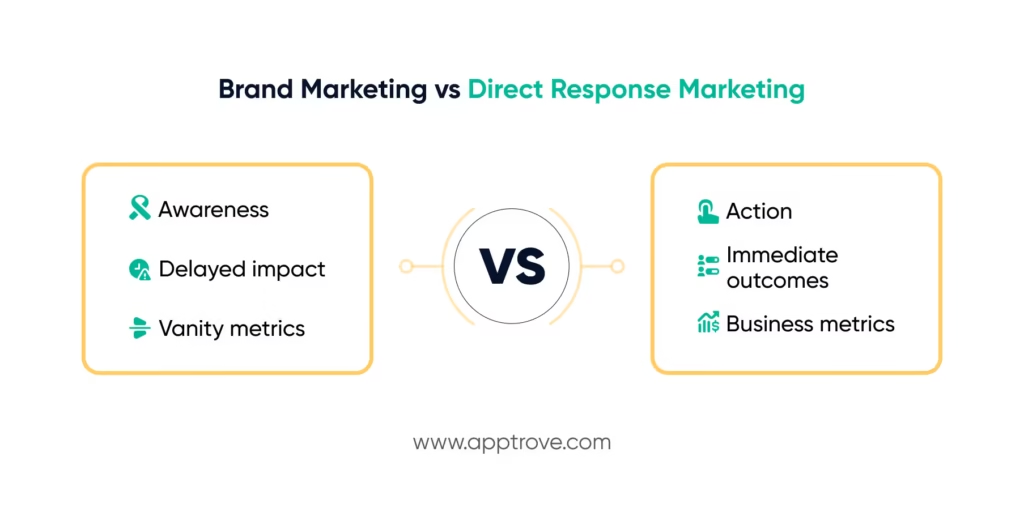
Direct Response Marketing uses a different psychology compared to traditional awareness marketing. In a performance-first world, success is not defined as how many people saw your piece of communication, but rather by how many actually acted on that communication and what action they participated in thereafter. This shift from an awareness to an action focus is tactical, but also very much a psychological switch.
The essence of Direct Response Marketing is urgency and relevance. You are sending a communication to your target audience at a time when they have an intent to do something (i.e., an actionable intent) or at a time that you have triggered an intent to do something. Therefore, your communication needs to feel relevant (i.e., timely, personalized, immediately beneficial) at the time you send it. In contrast to brand campaigns that typically build familiarity through repeated exposures, Direct Response Marketing acknowledges that people’s attention spans are a matter of seconds or even fractions of a second. So, it is your job to present to your target audience why your communication is relevant right now, so that when you provide a takeaway, your audience will naturally take action.
As a marketer, measuring your results is important for the reasons stated above. In a performance-driven world, the ROI of a marketing budget can no longer be measured by reach or impressions. Marketers must show what value a campaign provides, how efficient the campaign was and whether it will grow. Direct Response Marketing bridges the gap between the marketer’s efforts and the business’s success by tying each connection to an actionable outcome (clicks = next steps, conversions = intent ). On the contrary, Direct Response Marketing also shows the impact of actions taken on actual business goals.
Attribution and accountability are now at an all-time high for marketing professionals. With the continued evolution of tracking environments, combined with the increasing public’s expectation of privacy, marketing professionals can no longer rely on assumptions or incomplete data. Questions now revolve around “Did this campaign reach its audience?” and “Did this campaign drive meaningful action—and how can we quantify this?” Direct Response Marketing excels in this type of environment because its structure promotes accountability. Each marketing decision made by the marketer (such as creative, channel, and timing) will be guided by the performance data collected from the campaign rather than being based on intuition.
Part of wider performance marketing strategies. Direct response marketing acts as the engine for transforming intent into action. It does not supplant brand development; rather, it builds on brand presence by capturing leads when they matter most (this example of marketing, when executed properly, develops into a virtuous cycle in that learning occurs quickly and optimizations subsequently become a continual process resulting in intentional growth versus unintended growth).
In a metric-driven world that demands accountability, direct response marketing operates based on an entirely different philosophy because it was designed to do so from its inception.
Direct Response Marketing Is Different Than Traditional Advertising
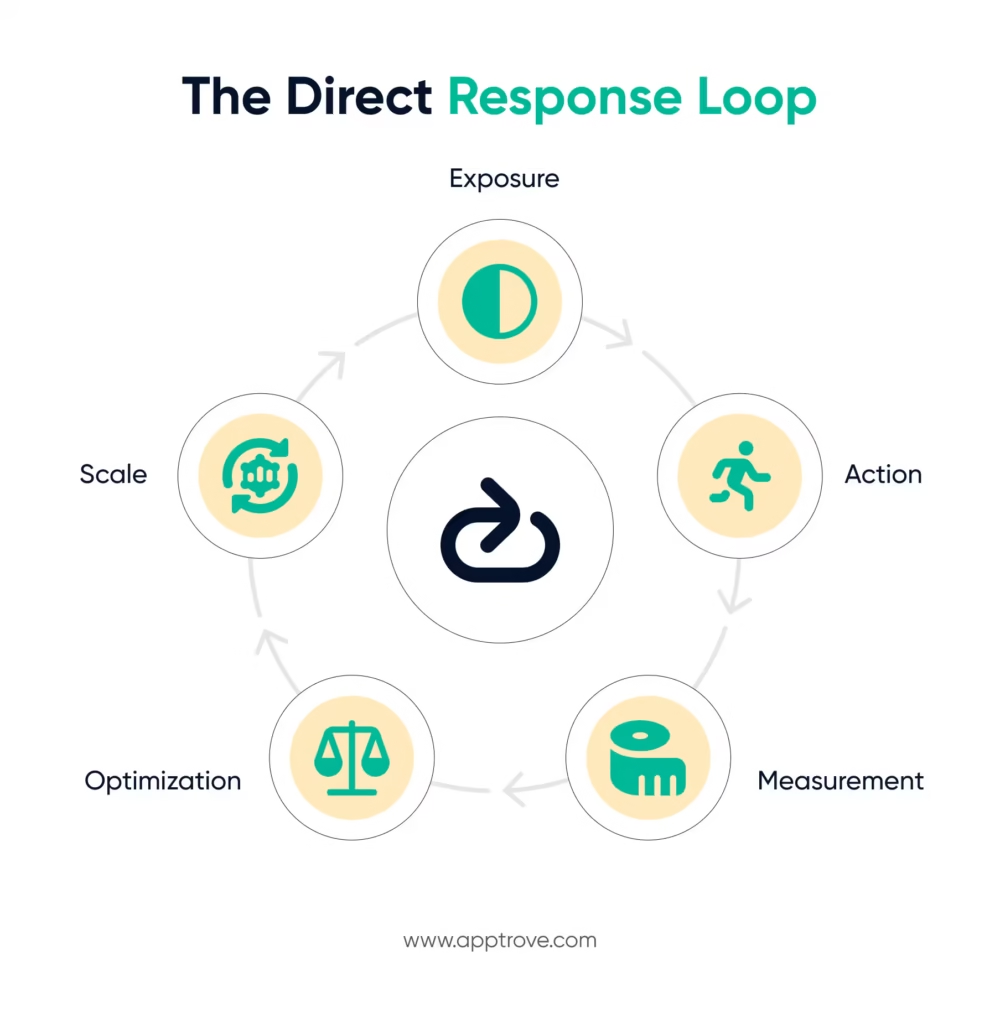
The main difference between Direct Response Marketing and traditional advertising is the speed at which cause and effect occur. Traditional advertising typically has a delayed impact. You create an ad, build up to it, and hope to have a recall that affects the consumer’s future behavior. In Direct Response Marketing, the distance that exists between exposure to an ad and resulting action is eliminated. You build the Direct Response ad such that exposure immediately results in action, and that action can be quickly measured.
A key characteristic of Direct Response Advertising is the use of a structured format. Each message has a corresponding next step, and each next step can also be measured. No matter what the desired outcome is (click, sign up, install), the process is the same: you create urgency and prompt someone to take action; capture their response; and learn from the response.
Direct Response Marketing is more about engineering behaviour than it is about broadcasting messages widely. The importance of immediate feedback in marketing stems from how much quicker advertisers can learn from their campaigns. With real-time responses to what is effective, it is possible to recognize trends at a rapid pace: how consumers respond to messages, what creative assets are driving traffic, and how many users are dropping off.
According to HubSpot, companies that prioritize blogging as part of their marketing strategy are 13x more likely to see positive ROI, highlighting the measurable advantage of performance-driven, response-focused marketing efforts.
As such, the ability to continuously refine and enhance campaigns transforms them from static launches into living systems. The continual refinement of campaigns through ongoing feedback loops gives Direct Response Marketing the greatest overall advantage. Every new interaction with a user provides information that informs the subsequent decision made by an advertiser (creating an ongoing cycle of improved performance through constant refinement). Rather than function on the premises of history or previously established metrics, advertisers receiving real-time signals are able to make the most appropriate choice that is based upon direct input from their audience. As time passes, these incremental improvements build up; through repeated execution of minor optimizations over time, Direct Response Marketing generates better outcomes than traditional advertising.
With real-time performance data, the methods used for approaching creative processes, channels, and messaging have also changed. Creative is no longer a single-use asset—it is now something that will continue to change as the audience responds. Channels are not chosen based on reach alone; they are chosen based on their ability to generate measurable outcomes. Messaging will be more focused and have a clearer connection to the intent of the user.
As a result of these changes, people who use direct response marketing will not only be using a different form of advertising than those who use traditional advertising; they will also be using adaptive direct response marketing that has been designed to react to the actual way users engage with the message instead of making assumptions about how they will respond.
How Channels Created to Provide Direct Response Marketing Efforts Yield on the Relationship Between the Metrics They Can Provide Insight Into
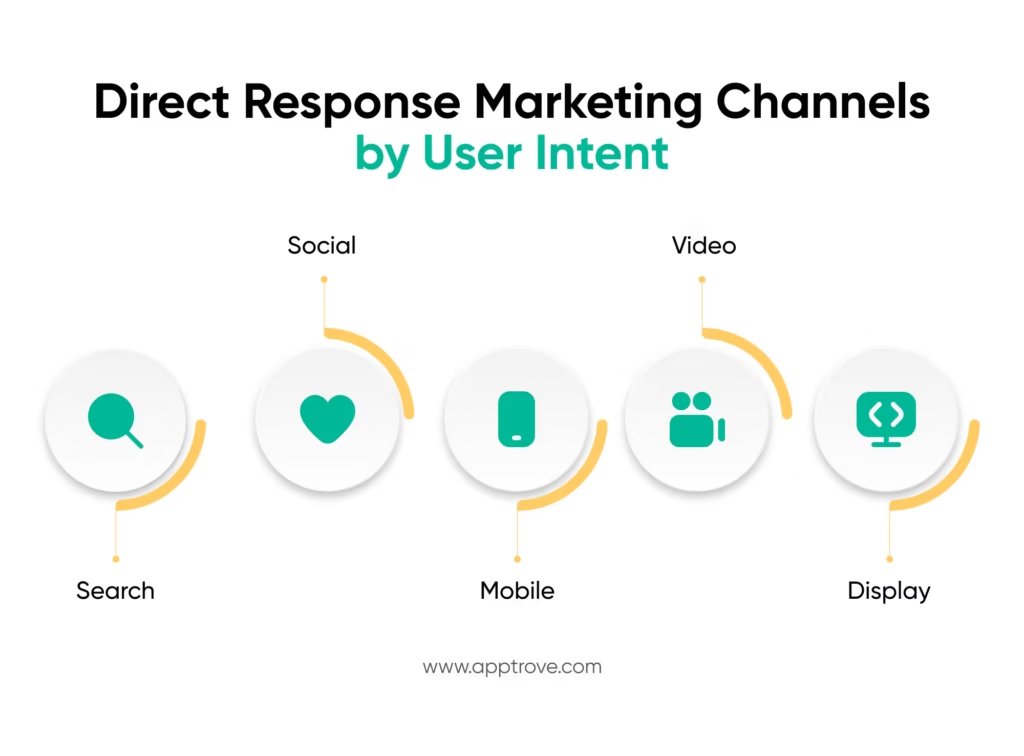
The way that channels provide effectiveness for Direct Response Marketing is primarily due to the way that these channels relate to how each channel captures a user’s intent based on the various touchpoints users experience during their use of the Internet in a performance-driven manner. Therefore, channels are to be measured more on the basis of how well they convert intent to action, rather than simply measuring the number of people that can be reached by a given channel.
With the flexibility associated with the paid social channel, it is possible to generate demand through the paid social channel while at the same time capturing demand through the paid social channel. Although users do not necessarily have an immediate need for a product/service during their experience on the Internet, there is still a high level of receptivity to messaging that resonates with them. Thus, when users can be exposed to creative and properly targeted audiences in the form of paid social advertisements, they can be inspired to take action immediately following exposure through impulse responses. Because of the very short time frame in which feedback can be received through social media, such as likes, clicks, installs, and/or conversions, paid social has become an ideal channel for direct response marketers who are looking to quickly experiment with creative and develop an iterative process for developing Direct Response Marketing campaigns.
According to WordStream, the average conversion rate for Google Search Ads across industries is 4.40%, demonstrating how intent-driven channels like search consistently convert user demand into measurable action.
On the other hand, search is a natural fit for direct response advertising because intent is clear. The seconduser’ss search, they have already stated their need. Direct Response Marketing thrives in this space because it matches high-intent queries with clear value propositions and immediate calls to action. Along with the measurable nature of search performance, the efficiency can be measured; however, it also requires precision. Any messaging that does not specifically address intent will not convert, regardless of how recognizable the brand is.
The mobile-first experience is central to all direct response channels. Most direct response interactions occur on mobile devices, which means the necessity for fast, clear, and simple experiences is at an all-time high. If a landing page takes too long, creates confusion, or does not align with the promise of the advertisement, the user will lose their intent to act. Direct Response Marketing relies heavily on mobile flow without friction; therefore, any minor delay can disrupt a user from taking action and change the performance signals.
Placement of the creative affects response behaviors, and how and where an ad appears creates a user mindset. For instance, people consuming a full-screen video experience an immersive ad, while people consuming ads natively through their news feeds find that the ad blends into their overall content consumption and do not have the same experience. The differences between the contexts in which ads appear will alter the way that a user interprets the message in the ad and their willingness to act on it at that time. With Direct Response Marketing, the creative also includes where you say something and when you say it, not just what you are saying.
In addition to differences based on where an ad appears, the user’s intent is different by channel, which is why a one-size-fits-all approach rarely proves effective. For example:
– The search user is usually very aware of their problem and is motivated to take action,
– The social user is more influenced by emotional relevance and the timing of their ad
– The display and video advertising user generally resides in the beginning stages of their purchase or is looking to reaffirm their decision to purchase.
The more you understand how a user behaves differently by channel, the more you will be able to align direct response marketing strategies to how they actually behave; therefore, creating an environment in which to measure the expected outcomes will be more predictive, more explainable, and easier to optimize than if you treat the channel as a distribution channel.
How Direct Response Marketing Metrics Actually Measure Success
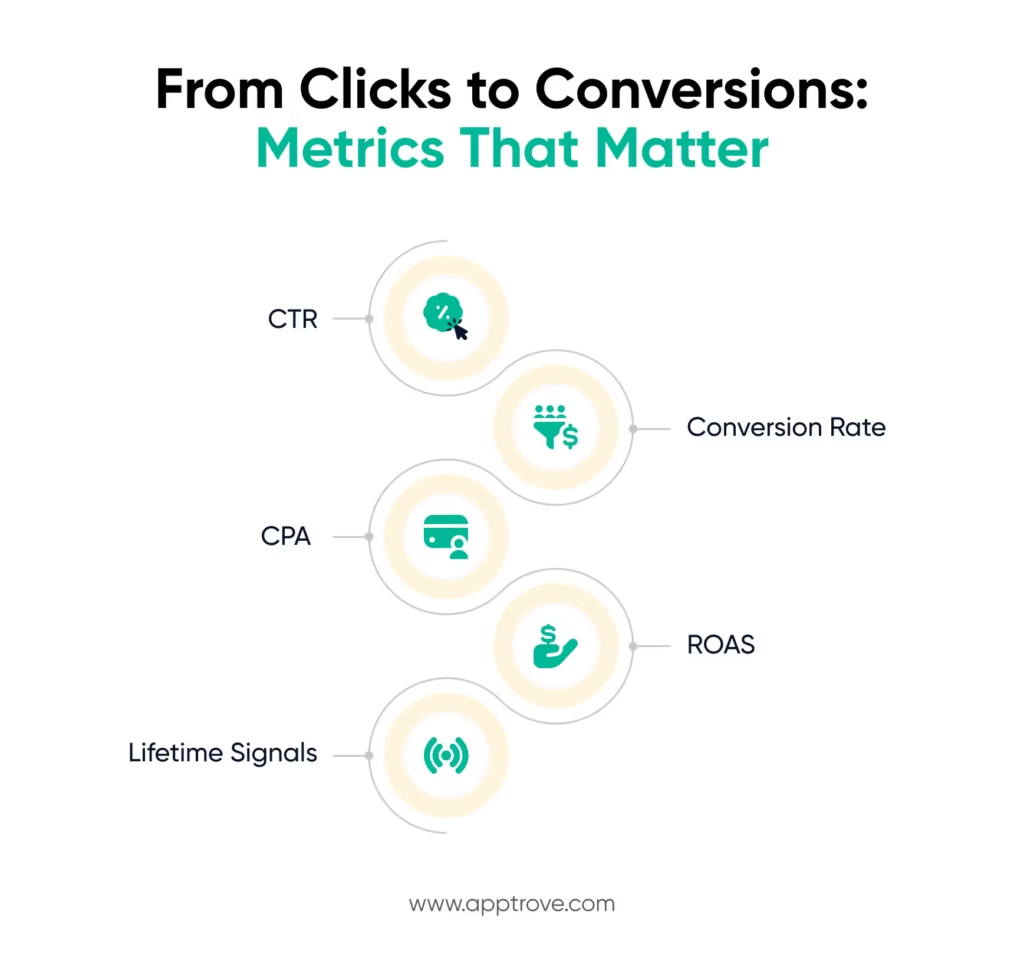
In Direct Response Marketing, metrics are more than measures of activity; they provide indications of intent and value. One of the biggest mistakes performance marketers make is to treat early metrics, such as clicks or impressions, as measures of success. Yes, clicks tell you that something has attracted a person’s interest, but they do not give you any indication of whether the attention given to that item resulted in a meaningful outcome.
What really matters is what happens after the click. Conversion Rates provide early indications of alignment between the message delivered and the expected experience, while Cost Per Acquisition (CPA) provides evidence of effectiveness in achieving that alignment. In Direct Response Marketing, these metrics work together to provide the necessary insight. A high click-through rate (CTR) but poor conversion indicates misalignment between the message and the performance of the offering.
To measure success, we need to consider all of the metrics involved in determining the value of a response, and we will celebrate the totality of the response, not just the first interaction.
The importance of conversion quality cannot be overstated — it is also an often overlooked measurement. All conversions do not have the same value. High volume of low-intention actions can create an inflated performance on paper; however, these may not create any long-term impact.
Direct Response Marketing will be successful if you also look at whether the conversion has created a continuing level of engagement, retention, or revenue. This is where lifetime signals add another level of depth to your understanding of the long-term value of a conversion beyond just the immediate result.
A major challenge is balancing short-term versus long-term performance. Short-term performance indicators (such as CPA and ROAS) can help guide optimization, but they may not adequately indicate long-term effects. Some campaigns may provide good results in the beginning, and continue to deliverhigh-qualityy users over time. Other campaigns may look very efficient initially and ultimately prove not to be viable options due to a lack of engagement after the initial response. To that end, Direct Response Marketing requires an appropriate balance of the two types of metrics in order to make the best decisions regarding a specific campaign.
Attribution windows produce additional insight into performance – specifically the time frame you want to give credit for conversion, because the channel, creative, or message that happens to be successful may be a product of how much time has passed since the action was taken, and there may be a significant difference between immediate action (short term attribution windows) versus delayed action (long-term attribution windows). With people’s journeys becoming increasingly fragmented, understanding this difference is incredibly important, as direct response marketing metrics are only useful when using the correct measurement lens.
The goal shouldn’t be to optimize to the nth degree for each metric; rather, it’s about interpreting performance in an informed way. If you over-optimize to the point where you lose flexibility and creativity, you will never optimize effectively. Direct response marketers who use the available metrics as a guide instead of a rule will have an easier time adapting, learning, and developing confidence in their efforts than those who only focus on the number itself.
How Direct Response Marketing Strategies are Enhanced by Creative Strategy
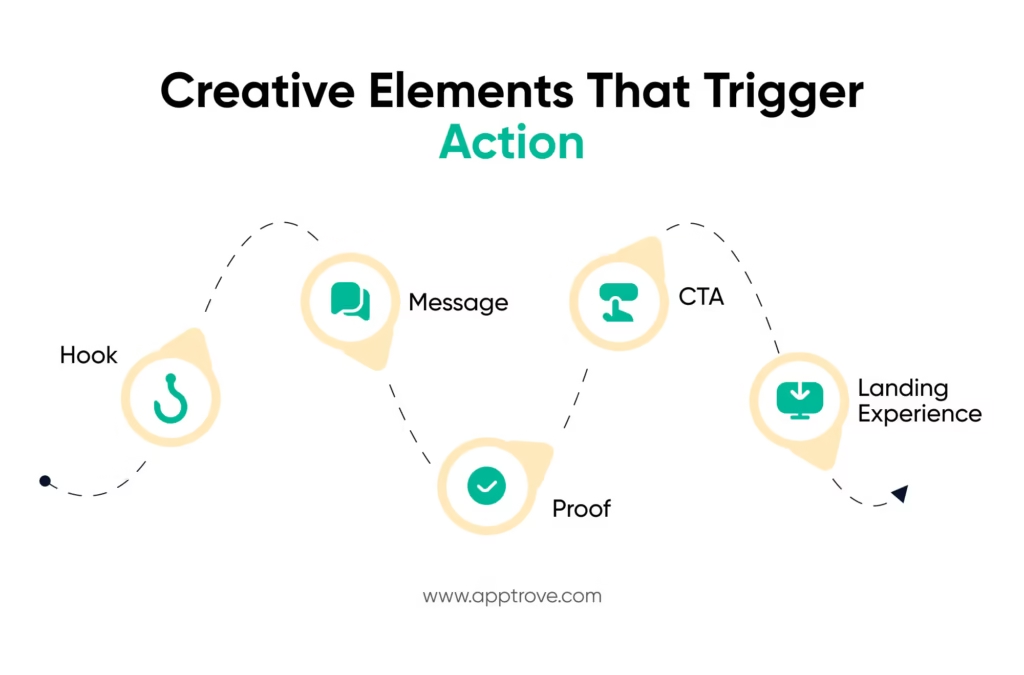
Direct response marketing typically confuses the creative side with visual-based creativity. Unlike that, creativity is actually behaviorally based engineering. When a company makes a creative decision, it will utilize that decision to reduce the amount of friction involved in achieving a goal and cause motivation to reach that goal. Creatively designed visual aesthetics assist with providing clarity and intent; it is still the case that if a piece of creativity does not cause someone to take action, it has not fulfilled its purpose — this is true regardless of how professionally designed the piece is.
To achieve successful direct response marketing, companies must balance both the emotional and the logical triggers through the creative decisions they make. The emotional appeal creates attraction and resonance to the offer, while the logical appeal gives the prospect a valid reason to justify the offer. A prospect’s initial curiosity or urgency will be created from the hook or headline,e but the continued interest of a prospect will be sustained by the message and proof the prospect is provided with. Testimonials, clearly defined benefits, and contextual support will help bridge the gap between impulsive and confident decision-making. When the emotional and logical aspects of the creative decision are utilized together, response rates improve naturally.
In the world of direct response advertising, relevance outweighs polish consistently. Consumers expect usable and helpful messages over perfection in quality or other aspects of professional design or execution. Therefore, messaging that feels current and specific will generally outperform high-end productions that feel like they belong to no particular place or time. Further, direct response marketing is all about alignment; the user’s state of mind matches the message they receive that will lead them to take the action desired by you. When relevance is high enough, even the simplest of ccreativescan generate good results.
Another key element is creative fatigue. Due to the need for repetition and scale in direct response marketing, over time, customers will no longer respond to the same messaging because they have already processed it. This can happen not because of the offer itself but instead due to the user having seen it too many times already. Therefore, it is essential to use iterations rather than create entirely new campaigns. By making small changes in the messaging, format, or framing of the offer to keep it fresh, you can continue to see positive results from your creative work for an extended period of time. Thus, creative work becomes an ongoing activity rather than something you do once and are finished with.
When it comes to communicating clearly through advertising, clarity is more important than being clever. The use of ambiguous messages in Direct Response Advertising can confuse and frustrating for the user. The message must make it clear what the offer is, why it is important, and what you want the user to do next. Creative ways of communicating using clever language or abstract ideas may attract people’s attention momentarily, but they could delay someone’s decision about whether or not to respond to your offer.
The direct method of advertising is advantageous to Direct Response Marketing because it allows for a communication strategy that respects the user’s time and attention.
Utilizing creative strategy as a form of systematic behaviour control provides marketers and advertisers with one of the strongest tools available for creating measurable outcomes. By aligning thought and emotion, relevance and action, and clarity and confidence, the conversion of attention to results is more likely than the conversion of attention to impressions.
How the Strategy and Measurement of Attribution Shape Performance of Direct Response Marketing
Clarity is an essential component of successful Direct Response Marketing. Without being able to clearly associate an action with its source, you are left guessing at how to optimize your ongoing efforts. Attribution will turn your activity into insight by showing which channels drove the response, which creatives accelerated the response, and which touchpoints contributed to results in the measurement of success. Without attribution, direct response marketing will lose its greatest strength: the ability to improve through evidence.
Optimization based on response will only occur if you have an understanding of the cause and effect between the two. Attribution models will allow you to create a map of the cause-and-effect relationship between your various marketing efforts. Attribution models will also allow you to determine the effectiveness of the various marketing efforts you have made based on where intent was captured, success in developing the intent, and where intent was ultimately converted to a desired outcome. Through careful analysis of these signals, you will be able to reallocate your budget according to the effective marketing channels, refine your messaging, and establish which marketing channels provide the best return on investment. Attribution not only provides you with data related to your results; it also assists you in making business decisions.
Using only last click thinking can skew this entire process. Last Click Attribution gives credit for the last touch before conversion, but the customer journey is more complicated than that. Customers can have many touches before taking action (think social exposure, refining their searches, or being reminded of your products through retargeting ads).
Direct Response Marketing becomes more effective and strategic when you realize that influences build over time. If you look beyond the last touch, you will be able to value the complete response path rather than oversimplifying it.
Measurement has also become more difficult because we now live in a “Privacy First” world. As access to data continues to change and trackability becomes more restrictive, marketers are using partial signals to make performance decisions. This does not mean that Direct Response Marketing is dead; it means that you must change how you determine performance. Models based on probability, aggregate reporting, and modeled conversions are now part of our vocabulary; the challenge is not perfection but consistency.
Consistent and reliable data are much more important than hyper-granular data that may change randomly. With a stable measurement framework, you are able to see ongoing trends even if there are some missing signals. A level of consistency creates confidence in optimization decisions. If there is no consistency, there is a chance of reacting to noise instead of an actual change in performance.
Do not panic at the loss of signals. Instead, be more thoughtful and smarter in your approach to analysis. Focus on directional trends, conversion quality, and long-range impact rather than chasing after every up and down. Direct Response Marketing continues to be successful because it is a measurable means of taking action. Even with changing privacy conditions, using an evidence-based attribution and a disciplined interpretation, you can optimize with confidence rather than fear.
How Direct Response Marketing Could Be Implemented Within A Sustainable Performance Marketing Strategy
Within a Sustainable Performance Marketing Strategy, Direct Response Marketing is a very effective tool; however, it is important that Direct Response Marketing never aactsin a vacuum. When used independently and only as a short-term tactic (i.e., focused solely on immediate conversions), Direct Response Marketing can lead to short-term spikes in your results; however, it will not contribute to the building of sustained momentum in any area of your business. Instead, to leverage the full value of Direct Response Marketing as part of a Sustainable Performance Marketing Strategy, you must incorporate other strategies (e.g., First Click Attribution Strategies, User Experience Strategies, etc.) into your overall sustainable performance marketing system to fully recognize the value of Direct Response Marketing on your business.
As you begin to achieve balance between immediate performance and longer-term growth, you will begin to gain maturity in your overall business. You can measure short-term metrics such as cost per acquisition and return on advertisement spend to optimize efficiency; however, you are not always able to measure brand equity, quality of retention, or downstream revenue. If you make decisions based solely on short-term results, you have a tendency to undervalue those campaigns that establish familiarity and trust over the long-term. To achieve a Sustainable Performance Marketing Strategy, you must evaluate your Direct Response Marketing results within the context of your overall business; they cannot be evaluated in isolation by using them as scorecards.
Burnout may occur from hyper-optimization related to both campaigns and teams. Every little performance fluctuation leads to reactive adjustments and creates a lack of strategic direction. Direct Response Marketing does thrive on iterative processes; however, these processes need to be structured and orderly as opposed to being chaotic in nature. Having a clearly defined testing framework,k along with defined test periods and objective criteria on which to evaluate, te allows you to limit the extent to which you have overreacted to fluctuations in performance. When you react to every decrease in performance, you are not looking at meaningful indications of change; instead, you are chasing every small decrease without validating which changes have occurred as a result of those decreases.
Thoughtful and structured testing and scaling processes are essential. Early-stage campaigns will want to focus on maximizing the velocity to learn by testing messaging, creative formats, and audience signals in order to see what resonates with their audiences. Scaling will be much easier as long as you have established stable performance levels; scaling will be based on evidence rather than assumptions. Direct Response Marketing will sustain its potential for success by using a phased approach with the three phases consisting of exploring, validating, and then expanding, so that you do not sacrifice efficiency for growth.
Strategic maturity in your performance marketing strategy requires an understanding that Direct Response Marketing is a tactical driver but also serves as a diagnostic tool for performance. This channel gives insight into user behavior and how messaging aligns with user intent and where users encounter friction while navigating your site or service. When you combine Direct Response Marketing with your overall strategy through a cohesive plan, it helps to produce long-term, measurable growth that accumulates over time as opposed to being exhausted at the conclusion of every campaign cycle.
What is Direct Response Marketing’s Future?
The world of Direct Response Marketing continues to evolve along with changing consumer behavior, social media platforms, and increasing regulatory requirements. The next phase of Direct Response Marketing will include advances in sophistication, balancing automation (mechanics) with human intuition (creativity), and adaptation to new measurements while remaining accountable.
A major trend will be the balance of automation vs. human decision-making. Automated machinery and tools will automate tasks such as automated bidding, automated audience segmentation, and automated dynamic creative adjustments through machine learning technology. However, marketers will still rely heavily on human judgment to develop strategic direction, to convey meaningful messages, and to provide insight about the overall performance of campaigns in the context of relevant users. While executing campaigns faster via automated tools is certainly valuable to marketers, automation does not eliminate the need for insight; instead, it enhances insight.
Finally, increased emphasis placed on privacy-centric measurement paradigms will impact how marketers approach their task. Third-party tracking is rapidly becoming obsolete. Therefore, marketers will develop campaigns centered around the understanding of first-party (consented) data and contextual signals, providing insight into user behavior (i.e., where did they go and what did they do?). Campaigns created with respect to privacy and consent will be more successful in building trust with consumers while maintaining positive performance levels. This shift to data-based (trend- and pattern-based) decision-making creates a stronger emphasis on the quality and effectiveness of signals instead of merely the quantity or physical location of the individual signals.
Future marketing will place more emphasis on creative-led performance, primarily because platforms are becoming more algorithmic in the measurement of engagement. Creative is what will separate campaigns that simply run from ones that actually create impact. Future Direct Response Marketing will require marketers to test not only the different formats of creative, but also to evaluate the numeric elements of the creative designed to encourage user action. Strong hooks, appropriately framed values,s and seamless transitions from the ad to the landing page will all be priorities for marketers.
In a lot of cases, signal-based optimization will replace traditional deterministic measurement. Marketers will be working with probabilistic aggregateddatad or modelled impression data rather than exact user paths in determining success or failure (deterministic evaluation). Marketers will use aggregated signals/probability-driven insights, modelled conversions, and privacy-protected measurements to maintain performance, learning from their efforts. Incrementality testing and mixed measurement frameworks are beginning to gain traction for this reason.
Though there have been some changes to how we do business with customers, Direct Response Marketing has not disappeared; it has changed forms. This type of marketing will be successful for many years to come because it still delivers the same value proposition—connecting an intention with a relevant action that can be tracked and improved. Growth trends in the industry show that there will continue to be a strong demand for this type of marketing. For example, the online advertising industry was projected to increase from about $734 billion in 2024 to over $843 billion in 2025, indicating that measurable and performance-oriented marketing is still critically important to businesses. This growth indicates a very strong trend toward accountability in business, meaning that it is no longer just something companies want; it is now something that they must deliver as part of their overall strategy.
As technology continues to change and develop, privacy issues become more critical, and consumer demands become more sophisticated, marketers who use both creative thinking and a signal-based analytic approach to direct response will drive the future of direct response marketing. Direct response marketing will continue to play an important role in the evolution of this industry and provide marketers with a flexible framework for executing their marketing programs based on clear goals, responsiveness to changing market conditions, and measurable results.
What is Direct Response Marketing: Why Intentional Implementation Is Key
The first step to implementing Direct Response Marketing (DRM) more intentionally is changing your mindset. Instead of focusing on short-term hacks or isolated victories, focus on creating systems. A single successful ad will give you temporary results, whereas using a systematic framework for testing, measuring consistently, and optimizing repeatedly will provide sustainable results and growth over time. Treating Direct Response Marketing as an intentional process makes it infinitely stronger than simply working from a list of tactics.
Your number one priority should be learning velocity. The goal is not just to have campaigns run; it is also to learn from them. Each of your creative variations, each piece of your audience test, each channel that you experiment with should have a specific question that you can answer. What creative appeals to your consumer the most? What intent signals convert best, and what types of friction occur? When your focus is on the speed and clarity with which you learn, then naturally your performance will improve because your decisions will be based on facts instead of assumptions.
Developing trust in your performance data is equally important. A lot of performance changes don’t need you to take action. For Direct Response Marketing, the fluctuations in your data need to be assessed over time. Reliable, usable performance measurement systems, consistent attribution models, and specific metrics for success help you to make adjustments confidently without having to act quickly. You should let data direct you, not dominate you.
Finally, instead of asking “Did it work?” of your campaign, consider: “How can we learn from this?” or “What does this tell us about the intentions of the user?” Direct Response Marketing is about obtaining insight into behavior over time and using that insight to develop a more successful strategy. In addition, making planned changes instead of reactive changes to your campaign will provide you with a more substantial and long-lasting marketing plan.
If you’re interested in finding out how clear attribution and structured measurement can help you make better Direct Response Marketing decisions, you can see it for yourself by starting a free trial with us. You’ll be able to see how actionable performance insights can help improve your confidence and clarity when optimizing.
FAQs
What is Direct Response Marketing best used for?
Direct Response marketing can help you achieve an immediate, measurable response from your audience, whether it’s a click, sign-up, or purchase. Since it provides accountability, you can link your marketing efforts to a specific intent and outcome, allowing for measurable growth driven by both performance and results.
Why is Direct Response Marketing important for performance teams today?
By offering measurable feedback loops, performance teams can rapidly learn from their experiences and gain confidence in their performance improvement strategies. Direct Response Marketing provides measurable results in environments where accountability is important to justify advertising budgets using clear outcome metrics.
How does Direct Response Marketing differ from brand marketing?
Direct Response Marketing is all about getting an immediate reaction and measuring it as quickly as possible. On the other hand, Brand Marketing is creating a long-term sense of familiarity with your brand. The key differences between these two marketing techniques are the time frame, the intent of your marketing campaign, and how you measure success.
What metrics matter most in Direct Response Advertising?
The most important performance-driven metrics for evaluating the success of a campaign are: conversion rate, cost per acquisition, return on advertising spend, and user quality. These metrics can help determine whether your campaigns create value for your business after the first touchpoint has occurred.
How does attribution influence Direct Response Marketing decisions?
Attributing results from multiple channels and touchpoints will provide you with more visibility into how to optimize for those channels, as well as provide clarity on the effectiveness of your marketing spend. As a result, you’ll be able to make better-informed decisions based on reliable measurements versus relying on less accurate data, such as inaccurate or inconsistent reporting methods.