
What is a self-attributing network (SAN)?
A self-attributing network (SAN) is an advertising platform that performs attribution for its own campaigns using its own data and attribution logic, then reports those results to advertisers. SANs can also integrate with mobile measurement partners, but their reported attribution may differ from the MMP’s methodology.
Google Ads, Meta, and TikTok are the most common examples that most marketing teams encounter. Each platform runs its own attribution logic internally, decides which ad interactions led to an install or conversion, and hands advertisers a final number through its own dashboard or API.
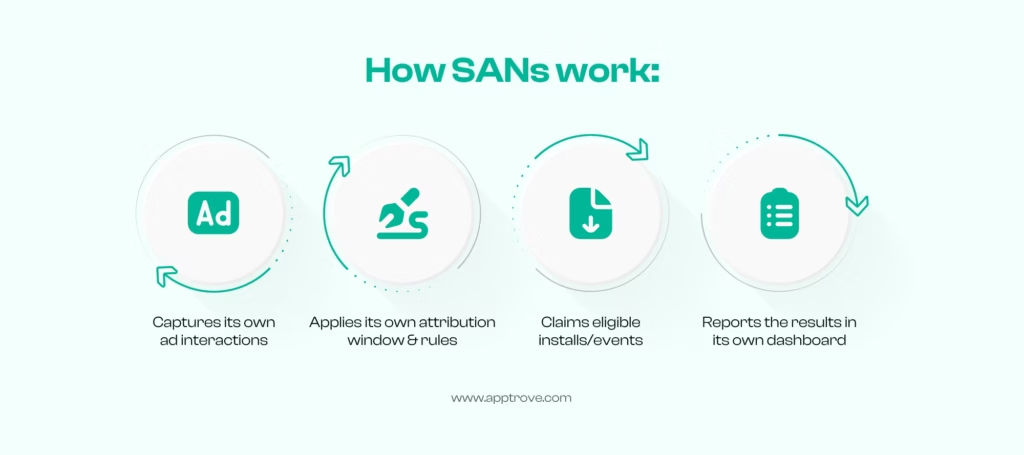
A self-attributing network is essentially an advertising platform that uses its own attribution logic to evaluate the performance of the campaigns running on it.
This matters more than it sounds. The platforms selling the ad inventory are also the ones scoring their own results. Understanding how that works, and where it breaks down, is foundational to any serious approach to mobile measurement or multi-touch attribution.
Why Do SANs Need Added Tracking?
Here’s a realistic scenario.
A performance marketing manager is running campaigns across Google Ads, Meta, and TikTok simultaneously. A user sees a TikTok ad, scrolls past it, then clicks a Meta ad two days later and installs the app. Both TikTok and Meta might claim credit for that same install. Each platform applies its own attribution window and its own logic to decide what counts as an influenced conversion.
The budget consequences of this are real. If three channels are each claiming the same 10,000 installs, and a team is optimising spend based on those self-reported numbers, resources flow toward channels that look productive on paper but may be double-counting results that only one of them actually caused.
How Do Self-Attributing Networks Work With an MMP?
A self-attributing network keeps much of its advertising and engagement data within its own ecosystem. That changes the way attribution works compared with a traditional ad network.
Nobody outside a SAN can fully verify how its attribution decision was made. That’s the core tension in SAN marketing: the platforms selling the ad inventory are also the ones scoring their own results. The same install can appear as a win in more than one dashboard simultaneously, not because anyone is deliberately deceiving, but because each self-attributing network measures its attribution independently without comparing notes with any other.
With a standard network, an MMP may receive information about ad interactions such as clicks or impressions and use those signals when evaluating an install. With a SAN, the MMP generally does not receive the network’s complete engagement history upfront. Instead, it can ask the network whether it recorded a relevant interaction for a particular conversion.
A simplified flow looks like this:
- A user interacts with an advertisement on a SAN.
- The user later installs and opens the advertised app.
- The MMP records the install and gathers the signals available to it.
- The MMP sends an attribution request to the relevant advertising platform.
- The SAN checks its own records for a qualifying interaction.
- The network returns the result of that check.
- The MMP considers that response alongside signals from other acquisition sources before applying its attribution rules.
The important point is that the SAN retains control of its own engagement data and attribution logic. The MMP provides the cross-channel measurement layer around those platform-specific claims.
That is why integrating a SAN with an MMP is different from simply receiving click data from a conventional advertising network.
SANs and Standard Ad Networks: What Changes?
Both SANs and conventional ad networks can bring users into an app. The difference is mainly in how their advertising data is made available for measurement.
A standard network can typically pass engagement information to an MMP, giving the measurement platform data it can use across the broader customer journey. A SAN generally keeps its interaction data within its own environment and responds to attribution requests based on what it knows about the user and the ad interaction.
| Measurement aspect | SAN | Standard ad network |
|---|---|---|
| Engagement data | Primarily retained within the platform | Can be passed to the MMP |
| Attribution input | Network’s own recorded interactions and rules | Data supplied to the MMP |
| Cross-channel comparison | Requires an external measurement layer | More directly available through the MMP |
| Attribution methodology | Defined by the network for its own reporting | Applied by the MMP to available engagement data |
| Integration approach | Commonly based on an API or platform integration | Often uses tracking data passed to the MMP |
This distinction becomes especially important when a business runs several acquisition channels at once. A SAN can tell you how it evaluates its own campaigns, but that view does not automatically show how those campaigns compare with activity from competing networks.
An MMP fills that measurement gap by giving marketers a common framework for looking at performance across sources.
Why Do SAN and MMP Numbers Sometimes Differ?
Different numbers do not necessarily indicate a reporting error.
A SAN and an MMP may be measuring the same conversion from different perspectives. The advertising platform evaluates its own interactions using its rules, available signals, and attribution windows. The MMP evaluates the available evidence across multiple sources according to its own measurement methodology.
That can lead to different attribution outcomes.
For example, imagine that a user sees an ad on Network A, clicks an ad from Network B the following day, and then installs the app. Network A may still report the install under its own attribution rules, while an MMP may evaluate the interaction from Network B as the stronger qualifying touchpoint.
Other factors can also create differences, including:
- Click and impression attribution windows
- Different definitions of a qualifying interaction
- Install and first-open timing
- Re-engagement or redownload treatment
- Privacy restrictions on available identifiers
- Differences between platform-specific and cross-channel measurement
So when two reporting systems show different results, the right response is not to assume that one is automatically incorrect.
Instead, look at how each number was generated. Understanding the methodology behind a result is essential when using attribution data to make budget or optimisation decisions.
Why SANs Matter To User Acquisition Teams?
Self-attributing networks are important because they power some of the largest channels used to acquire mobile users. They combine advertising reach with large amounts of first-party information from their own ecosystems, which can help them optimise campaigns towards installs and post-install actions.
That makes SAN reporting valuable for everyday campaign management. A user acquisition team can use platform-level reporting to evaluate creatives, bids, audiences and campaign performance within each network.
The challenge appears when the team needs to answer a broader question:
Which channels are actually contributing to overall app growth?
A user may discover an app through one platform, interact with another campaign later, and install after several other touchpoints. No individual SAN has a complete view of all of those interactions because its visibility is largely tied to its own ecosystem.
This is where an MMP becomes useful. Instead of replacing the reporting provided by the advertising platforms, it adds a cross-channel measurement layer. That makes it easier to evaluate SAN performance alongside other acquisition sources and understand the wider customer journey.
For growth teams, the combination is often more useful than either view on its own: SAN reporting for platform-level optimization and MMP measurement for broader performance analysis.
This version is independently written and does not reproduce the wording or sentence structure of the referenced glossary. The underlying concepts are based on the SAN/MMP framework discussed in the source.
Is A SAN The Same As An SRN?
Yes. Self-reported attribution (SRN) is an older, alternate label for the same concept. Both terms describe a platform that attributes its own campaign performance internally rather than routing raw data through a neutral third party before reporting it to advertisers.
Some measurement vendors popularised the SRN phrasing in their documentation while self-attributing network became the more widely used industry term. If you see both terms in different vendor glossaries, they’re describing the same behaviour, not two different ones.
Top 5 Popular SANs
The major self-attributing networks most marketing teams deal with regularly:
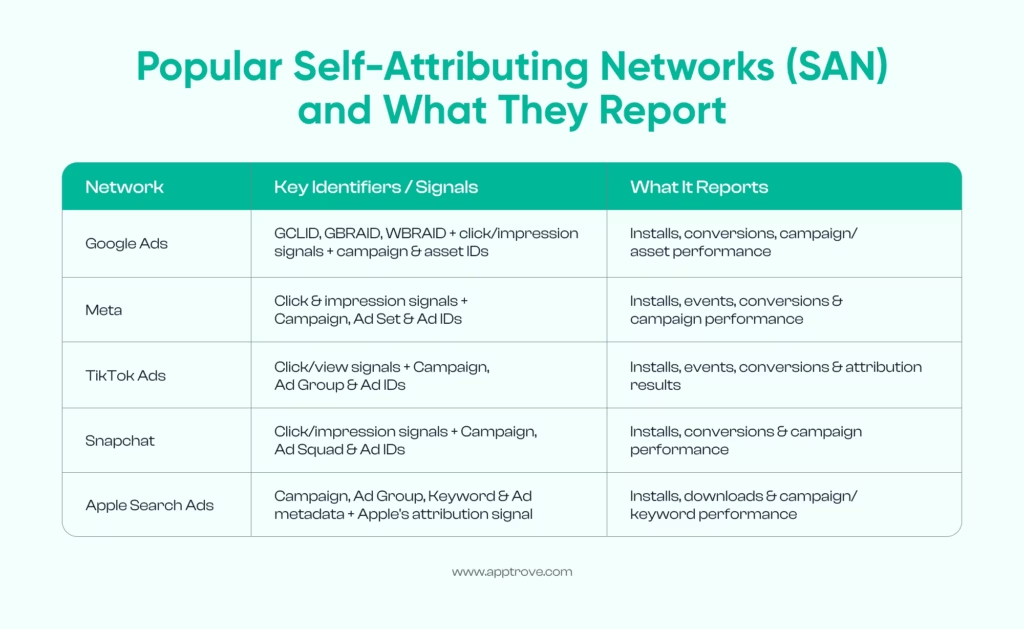
Google Ads: Google measures app campaign performance within its own advertising ecosystem and supports multiple app-measurement pathways. For advertisers using an App Attribution Partner, Google can receive conversion events and consent signals through the MMP integration, while its current iOS measurement stack also includes modeled conversion reporting, Integrated Conversion Measurement, and SKAdNetwork. The key characteristic here is the breadth of Google’s measurement ecosystem: marketers can see Google-reported performance alongside an MMP’s cross-channel view rather than treating the two as identical datasets.
Meta: Meta’s strength is the amount of activity that happens within its own ecosystem, particularly across Facebook and Instagram. For app advertisers, this creates a large pool of first-party signals that can be used for campaign delivery, optimisation, and measurement. Meta has also supported integrations with MMPs for campaign-level measurement, giving advertisers a way to connect advertising performance with downstream app outcomes and revenue.
TikTok Ads: TikTok’s SAN approach is particularly notable because it was designed to capture more than just the last-click interaction. Its SAN integration supports configurable attribution windows and metrics such as engaged view-through attribution, allowing TikTok to measure conversions influenced by ad views as well as clicks. This matters for a platform where users may discover a product or app through a video, leave the platform, and convert later.
Snapchat: Snapchat combines its own platform signals with mobile measurement infrastructure for app campaigns. Advertisers can connect an MMP to measure what users do after interacting with Snapchat ads, while Snapchat’s newer Unified Attribution brings platform signals and MMP cross-channel measurement closer together for campaign optimisation. Its distinctive characteristic is this move toward using both first-party platform signals and MMP outcomes to inform optimisation rather than treating them as completely separate datasets.
Apple Ads: Apple Ads is different because its attribution sits within Apple’s privacy-focused advertising ecosystem. Apple provides attribution through the AdServices API and AdAttributionKit, giving advertisers campaign and placement-level information without exposing user or device identity. Apple Ads can therefore provide highly relevant first-party measurement for App Store advertising, while AdAttributionKit provides privacy-preserving attribution across participating ad platforms. One important distinction is that AdServices only knows about Apple Ads activity; it does not see advertising interactions that happen outside Apple’s advertising ecosystem.
Do You Still Need An MMP If You’re Running On SANs?
A mobile measurement partner doesn’t replace what a self-attributing network reports. It sits above individual SANs and consolidates their numbers using one consistent attribution logic, rather than trusting each platform’s own maths. Without a mobile attribution platform, a marketing team is left comparing dashboards that each use different attribution windows, different fraud filters, and different definitions of what a conversion even is.
An MMP normalises that. It also acts as the source of truth when two or more self-attributing networks claim the same install, deciding which one gets credit based on a single, transparent rule set rather than each network’s self-reported claim. This is what MMP attribution actually means in practice: one layer, one methodology, applied consistently across every channel.
Apptrove functions as that neutral layer. Rather than accepting what each self-attributing network reports at face value, Apptrove applies one attribution methodology consistently across every channel and gives marketing teams a number they can actually trust when making budget decisions. That’s the practical value of a mobile attribution platform in a SAN-heavy environment: not replacing the networks, but holding them accountable to a single standard.
SAN Reporting Vs. Multi-Touch Attribution
These two concepts often get conflated. Keeping them separate matters.
SANs use their own attribution rules, which can include click-through and view-through attribution as well as platform-specific attribution windows. These rules can differ from the methodology used by an MMP. Whichever ad interaction happened most recently before the install, within that network’s own window, gets full credit. Simple to implement, but it ignores every other touchpoint the user encountered on the way to converting.
Multi-touch attribution takes a different approach. Instead of giving all the credit to the last click, it distributes credit across multiple touchpoints in the user journey. That might be an even split, a weighted model favouring the first or last interaction, or a data-driven model built from historical conversion patterns.
Multi-touch attribution models are typically run at the MMP or analytics layer, not inside an individual self-attributing network, because they require visibility across channels that no single SAN has on its own. A self-attributing network only sees its own touchpoints. A mobile measurement partner sees all of them.
Neither approach is universally right.
The last-click attribution model works reasonably well for simple, single-channel funnels where one touchpoint is genuinely responsible for the conversion. Multi-touch attribution is more accurate for campaigns running across several channels simultaneously, but it requires more data infrastructure and more confidence in the model doing the weighting. Most mature mobile marketing teams use both: SAN reporting for channel-level operational decisions and MMP attribution for strategic budget allocation.
What Did iOS 14 And ATT Change For SAN Reporting?
Apple’s App Tracking Transparency framework, introduced with iOS 14, restricted the device-level data that ad networks could access without explicit user consent. For self-attributing networks, this forced a significant shift.
Before ATT, SANs could attribute installs deterministically by matching device identifiers across ad exposure and app install events. After ATT, that device-level trail became unavailable for most iOS users. Networks shifted to SKAdNetwork, Apple’s privacy-preserving alternative, which reports conversions in aggregate with limited and delayed data rather than tying a conversion to a specific device or user.
The practical result for marketers is that iOS campaign attribution now involves modelled data, aggregated postbacks, and probabilistic estimates rather than the clean deterministic signals available on Android. Any campaign strategy built purely on iOS SAN dashboards needs to account for this gap. A mobile measurement partner running probabilistic modelling alongside SKAdNetwork postbacks can partially close it, but it’s a genuine constraint, not a solved problem.
How To Spot Over-Claiming Across Self-Attributing Networks
Over-claiming happens when more than one self-attributing network reports credit for the same install. It’s one of the most common and quietly expensive problems in mobile UA. Teams can end up believing multiple channels are driving results that, in reality, only came from one, and allocate budget accordingly.
A few practical signals worth monitoring:
Compare total installs across reporting sources. Add up the installs each SAN reports individually and compare the sum against your mobile measurement partner’s total and your app store console data. If the SAN sum significantly exceeds your actual install count, overlap is happening somewhere in the attribution chain.
Watch attribution windows carefully. If a self-attributing network is claiming credit for a conversion that happened well outside a realistic window for that platform, flag it for review. View-through attribution windows are particularly prone to this.
Compare CPI and CPA figures between sources. A significant gap between a SAN’s reported cost-per-install and your MMP attribution data for the same campaign usually points to a difference in how credit is being attributed, not necessarily bad data on either side. When the gap is large and consistent, it almost always means the SAN is over-claiming.
Look for patterns across campaigns. A single outlier might be noise. The same over-claiming pattern appearing across multiple campaigns from the same network is a signal worth acting on.
This is one of the reasons a mobile attribution platform like Apptrove exists. Rather than accepting each self-attributing network’s reported numbers at face value, Apptrove applies one attribution methodology to every channel, catches install overlap before it inflates CPI calculations, and gives growth teams a consistent baseline for comparing SAN marketing performance across platforms. Not several different scorekeepers using several different rulebooks, but one.
Frequently Asked Questions About SAN
What does self-attributing network actually mean?
An ad platform, like Google, Meta, or TikTok, that measures and reports its own ad performance internally rather than relying on an independent third party to confirm conversions. The platform attributes its own results and reports them on its own terms.
Why do these networks get to grade their own results?
Because they have the scale and first-party data to run attribution logic in-house, and there’s no regulatory requirement forcing them to route that data through a neutral third party before reporting. A mobile measurement partner sits above them to provide that independent layer, but it’s an optional layer the advertiser has to choose to add.
Do I still need an MMP if I’m running ads on SANs?
In most cases, yes. An MMP consolidates data from every self-attributing network using one consistent MMP attribution model. That’s the only reliable way to compare channel performance, apply a consistent last-click attribution model or multi-touch logic across platforms, and catch install overlap before it distorts budget decisions.
Which platforms are self-attributing networks?
The main ones are Google Ads, Meta, TikTok, Snapchat, and Apple Search Ads. Each attributes its own campaign performance internally and reports results through its own dashboard.
Is a SAN the same as an SRN?
Yes. Self-reported attribution (SRN) is simply an alternate term some measurement vendors use. Both describe the same behaviour: a platform that measures and reports its own ad performance without routing raw data through a neutral external party.
How did iOS 14 and ATT change SAN reporting?
Self-attributing networks shifted from deterministic, device-level attribution to SKAdNetwork’s aggregated, privacy-preserving model. This reduces precision and introduces delayed, modelled data for iOS campaigns. Any serious mobile attribution platform now needs to handle both deterministic and probabilistic measurement to give meaningful iOS results.
How do I know if a SAN is over-claiming conversions?
Compare each network’s reported installs against your mobile measurement partner’s consolidated total. Watch for conversions credited outside realistic attribution windows. Flag campaigns where a SAN’s CPI looks significantly different from your MMP attribution data for the same period. Consistent gaps almost always indicate over-claiming rather than data discrepancies.
What’s the difference between a last-click attribution model and multi-touch attribution?
A last-click attribution model gives full credit to whichever touchpoint happened immediately before the conversion, within the platform’s own window. Multi-touch attribution distributes credit across multiple touchpoints in the user journey. The first requires less infrastructure. The second requires a neutral mobile measurement partner with visibility across all channels, because no single self-attributing network can see touchpoints that happened on competing platforms.