Mobile App Publishers are always looking for ways to understand how they can improve their user base and how impactful their app is in the market. K-factor is a mobile marketing metric used to measure how many new users an existing user brings to an app through referrals, sharing, or word-of-mouth. It helps marketers understand an app’s virality and the impact of organic growth generated by paid and unpaid user acquisition efforts.
In this article, we’ll explain everything you need to know about K factor measurement, why it is so important, and how to boost K-factor marketing for your mobile app.
What Is K-factor?
K-factor is basically an assessment that determines the virality of an app. It is adapted from medical terminology that determines how fast a virus spreads. But in the mobile marketing industry, it measures that how many new users are added by each existing user to your app. Which is a great thing as you’re acquiring new users without any additional marketing cost!
So, essentially K Factor acts like a bridge between organic installs to user acquisition(UA).
For your UA campaigns, there are many variables that can impact your traffic such as regional campaigns, timings, networks, etc., which can result in a low or a high k-factor virality.
How Is K-Factor Calculated?
K-factor is calculated using the following formula:
K = i × cWhere:
| Variable | Meaning |
|---|---|
| i | Average number of invites sent per user |
| c | Conversion rate of those invites |
Example:
- Each user invites 4 friends
- 25% install the app
K = 4 × 0.25 = 1This means every user generates one additional user.
Why Is K-factor Important?
K-Factor allows you to have a complete understanding of how paid traffic and installs affect organic installs in your campaign. It is like an interest rate that you pay for your user acquisition investments and helps you spend your money on campaigns more efficiently.
A good K-factor marketing will result in a successful UA campaign as well as gaining traction on the app store charts. This increases your organic installs even more due to higher visibility and user discovery. K Factor also tells how users are influencing your organic installs via word of mouth and result in a positive return on your user acquisition investments.
Learning more about the K Factor of your app also allows you to have a better insight into the effectiveness of the sharing features you have developed in your apps such as referral programs, and work on incentives for your existing users to motivate them to recommend the app even more.
All in all, it allows you to justify your campaign efforts and enable you to spend your UA budgets more wisely.
K-Factor vs Virality: What’s the Difference?
| Metric | Measures |
|---|---|
| K-factor | User-driven growth |
| Virality | Overall sharing impact |
| Referral Rate | Invite activity |
| Churn Rate | User loss |
What Is A Good K-factor?
The higher your K-factor is, the better, even fractionally. This indicates that your K factor surpasses your churn rate by an increase in the viral growth of your app.
A K factor of one stipulates that your app has stable viral growth and is not declining. A K factor lower than one indicates a decline in its virality.
To sum it up, a K factor should be greater than your churn rate to call it a good K factor.
K-Factor Benchmarks
| K-Factor | Meaning |
|---|---|
| Below 0.5 | Weak virality |
| 0.5–1 | Moderate growth |
| 1 | Stable growth |
| Above 1 | Viral growth |
| 1.5+ | Exceptional virality |
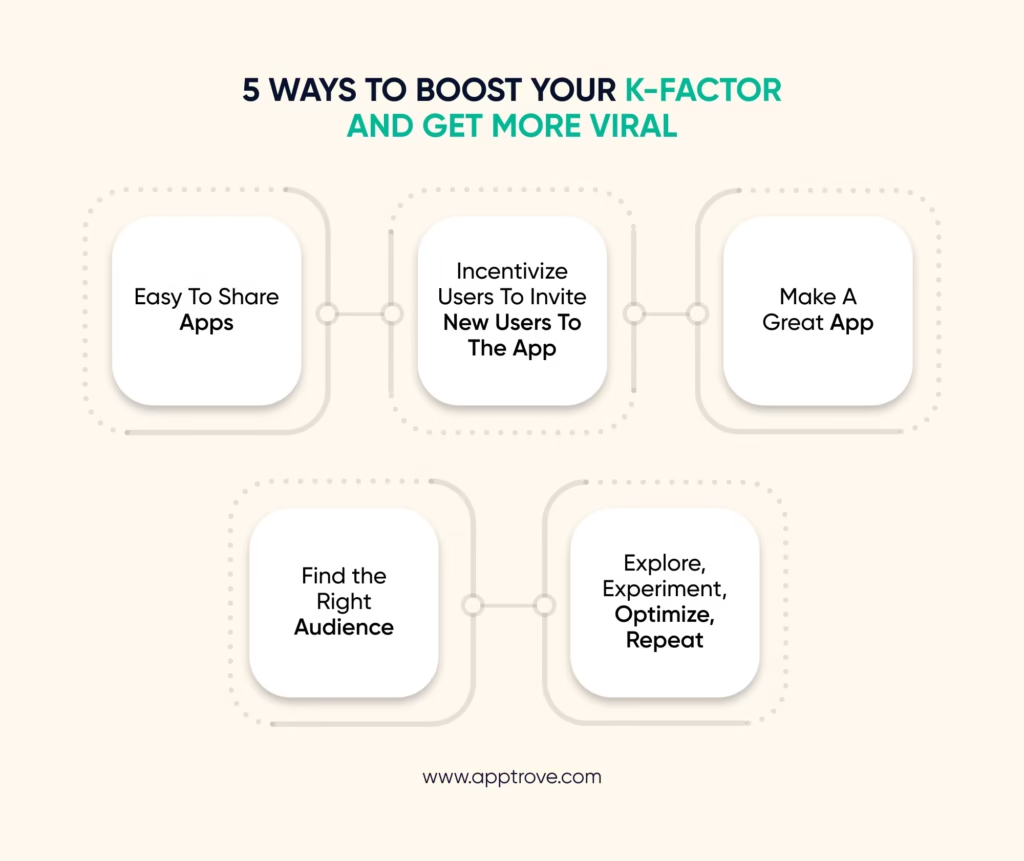
5 Ways To Boost Your K-Factor And Get More Viral
It’s crucial to identify the influential aspects of your K factor and optimize them as often as possible. Doing so will boost the number of installs from organic that come from the force of paid. ASO, optimization, and creating sharable apps are three key ways to lift your K factor. Let’s cover how they each can serve to improve your app’s K-factor.
1. Easy To Share Apps
Ease of sharing the app helps boost your app’s K-Factor immensely. It encourages users to share conveniently as the app is designed to share. Integrate traffic drivers, as much as possible in the event flow of your app, such as sharing achievements or completing a level of a game with friends on social media. It makes it easier for users to share and invite new users to your app.
Adding multiple permissions or logins overcomplicate the sharing process and discourages users to invite friends.
2. Incentivize Users To Invite New Users To The App
Creating incentives for existing users can prove a massive benefit for your mobile app in gaining organic users. Encourage users to use referral codes for inviting their friends, family, and colleagues to install the app. It can be making any in-app feature free, or digital in-app currency, something that is meaningful to the user. It also makes it easier for you to measure new user conversions invited by existing users.
Also, you can provide users incentives and rewards for installs and sign-ups. Provide them offers for in-app purchases once they start using the app.
Incentives are one of the best and the most used ways to improve your K Factor.
3. Improve User Experience and Retention
The most important and obvious thing to do is to make a useful app that attracts the right audience. The best way to make your app go viral is to make it the best app out there, which does everything that it is designed for, and is simple and easier to use.
Invest more time to work on your app, research your competitors, and understand what your users need, which brings us to the next important step, Finding the right audience.
4. Find the Right Audience
Use your K-factor to understand who your audience is. This allows you to optimize your budgeting for User Acquisition. You can adjust your UA campaign spending once you know what kind of users drive your K Factor.
5. Explore, Experiment, Optimize, Repeat
Try to utilize different ad creatives and find the source of quality and valuable users. It is essential for a mobile publisher to measure and analyze all marketing campaigns. One can only maximize their ROI with proper attribution of their ad campaigns and accurate analytics.
That’s where we come in!
A mobile analytics platform like Apptrove offers you a better understanding of your mobile ad campaigns and helps you deal with frauds to maximize your ROI, all in one dashboard.
To learn more about our Attribution solutions, check out our website and get a free trial today!
How Referral Programs Improve K-Factor
Referral programs can directly improve an app’s K-factor by encouraging existing users to invite new users. Since K-factor depends on both the number of invitations sent and the percentage of those invitations that convert, a well-designed referral program can improve either—or both—of these factors.
For example, if each user sends 3 invitations and 20% of those invitations result in a new user, the K-factor is:
K = 3 × 0.20 = 0.6
Increasing the number of successful referrals can push the K-factor higher and create a stronger cycle of user-driven growth.
To improve referral-driven growth, app marketers can:
- Offer meaningful incentives: Rewards such as discounts, credits, cashback, or in-app benefits can motivate existing users to invite others.
- Make sharing simple: Referral links, codes, and one-tap sharing options reduce friction and make it easier for users to recommend an app.
- Create a clear referral journey: Users should be able to understand how to invite friends, what they receive in return, and how the referred user benefits.
- Track referral conversions: Measuring invitations, clicks, installs, and post-install events helps marketers understand which referral efforts generate valuable users.
Deep links can also make referral campaigns more effective by taking invited users directly to the relevant app experience or destination. By combining an easy referral experience with accurate attribution and conversion tracking, marketers can identify which referral strategies are contributing to a higher K-factor.
Why Attribution Matters for Measuring K-Factor
Attribution helps app marketers understand where new users come from and how referral or user-driven growth contributes to overall acquisition. This is important when measuring K-factor because not every new install can be directly attributed to a specific referral, campaign, or existing user.
By tracking the source of installs and post-install activity, marketers can better distinguish organic growth from paid acquisition and referral-driven installs. This makes K-factor analysis more meaningful and helps identify which acquisition and sharing strategies are contributing to app growth.
For example, attribution can help marketers measure:
- Referral-driven installs: Identify how many new users came through invitations, referral links, or codes.
- Conversion from referrals: Track how many users who received an invitation actually installed and engaged with the app.
- Post-install behavior: Understand whether referred users complete valuable actions after installing.
- Channel contribution: Compare referral-driven growth with installs generated through paid campaigns and other acquisition channels.
Accurate attribution also helps marketers avoid overestimating organic or viral growth. By connecting installs and post-install events to their acquisition sources, teams can make more informed decisions about referral strategies, user acquisition, and overall app growth.
For apps using referral links or deep links, attribution can further help connect the referral journey from the initial click-through to the app install and subsequent user activity.
FAQs
1. What is K-factor in mobile marketing?
K-factor is a metric that measures how many additional users each existing user brings to an app through referrals, sharing, or word-of-mouth. It helps marketers understand app virality and organic growth.
2. Why is K-factor important for app publishers?
Importance of K factor is that it reflects the growth potential of your app without the need to spend more on marketing efforts. High K factor implies that users are referring their friends to your app, creating K factor virality and lessening the need to use an expensive paid strategy. It will also assist app publishers in reviewing referral program, sharing options and general user interactions.
3. What is considered a good K-factor for apps?
The K-factor that is higher than the churn rate of your app is good. A K factor of 1 shows that there is a stable growth in viruses, and above that, the K factor virality is exponential growth. The effect of small fractional increases can be very important to the eventual take-up and visibility of apps.
4. How can you improve K-factor marketing for your app?
For K-factor marketing, you can make it easier to share the content, provide a referral incentive, develop a valuable application, and reach out to the right people. Viral metrics like encouraging users to share achievements, referral bonuses, and maximizing user acquisition campaigns should be encouraged to increase the K-factor virality.
5. What role does K-factor virality play in app success?
K-factor virality is an important aspect in natural user acquisition. The invitation of people to download your app in a natural manner would decrease your cost per acquisition and enhance ROI. High K-factor virality also enhances rankings, visibility, and sustainability of brand growth in the long term in app stores.