
Introduction
Clicks were once viewed as the most reliable indicator of a marketing campaign’s success. If a campaign received clicks, the general assumption was that the campaign was successful. However, this is no longer an accurate way to view a marketing campaign.
Increasingly, both from a regulatory and a technological perspective, marketers have become limited as to the types of access they have to user-specific data. As a result, the click-based approach to measuringthe effectiveness of marketing campaigns has become limited in its usefulness, because as users have become more fragmented in their customer journeys, the result of using clicks alone is often to miss the real outcome of marketing efforts.
Studies show that the bulk of digital ad spending is still controlled by click-based metrics, despite an increase in the volume of conversions that occur through indirect, delayed, or non-click interactions. According to an eMarketer report, only about 21.5% of marketers believe that last-click attribution accurately reflects a platform’s long-term impact on their business. This highlights the widening gap between ad impressions and actual business results; thus, marketers are looking to move beyond simply asking how many people clicked on their ads.
Attribution measurement for today’s marketers must adapt to accommodate these changes. To understand the performance of ads, marketers must utilise privacy-friendly signals, aggregated and modelled data, and employ platforms such as SKAN for the continued ability to measure ad performance without using disappearing identifiers or jeopardising user trust.
The establishment of a strong attribution measurement ecosystem represents a key piece in building and managing the business case for your organisation’s use of marketing. It is not about tracking clicks, but rather facilitating the connection of marketing activities to their respective outcomes, based upon the actual consumer experience of discovering, engaging with, and converting.
In this unit, we will explore the reasons for the need for the evolution of attribution, how to utilise better measurement practices to improve organisational decision-making, and insight into how we can objectively evaluate the long-term impact of our marketing efforts in a privacy-centric environment without relying upon cookie-based click-throughs.
What is the Objective of Attribution Measurement?
Attribution measurement is about giving a clear view of how marketing is driving results and is not limited just to the outcome being tracked to a single touchpoint, like where a purchase is recorded.
In contrast to the last-click model, which gives all of the credit to the last click and, in turn, reduces the value of other interactions along the user journey, Attribution measurement considers the totality of how exposures affect the overall outcome. It seeks to explain more clearly what happened before a conversion occurred.
Attribution measurement enables marketers to make sense of complicated non-linear journeys, which are very common these days. Marketers can see when a particular ad was shown to a user and when they engaged with the ad, but they may also see users convert on an entirely different channel without actually clicking on the ad. Attribution measurement allows marketers to accurately connect these different signals over different times and channels and ensure that the entire journey is meaningful, even when other types of influence are not directly visible or have occurred later.
According to a recent survey, 70% of businesses struggle to act on the insights gained from attribution measurement, highlighting the complexity and challenges of interpreting cross‑channel data effectively. This stat emphasises the importance of adopting a more sophisticated and accurate attribution model to fully understand the customer journey.
Because tracking refers to recording things that happen and recording where they happen, like downloads, purchases, or sessions, it is important for marketers to differentiate the two so that they know how to make their marketing efforts effective. If a marketing team does not know the difference between tracking and measuring, it risks optimising its marketing activity on a surface level rather than for growth.
It’s now impossible for growth teams to define success as only what happens at the last pixel or to simply assign credit to their channels. Rather, they are being forced to create a more accurate picture of performance based on what users have done throughout the entire journey. This new way of looking at how your business grows requires that growth teams develop a system of measurement that accurately reflects the performance of multiple channels and removes the need to assign credit to any one channel for driving that customer to your business.
Why Measurement and Attribution Can Not Use Click-Based Models Going Forward
Historically, clicks set the standard for measurement and attribution. They were simple to capture, instantaneous, and provided marketers with an objective measurement of user intent. The context of how people accessed digital advertising during the initial days of digital marketing was simpler; fewer devices existed, users often saw an ad and quickly converted afterwards, and digital advertising platforms provided marketers with clear views of their individual users’ behaviours. A click painted a clear, accurate, and confident picture of how successful an ad was to a particular user.
That is no longer the case.
Due to the evolving nature of the digital world, where there is a clear emphasis on user privacy, there are a number of factors that have contributed to breaking down the traditional definition of clicks and click-based attribution. Regulation has removed the ability of companies to collect data on their users, limiting their access to very few identifiers from each user through the platforms themselves, to what the user chooses to provide to a marketer. This means many conversions occur hours or days after the user was exposed to the advertisement, and in many cases, no clicks occurred. Further complicating matters is the notion of consumers moving seamlessly across devices; they may discover brands on one device, begin research on another, and complete the conversion process on yet another. That trend continues to make click attribution less and less relevant.
Creating a model based on a desire to maximise clicks creates a false sense of security. Click-based results tend to favour where you will see what was the easiest to find (and also be able to claim credit for) rather than which channels will ultimately create or influence the outcome. Channels that produce awareness and impact at other points in the customer journey may appear ineffective when evaluating using only the number of clicks. This results in misinformed budgets and efficiency decisions favouring immediate indicators (click-through rates) over indicators of long-term success (lead acquisition and brand loyalty).
A modern approach to measurement and attribution must include all outcomes triggered by an advertisement—direct and indirect; long-term, short-term; and grouped—for all marketing channels, not just the immediate action taken by someone after viewing a specific advertisement. If all you’re measuring is what’s easy to measure today, you’re not measuring performance. In addition, as privacy becomes more of a concern and data availability becomes limited, measuring “easy” is not necessarily representative of your actual performance.
Attribution Measurement Benefits More Intelligent Decisions Across Various Platforms
Attribution measurement is critical in today’s fragmented marketing environment for helping marketers make more informed and confident decisions. Today’s Customer Journey is becoming increasingly fragmented across many different channels, platforms, and timelines. This fragmentation makes the decision-making process very difficult based solely on the isolated metrics available at one point in time. Attribution provides clarity within the complexity and ultimately shows how the channels and/or platforms support multiple marketing outcomes, not just in isolation but as part of an overall cohesive ecosystem.
According to industry research, 75% of businesses now use multi‑touch attribution models to measure performance across marketing channels, underscoring the widespread adoption of cross‑platform measurement to improve decision‑making and budget allocation.
From a budgeting perspective, Attribution Measurement provides marketers with a view of where their dollar investment is providing measurable results. Rather than hitting your budget with heavy volume to the most clicked or visible channels, you will have access to which marketing touchpoints have had the greatest impact on driving conversions over the long run. Therefore, you can allocate your budgets accurately and make them work more effectively in awareness, consideration, and conversion phases rather than disproportionately over-optimising for one phase.
Attribution also provides more clarity on how creatively effective your creative messaging is working for your business. With attribution, a marketer can assess their messaging and understand if the creative assets used in conjunction with a marketer’s creative messaging are resulting in down-funnel conversions that have a material effect on business results. As such, success is no longer exclusively based on user interaction with a marketer’s creative; it is also dependent on how effectively marketers are able to demonstrate that the creatives are positively affecting true business outcomes.
A unified measurement framework also improves the transparency of channel effectiveness by allowing for the connection of users’ journeys across multiple channels while complying with their privacy. Through combined data using anonymity-based signals, modelled insights, and data derived from compliant platforms, cross-channel teams can see the complete picture without invasive tracking or relying on incorrect precision due to the nature of using only one type of measurement signal.
Cross-channel measurement clarity will continue to be a must-have for most growth teams. As teams continue to rely on resources such as Apptrove to learn how unified measurement frameworks can turn fragmented measurement signals into actionable insights, the ability to make decisions based on measurement data that is consistent and privacy-safe will result in more proactive and resilient decision-making.
How a Privacy-First Approach Shapes the Future of Attribution Measurement
The concept of a privacy-first approach forms the basis for measuring digital attribution today. Privacy regulations worldwide, as well as changing platform policies and user expectations, mean that marketers can no longer expect to have unfettered access to whatever user-level data they desire. Instead, marketers must implement data flows based on consent, limited identifiers, and comply with stricter controls on data governance. All of these new ways create new processes for measuring how digital performance happens in an ever-changing digital ecosystem.
Many of the changes made to iOS and Android platforms have accelerated this transformation. Marketers find themselves in an environment where the signals have been intentionally limited, delayed, or aggregated. As a result of this new level of constraint on the flow of information regarding user behaviour and engagement, the measurement of attribution is now inherently stronger and more strategic. The focus has shifted from a focus on tracking individuals to understanding patterns, trends, and outcomes across a much larger base.
Current methods for measuring attribution increasingly rely on aggregated signals, which show performance while providing anonymity for the consumer. Insights from modelling help to fill in the gaps left by signal loss and provide statistically valid methods for informing the understanding of influence over time through direct correlation. This is made possible via structured and compliant access to performance through APIs provided by the platforms themselves. Thus, attributions are consistent and compliant with both regulatory guidelines and requirements attributable to the platforms.
Besides compliance, privacy-first attribution supports building trust between the user and the platform. When users feel like their data is being treated responsibly, they are more likely to contribute to the longevity of the platform. It is through this stable relationship that brands can build long-term strategies rather than rely upon weak or short-lived solutions to grow. Creating a measurement system based upon principles of privacy creates a pathway for sustained performance, ongoing regulatory compliance, and decisions that will ensure continued success with no loss of transparency or accountability.
How DSPs & Marketers Are Using Attribution To Establish Incrementality
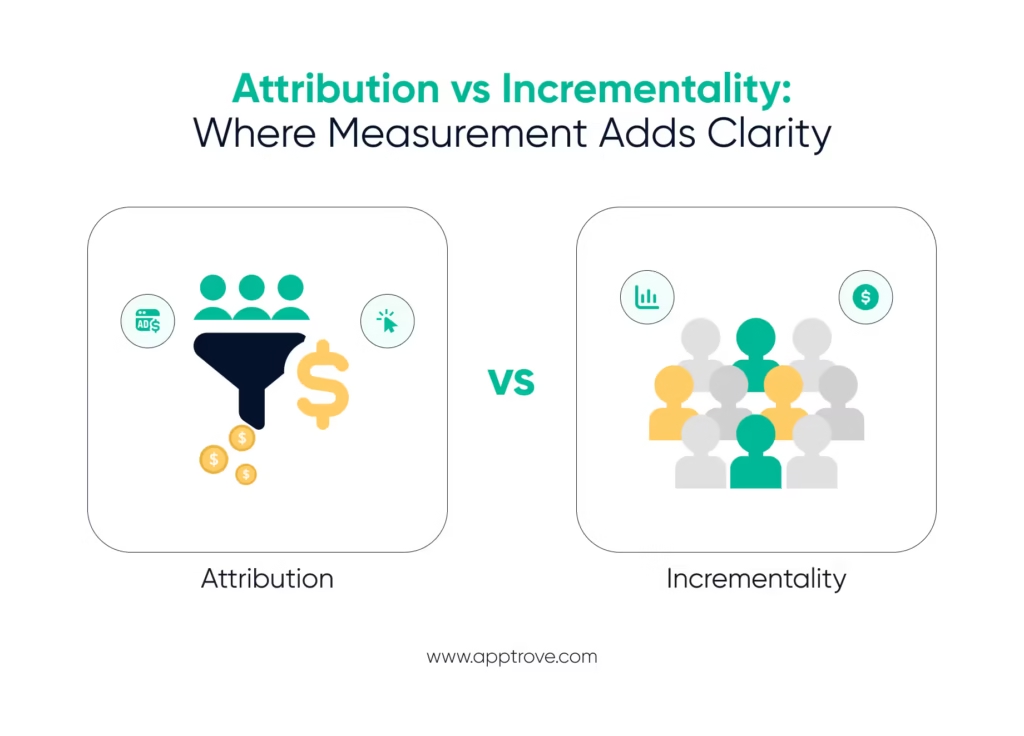
Marketing attribution can show you where your conversions come from, but incrementality can answer the most critical question: ‘Would that conversion have taken place without the presence of that touchpoint?’ While attribution assigns value, incrementality provides an analysis of the ‘incremental’ value of your marketing activity, which is important as economic and privacy constraints increasingly restrict your ability to evaluate the performance of your campaigns through direct means.
Today’s attribution measurement allows marketers to marry the insights they gain through attributive efforts to an outcome-based approach. Instead of making an ‘assumed’ impact determination based on exposures or clicks, modern marketing attribution solutions enable marketers to examine the direct evidence of whether the marketing campaign actually had an effect on that individual consumer. Ultimately, attribution-based marketing systems enable DSPs and marketing teams to move from Correlation (the old style of viewing the relationship between touchpoints and conversions) to Causation (the new way to view the relationship between touchpoints and incremental value) as well.
The use of experimentation is a key principle in this method, as teams can use holdout groups, geographic experiments, and other controlled experiments to compare the performance of exposed and unexposed audiences. Attribution measurements provide the context needed to understand which channels, tactics, or strategies resulted in incremental lift—not just attributed volume. This helps to reduce over-crediting of channels by showing where actual value is being created by marketing and not just where performance metrics are rewarded for capturing demand.
As evidenced by current industry research, a significant portion of digital advertising spending is done without any verification of incrementality or anything similar. This leads to wasted expenditures and inflated performance metrics that reward capture instead of demand creation. Marketers can achieve a clearer and more honest understanding of what truly creates growth by utilising attribution and incrementality testing methods together.
The outcome of this combination is more accurate optimisation processes, more credible reports, and the assurance that decisions are supported by measurable impacts rather than assumptions.
How Unified Measurement and Attribution Lead to Continued Growth Confidence for Years to Come
Unified measurement and attribution do not simply provide performance reports; they build confidence in decision-making. With a consistent approach to measurement across multiple channels, all platforms and over time, it is possible to provide a more accurate forecast for future performance. This means that rather than creating budgets, targets and expectations based on fragmented, non-credible or inflated metrics, teams can develop budgets based upon metrics that indicate real, positive and sustained growth over time.
Having a consistent way to measure performance avoids confusion between teams within an organisation as to what has occurred on a particular marketing channel or platform due to conflicting or inconsistent attribution logic used by each team. Because of the differences in attribution logic, performance discussions between teams often become debates concerning whose attribution numbers or methodology are “correct” or “greater.” By implementing a unified framework that establishes a single source of truth within the organisation that aligns all teams, including marketing, growth and leadership, around a single set of performance metrics, this alignment will allow for the elimination of redundant discussions while promoting quicker decision-making.
The confidence of stakeholders in your organisation (trust) is a long-term result. When organizations utilize transparent attribution logic and repeatable measurement methods resulting in accurate and meaningful insights, the stakeholders are able to have the confidence that what they are seeing is truly representative of the actual performance of the organisation (there are no short-term spikes, “optimisation” artefacts, or platform bias). Once stakeholders have this confidence in the organisation, they will view marketing as the engine to deliver future growth, and no longer think of it as a cost centre that needs constant justification.
In the end, with Unified Measurement and Attribution, organisations change the mindset from chasing “wins” to creating sustainable growth. Organisations move from a reactive to an intentional approach to optimising their approach and transitioning to using evidence-based strategies for Smart Strategy, Resiliency, and Long-Term Success.
Conclusion: Why Attribution Measurement Is Critical to Growing a Business
Attribution Measurement Will Play a Key Role in Achieving Long-term Sustainable Business Growth in a Privacy-first Environments. Attribution measurement has moved beyond being just another added feature to becoming critical and central to achieving continued long-term sustainable business growth in a business environment that puts a premium on user privacy. As user journeys continue to increase, such as the elimination of direct signals, businesses continue to face challenges associated with relying on dated measurement models that create blind spots and impact both the business strategies and the results. Modern Attribution Measurement has benefited businesses by providing clarity to these complexities, accountability when making decisions, and delivery in performance evaluations while providing a level of trust associated with maintaining user privacy.
Organisations building on more aggregated insights, modelled outcomes, and user-compliant data flows allow their growth teams to focus on what drives impact rather than on what’s easy to measure. The change in how businesses measure attribution has shifted the manner in which they run their growth strategies (planning with confidence, optimising responsibly, and measuring performance through long-term sustainability rather than just on short-term performance spikes).
While from historical perspective, any time measuring activity generated within a user’s journey is key. However, with the emergence of new privacy-first environments, measuring how much impact you’re actually impacting users will be the question of the future.
If you’re ready to metric and plan for the future of your business based on privacy first and outcome-based focuses on attribution measurement, sign up now for a free trial and see how a unified approach to measurement can build greater clarity and confidence into your growth strategies moving forward.
FAQs
1. What is the difference between attribution measurement and attribution tracking?
Tracking Attribution looks at how users contribute to a specific outcome. This captures users performing a click or install and helps to determine which channels had the most influence on how users contributed to your business.
2. Why is attribution measurement critical in a privacy-first environment?
In an environment focused on privacy, there is a limited ability to track individual users directly due to the loss of signals. To measure attribution, analysts/marketers use either aggregated data or models when interpreting results from their advertising/networking activity, thus ensuring that they are able to provide consumers with trustworthy insights without having access to identifiable/user-level information.
3. How does attribution measurement handle delayed conversions?
Attribution measurement defines the conversion window within which delayed conversions will be counted and then aggregates on a cumulative basis. In doing so, attribution measurement links your marketing output to what happens as a result of that output days or weeks later, without giving undue credit to immediate interaction types.
4. When should marketers rethink their measurement and attribution strategy?
When you experience any change in platform policies or when your business is growing in multiple marketing channels and reported returns from those channels appear inconsistent with your true business results, you will need to review your measurement and attribution strategy to ensure you are not missing some key data points.
5. How does attribution measurement support long-term business outcomes?
The benefits of attribution measurement on long-term results include better forecasting accuracy, greater trust in performance measurement insights, and long-term sustainable optimisation decisions that take into account both short-term and durable, privacy-safe growth.