Data.ai reports that consumers continue spending record amounts of time in mobile apps, making performance marketing more competitive than ever.
Mobile app marketers are faced with this harsh reality: 77% of users drop an app during the first three days of installing it on their mobile devices. With the rising costs of acquiring users, especially with a 60% year-over-year increase, every marketing dollar will need to have an immediate and measurable result. Within the advertising realm, direct response marketing (DRM) functions as a veritable lifesaver. Compared to data-driven media that aim to produce an anticipated flow of revenue, DRM produces an instant effect, an immediate download, a subscription, or an occasion.
However, due to the recent iOS privacy update, the value of DRM is already weakened, and the establishment of proper attribution must become paramount. Marketers cannot optimize performance without granular awareness of user journeys. Therefore, the legitimacy of DRM is conditional on the authenticity and stability of the attribution layer of information, validating the fact that a vivid mobile measurement partner like Apptrove is a must.
What is Direct Response Marketing?
Direct Response Marketing (DRM) involves marketing methods aimed at getting visible and immediate reactions from consumers. Unlike other marketing approaches whose primary goal is to form brand recognition, Direct Response Marketing is about making a customer do something since he/she sees an ad. For instance, customers may get motivated to install an app, sign up for a trial, make a purchase, or fill out a questionnaire.
As a rule, each direct response marketing campaign includes a strong call to action (CTA); its effectiveness is evaluated by such indicators as CTR, CVR, CPA, and ROAS, thus allowing marketers to evaluate the success of the campaign and make advertisement management more profitable.
In the field of mobile applications, direct response marketing is extensively used in Google Ads, Meta Ads, TikTok, and Apple Search Ads to achieve installations, registrations, purchases, and other activities inside an application.
For example, instead of saying “Our fitness app is the best” in an advertisement, the one built on pursuing the principles of direct response marketing would include the phrase:
“Download our app and get a 7-day free trial.”
In short, direct response marketing focuses on driving immediate, trackable customer actions, making it one of the most effective approaches for performance marketing and mobile app growth.
What Makes Direct Response Marketing Different?
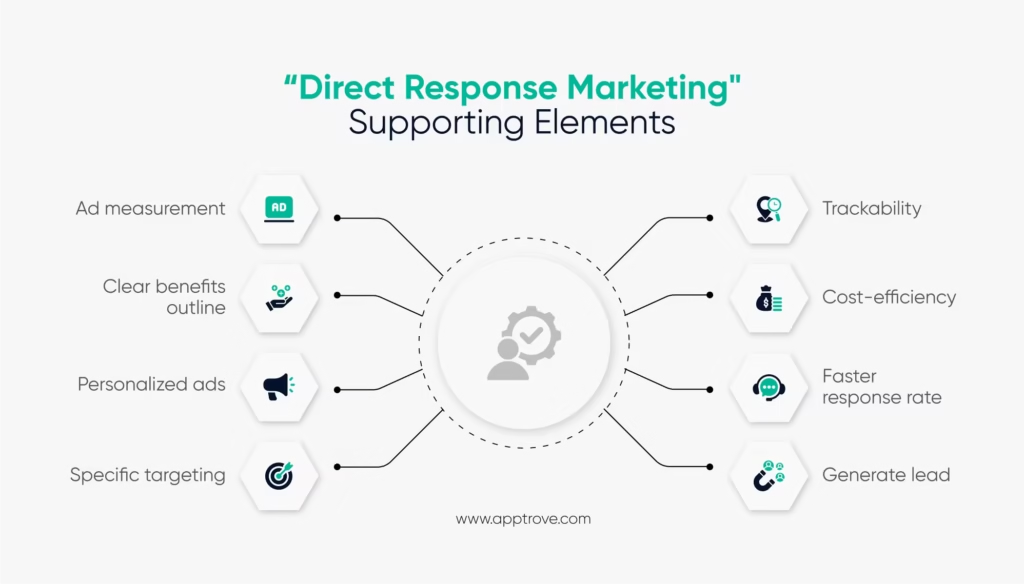
DRM avoids the long-term impression that brand-building applications tend to have to achieve short-term, specific objectives. A commercial that says download this app, or you are invited to sign up for a free trial, is representative of DRM in action. In comparison, traditional marketing strives to create awareness in the long run. In the probable case scenario of saturated app stores, in which mobile applications have to compete, speed and efficiency in the persona of DRM is a determinant.
The Context of the Mobile
Mobile consumer behavior is not like desktop consumption. The behavior among users is unplanned decision-making, quick anticipation of gratification, and a relatively fast abandonment of the application when they fail to get immediate value. These patterns go hand in hand with the focus of DRM on immediacy; ones that can be the solution to the immediate needs of users.
Practice Implications
Marketers’ underpinning is a DRM mindset strategic orientation, as well as a disciplined MMP model to the reality of contemporary market conditions. Successful direct response marketing campaigns are focused on an end-user action; proper attribution mechanisms, in their turn, allow continuous optimisation. Efficacy of DRM and powerful MMP solutions is an essential precondition to the sustainable success of mobile advertising.
Direct Response Marketing vs. Brand Marketing
Although both approaches aim to grow a business, they serve different purposes.
| Direct Response Marketing | Brand Marketing |
|---|---|
| Focuses on immediate action | Focuses on long-term awareness |
| Measures installs, leads, purchases | Measures brand recall and perception |
| ROI can be tracked immediately | Results appear over time |
| CTA-driven campaigns | Storytelling and emotional campaigns |
| Ideal for performance marketing | Ideal for brand building |
Most successful app businesses combine both strategies. Brand marketing creates awareness, while direct response marketing converts interested users into customers.
Core Elements of Winning Direct Response Marketing Campaigns
A rigorous examination of successful direct response marketing campaigns reveals a shared set of characteristics. Effectively done, these aspects set apart high-performing initiatives compared to low-performing ones:
Clear, Compelling Calls-to-Action
The call to action is the main instruction of any direct response marketing campaign. Statements like Learn more, do not do the trick, but statements like Get your free workout plan in 30 seconds sound much more convincing. Good CTAs use action-related words, create intrigue, clarify the particular benefits, and explicitly mention what will happen to the user when they click.
Laser-Sharp Audience Targeting
Generalized audiences are a resource sink for campaigns. The top-performing initiatives utilize highly focused groups and gear involvement towards a dimension of relevance as well as demographics. Instead of focusing on everybody who cares about their health, a fitness app must be relevant to a specific segment of the population, such as busy professionals seeking fit 15-minute routines that can be performed at their workstations.
Measurable Outcomes
Without data, no improvement has a chance. Quantifiable metrics must be set in each direct response effort. Such metrics usually include installs, sign-ups, sales and revenues of apps. To reveal the best insights: to set specific goals before launch, observe the performance as long as possible and adapt constantly, using empirical results but no hunches.
Benefits of Direct Response Marketing
Direct response marketing offers several advantages for app marketers and businesses:
Measurable ROI
Every click, install, and purchase can be tracked.
Faster Campaign Optimisation
Performance data allows marketers to pause underperforming campaigns and quickly scale successful ones.
Better Budget Allocation
Marketing budgets can be invested in channels that generate measurable business outcomes.
Continuous Testing
A/B testing enables constant improvement in messaging, creatives, and landing pages.
Higher Conversion Rates
Personalised messaging and precise audience targeting often lead to stronger conversion performance.
Building Your First Direct Response Marketing Campaign
To design campaigns that can lead to measurable conversions, proceed backwards in an iterative path:
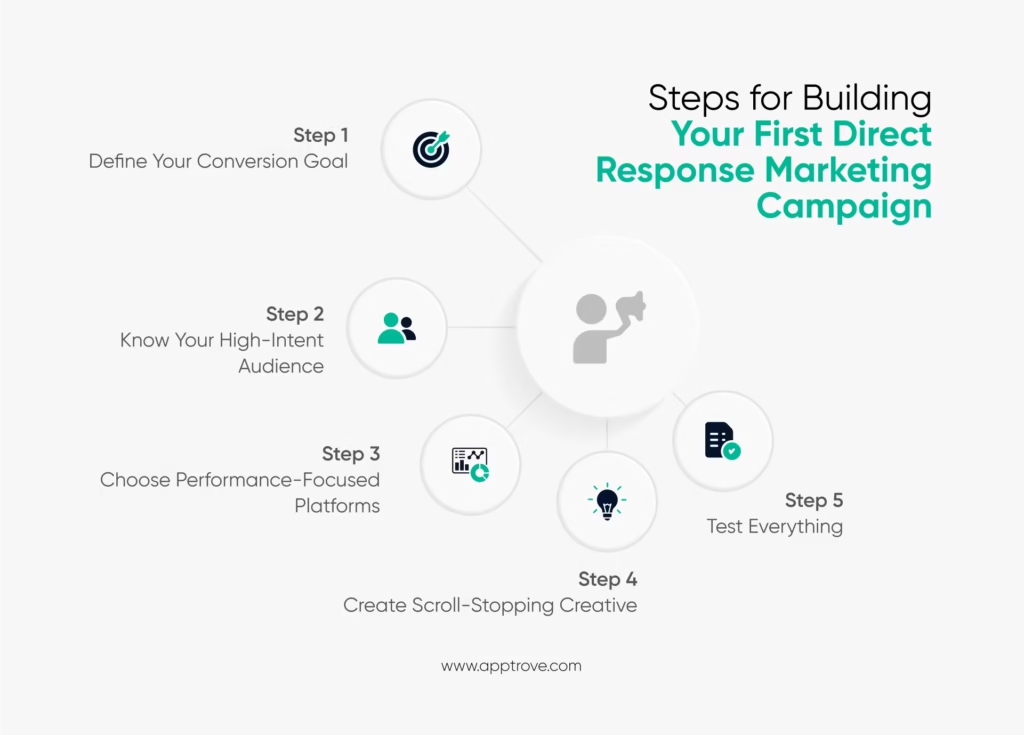
Step 1: Define Your Conversion Goal
What action do you want users to take? Be specific. “Increase engagement” is vague. “Get 1,000 new users to complete app onboarding” is clear. Your goal shapes everything else. Your messaging, your targeting, your creative – it all flows from this single decision.
Step 2: Know Your High-Intent Audience
Analysis of existing user groups does reveal identifiable characteristics age, geography, interests, and behavioural patterns and can be used to form groups of lookalikes who exemplify these characteristics. Target individuals whose profile most closely resembles the best existing customers to maximise engagement with direct response advertising.
Step 3: Choose Performance-Focused Platforms
Direct response is not all platforms. Give preference to those that provide real-time optimisation, granular targeting, effective conversion tracking and performance-based bidding. Facebook, Instagram, Google, and TikTok exemplify such environments for mobile direct response marketing.
Step 4: Create Scroll-Stopping Creative
An advert possesses three seconds to capture attention. Use attention-grabbing imagery and leading with benefits over features; show how the application specifics solve real challenges to users. Video also succeeds in direct response campaigns due to its ability to express value swiftly and in a memorable way.
Step 5: Test Everything
Launch with multiple ad variations. Test different headlines, images, and CTAs. Let data decide the winner. Successful direct response marketing remains contingent upon perpetual iterative testing; performance that proves efficacious today may prove inadequate tomorrow, necessitating agility in methodology.
Direct Response Advertising Examples That Convert
There are specific types of advertising that are always effective in performing conversions in mobile applications.
Limited-Time Offers: The offer, which reads, “Download now and your first month is free,” has created an element of urgency. Users are afraid to miss a good deal, which prompts them to take immediate action.
Problem-Solution Ads: “Tired of forgetting passwords? Our app remembers them all.” This format identifies a pain point and offers an immediate solution.
Social Proof Campaigns: “Join 50,000 users who’ve already transformed their productivity.” Numbers build trust and encourage action.
Interactive Previews: Show them how the app works so that people can see how it works before downloading.
Measuring Success in Direct Response Marketing
Attribution Challenges
Privacy-First Attribution
Privacy changes such as Apple’s App Tracking Transparency (ATT) have reduced access to device identifiers, making attribution more complex than before.
Modern Mobile Measurement Partners (MMPs) help marketers measure campaign performance using privacy-compliant attribution methods, aggregated reporting, SKAdNetwork, and first-party data.
Rather than relying solely on deterministic attribution, marketers should combine multiple measurement techniques to understand campaign effectiveness while respecting user privacy.
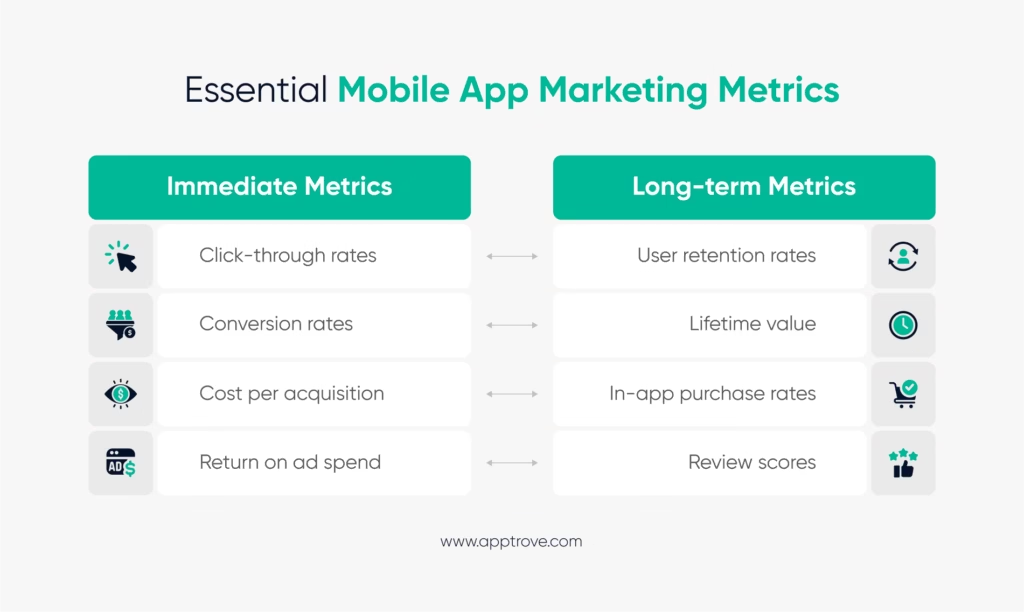
Key Direct Response Marketing Metrics
Successful campaigns are measured using multiple KPIs instead of a single metric.
Click-Through Rate (CTR)
Measures how many users clicked the advertisement.
Conversion Rate (CVR)
Measures how many users completed the desired action.
Cost Per Acquisition (CPA)
Shows how efficiently customers are acquired.
Return on Ad Spend (ROAS)
Measures campaign profitability.
Customer Lifetime Value (LTV)
Determines the long-term value generated by acquired users.
Common Mistakes That Kill Conversions
Avoid these direct response marketing pitfalls:
Weak Value Propositions: People should understand the value within a few seconds, or they will continue to scroll.
Complicated Conversion Flows: The more steps, the more the conversion opportunity dies out.
Poor Mobile Experience: When a landing page fails to load fast on mobile, ad spending is a waste.
Ignoring Creative Fatigue: The same ad loses effectiveness over time. Refresh your creatives regularly.
Advanced Strategies for Scaling Success
Once you’ve mastered the basics, try these advanced direct response marketing campaigns tactics:
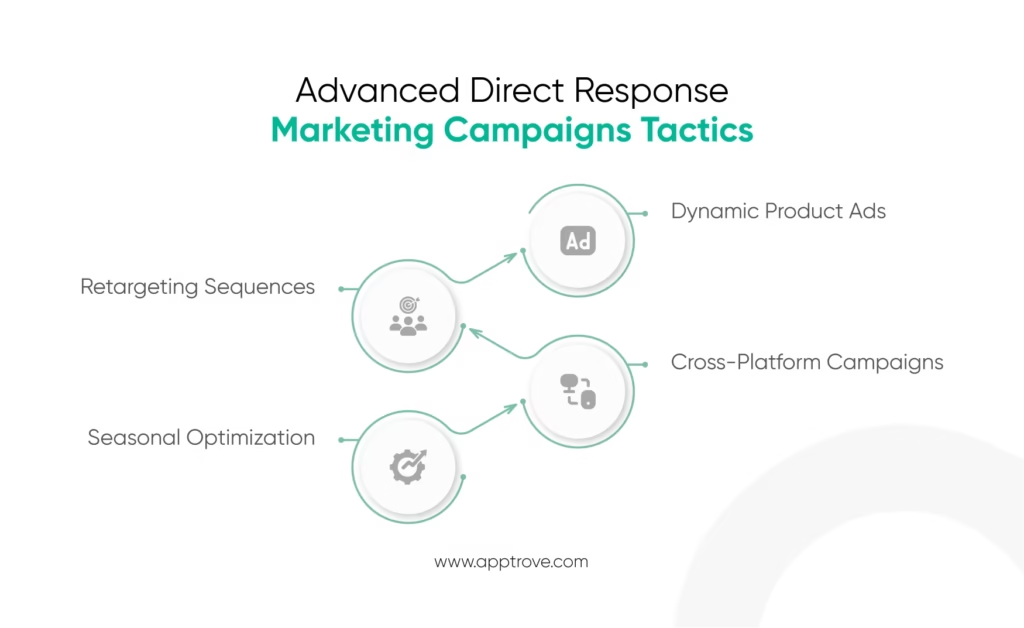
Dynamic Product Ads: Present every user exactly the product or service he has already shown interest in. As an example, in case a user has been exposed to content about fitness, show them the main functions of a fitness app.
Retargeting Sequences: Revive non-converting customers who did not buy the product on a previous visit. In many cases, only one more touch point can be used.
Cross-Platform Campaigns: Take the social-media, search-advertising, and display-advertising targeting campaigns to the location where users are present with a multi-pronged approach where everything is organized to get optimum exposure.
Seasonal Optimization: Adjust your messaging for holidays, events, and seasonal trends. “New Year, New You” campaigns work for a reason.
Best Practices for Direct Response Marketing
- Keep landing pages focused on one conversion goal.
- Match ad messaging with landing page content.
- Test multiple creatives continuously.
- Optimise campaigns using attribution data.
- Refresh creatives before fatigue reduces performance.
- Monitor campaign performance regularly.
The Future of Direct Response Marketing
DRM continues evolving. Artificial intelligence improves targeting. Machine learning optimizes bidding. Voice and visual search open new channels. But the fundamentals remain unchanged. Clear value propositions. Strong calls-to-action. Measurable results. Focus on these pillars, and your campaigns will succeed regardless of platform changes.
Ready to Transform Your Mobile Marketing?
Direct response marketing transcends immediate gains; it builds a dependable growth engine that delivers predictable results. With users in the competitive app market having an unlimited supply of alternatives, traditional brand advertising is not sufficient. You need tactics that lead to action, create metrics, and amplify success. Do not delay: commence the development of direct response marketing campaigns that convert prospects into loyal users.

Frequently Asked Questions
What’s the difference between direct response marketing and brand marketing?
DRM focuses on immediate action and measurable results. You ask users to download, buy, or sign up right now. Brand marketing builds awareness over time without expecting instant conversions. For mobile apps, DRM typically delivers faster ROI and clearer performance metrics.
How quickly can I see results from direct response marketing campaigns?
Most DRM campaigns show initial results within 24-48 hours. You’ll see clicks, installs, and conversions almost immediately. However, give campaigns 7-14 days to optimize before making major changes. The algorithm needs time to learn and improve performance.
What budget should I start with for direct response advertising?
Start with $50-100 per day for testing. This allows you to gather meaningful data without overspending. Once you identify winning direct response advertising formats, gradually increase budgets on top-performing campaigns. Many successful mobile apps scale from $100 to $10,000+ daily budgets.
Which platforms work best for mobile app direct response marketing?
Facebook and Instagram lead for social discovery. Google UAC excels for search intent. TikTok drives younger demographics. Start with 1-2 platforms, master them, then expand. Each platform requires a different creative approach and DRM strategy.
How can I track the success of direct response marketing in light of iOS privacy changes?
Use privacy-compliant attribution tools like SKAdNetwork for iOS campaigns. Focus on first-party data collection within your app. Set up server-to-server tracking where possible. While tracking is more challenging, DRM still works – you just need better measurement strategies.