
Why Return on Experience (ROX) is Quickly Becoming an Important Gauge for Mobile App Development
You are currently working within an app space that is characterised by short attention spans, limitless options, and weak customer loyalty. Growth must happen after the initial launch event and can only occur once users have had a meaningful experience with the product. While traditional metrics will provide you with information about the number of users who converted, retained, and churned, very few will give insight into what the user actually experienced. This is one of the main reasons for the emergence of ROX as a valuable metric for measuring growth. Through the ROX model for measuring growth, companies can focus on how users feel rather than how well they perform to grow. As companies transition to a more user-centric operating model, prioritizing ROX is essential. Industry data shows that about 25% of users open an app only once and then abandon it, most often due to poor usability or confusing in-app experiences — frequently before users have the chance to engage meaningfully with the product. ROX addresses this problem by linking experience quality to value over time and is drawing upon the capabilities of modern mobile experience measurement systems like Apptrove that move beyond simply counting installs to providing information about the actual behaviours, pain points, and feelings experienced by real app users, thus ensuring that your ability to grow your business becomes intentional.
How can You Measure the Success of Your App by Return on Experience (ROX)?
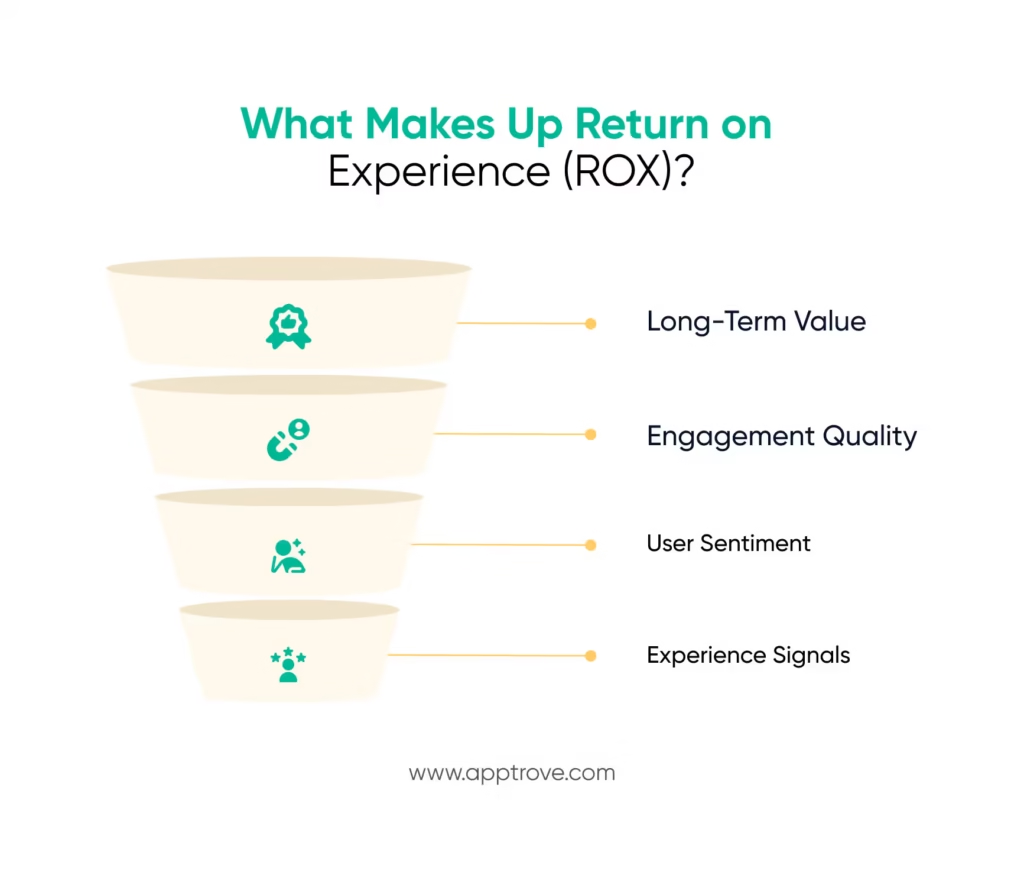
Return on Experience (ROX) measures the growth of your app from the user’s perspective rather than through conversions. ROX provides a holistic view of user engagement with your app and how your app can appeal to the emotional and functional needs of your users. In addition to the traditional metrics of revenue and installs associated with ROIs, ROX incorporates qualitative measurements like intuitive design, trustworthiness, and helpfulness to ensure that your users continue using your app vs. leaving silently—an important consideration given that 88% of users are less likely to return after a poor in-app experience.
ROX exists within the app itself, while traditional performance metrics are derived from the attribution dashboards. The app will provide users with a smooth onboarding process or present a confusing feature interaction, or give them a well-timed prompt, allowing them to feel appreciated versus interrupted. Users’ perceptions of the app will be formed long before revenue or retention metrics can reveal the impact of these moments.
ROX becomes more significant when it is connected to the in-app feedback loops and the level of quality of each session by the user. Micro-responses, user engagement cues, and contextual feedback provide insight into how users reacted to specific experiences after downloading the app and using it. Over time, these signals will show you patterns of what creates user engagement, trust, and long-term value, which allows for the building of apps that not only keep users engaged but also create a desire for users to return to.
How the Value of a User’s Experience (ROX) Outweighs Traditional App Metrics
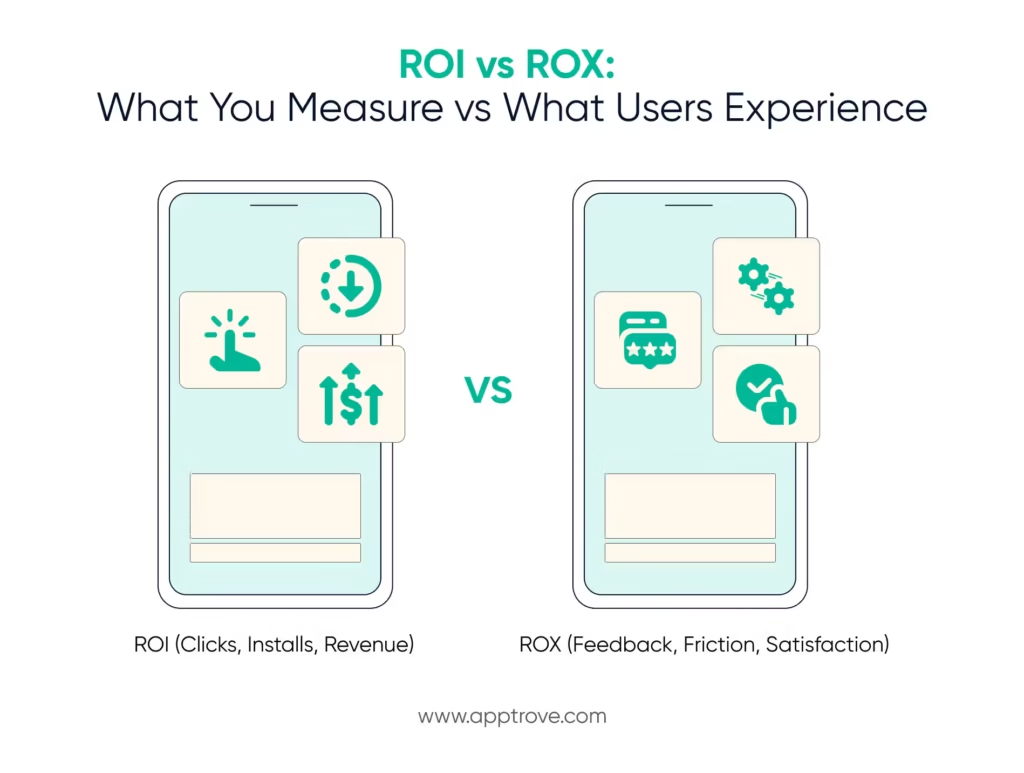
Traditional app metrics such as installs, CTRs, and even retention percentages may suggest that your app has a healthy userbase, but behind the scenes, there could be multiple underlying issues with your product. A user who installs an application could only use it once or twice before never opening it again without raising any immediate concerns. This is the gap left by traditional App Metric tracking, as they provide your company with a view of results, but not experiences. Traditional App Metrics don’t include post-install disappointment, confusion, and/or unmet expectations, which can go unnoticed on a traditional App Metrics dashboard and eventually lead to lost customers through “silent churn”.
The concept of ROX (Return on Experience) is invaluable when it comes to understanding “why” a user behaves in a particular manner rather than simply focusing on “what” they’re doing. ROX goes beyond simply asking whether users completed a flow and instead asks how that flow made them “feel.” Previous research has consistently demonstrated that experience quality significantly affects customer loyalty, as many users who have only one adverse experience with your application will abandon your app. This abandonment occurs well before any metrics, such as revenue or retention, have been gathered.
Utilization of in-app feedback allows you to recognize user intent much earlier in the lifecycle of a user by identifying signals such as a skipped step, a low-effort response, or hesitation, all of which indicate user dissatisfaction that will eventually lead to user churn. By using ROX to identify instances of this nature, you have the opportunity to make changes and apply improvements in user experience while there is still an opportunity to influence user behavior prior to them leaving your application.
The Role of In-App Feedback in Developing and Supporting Return on Experience (ROX)
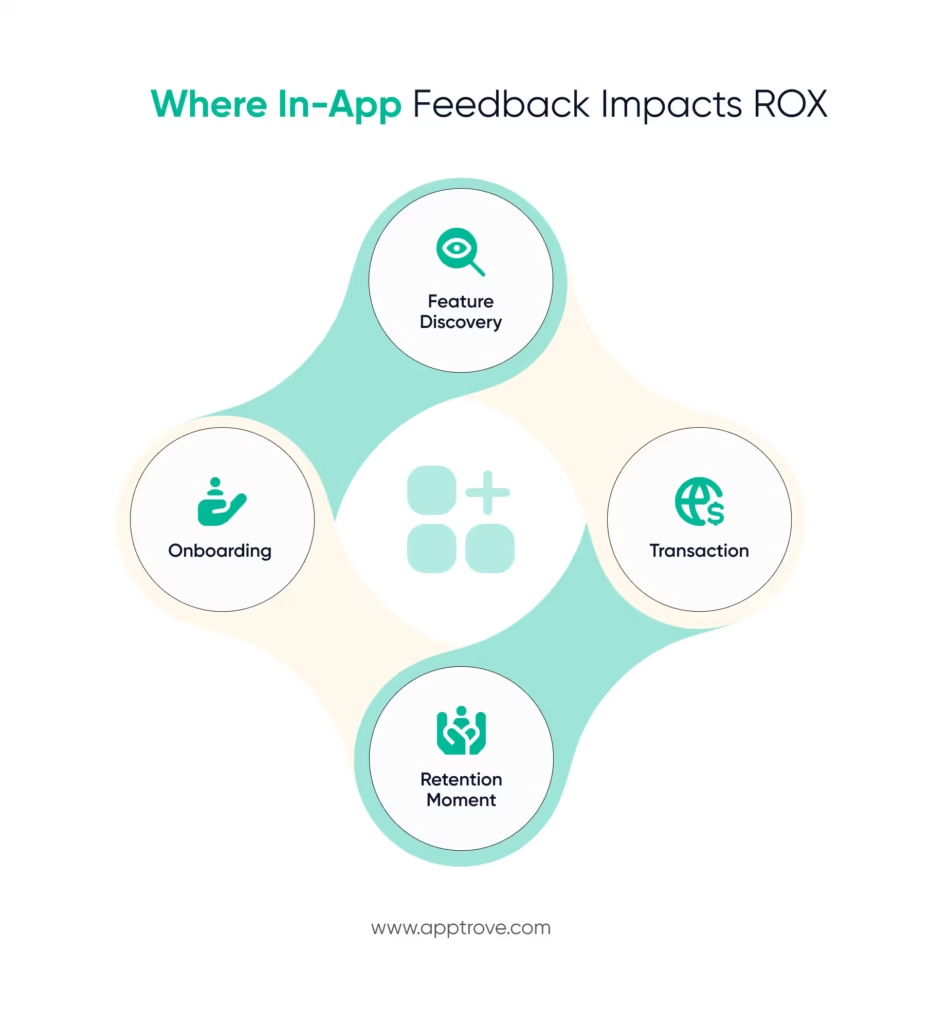
Feedback from users via an application is the point at which ROX goes from a theory to an observational experience that can be leveraged. Each time a user interacts with the application, the user has an opportunity to form a perception of their experience (feeling competent, confused, etc.). The capture of this information while it is “fresh” provides valuable insight into user perspectives.
Contextual prompts that appear following significant operations, questions provoked from those changes in behaviour, and passive indicators such as hesitation, abandonment, and attempted multiple times while using the application, allow for capturing these points of view through in-app feedback mechanisms (i.e., ratings).
When feedback is collected during the user journey, it has a much greater chance of being experienced in context and accurately reflecting user intent. Collecting feedback based on when a user had a positive or negative experience, in contrast to when it happened, provides more meaningful insights into what attracted users to your product or service and whether they will return to use it.
The precision of this feedback collection is critical to measuring the ROX. Tracking the collection of in-app user feedback at key points within the user journey (onboarding, discovery, and retention) enables the identification of the patterns of user experience that are often overlooked by traditional analytics. In conjunction with user journey and segmentation analyses, such as those found in platforms like Apptrove, continuous in-app feedback acts as a closed feedback loop that allows you to understand what users do when they use your product or service and where opportunities exist for improving user experience over time.
How to Determine Return on Experience (ROX) with In-App Signals
Determining Return on Experience (ROX) does not have to be overly complicated, nor do you need to have complicated models or formulas. It is more about understanding how to look at patterns that occur when you combine qualitative feedback with quantitative behavioral data. A lone data point typically doesn’t show the entire story, but a trend over time often does, and this helps establish trends and patterns that highlight healthy experiences. When users consistently pause and/or stop at the same information step, show a lack of interest in a product feature after curiosity, or show consistently mixed feelings (positive and negative) in providing contextual feedback, those users will help you form a clearer picture of your overall experience health.
To analyze ROX, one technique is to study the temporal effects of experience quality on users through successive usages, determining whether their confidence increases with each pass through the software suite or remains flat after an initial spike. The measurement of user sentiment toward specific features can often inform potential issues with an application’s usability, yielding insight into user retention before churn data is available on a mobile analytics dashboard.
With this additional layer of user experience detail provided by feature-specific user sentiment, a much richer perspective can be gained about the relationship between different factors affecting user engagement. Traditional interpretations of user feedback on an app would only allow for a high-level understanding of how those particular experiences translate into sustained user engagement. However, utilizing advanced tools and methods (such as Apptrove) allows for better visibility of the relationship between different user experiences over time; therefore, determining which particular experiences build a positive connection with each user can lead to increases in retention.
How to use Return on Experience (ROX) to make Better Decisions on Product and Growth
When viewing growth through the lens of Return On Experience (ROX), it changes the way we choose the best products/marketing strategies. Instead of just picking features based on their popularity (higher usage spikes on the usage chart) or pressure to complete the product roadmap within a certain time frame, we are now looking at the way the products make customers feel while using them (user experience).
By collecting information from customers about what worked well for them in using our product and then through the use of session signals, we can see which user experience elements could have been better optimized and therefore would have had a more positive impact on the growth of the business. Additionally, we can easily identify which elements had friction added to them and, therefore, should be simplified or eliminated altogether.
With Return on Experience (ROX), we have also gained more focus on how the experience is improved through the most useful means possible. Instead of redesigning experiences based on our own assumptions, we are now reacting to moments in time when the user hesitated or gave up using our product completely (abandonment/hesitation). This feedback allows us to become more thoughtful in our redesign efforts, focusing on optimizing the pain points rather than just improving the experience itself. As such, the processes involved with making design improvements as a result of experimentation have also become more targeted toward the overall experience of the user, rather than simply increasing conversion rates.
By using ROX, you are encouraged to develop growth strategies with empathy in mind. While you’re still looking at traditional performance metrics, ROX gives you a different view by using the human perspective to understand the meaning of the data behind those performance metrics. Therefore, ROX doesn’t replace the use of traditional KPIs. However, it puts them into context by reminding businesses that every single metric represents a real customer experience. When businesses use this method when deciding how to motivate growth, it helps them create growth strategies that are not only sustainable but also meaningful to both customers and employees.
Final Thoughts
Return on Experience (ROX) ultimately asks you to pause and listen more closely to what your users are already telling you, not through louder dashboards or more aggressive tracking, but through the quiet signals that surface inside the app- moments of ease, frustration, confidence, or doubt. ROX reframes growth as something shaped by understanding these experiences rather than chasing outcomes alone. When you pay attention to how users feel at key moments, decisions become clearer and more grounded in reality. This shift doesn’t replace performance metrics; it gives them context. In-app feedback turns experience into something observable, learnable, and improvable over time. And if you ever want clarity on how to interpret experience signals or connect them back to meaningful growth decisions, you can contact us to continue the conversation. As apps compete less on features and more on how they make users feel, ROX becomes a mindset—one rooted in listening, empathy, and experience-led growth.
FAQs
1. What is Return on Experience (ROX) in mobile apps?
Return on Experience (ROX) incorporates users’ feelings and levels of happiness as well as in-app experiences, measuring those aspects over time instead of concentrating strictly on revenue and acquisition, as ROX does.
2. Why is in-app feedback critical for measuring ROX?
In-App feedback allows you to see how users feel about your experience and identify where they are experiencing difficulties in real-time. This information can be obtained through direct in-app feedback instead of relying on behavioral assumptions.
3. How does ROX influence app retention and loyalty?
ROX makes visible gaps in customer experience so that your company has ample opportunity to correct them before they create Customer Silent Churn (C.S.C.) and before trust issues arise. Trust is a significant contributor to both Retention and Long-Term Loyalty, and continues to be a leading factor in retention and long-term loyalty for most customers.
4. When should apps start tracking Return on Experience (ROX)?
Once a user interacts with core features of the app, you should start tracking their ROX. During onboarding, when users discover new features, and at certain times throughout their journey (such as when they first start using the app).
5. How is ROX different from traditional engagement metrics?
ROX adds an additional dimension to engagement metrics by examining why users connect or separate from the app through the user’s engagement behaviour, and what they are feeling and experiencing when they engage with the app.