Remarketing has become one of the most important growth levers in mobile marketing. Yet it is also one of the easiest places for inefficiencies to hide.
Most app marketers invest heavily in bringing users back. They launch re-engagement campaigns, build audience segments, optimize creatives, and continuously increase spend to improve retention and customer lifetime value. Platforms like Apptrove are increasingly helping marketers understand these journeys better because modern growth is no longer just about acquiring users. It is about understanding what keeps them coming back.
On paper, most remarketing programs appear healthy. Re-engagement numbers look stable. Conversion rates seem strong. ROAS holds steady.
But then growth slows down.
Customer acquisition costs rise. Retention plateaus. Budgets increase faster than revenue. Teams begin questioning whether their remarketing efforts are truly driving incremental growth or simply claiming credit for users who may have returned anyway.
At Apptrove, we believe remarketing should not just answer who returned. It should answer why they returned, which touchpoints influenced them, and whether your investment actually changed behavior.
The challenge is that modern remarketing is no longer a simple re-engagement exercise.
Today’s users move across apps, websites, devices, and channels in ways traditional measurement systems often struggle to capture. Someone might discover a product through an ad impression, browse on mobile web, receive a push notification later that day, and finally convert inside the app days later. When marketers cannot connect these touchpoints, they end up optimizing incomplete journeys.
This creates one of the biggest problems in mobile growth today, which is that teams mistake visible performance for actual performance.
What Is Remarketing in Mobile Marketing?
The process of remarketing involves reconnecting with users who have previously interacted with the app but weren’t able to finish the transaction. It is about getting the old customers back into the line by personalized ads, emails or push notifications instead of reaching new audiences.
In the area of mobile marketing, remarketing is significant for establishing customer loyalty, enhancing customer lifetime value (CLV) and increasing return on advertising expenses (ROAS). Since users are already aware of the brand, remarketing campaigns provide a good return of investment for advertisers.
However, the success of a remarketing campaign cannot be measured only by number of reactivated users. It also relies on accurate attribution, audience segmentation and measurement.
Why Remarketing Matters More Than Ever for Mobile Growth
A few years ago, growth teams could compensate for weak retention by increasing acquisition budgets. That approach is becoming harder to sustain.
Privacy changes have reduced visibility into customer journeys. Competition across app categories has intensified. User acquisition costs continue to rise across industries. Meanwhile, users have become increasingly selective about which apps earn their attention and, more importantly, keep it.
This shift has fundamentally changed how marketers should think about growth. The question isn’t as simple as how many users you’re able to acquire anymore. It is about how many users you can keep engaged long enough to create long-term value.
Effective remarketing helps marketers extend customer lifetime value, recover inactive users, improve retention, and maximize the value of acquisition spend that has already happened.
More importantly, strong remarketing creates compounding growth.
When users return more often, engage more deeply, and convert repeatedly, growth becomes more efficient. Apps that ignore remarketing continuously spend money replacing churned users, and the ones that master remarketing build systems that reduce the need for replacement in the first place.
What Is Remarketing in Mobile Marketing?
Remarketing is the practice of re-engaging users who have previously interacted with your app but have not completed a desired action or have stopped engaging over time.
In mobile app ecosystems, remarketing audiences often include:
- Users who installed but never activated
- Customers who abandoned carts or checkout flows
- Users who dropped off during onboarding
- Churned subscribers
- Inactive high-value users
- Users who previously engaged but stopped returning
Unlike acquisition campaigns, it focuses on users who already know your brand.
That familiarity is exactly why remarketing often produces stronger conversion rates, lower acquisition costs, and higher long-term value when executed correctly.
But successful remarketing is not just about reaching existing users again.
It is about reaching the right users, at the right moment, with the right message, while accurately measuring whether your efforts actually changed behavior.
The Remarketing Blind Spots Holding Back Mobile App Growth
Most remarketing problems are not obvious. Marketers rarely wake up one morning and discover that their re-engagement strategy is broken. More often, inefficiencies build gradually. Budgets shift toward channels that appear to perform well. Retention slows despite increasing spend. Campaigns generate activity but fail to create meaningful long-term engagement.
What makes it particularly difficult today is that customer journeys have become increasingly fragmented. Users move between apps, websites, devices, and platforms faster than measurement systems can keep up. As a result, many growth teams end up optimizing incomplete journeys using incomplete signals.
The consequence is not always immediate failure. In fact, ineffective remarketing often looks successful for quite some time.
Dashboards remain healthy. Attribution reports appear stable. Campaigns continue generating conversions.
Meanwhile, hidden inefficiencies quietly increase acquisition costs, reduce retention efficiency, and create blind spots that become more expensive over time.
The following blind spots are among the most common reasons why growing apps struggle to sustain momentum while competitors create stronger retention loops and more efficient growth engines.
Blind Spot 1: Measuring Clicks Instead of Measuring Influence
Many remarketing strategies still rely heavily on click-based measurement models because clicks feel tangible and easy to attribute. The challenge is that modern customer journeys rarely follow linear paths anymore.
Consider a user browsing products inside your app who leaves without purchasing. Later that day, they see a remarketing ad while scrolling social media but do not interact with it. That evening, they revisit your website, browse a few products, and finally reopen the app the next morning to complete the purchase.
The obvious question becomes: which touchpoint influenced the conversion?
For many marketers, there is no clear answer because traditional remarketing measurement often prioritizes clicks while overlooking broader customer behavior. When impression-driven interactions, assisted conversions, and cross-device journeys remain invisible, marketers begin optimizing for what is measurable rather than what is meaningful.
This creates several problems. Budgets shift toward channels generating more clicks instead of channels generating stronger influence. Impression-led journeys disappear from reporting. Performance dashboards continue looking healthy while actual efficiency slowly declines underneath.
Modern remarketing requires moving beyond interaction-based measurement toward influence-based measurement. That means understanding how different touchpoints contribute to re-engagement instead of focusing only on the final action before conversion.
Blind Spot 2: Treating Every Inactive User Like the Same User
One of the fastest ways to waste budget is by assuming all inactive users require identical messaging, incentives, and re-engagement strategies.
Many marketers still create audience segments using broad conditions such as “users inactive for 30 days” or “dormant users.” While these segments simplify campaign setup, they rarely reflect how users actually behave.
A user who abandoned onboarding yesterday has completely different motivations compared to someone who stopped using the app two months ago. Similarly, a high-value customer showing early churn signals should not receive the same messaging as a first-time installer who never completed registration.
Strong remarketing depends heavily on behavioral segmentation because behavior reveals intent far more accurately than inactivity windows alone.
Growth teams should segment users using multiple dimensions, including engagement patterns, lifecycle stage, purchase history, feature adoption, and customer value. The more accurately audiences reflect real behavior, the easier it becomes to deliver remarketing experiences that feel relevant rather than repetitive.
Poor segmentation increases costs. Better segmentation increases efficiency.
Blind Spot 3: Optimizing Channels Instead of Customer Journeys
One of the biggest shifts in remarketing over the last few years is that customer journeys have become increasingly fragmented, while measurement systems often remain channel-specific.
Users rarely interact with brands in predictable, linear paths anymore. A customer might discover your app through a paid social campaign, browse products on mobile web, receive a push notification later in the day, revisit through search, and finally convert directly inside the app days later.
Yet many remarketing strategies still evaluate each of these interactions independently.
This creates a major visibility problem.
When channels operate in silos, marketers lose the ability to understand which touchpoints genuinely influenced behavior. Multiple platforms may claim credit for the same conversion. Organic traffic often absorbs campaign influence. Budget decisions become based on partial journeys rather than complete ones.
The challenge becomes even greater as users increasingly switch between devices throughout the day. Someone may discover your product on desktop during work hours, engage with an email campaign later on mobile, and finally convert inside the app. Without connected measurement, these interactions appear unrelated despite belonging to the same journey.
Growing apps do not simply optimize individual channels, but they optimize customer journeys.
Blind Spot 4: Ignoring Incrementality and Counting Existing Behavior as Campaign Success
One of the most overlooked questions in remarketing that also happens to be one of the most important is if this customer would have returned anyway.
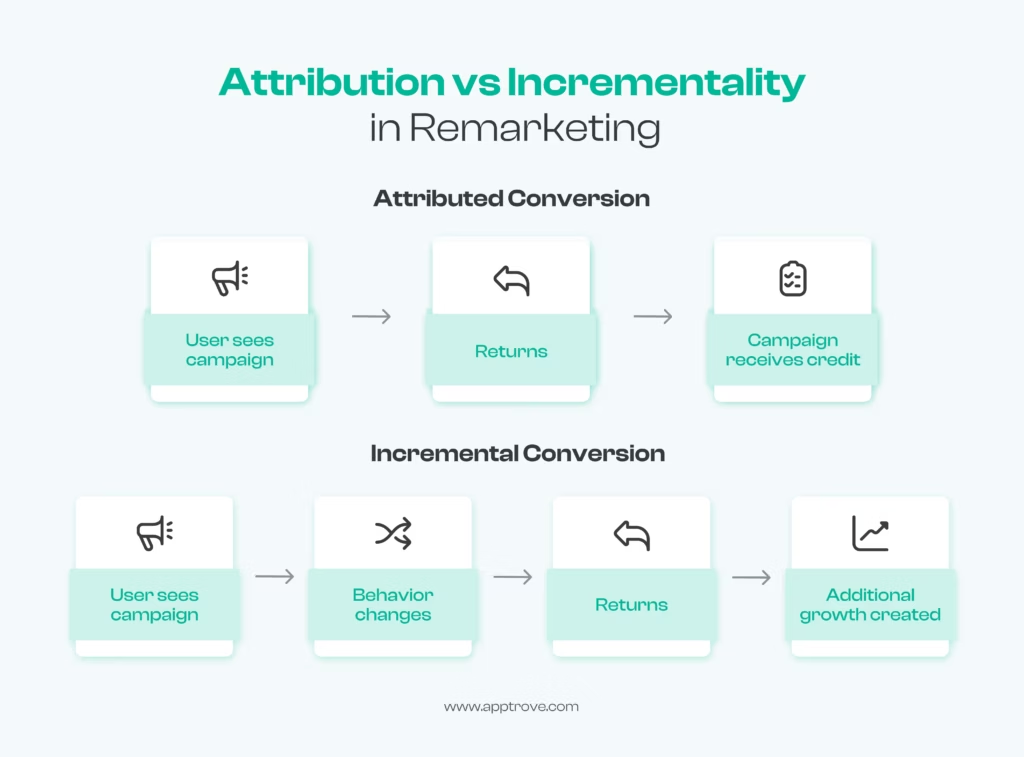
Many growth teams focus heavily on attributed conversions because attribution reports are easy to access and easy to communicate. However, attribution alone does not explain whether remarketing actually changed behavior.
Imagine two customers. The first customer receives a re-engagement campaign, returns to the app, and completes a purchase because of that campaign. The second customer was already planning to return but happened to see your campaign before doing so.
Most attribution systems count both outcomes equally.
Remarketing teams that fail to separate attributed behavior from incremental behavior often overestimate performance and unintentionally waste budget on users who never needed re-engagement in the first place.
This creates several hidden costs.
Campaign efficiency appears stronger than reality. Budgets scale toward audiences with lower incremental lift. Organic behavior gets counted as paid success. Teams begin optimizing campaigns that create activity without necessarily creating growth.
Strong remarketing measurement should therefore go beyond asking who converted, and should instead ask whose behavior changed because of the campaign.
Blind Spot 5: Building Remarketing Audiences Using Incomplete Data
Audience quality often determines remarketing performance long before campaigns go live.
Many marketers build audiences using limited signals from individual platforms, isolated campaign data, or narrow behavioral triggers. While this may simplify campaign execution, it creates incomplete audience definitions.
Incomplete audiences create two major problems.
First, marketers waste spend targeting users who were already likely to convert.
Second, they miss high-intent users whose behaviors happened outside the platform where audience creation occurred.
Consider a shopping app customer who browsed products on mobile web, added items to cart inside the app, but never completed checkout. If remarketing audiences only reflect in-app activity, important context disappears.
The same challenge applies across finance apps, subscription businesses, gaming apps, and marketplaces.
Strong remarketing audiences should combine signals across multiple dimensions, including:
- App activity
- Web behavior
- Purchase history
- Feature engagement
- Customer value
- Churn signals
- Cross-channel interactions
Better audience inputs create better outcomes because personalization quality depends entirely on signal quality.
Remarketing Best Practices for Mobile Apps
While every app has unique growth objectives, several remarketing best practices consistently improve campaign performance.
Segment audiences using behavioural data
Go beyond inactivity windows by analysing user engagement, purchase history, feature adoption, and customer value.
Measure complete customer journeys
Understand how multiple marketing touchpoints influence conversions instead of relying solely on last-click attribution.
Prioritise incrementality
Identify whether campaigns genuinely changed user behaviour or simply received credit for actions users would have completed naturally.
Refresh remarketing audiences regularly
Customer behaviour changes over time. Regular audience updates help maintain campaign relevance and improve engagement.
Continuously optimise creative messaging
Test different offers, messaging, and creatives for different audience segments to improve long-term remarketing performance.
How Better Measurement Improves Remarketing Performance
Most remarketing challenges ultimately lead back to one underlying issue:
Incomplete visibility.
When marketers cannot accurately understand user journeys, audience behavior, attribution quality, or campaign influence, optimization becomes reactive instead of intentional.
This is where measurement infrastructure becomes critical.
At Apptrove, we believe remarketing performance should extend beyond campaign reporting. Growth teams need clearer visibility into how users engage, where friction exists, and which efforts genuinely influence long-term outcomes.
Better measurement helps marketers:
- Identify audience segments more accurately
- Improve attribution quality
- Understand retention patterns
- Optimize re-engagement strategies
- Reduce wasted spend
- Build stronger customer journeys
Because remarketing works best when decisions are driven by complete signals rather than isolated metrics.
Frequently Asked Questions
1. What is remarketing in mobile app marketing?
Remarketing refers to re-engaging users who previously interacted with your app but became inactive, dropped off during a journey, or failed to complete important actions.
2. What is the difference between remarketing and retargeting?
Remarketing is often used as a broader term that includes multiple re-engagement channels such as email, push notifications, and paid campaigns, while retargeting frequently refers specifically to ad-based re-engagement efforts.
3. Why is remarketing important for mobile apps?
Remarketing helps apps improve retention, recover inactive users, increase customer lifetime value, and maximize acquisition investments by focusing on users who already know the product.
4. How do you measure remarketing performance?
Strong remarketing measurement typically includes retention metrics, re-engagement rates, incremental lift, conversion quality, customer lifetime value, and attribution analysis rather than relying only on click metrics.