What is Programmatic Advertising
The definition of Programmatic Advertising has changed; it started as an efficient way to get digital impressions, and now it is an outcomes-oriented ecosystem built on real-time decision making, data, and machine learning. When Programmatic Advertising began, the primary goal was efficiency (such as automated bidding, lower touch time, and increased reach). Now, efficiency is just the baseline.
According to Statista, global programmatic digital display ad spending is projected to reach over $725 billion by 2026, reflecting how central automated and intelligence-driven buying has become to modern media strategy.
In 2026, automation will be insufficient.
Advertisers are working in a privacy-based world where there is a significant drop in signals, where third-party cookies are being removed from the market, and where users are being tracked to a lesser degree than before. The cookieless world isn’t a forecasted future; it’s the world you now work in every day. This is why Programmatic Advertising is transitioning from mechanical automation to predictive intelligence. AI Based Bidding Models, Contextual Relevance, First-Party Data Activation, and Privacy Compliant Measurement Models will change how you reach and understand your audience.
Measurement is an essential component in addition to media buying. As a mobile measurement company with a privacy-first approach, Apptrove acknowledges that we need to view Programmatic Advertising based on both the number of impressions delivered and also how the end outcomes were measured in a responsible, intelligent way. Attribution clarity / signal resilience/fraud prevention / cross-channel visibility all play an integral role in a marketer’s ability to create sustainable growth.
The way you engage as a marketer has also changed. Rather than just focusing on optimizing your CPMs and chasing down impressions, you now engage in evaluating incrementality, deciphering disparate signals, and making decisions based on probabilistic data rather than deterministic facts.
This document does not contain hype or buzzwords; this guide is to understand the current workings of Programmatic Advertising and the major shifts that have occurred in our industry, as well as how you can achieve data-driven, scalable growth in an environment where intelligence is as valuable as the number of automated processes used.
Defining Programmatic Advertising – The Backbone of Today’s Media Buying
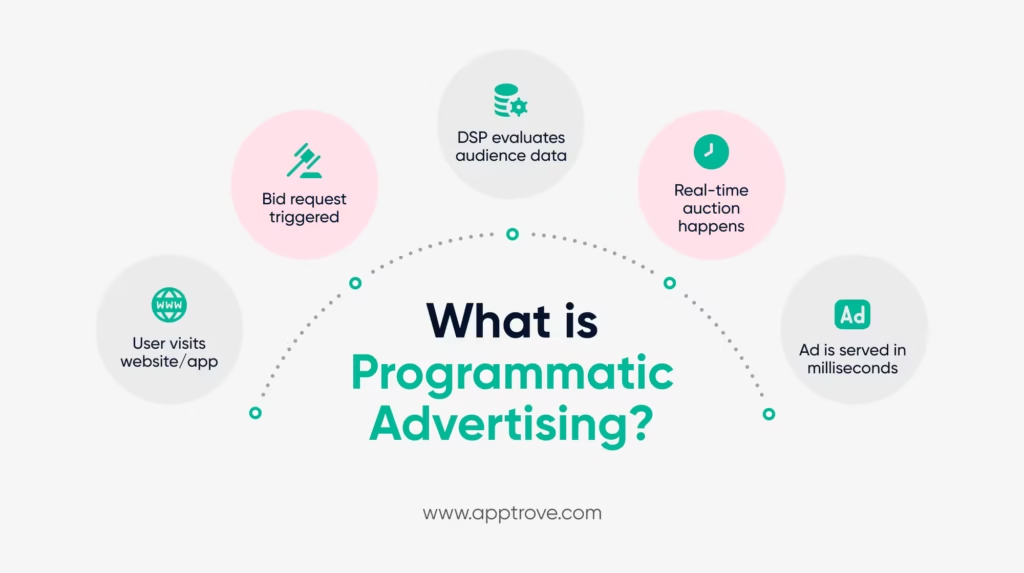
If you want an easy answer to what is programmatic advertising the most simplistic explanation is that it is the real-time purchase and sale of digital advertisements through an automated method against your target audience using their data and algorithms. This being said, this only scratches the surface.
Fundamentally, programmatic advertising is an ecosystem that uses technology to rapidly process multiple data points to make a decision — usually in milliseconds — on an impression and match the right creative to the right user based upon stated interests, meaning, bidding logic (your impression values), and campaign objective. In most cases, this takes place before a web page has completely loaded.
Automated vs Intellectual Activities
With the original birth and development of programmatic ad buying, there was emphasis on automation, or converting a human media buyer into “software” capable of placing “instantaneous” bids. As such, automation provided increased efficiency. However, in 2026 and beyond, using automation alone is no longer the key differentiator.
Intelligence is that key differentiator.
More recently created programmatic systems utilize machine learning, where systems analyze previous consumer behavior, forecast conversion likelihood, automatically adjust bids, and utilize optimized creative message delivery. No longer do you merely automate your ad placements; you now have intelligence-driven and predictive decision-making systems that learn and adapt as time passes.
The Mechanism Behind RTB
Real-Time Bidding is at the centre of Programmatic Advertising.
When a user goes to a website or app:
1. The publisher sends a bid request that gives anonymous data (like browser type, where they are located, and what they were doing before they arrived at the site).
2. Each Demand-Side Platform will evaluate the impression against your campaign goals and objectives.
3. Algorithms will determine the value of that impression to you based on your campaign goals; therefore, the system does not determine value based on standard benchmarks.
4. The highest qualified bid will win and serve the ad within milliseconds.
As an advertiser, you don’t have to place manual bids for each impression because you established campaign goals, targets, budgets, and optimization signals; the RTB Platforms will be able to execute your goals at scale.
The Importance of Data: First-Party and Third-Party Data
Data strategy plays an important role in the success of programmatic advertising in today’s privacy-oriented world.
- The value of first-party data (e.g., data from your users, CRM lists, app activity) is rising and is also compliant with privacy legislation.
- Many third-party sources of data are being restricted because of increased regulation and browser user visibility.
With the increasing loss of signals, programmatic advertising will rely more on using consent-driven first-party methods, contextual targeting,g and modeled audiences to successfully execute programmatic campaigns.
How Large is the Programmatic Advertising Market
When looking at multiple sources for market estimates for the purpose of understanding the total market size of programmatic advertising, such as eMarketer and Statista, the evidence clearly shows that the total global digital ad expenditure from all sources continues to grow at an ever-increasing rate and has outpaced other types of media to a considerable degree. In addition to total market growth, there is a tremendous number of digital transactions that occur through the use of programmatic media channels. Therefore, it is clear that this is no longer just considered to be a “niche” marketing channel — it now represents the foundation of how modern media is bought.
Understanding Programmatic Advertising is more than a buzzword; it provides a means to create an intelligent, strategic system of marketing that efficiently delivers the correct message to the appropriate consumer through digital mediums, with measurable results.
Why Programmatic Advertising Dominates Digital Media Budgets
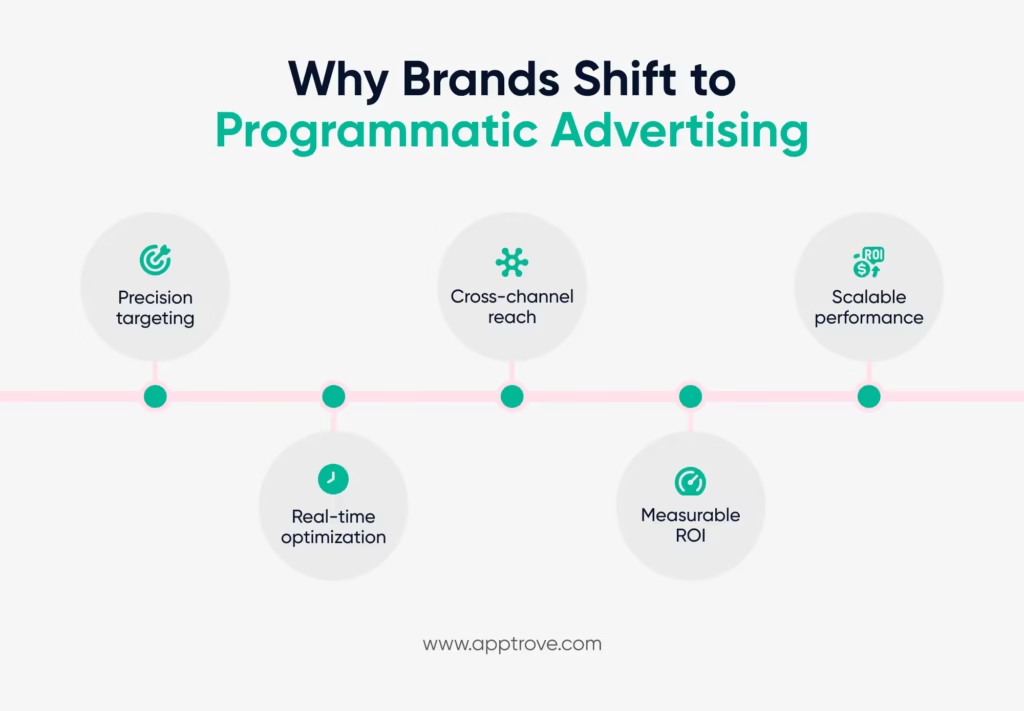
The reason why programmatic advertising is dominating digital media budgets is that it aligns closely with the way that marketers are now being accountable for and assessing the success of their efforts through performance, accountability, and measurable results.
The days of justifying your investment in media based on the reach, volume, and visibility you receive are now over. You have to demonstrate that your investment was made with the intention of delivering results (installs, purchases, subscriptions, LTV) by showing how many dollars you spent on ad placements and how many times those placements led to install purchases or subscriptions. Programmatic advertising allows you to create that framework.
Moving Away from Manual Buying to Intelligent Allocation
Media buying using traditional methods consisted of manual negotiation, fixed ad placement, and targeting broad demographics. The traditional method of media buying created an audience but didn’t have agility. With the advent of programmatic advertising, the framework of buying ads shifted to a new model based on an auction system to buy ads with a dynamic pricing structure and allow for decision-making at the impression level.
A significant percentage of digital display advertising is now purchased programmatically on an international basis. As per various reports from numerous sources (like eMarketer), 90% of digital display advertising in mature countries/markets was bought using a programmatic ad buying system. This shift to programmatic buying ads shows the trust advertisers have put into that method of purchasing, with its features of efficiency and transparency.
Precision Targeting at Scale
Using Programmatic Advertising to target specific audiences can now be based on consumer behavior, context of the ad, characteristics of the device, as well as proprietary first-party data. You aren’t just buying “placements” anymore but are purchasing access to high probabilities of targeting an audience, regardless of their environment.
Increased precision in targeting your audience decreases wasted advertising dollars and results in your campaign being more relevant. Consent-based first-party data, contextual intelligence, and predictive modeling are now more often used to achieve this type of targeting as we move into a “privacy first” world where invasive tracking will become obsolete.
AI & Real-Time Optimization
AI has become a key driver in why advertisers increasingly move budget from traditional media to programmatic media. It helps improve the budget allocation via real-time optimization through automated systems that have the ability to identify performance signals such as clicks, conversions, and engagement patterns, and adjust the bidding for an ad by making changes to the bid in real time (within milliseconds).
Predictive models help determine the probability of conversion at the moment before placing a bid. Therefore, advertisers today are not only responding to their performance results days down the road after the fact but rather optimising them instantaneously (in milliseconds).
Unified Measurement, Cross-Channel Reach
Using programmatic advertising is not limited to displaying ads. Programmatic advertising can also include:
– Mobile Apps
– Digital Audio
– Digital-Out-of-Home
Programmatic advertising’s ability to reach through multiple channels enables marketers to launch coordinated multi-channel campaigns and provides the ability to pull the same data from every channel in one centralized reporting platform.
With increasing expectations for performance and the requirement that marketing teams demonstrate revenue impact, programmatic advertising has changed from an option to a necessary part of any business. Programmatic advertising provides scalability and control, which is critical to successful budget development in the current digital ecosystem.
Programmatic Advertising Explained: A Process from Auction to Attribution
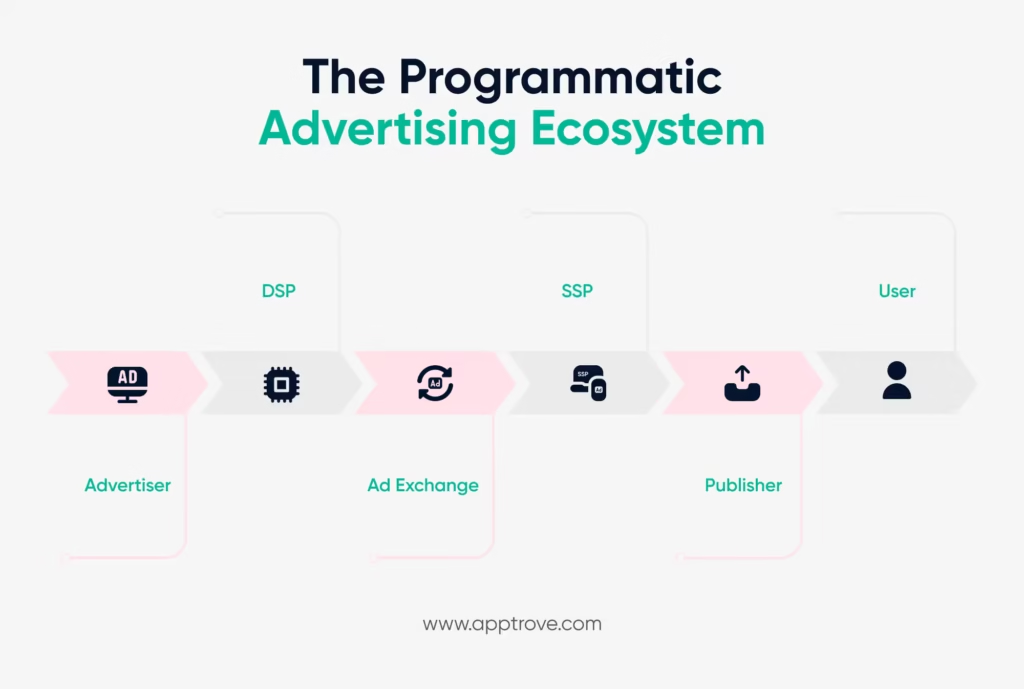
If you want to understand Programme Advertising, now you know what is actually happening behind the scenes of the system that runs it. A single platform may be executing your campaign; however, it is an ecosystem of various technological platforms working together in a matter of milliseconds to get your ads in front of their target audience.
Let’s take apart how this actually works.
Step 1: Define The Purpose (Advertiser)
As an advertiser, you begin by defining your purpose of obtaining installs, conversions, purchases, or engagements. You will also define your audience parameters, set your budget, use creatives, and determine what signals you want to use to optimize.
Once all of this is defined, technology will execute on your behalf at scale.
Step 2: Demand-Side Platforms (DSPs)
The Demand-Side Platform (DSP) is where you go to manage and automate your programmatic campaigns. The DSP will identify available impressions across thousands of publishers in real-time and will evaluate each bid request by analyzing the following factors:
– Audience Signals
– Contextual Relevancy
– Performance History
– Probable Conversion
It will determine if it wants to bid and for how much.
Stage 3: Advertising Exchanges
Advertising exchanges are online platforms that connect advertisers with publishers, providing both sides of the transaction (advertising demand and supply) with access to the same pool of inventory. An advertiser’s purchase of “impressions” can take place in an online auction format where the winning bidder receives the opportunity to display an ad on a publisher’s website or app as soon as a user accesses that property.
Stage 4: Supply-Side Platforms (SSP)
Publishers can use Supply-Side Platforms (SSPs) to manage their ad inventory. SSPs facilitate the transfer of impression data into an advertising exchange, which allows a publisher to receive multiple bids for its advertising inventory from multiple advertisers.
Step 5: Implementation of Real-Time Bidding (RTB)
RTB occurs in a very short amount of time:
– Someone visits a web page or opens the application.
– The SSP provided the ad impression data to the ad exchange.
– The ad exchange sends the bid request to various Demand-Side Platforms (DSPs).
– The DSP algorithms look at the bidding opportunity.
– The highest bid that meets the eligibility criteria wins.
– The advertisement that received the highest bid will be placed on the site immediately.
All of these activities occur before the web page loads completely.
How Data Management Platforms work
DMPs allow you to manage and activate your audience data. In the past, they were built largely around third-party data, but today, due to greater privacy laws and loss of signals, first-party data will be the basis of effective programmatic advertising.
Today, you are also working in a world where data governance, consent, and signal resilience are at least as important as how you bid on inventory.
From Bid to Attribution, From Clicks to Conversions
Winning a Programmatic Advertising auction is merely the beginning of the measurement process. The most important question to ask is whether the ad can be attributed to delivering a measurable impact.
Attribution is very much an integral component of the Programmatic Advertising Data Model because it connects exposure through an ad to action taken by an end user. In the absence of reliable attribution, optimization becomes guesswork.
You have to know the following pieces of information to make Programmatic Advertising work:
– The Impression(s) that influenced the decision to convert
– The way that multiple touchpoints interact with each other
– Whether the ads have delivered incremental value
Programmatic Advertising doesn’t end with the bid — it ends with insight. The auction determines the level of exposure, while the attribution process will provide measurement of the success or failure of an ad’s ability to encourage action. When these functions work together, you progress from merely purchasing impressions to being able to measure the impact of those impressions.
Programmatic Ad Networks: Factors to Evaluate
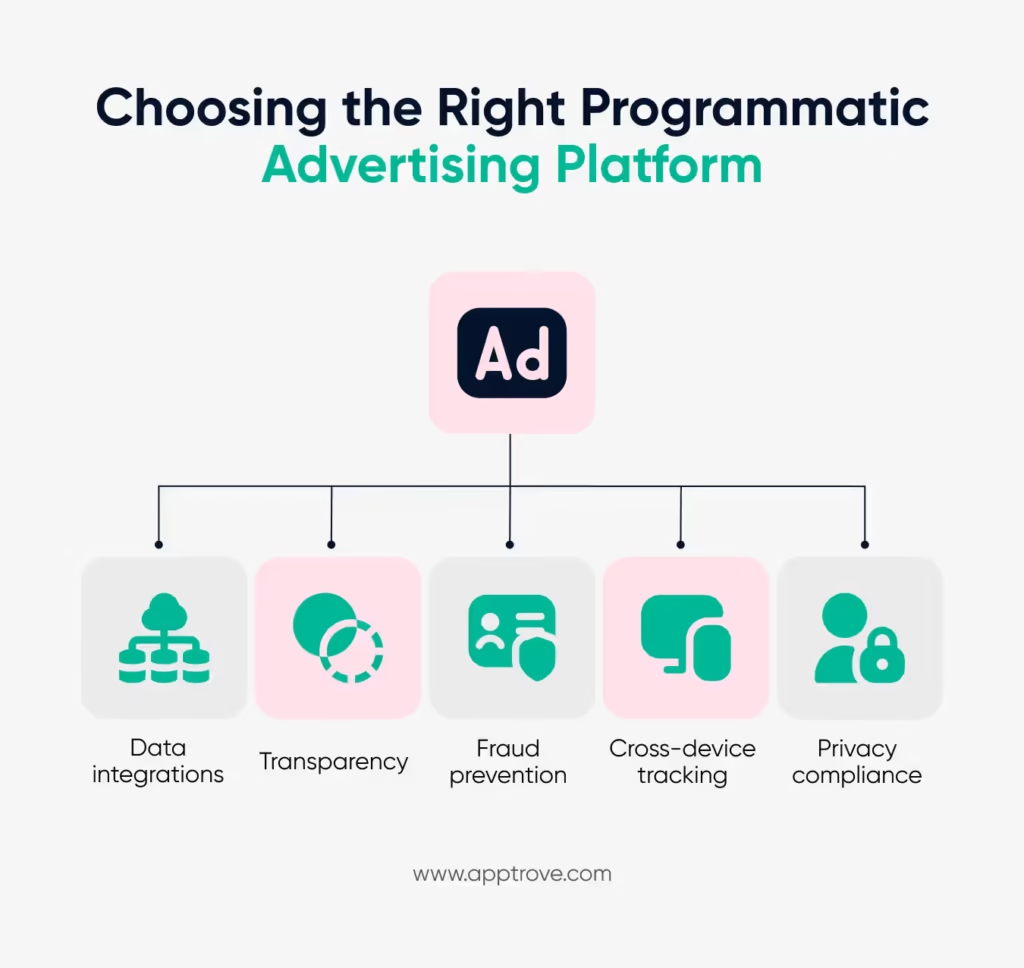
Not every programmatic advertising network provides the same level of quality or service. Most have some type of automated bidding system; however, where they differ is in how much intelligence they provide, the transparency of their reporting, and how deeply they allow you to measure individual campaign performance.
Marketers will assess programmatic advertising networks in 2026 on several attributes beyond reach, specifically signal quality, resiliency, and accountability.
1. Excellent Data Connections
A good platform must be able to integrate well with the following:
– Your first-party customer relationship management (CRM) data
– Your analytical tools
– Your third-party mobile measurement solutions
– Your consent management systems
As a result of the new privacy-friendly environment, you will gain a competitive edge from your first-party data. Platforms that enable secure and efficient data activation will help maintain targeting accuracy while complying with all applicable compliance standards.
2. Visibility & Reporting
The level of transparency is essential in all forms of advertising. As such, you need to see:
– Where your advertisements appear
– What cost per (CPM) will each impression be
– How the optimisation of my bids was made
– Where my placements are achieving actual outcomes
The absence of sufficient transparency through reporting poses a risk to your ability to make confident budget distribution decisions, as the lack of detail limits your ability to strategically optimize the results of a product or service via your advertising.
3. Prevention of Fraud Through Built-In Features
Ad fraud is one of the largest threats to programmatic advertising (also referred to as display advertising). Fraud can take many different forms, including bot traffic, click injections, and fake inventory that may impact performance metrics and result in lost ad spend.
A reputable platform should have developed ways of identifying fraudulent activity before it occurs (proactive) and not after the fact (reactive).
4. Attribution Alignment & Cross-Device Tracking
Users frequently traverse multiple devices,s including mobile, desktop/web, tablets, and connected televisions. Any programmatic advertising platform must provide the ability to track users across fragmented journeys on said devices. Having cross-device visibility allows for the measurement of attribution to accurately reflect use across multiple touchpoints in real life, rather than simply measured via isolated touchpoints.
If you do not have unified measurement, optimization will also become fragmented as well. Deep insight into mobile attribution as well as cross-channel tracking will be far more important for illuminated performance.
5. Privileged Design & Signal Durability
The reality of missing signals impacts how you optimize your ad assets. True programmatic advertising platforms are developed with the principle of privacy-first (privacy-compliant) at their center. This includes but is not limited to:
– iOS campaign compatibility with SKAN
– Consent-aware tracking
– Aggregated and modeled(s) reporting
– Contextual targeting capabilities
If you are investing in driving growth on iOS, then understanding your iOS growth strategy through analyzing your SKAN Analytics data or other privacy-first measurement frameworks is critical to successfully maintain performance and execute within a restrictive environment.
6. Capabilities of Artificial Intelligence And Predictive Optimization
Ultimately, intelligence represents a competitive advantage. To enable these advantages, platforms must use machine learning to:
- Project potential changes in conversion rates
- Change bid prices in real time
- Change creatives automatically when optimising
- Identify the user segments who are most likely to generate ROI
In today’s digital landscape, the right Programmatic Advertising platform does much more than provide automated functionality; it also interprets signals, protects budget, ensures compliance,e and increases your capability to measure growth sustainably.
When assessing Programmatic Advertising Platforms, you must ask yourself, “Does this platform simply purchase impressions or does it help (empower) you make more intelligent decisions that protect consumer privacy and leverage data?”
Creating a Successful Programmatic Advertising Strategy in a Privacy-Focused World
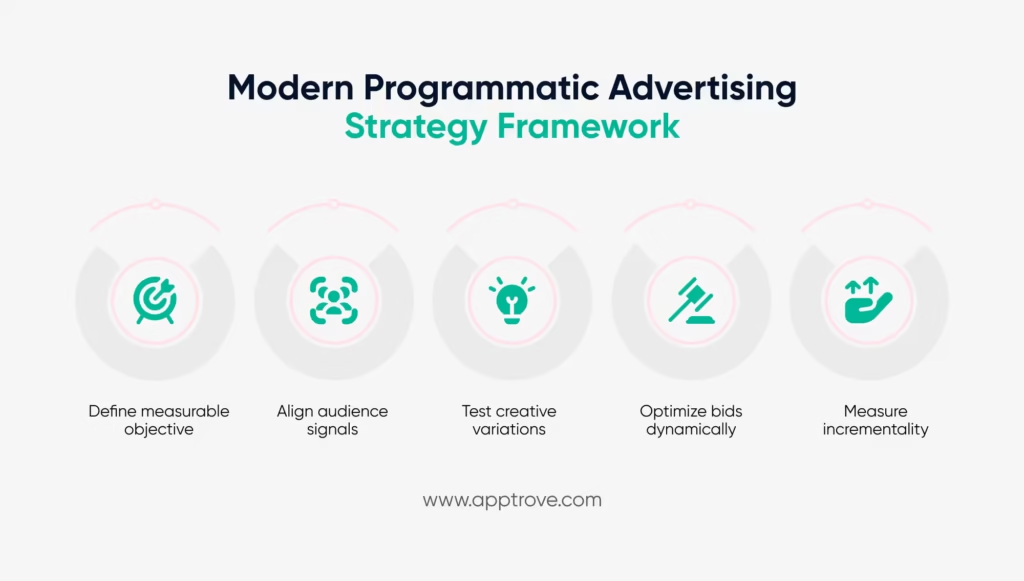
To develop an effective programmatic advertising strategy in 2026, there is much more to consider than simply activating a DSP and developing a budget. There will be different performance outcomes due to the restrictions associated with operating within a cookieless, privacy-focused environment. Today, success depends on overall strategy and having the proper signals at your disposal to maximise campaign performance.
1. Specify How to Measure Objectives
You should create specific definitions of success before you launch any campaign. Is success based on the number of installs? Is it based on purchases made? Is success based on how many subscription renewals you have? Is it your lifetime value (LTV) for customers?
Programmatic Advertising has the ability to be optimized based on events that can be defined as having a clear measure against them. Those who have broad goals can experience a dilution of their signals. The more precise the objectives in defining overall success,s the stronger the learning for your algorithm.
2. Prepare for a Cookieless Future
The removal of third-party cookies and a stricter global approach to privacy regulations have fundamentally changed how digital media is consumed and measured worldwide. What was once a tracking-heavy ecosystem is now transitioning toward privacy-first frameworks built around consent and responsible data usage. According to recent industry research, by the end of 2024, data protection and privacy laws covered approximately 6.3 billion people — nearly 79% of the global population — with 144 countries implementing formal data and consumer privacy regulations, underscoring how privacy requirements continue to expand year over year and directly influence how user data is collected, processed, and used across digital advertising markets.
The way we collect data and analyze the results will require the use of multiple ways of aggregating information about users, rather than only relying on using single user-level information.
You must be prepared for a very limited way to capture signals, and therefore, you cannot depend on unlimited access to user-level information.
3. Give First-Party Data Highest Priority
Today, your first-party data is the most important asset that you have. Your CRM list, the information about how a user has interacted with your apps, your purchase history, as well as engagement signals, provides you with consent-based data to use to target your customers as well as optimize your efforts.
When integrated properly, your first-party data improves:
- How accurately can you target an audience
- How accurate is your lookalike modeling is
- How efficiently you make bids
- How relevant your personalized experience will be.
In a privacy-centric world, what you do with your data becomes a competitive differentiator.
4. Embrace the Resurgence of Contextual Targeting
With the restrictions on behavioral tracking being implemented, the resurgence of contextual targeting is occurring. Rather than trying to define who your user is, you are simply targeting what they are seeing at that specific point in time.
When you use contextual targeting, it provides a brand-safe environment to play in, it increases the relevance of your message,s and decreases your dependence on persistent identifiers. For many brands, combining contextual intelligence with first-party modeling will provide a more robust Programmatic Advertising strategy.
5. Optimize Your Creative Content As Well As Your Bids
Marketers tend to spend most of their time optimizing bids and underestimate the effect that creative quality can have on click-through rates, engagement rates, and conversion likelihood.
An effective Programmatic Advertising strategy should include:
- Continuous A/B testing
- Dynamic qualitative optimisation of creative content
- Personalised messaging
- Experimentation with different formats (display, video, native, CTV)
Algorithms can optimise bids, but stimulating creative content drives the user to take action.
6. Measure Your Incrementality, Not Just Your Attribution
Last-click conversion analysis will not be enough in today’s fragmented signal environment. You need to know the incremental impact of your exposure to Programmatic Advertising by identifying what would not have occurred without exposure.
Incrementality testing allows you to:
- Prevent over-crediting
- Identify which channels are performing at a high level
- More effectively allocate your budget to the best-performing channel
- Validate various AI-powered bidding models
7. Orchestrate Multiple Channels
Consumers have the ability to transition seamlessly between multiple devices and platforms that are constantly evolving; thus, today’s best practice for a Programmatic Advertising strategy is to develop a holistic plan of measurement that integrates all existing (traditional) mobile, display, CTV, and new/emerging channels.
Cross-channel orchestration will allow you to optimise not as separate entities, but rather, as a multiplier effect on cumulative momentum being built across all touchpoints.
Programmatic Advertisements will no longer rely on volume (scale) alone; instead will be based upon the use of signal intelligence, creative adaptability, and the sophistication of measurement tools.
The combination of clearly defined objectives, strong first-party data foundations, contextually relevant advertising, creative experimentation, and testing for incrementality allows for the transformation of programmatic advertisements as automated purchases into strategic growth infrastructures.
Programmatic Advertising is Now an Omnichannel Ecosystem: Mobile, CTV, Display, etc.
Programmatic Advertising has evolved from desktop website display ads; it’s now powering numerous channels to allow you to target users wherever they consume content across channels, formats, and environments.
If you follow a strategy to only look at channels independently, you jeopardize gaining insights into your performance across all channels.
Performance Core of Mobile In-App
Mobile Programmatic Advertising is still mostly driven by mobile devices and specifically marketed towards those using apps. In-app environments provide strong engagement signals, contextual depth, and high-intent moments. Because mobile-first consumption tendencies continue to drive global digital interactions, mobile is not only the primary performance channel, but it is now the primary performance driver.
When you purchase impressions on mobile, you are purchasing an opportunity to interact and engage with users inside well-established and high-attention environments.
Connected TV (CTV) – The Fastest-Growing Area of Our Business
The Connected TV space (CTV) is quickly becoming the fastest-growing area of Programmatic Advertising. Research from industry analysts such as eMarketer indicates that Programmatic CTV investment is accelerating rapidly, as advertisers increasingly redirect budgets away from traditional linear television and toward streaming and on-demand environments. In fact, eMarketer reports that 43% of U.S. advertisers are shifting spend from linear TV to programmatic CTV, and programmatic is projected to account for 84.2% of U.S. CTV display ad spend by 2025, underscoring the structural reallocation of advertising dollars toward automated buying within streaming ecosystems.
CTV is the perfect combination of traditional TV’s storytelling capabilities and digital advertising’s targeting capabilities. You can segment audiences to ensure you’re reaching the right people, control frequency, and measure how successful your campaigns are at driving engagement with potential customers in ways that were never available through linear TV buying.
With the aid of CTV, advertisers are now almost entirely able to build brand awareness and create upper-funnel with an efficient extension of direct-response performance media.
Display – Foundational Layer
Display advertising is a key foundation of programmatic advertising. The display channel is thought to be mature but is always evolving as new technologies, such as dynamic creatives, allow for creativity beyond standard display. The display channel provides the capacity to scale, retarget, and reinforce your programmatic strategy with your other marketing channels.
Programmatic Audio/DOOH – Extending Attention
Programmatic audio allows you to reach users when they may not be using a screen, such as when commuting or exercising. Programmatic DOOH allows you to link the digital ecosystem of buying with the physical world of buying, allowing dynamic content updates to occur in real time in the physical world.
All of these developing programmatic channels will help you to reach more users, but still manage your centralised buying and reporting.
The Power — and Complexity — of Omnichannel Orchestration
While cross-channel expansion increases opportunity, it also increases measurement complexity. Users move between mobile, CTV, desktop, and offline environments fluidly. Without unified attribution and consistent performance tracking, optimization becomes fragmented.
A strong Programmatic Advertising strategy ensures that:
- Messaging remains consistent across touchpoints
- Frequency is managed holistically
- Attribution models reflect multi-device journeys
- Budget allocation responds to true incremental impact
Omnichannel orchestration is not about being everywhere. It is about being strategically aligned across environments where your audience is most receptive.
As Programmatic Advertising continues to expand beyond traditional display, your advantage lies in integration — connecting channels into one measurable, privacy-aware growth engine rather than operating in isolated silos.
Challenge in Programmatic Advertising – it’s All About Coordinating the Fragmented Ecosystem.
Programmatic advertising is a remarkable achievement that has brought about a slew of different technologies, approaches, and variations in how to communicate your message effectively to consumers. However, with these advances come corresponding challenges for advertisers.
As programmatic advertising progresses beyond simply being a “solution,” understanding these challenges is essential to transitioning from reactive troubleshooting to proactive, data-driven strategies.
1. AD Fraud
One of the largest challenges facing programmatic advertisers today is the negative impact of ad fraud on both performance data and cost analysis. From click fraud to bot-generated impressions, many forms of fraud exist in the digital ad ecosystem that can mislead an advertiser about the performance of their campaign, ultimately impacting future budget allocation based on incorrect performance data.
If fraud is present within your signal(s), then the optimization algorithms you use will learn from erroneous data and therefore be unable to optimize properly, resulting in misallocated spend and inaccurate ROI metrics. It is, therefore, critical that programmatic advertisers implement effective fraud detection programs with active monitoring to ensure the integrity of their signals.
2. Signal Loss
Privacy regulations are becoming stricter, and third-party cookies are no longer used, which means that signal loss is one of the key issues businesses face today. As a result, deterministic tracking is also decreasing, thereby causing businesses to rely upon aggregate data, modeled attribution, and consent-based measurement.
Marketers must adjust their businesses by building their first-party data strategies and utilizing analytics that adhere to privacy guidelines. Programmatic Advertising now requires businesses to be resilient rather than completely relying on unrestricted tracking.
3. Viewability and Brand Safety
There are many impressions that are served but not necessarily seen, and low levels of viewability can adversely impact the effectiveness or success of the ad that is served. For example, when serving an ad in a low-viewability impression that is not safe, this could damage the reputation of the brand that’s associated with that impression.
Marketers should have the ability to see where their ads are running and how to measure viewability because viewability standards and contextual controls will provide marketers with performance benefits and perception benefits.
4. Excessive Optimization
Advanced algorithms are incredibly capable of helping marketers run their digital advertising campaigns; however, if a marketer continues to quickly optimize performance aggressively for short-term results, they can ultimately limit their audience.
With a programmatic advertising strategy built on equilibrium, you can combine automated processes with strategic oversight. For long-term growth, you need a sustainable optimization plan instead of a routine of constantly micro-adjusting your campaigns based strictly on immediate conversion data.
5. Fragmented Reporting
Cross-device activity, different platforms, and disconnected analytics can result in fragmentation across various areas of report outputs. Disjointed data reporting can lead to inconsistent interpretations of performance.
The digital marketing industry can overcome fragmented reporting through unified measurement frameworks. Attribution, fraud detection, and cross-channel reporting components that are fully integrated will bring back clarity.
In the digital advertising world, every issue comes down to the same theme — accountability. Clean data, transparent reporting, and measurement methodologies that are cognizant of privacy regulations make sure that your campaigns will deliver on how effectively they are running, with actual impact that is easily measurable.
What Will Be the Role of Artificial Intelligence, Predictive Bidding, and Decision Intelligence in the Future of Programmatic Advertising?
When looking to the future of Programmatic Advertising, automation is only one piece of an entire puzzle; intelligence, flexibility, and accountability are equally important factors that contribute to the success of a Programmatic Advertising campaign.
AI has already changed the landscape of how we execute our campaigns. For example, with AI-driven creative testing, we can now look at how well our campaign messages work based on consumer interactions (as opposed to traditional A/B testing). With predictive bidding, we can also better predict how likely it is that a consumer will purchase after viewing an ad impression, even before we purchase the impression. Rather than reacting to historical data to determine how successful our campaign will be, we can begin predicting the efficacy of our campaigns based on the same attributes Agencies use to characterize success.
Additionally, the growing number of privacy regulations and the presence of sandbox environments have made it more challenging than ever to gain access to the data necessary for activating campaigns. Signal loss is affecting our ability to activate campaigns; however, Programmatic Advertising is becoming much more resilient as a result. The move to first-party data strategies, contextual targeting, aggregated measurement, and modeled attribution has greatly reduced the reliance on unidentified users.
You also see how retail media and closed ecosystems are becoming more prevalent through the use of first-party, deterministic data. These are indicative of the larger trend of utilizing and controlling ownership of data and consent as strategic assets.
Looking towards the future of Programmatic Advertising, its evolution will extend beyond impressions to include outcomes such as increasing growth, customer lifetime value, and measuring business impact.
To determine how well you convert your media exposure into sustainable performance, you will need to use decision intelligence (AI, predictive analytics, privacy-first infrastructure, and unified measurement).
You will need more than new tools to have an advantage in the evolving ecosystem. The key will be to integrate technology, data, creativity, and measurement as a cohesive, privacy-first growth strategy.
If you want to learn about the ways that privacy-first measurement can help your Programmatic Advertising strategy, reach out to us, and we’ll get started on a conversation!
FAQs
What is Programmatic Advertising and why does it matter today?
Programmatic Advertising is the automated, data-driven buying of digital media in real time. Programmatic Advertising matters today because it enables scalable targeting, measurable performance, and intelligent optimization in a privacy-first digital ecosystem.
How does Programmatic Advertising improve campaign performance?
Programmatic Advertising improves campaign performance by using real-time bidding, predictive modeling, and audience segmentation. Programmatic Advertising continuously optimizes bids and placements, ensuring your budget focuses on high-probability users who drive measurable outcomes.
Why is Programmatic Advertising important in a privacy-first era?
Programmatic Advertising is important in a privacy-first era because it adapts to signal loss through contextual targeting, first-party data activation, and modeled attribution. Programmatic Advertising enables compliant, intelligent growth without relying solely on third-party identifiers.
Who should invest in Programmatic Advertising?
Programmatic Advertising is suitable for brands seeking scalable digital growth, measurable ROI, and cross-channel reach. Whether you are performance-focused or brand-driven, Programmatic Advertising supports data-backed decision-making across evolving media environments.
What metrics define success in Programmatic Advertising?
Success in Programmatic Advertising is defined by measurable outcomes such as conversion rates, incremental lift, customer acquisition cost, and lifetime value. Programmatic Advertising performance should be evaluated through attribution clarity and long-term growth impact.