Introduction
Advertising through Connected TVs (CTV) is not only increasing in size, but also in velocity. According to projections, CTV advertisers are expected to reach an investment of $46.89 billion by 2027; as such, brands are shifting an unprecedented amount of budget to this channel. While CTV is growing rapidly, measuring the results has become more complicated than ever before. MMPs like Apptrove enable accurate cross-device attribution and insights.
The advanced CTV system may create problems for marketers as it is so advanced that accurately measuring their results is nearly impossible, due to CTV being advertised using unique CTV app-based performance systems. Marketers will experience the most significant challenges and best opportunities through the use of the CTV Measurement platforms to effectively reach their target audiences.
Marketers can expand their ability to build relationships with viewers through CTV by leveraging its increased reach and measurement platforms to effectively reach and connect with viewers. This guide will show marketers how to measure CTV content, the incremental lift associated with CTV, and provide them with a complete understanding of how MMP tools enhance the performance of their CTV brand campaigns on CTV.
Understanding CTV Measurement Fundamentals
At its core, CTV measurement is about understanding how ads perform across connected TV platforms. Unlike traditional TV panels, CTV relies on digital data signals, giving marketers a much clearer picture of user behavior and campaign impact.
The Building Blocks of CTV Measurement
CTV measurement requires using multiple sources of data and evaluation methods to work effectively:
1. Impression Tracking: The measurement of CTV is comprised of several different components; however, one of the key aspects of CTV measurement revolves around measuring the right impression counts. While there are many different platforms and devices that CTV operates on, measuring the impression count correctly is much easier said than done.
2. Identity Resolution: Tools used for measuring CTV allow advertisers to track their ad impressions. By linking the viewer’s identity across multiple devices, advertisers can identify the frequency of CTV ads being viewed.
3. Attribution Modeling: CTV metrics generally include estimates for how much value each viewer action has on the sale through the use of an attribution model. Attribution models for CTV can be simple last-click tracking models as well as more complex setups that track all customer behaviors leading to a buying decision.
4. Cross-Platform Integration: To get a complete picture of how well a CTV ad is performing, data collected from all other marketing channels needs to be blended with the CTV data. This will allow MMPs such as Apptrove, which are currently recognized as the most useful for CTV measurement.
Companies using unified CTV measurement solutions have seen far greater campaign ROI compared to companies that have used siloed measurement methods. This difference in effectiveness highlights the need for an integrated and unified CTV measurement solution.
The CTV Measurement Ecosystem
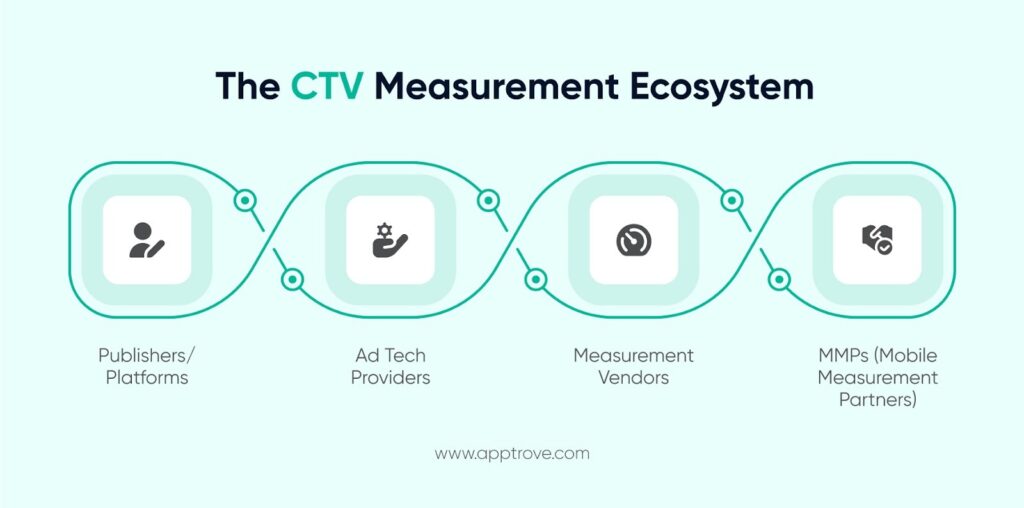
The CTV measurement landscape consists of several key stakeholders:
- Publishers/Platforms: Online video services, including Hulu and Amazon Fire, are two platforms that can stream TV shows and commercials to their audiences. However, each of these services has a different methodology for tracking data and defining standards for who watches their shows. More importantly, these platforms provide the primary source of information to advertisers who are interested in determining how successful (in terms of reach) their ad campaigns are and how many times their ads were viewed by the audience.
- Ad Tech Providers: Ad Tech Providers allow for both the programmatic and direct management and purchasing of CTV ad inventory. They have multiple advertising targeting capabilities in addition to open, real-time bidding that allows advertisers to have complete oversight of how they are tracking their campaigns and how effective the efforts were.
- Measurement Vendors: Measurement vendors focus on providing accurate measurements of CTV ads through advanced analytics and result modeling. With an innovative approach, companies can determine the attributes of when ad impressions were made and what the resulting actions were based upon those impressions, making it easier for advertisers to evaluate their ROI.
- MMPs (Mobile Measurement Partners): Attribution experts like Apptrove that provide means for linking CTV impressions to downstream activity across devices and platforms. MMPs are specialists in both cross-device tracking and cross-platform attribution, allowing advertisers to measure the place CTV occupies in the overall customer journey and how CTV has helped convert customers along the way.
Each of these players contributes unique data and capabilities to the CTV measurement process, but the fragmentation between them has historically created significant blind spots. This is where advanced CTV measurement solutions become essential for advertisers seeking a complete picture of their campaign performance.
Key CTV Metrics That Drive Performance
Effective CTV measurement requires focusing on the right metrics that truly indicate campaign success. While traditional TV relied primarily on reach and frequency, CTV measurement offers a substantially richer set of performance indicators that bridge the gap between brand awareness and direct response.
Essential CTV Metrics for Modern Marketers
The most valuable CTV metrics combine the best aspects of traditional TV measurement with the precision of digital attribution:
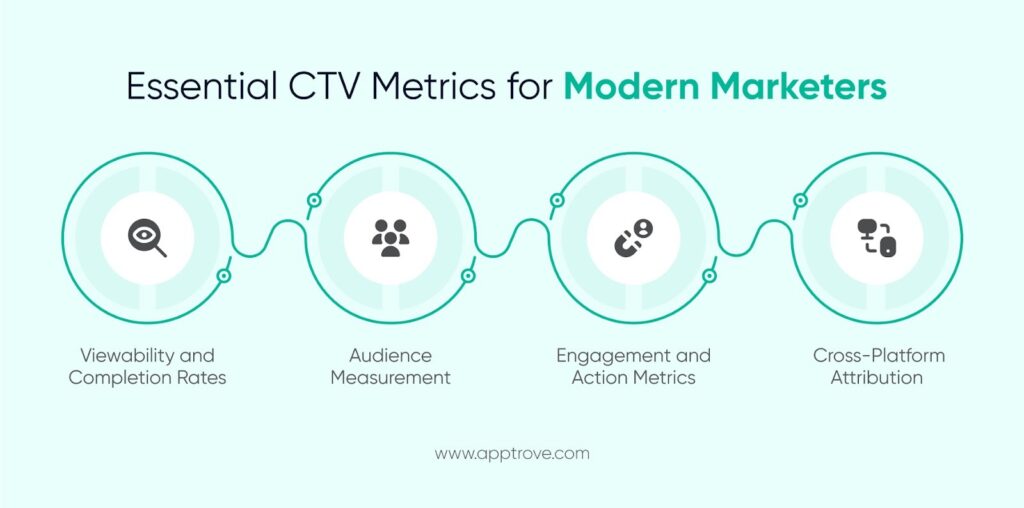
A. Viewability Rate: Metrics that indicate how many impressions met industry standards for having been viewed on active screens. The function of this metric is to ensure that your advertisements have reached an exact audience and there have not been any accidental or broken impressions (e.g., ads showing up on a screen that the viewer was not actually looking at).
B. Video Completion Rate (VCR): A VCR is assigned to each ad impression when the entire ad creative is viewed without interruption. A high VCR indicates either that the content was very compelling to the viewers or that the placement of the ad was highly successful. A low VCR can be attributed to a number of reasons, including that the viewer is not engaged with what is being presented to them, or there was not a suitable placement of the ad.
C. Quartile Completion: This metric demonstrates the percentage of your impression that was viewed by an audience, and allows the advertiser to measure the impact of their ad on a more granular level, as well as isolate the effective elements of their advertisement in order to modify those elements. By utilizing the information provided by individual ad impressions, advertisers can refine their advertisements and keep their advertising effective.
In comparison to other forms of video advertising, advertisers see a higher than normal VCR; for example, the average VCR for a successfully delivered CTV ad is above 95%.
2. Audience Measurement
Advanced CTV measurement provides detailed insights into who is viewing your ads:
A. Unique Reach: Unique Reach measures how many people see your ads without double-counting when they see them again later. This metric helps to identify how many people will view an ad and provides an indication of how often you may annoy the same person with an ad.
B. Frequency: Frequency measures how many times an individual has seen an advertisement across all digital devices in a given household. Advertisers use this metric for determining a better balance of exposure and frequency so that they can provide multiple exposures to the same audience without resulting in negative impressions of the ads.
C. Audience Composition: Audience Composition compares an audience’s demographic and interest characteristics to advertisers’ desired audiences and the advertiser’s campaign objectives. The audience composition provides information on whether the audience being targeted by advertising is being met and if there are ways to improve targeting.
D. Co-Viewing Estimation: Co-Viewing Estimation provides the number of viewers viewing television content in the same household. Advertisers can utilize this information to determine the reach of their ads beyond just the screen.
3. Engagement and Action Metrics
The real power of CTV measurement comes from connecting ad exposure to subsequent actions:
A. Website Traffic: CTV’s effects on website traffic can be assessed through advanced tracking models that can measure how viewers switch between using multiple devices. The number of people who responded immediately/positively to a CTV ad can help you determine how effective your CTV marketing campaigns were at driving conversions.
B. Mobile App Downloads: The ability to link cross-device reporting allows advertisers to measure how many of the consumers who viewed their CTV advertisements also downloaded their mobile applications. Mobile application developers can assess both the extent to which their application users are receptive to premium video content and how those videos have contributed to the growth of their mobile business.
C. Online Conversion: Online conversion is defined as the action of either purchasing or signing up for a service after viewing a CTV advertisement, which can be measured through multi-touch attribution analysis that identifies the various stages of interaction between a customer and a business. Online conversions represent the strongest evidence that your advertising campaigns are successful and provide a clear and concise representation of your return on investment.
D. Incremental Lift: Incremental lift measures the number of incremental conversions produced as a direct result of consumers watching a CTV advertisement(s) by using controlled testing methodology associated with advertising campaign effectiveness. Incremental lift allows for the comparison of the outcomes of CTV ad viewers with those who did not view the advertisements, yielding an unambiguous indication of the incremental lift resulting from the advertisement.
These CTV metrics provide concrete evidence of campaign impact and form the foundation for calculating return on investment.
4. Cross-Platform Attribution
Comprehensive CTV measurement requires connecting exposures across various platforms:
A. Cross-Device Conversions: Actions taken on mobile or desktop after a CTV impression, tracked through identity resolution. This metric is where MMPs earn their keep; it requires a reliable device graph and consistent attribution logic across platforms.
B. View-Through Attribution: Conversions that follow ad exposure but don’t involve a click. CTV is fundamentally a passive medium, so view-through attribution is essential for capturing its real impact. The window length matters a lot; a 24-hour window and a 7-day window will tell very different stories.
Multi-Touch Attribution: Distributes conversion credit proportionally across all the touchpoints in a customer’s path. This prevents CTV from being systematically undervalued when a last-click model gives all the credit to a search ad that a well-targeted CTV campaign made more likely to succeed.
Establishing Your CTV Measurement Framework
When developing a CTV measurement strategy, marketers should establish clear KPIs aligned with business objectives. Different campaign goals require emphasis on different CTV metrics:
- Brand Awareness Campaigns: Focus on reach, frequency, and audience quality metrics to understand message penetration and brand lift potential. These campaigns prioritize impression quality and audience composition over direct response metrics, requiring measurement frameworks that capture upper-funnel impact.
- Consideration Campaigns: Emphasize engagement metrics like website visits and content consumption to track interest generation and research behavior. These campaigns bridge awareness and conversion, requiring measurement of both brand metrics and behavioral indicators that signal purchase intent.
- Conversion Campaigns: Prioritize attribution metrics connecting CTV exposure to purchases and measurable business outcomes. These performance-focused campaigns require sophisticated attribution modeling and incrementality testing to prove direct ROI and optimize for cost-effective customer acquisition.
By focusing on the right combination of CTV metrics tailored to specific business objectives, advertisers can maximize the value of their connected TV investments and continually optimize performance.
Common Challenges in CTV Measurement
Despite rapid technological advancement, CTV measurement continues to face significant obstacles that complicate advertisers’ ability to accurately evaluate campaign performance. Understanding these challenges is the first step toward implementing effective solutions.
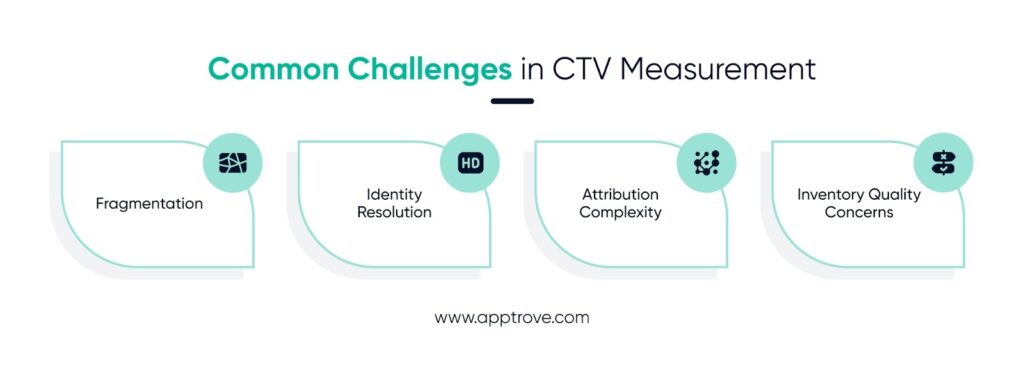
The Fragmentation Problem in CTV Measurement
Perhaps the most fundamental challenge in CTV measurement is the highly fragmented nature of the ecosystem:
- Platform Proliferation: Dozens of streaming apps, each with different data structures, reporting APIs, and integration requirements. Getting clean, comparable data across all of them is a real engineering problem, not just a dashboard design question.
- Inconsistent Standards: One platform counts a completed view at 97% watched. Another counts it at 100%. One reports audience demographics based on logged-in users; another extrapolates from panel data. These differences compound when you’re trying to compare campaigns across platforms or build a consolidated view.
- Walled Gardens: The biggest streaming platforms restrict data sharing in meaningful ways. You get the metrics they choose to share, in the format they choose to report them, which may or may not align with how you measure success elsewhere.
This fragmentation creates significant blind spots in CTV measurement that prevent advertisers from gaining a complete picture of campaign performance. According to a recent industry survey, 41% of advertisers cite inventory fragmentation as their primary CTV measurement challenge.
Identity Resolution Hurdles
Accurate CTV measurement depends on the ability to connect viewers’ identities across devices and platforms:
- Household vs. Individual: A household of four people sharing one TV is a CTV measurement nightmare. When person A sees your ad and person B converts, standard attribution gets confused. Person-level measurement requires either logged-in user data or probabilistic modeling; neither is perfect.
- Cross-Device Connectivity: Connecting a CTV impression to an app download on a phone in the same household requires a working device graph. These graphs are built from a combination of deterministic matching (shared logins) and probabilistic modeling (IP addresses, device timing). Accuracy varies considerably.
- Privacy Restrictions: Cookie deprecation, ATT, and evolving data regulations have narrowed the tools available for identity resolution. This isn’t going away; it requires measurement approaches that work within privacy constraints rather than relying on tracking infrastructure that’s being phased out.
Attribution Complexity
Determining the true impact of CTV advertising involves numerous attribution challenges:
- Long Conversion Windows: Someone might watch your ad while researching a purchase they’re not ready to make yet. If they convert three weeks later, a 7-day attribution window misses it entirely. But open up the window too far and you’re picking up noise.
- Multi-Touch Reality: Most buyers interact with five to ten touchpoints before purchasing. Giving all the credit to the last click, usually a branded search ad, understates what earlier-funnel channels like CTV contributed to making that search likely.
- Online/Offline Connection: A meaningful portion of CTV-influenced purchases happen in physical stores. Connecting those transactions back to a viewing event requires data partnerships with retailers or specialized location-based attribution approaches that most measurement stacks don’t have built in.
Research indicates that standard attribution models may undervalue CTV’s contribution by up to 40% due to these complexities.
Inventory Quality Concerns
Not all CTV inventory is created equal, presenting additional CTV measurement challenges:
- Ad Fraud: Fake apps, spoofed device IDs, and manipulated traffic data can make fraudulent impressions look legitimate. CTV fraud has specific signatures, abnormal completion rates, impossible geographic distributions, traffic patterns that don’t match normal viewing behavior, but catching it requires active monitoring.
- Brand Safety: Ensuring your ad doesn’t appear alongside content that conflicts with your brand values is harder across a fragmented CTV landscape than on a curated publisher site. Pre-bid content verification and post-campaign auditing both matter here.
- Viewability Verification: Server-side ad insertion (SSAI), which is common in CTV, makes traditional JavaScript-based viewability measurement difficult. Verifying that an ad actually appeared on an active screen requires CTV-specific technical approaches.
How to Measure TV Advertising ROI Effectively
Calculating the return on investment for connected TV campaigns requires a structured approach that connects ad exposure to business outcomes. Here’s a comprehensive framework for how to measure TV advertising ROI in the connected era.
Setting Up Your ROI Framework
Before running a single CTV campaign, get these four things right:
- Define Primary Business Objectives: Are you trying to drive app installs, direct purchases, brand lift, or store visits? Each objective points to different metrics and different attribution approaches.
- Set Benchmark KPIs: Run your measurement baseline before the campaign starts. Trying to reconstruct a pre-campaign baseline after the fact introduces bias and guesswork.
- Determine Attribution Windows: How long does your customer consideration cycle typically last? A 24-hour window makes sense for a food delivery app. A 30-day window makes more sense for a financial services product.
- Build an Incrementality Framework: Decide from the start how you’ll distinguish genuine CTV-driven conversions from conversions that would have happened anyway. This usually means setting up holdout groups or planning a geo-based test.
The CTV Measurement ROI Formula
While specific approaches vary by industry and objective, the fundamental formula for how to measure TV advertising ROI follows this structure:

The math is straightforward: (Value of Attributed Conversions – Total Ad Spend) ÷ Total Ad Spend. The difficulty is in the numerator. What counts as an attributed conversion, and how confident are you in that attribution?
Three approaches improve the accuracy of that attributed value:
- Probabilistic Attribution: Statistical models that connect CTV exposures to downstream actions across devices. The output is a probability-weighted conversion count, not a deterministic one, which is more honest about the uncertainty involved.
- Incrementality Testing: Holdout groups and geographic split tests that measure how many additional conversions CTV exposure actually produced. This is the most rigorous way to answer the question, “Would they have converted anyway?”
- Lifetime Value Analysis: Looking at what CTV-acquired customers are worth over time, not just at first purchase. CTV often attracts higher-intent customers who generate more long-term revenue, which means a first-conversion ROI view systematically understates the channel’s value.
Technology Requirements
Accurate CTV ROI measurement requires a few specific capabilities in your stack:
- Cross-Device Tracking: You need a device graph that can reliably connect living room viewing to actions on phones and desktops. Without this, you’re measuring a subset of CTV’s impact.
- Server-Side Tracking: Client-side tracking, cookies, JavaScript pixels, don’t work reliably in CTV environments. Server-to-server tracking is more robust and less dependent on user-controlled browser settings.
- Data Clean Rooms: For matching your first-party customer data against platform viewing data without exposing personally identifiable information to either party. These have become essential infrastructure for any serious CTV attribution program.
- ML-Based Attribution Models: Pattern recognition that can distinguish genuine causal relationships between ad exposure and conversion from coincidental timing. The more data these models ingest, the more accurate they get.
Holistic Measurement
CTV doesn’t work in isolation, and neither should your measurement. The most useful frameworks treat CTV as one piece of the overall media mix:
- Marketing Mix Modeling (MMM): Econometric analysis that allocates contribution across all channels using regression techniques. MMM is good for long-run budget allocation and accounting for CTV’s halo effects on other channels.
- Multi-Touch Attribution (MTA): Path-based analysis that assigns fractional credit to each touchpoint. More granular than MMM, but dependent on having a reliable cross-device identity layer.
- Unified Measurement: Combining MMM and MTA gives you both the big-picture channel mix view and the granular customer journey view. The two approaches tend to validate each other when the measurement infrastructure is solid.
Practical Steps for Implementation
For marketers looking to improve how they measure TV advertising ROI, here’s a practical implementation roadmap:
- Audit Current Capabilities: Assess existing measurement tools and identify gaps in data collection, attribution modeling, and reporting infrastructure. This audit should evaluate both technical capabilities and organizational processes for managing measurement data and insights.
- Integrate Data Sources: Connect CTV exposure data with conversion tracking systems, customer databases, and other relevant data sources to create a unified measurement foundation. This integration often requires technical implementation work and data governance frameworks to ensure data quality and consistency.
- Implement Testing Framework: Develop controlled experiments to isolate CTV impact through holdout groups, geographic testing, or audience-based experiments. These frameworks should include statistical rigor to ensure results are meaningful and actionable for optimization decisions.
- Establish Reporting Cadence: Create regular measurement reviews to optimize campaigns based on performance insights, with clear processes for acting on measurement findings. These reviews should balance speed of optimization with statistical significance of results.
- Partner with Experts: Work with specialized providers like Apptrove, who understand the nuances of CTV measurement and can provide sophisticated attribution and analytics capabilities. These partnerships can accelerate implementation and provide access to advanced measurement technologies.
By implementing these comprehensive approaches to how to measure TV advertising ROI, advertisers can transform CTV from a brand awareness channel to a performance powerhouse with demonstrable business impact.
The Evolution of CTV Ad Measurement
The landscape of CTV ad measurement has undergone a remarkable transformation since connected TV first emerged as an advertising channel. Understanding this evolution provides valuable context for current measurement approaches and future developments.
Where CTV measurement is today looks nothing like where it started. A brief history helps explain both why current tools exist and what problems they were built to solve.
Early Days: Counting Deliveries
When CTV first attracted advertising dollars in the early 2010s, measurement was little more than delivery confirmation. Advertisers knew their ad was served. That was about it. Whether anyone watched it, who watched it, or whether watching it influenced anything downstream, nobody could tell you.
Panel-based audience estimates, borrowed from traditional TV research, partially filled the gap. But panels built to measure broadcast TV didn’t translate well to a fragmented ecosystem of niche streaming apps and device-specific audiences.
In that environment, CTV was treated like radio: awareness spend with minimal accountability. Brands ran it because their agency recommended it, not because they could prove it worked.
Middleware Phase: Connecting Devices
As streaming platforms grew and user logins became standard, the picture started improving. Logged-in user data enabled deterministic audience measurement; instead of extrapolating from a panel, platforms could report on actual viewers.
Cross-device graphs emerged as a separate infrastructure, built by data companies that aggregated signals across web, mobile, and CTV to map relationships between devices. The first real cross-device attribution became possible, though accuracy was inconsistent and scale was limited.
Basic post-view attribution emerged during this period, primitive by current standards, but enough to start making the case that CTV influenced behavior beyond the living room.
Current State: Precision Attribution
Today’s CTV measurement capabilities would have seemed implausible a decade ago. Sophisticated device graphs, incrementality testing at scale, privacy-compliant identity resolution, and integration with full-funnel marketing measurement platforms have all become standard.
The shift from “was the ad delivered?” to “did the ad cause something to happen?” is the defining measurement improvement of the last five years. Incrementality testing, in particular, represents a fundamentally different question, one that standard attribution still can’t answer on its own.
Privacy changes have pushed the industry toward methods that don’t depend on individual tracking, clean rooms, aggregated reporting, and federated measurement. These aren’t just compliance responses; they’re more scalable and sustainable approaches to attribution than cookie-based tracking ever was.
Best Practices for CTV Campaign Optimization
Maximizing the performance of connected TV advertising requires continuous optimization based on insights derived from comprehensive CTV measurement. The most successful advertisers follow these proven best practices to continually improve their CTV campaign results.
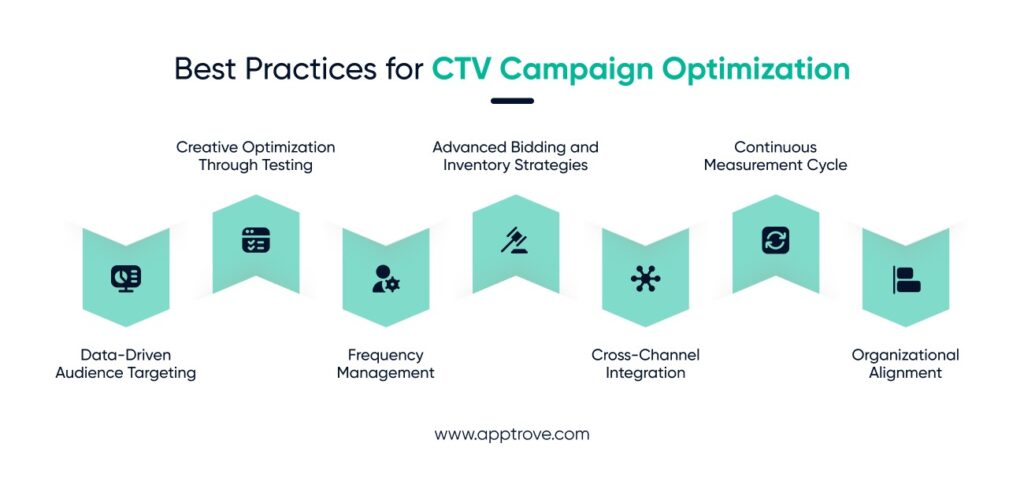
Data-Driven Audience Targeting
Effective CTV campaign optimization begins with refined audience strategies:
- First-Party Data Activation: Leveraging your customer data to create high-value audience segments that align with business objectives and campaign goals. This approach enables precise targeting of existing customers for retention campaigns or creation of lookalike audiences for acquisition, improving both relevance and conversion rates while reducing waste.
- Lookalike Modeling: Expanding reach by identifying viewers with similar characteristics to your best customers through advanced algorithmic analysis of viewing behaviors and demographic patterns. These models continuously learn from campaign performance to refine targeting precision and identify new audience segments with high conversion potential.
- Behavioral Targeting: Focusing on viewers demonstrating relevant interests and actions through analysis of viewing patterns, content preferences, and engagement behaviors. This targeting approach goes beyond demographics to identify audiences based on actual behaviors that indicate purchase intent or brand affinity.
- Sequential Segmentation: Adapting messaging based on previous ad exposures and audience journey stage, delivering personalized experiences that move viewers through the marketing funnel. This approach optimizes both message relevance and frequency management by tailoring creative and bidding strategies to each audience’s engagement history.
Creative Optimization Through Testing
Measurement-informed creative optimization dramatically improves CTV campaign effectiveness:
- A/B Testing: Systematically comparing different creative approaches to identify winners through controlled experiments that isolate creative impact from other variables. These tests should include sample sizes large enough for statistical significance and control for factors like audience composition, timing, and external market conditions.
- Creative Rotation: Preventing fatigue by refreshing ads based on frequency metrics, audience feedback, and performance indicators that signal diminishing creative effectiveness. This approach maintains engagement levels and prevents negative brand perception that can result from over-exposure to the same creative elements.
- Format Experimentation: Testing different ad lengths and interactive elements to identify optimal combinations for specific audiences and campaign objectives. Experimentation should include analysis of completion rates, engagement metrics, and downstream conversion performance to understand format impact on business outcomes.
- Personalization: Tailoring creative elements to specific audience segments based on viewing behaviors, demographic characteristics, and previous brand interactions. This approach leverages data insights to deliver more relevant messaging that resonates with individual viewer preferences and increases conversion likelihood.
Frequency Management
Controlling exposure frequency is crucial for CTV campaign efficiency:
- Cross-Platform Frequency Capping: Limiting total exposures across all CTV environments to prevent over-saturation and maintain message effectiveness while controlling costs. This approach requires sophisticated tracking and coordination across multiple platforms to ensure accurate frequency counting and optimal exposure distribution.
- Optimal Frequency Modeling: Identifying the ideal number of exposures for different audience segments through analysis of conversion curves and engagement patterns. These models should account for factors like product consideration cycles, audience characteristics, and competitive environment to determine segment-specific frequency targets.
- Diminishing Returns Analysis: Recognizing when additional impressions yield minimal incremental value through systematic evaluation of conversion rates and cost efficiency at different frequency levels. This analysis helps optimize budget allocation and prevents wasteful spending on audiences already saturated with brand messaging.
- Sequential Messaging: Progressing narrative across multiple exposures rather than repeating the same message, creating engaging storytelling experiences that build brand connection over time. This approach maintains viewer interest across repeated exposures while advancing the brand message and moving audiences through the consideration funnel.
Advanced Bidding and Inventory Strategies
Sophisticated inventory approaches driven by measurement insights:
- Programmatic Optimization: Adjusting bid strategies based on performance data, audience quality signals, and inventory characteristics to maximize campaign efficiency and effectiveness. This approach leverages real-time data to optimize spending allocation across different inventory sources and audience segments.
- Inventory Quality Filtering: Focusing spend on environments delivering measurable results through systematic evaluation of publisher performance, audience quality, and conversion metrics. This filtering approach helps prevent waste on low-quality inventory while concentrating investment on high-performing placements.
- Dayparting Refinement: Concentrating delivery during high-performance time periods based on analysis of audience availability, engagement levels, and conversion patterns throughout different parts of the day and week. This optimization maximizes campaign impact by reaching audiences when they’re most receptive to messaging.
- Context Matching: Aligning ad placements with relevant content categories to improve message relevance and audience receptivity while maintaining brand safety standards. This approach leverages content analysis and audience insights to identify optimal placement opportunities that enhance campaign performance.
Advertisers leveraging these advanced inventory strategies typically achieve 20-30% improvements in cost efficiency metrics.
Cross-Channel Integration
The most effective CTV campaign optimization approaches recognize the interplay between channels:
- Synchronized Messaging: Coordinating CTV creative with other channel executions to create cohesive brand experiences that reinforce key messages across touchpoints. This coordination ensures consistent brand presentation while optimizing message sequencing and frequency across the entire media mix.
- Sequential Channel Strategies: Using CTV for awareness, followed by targeted digital for conversion, creating optimized customer journey experiences that leverage each channel’s strengths. This approach recognizes CTV’s effectiveness for building brand awareness and digital channels’ strengths in driving immediate action.
- Attribution-Informed Allocation: Adjusting channel mix based on performance measurement that accurately accounts for cross-channel interactions and each channel’s contribution to business outcomes. This approach ensures budget allocation reflects true channel performance rather than last-click attribution biases.
- Unified Customer Journey: Creating seamless experiences across touchpoints that recognize and respond to customer interactions across all channels, providing personalized and relevant experiences regardless of the interaction point. This approach requires sophisticated data integration and customer identification capabilities.
Continuous Measurement Cycle
Successful CTV campaign optimization is never “set and forget” – it requires ongoing measurement and refinement:
- Establish Baseline Metrics: Document starting performance across key indicators to enable accurate measurement of optimization impact and campaign improvement over time. These baselines should account for seasonal factors and external conditions that might influence performance during the campaign period.
- Implement Test-and-Learn Framework: Systematically test optimization hypotheses through controlled experiments that isolate the impact of specific changes from other variables. This framework should include clear success criteria, statistical rigor, and systematic documentation of learnings for future application.
- Conduct Regular Performance Reviews: Schedule consistent analysis of measurement data with clear processes for translating insights into actionable optimization decisions. These reviews should balance speed of response with statistical significance and include stakeholder alignment on optimization priorities.
- Apply Incremental Improvements: Make data-driven adjustments throughout the campaign based on performance insights, maintaining a balance between optimization speed and testing validity. This approach ensures campaigns continuously improve while avoiding premature changes that might not be statistically significant.
- Document Learnings: Create an optimization playbook based on measurement insights that can inform future campaigns and improve organizational knowledge about CTV performance drivers. This documentation should include both successful optimizations and failed experiments to build comprehensive understanding.
Organizational Alignment
Effective CTV campaign optimization requires alignment across various stakeholders:
- Shared KPIs: Ensuring all teams agree on the primary success metrics and understand their roles in achieving campaign objectives, preventing conflicting optimization efforts. This alignment should include clear definitions of success and responsibility matrices for different optimization activities.
- Clear Optimization Protocols: Establishing who can make changes and when, preventing conflicting optimization efforts and ensuring systematic approach to campaign management. These protocols should balance speed of optimization with proper testing methodology and stakeholder communication.
- Cross-Functional Collaboration: Breaking down silos between creative, media, and analytics teams to enable integrated optimization that considers all aspects of campaign performance. This collaboration should include regular communication, shared tools, and aligned incentives across different functional areas.
- Executive Visibility: Providing leadership with clear measurement insights and optimization progress to maintain support for CTV investments and data-driven decision making. This visibility should include both tactical performance updates and strategic insights about CTV’s role in overall marketing effectiveness.
By implementing these best practices for CTV campaign optimization, advertisers can dramatically improve performance over time, achieving significantly higher returns on their connected TV investments.
CTV Inventory Quality Assessment
Not all CTV inventory delivers equal value, making quality assessment a critical component of effective CTV measurement. Understanding the various dimensions of inventory quality enables advertisers to make more informed decisions about where to place their connected TV ads.
The CTV Inventory Quality Challenge
The rapid expansion of the CTV ecosystem has created significant variation in inventory quality:
- Fragmented Supply: CTV inventory spans thousands of apps across multiple devices and platforms, each with different quality standards and verification capabilities. This fragmentation makes it difficult for advertisers to consistently evaluate and compare inventory quality across their entire CTV investment, leading to potential waste on low-quality placements.
- Inconsistent Standards: Quality metrics vary widely across different inventory sources, with some platforms providing detailed quality reporting while others offer minimal transparency. This inconsistency makes it challenging for advertisers to apply uniform quality criteria across their CTV campaigns and may result in misallocated budgets toward inferior inventory.
- Emerging Fraud Threats: As CTV ad spending increases, so do sophisticated fraud schemes that target the connected TV ecosystem through fake apps, manipulated viewing data, and artificial traffic generation. These threats can significantly impact campaign performance and waste advertising budgets without proper detection and prevention measures.
- Verification Limitations: Technical challenges in implementing traditional quality verification measures in CTV environments, particularly with server-side ad insertion and varied platform architectures. These limitations create blind spots in quality assessment that may prevent advertisers from identifying problematic inventory sources.
These factors make systematic CTV inventory assessment essential for advertisers seeking to maximize campaign performance.
Key Dimensions of CTV Inventory Quality
A comprehensive CTV inventory evaluation examines multiple quality factors:
Viewability and Completion
- Screen Activity Verification: Confirming the TV was actually on during ad delivery, not just that the ad was technically served. This distinction matters because a significant portion of CTV impressions are served to devices in low-power or background states where no one is watching.
- Ad Placement Quality: Ads served at natural content breaks perform differently from ads served mid-sentence or in awkward positions. Placement quality affects both viewer experience and completion rates.
- Completion Rate as Quality Signal: When completion rates fall well below 95% on CTV, something is usually wrong: placement issues, fraud, or content that isn’t what it was described as. Treating completion rate as a quality flag rather than just an engagement metric catches problems early.
Brand Safety and Suitability
- Content Categorization Accuracy: Knowing what your ad appeared next to matters for brand reputation. Inaccurate content categorization, a family-friendly app category that actually contains mature content, is common enough that pre-buy verification is worth the investment.
- Real-Time Safety Screening: Technology that flags unsafe content before your ad is served, rather than catching it in post-campaign audits. The latter finds the problem after budget has already been wasted.
- Suitability Matching: Beyond avoiding unsafe content, placing ads adjacent to contextually appropriate content actively improves performance. A travel brand appearing before travel content performs better than the same ad appearing in a random rotation.
Fraud Detection
- Server-Side Verification: Validating that ads are delivered to real devices with legitimate operating systems and network connections. Fraudulent traffic often reveals itself through device specification anomalies or network patterns that don’t match genuine household viewing.
- App Verification: Confirming that the app claiming to deliver your impression is authentic, properly represented in the app store, and not a fraudulent shell built to generate fake ad revenue.
- Traffic Pattern Analysis: Machine learning models that flag anomalies in delivery patterns, unusual geographic concentrations, completion rates that are suspiciously uniform, and viewing times that don’t match normal human behavior. These patterns are consistently present in fraudulent traffic and rarely present in legitimate inventory.
Audience Quality
Not all viewers deliver equal value, making audience assessment a key part of CTV inventory evaluation:
- Demographic Verification: It consists of matching viewer demographics and census data with household demographics and verifying that there is a match. This process validates to the advertiser that they are reaching their target audience and helps provide insight into the differences between the target audience they were promised and the actual audience they received.
- Attention Metrics: These are used to determine how engaged viewers are with the advertisement at the time of viewing by evaluating the percentage of people who view the advertisement until the end, who interact with the advertisement, and how they behave after having viewed the advertisement. The analysis of these metrics provides detailed measurements of how much viewers pay attention to the advertisement and how much they are engaged with it beyond normal viewability. The results can be used to evaluate the effectiveness of the creative and identify the most effective ad placement strategies for the advertisement.
- Household Characteristics: It includes the examination of household demographics, such as income level, history of purchasing, and behavioral indicators, and provides the necessary information for the advertiser to identify high-value targets. The evaluation of all of these attributes helps to determine which audiences are most likely to respond to the advertising messages.
Inventory Quality Measurement Methodologies
Leading advertisers employ multiple approaches to assess CTV inventory quality:
Independent Verification of Third-Party Inventory (Audit) – The evaluation of viewability, fraud, and brand safety through independent verification entities that can provide a non-biased evaluation of the quality of the inventory. An audit will include a full set of audits in three key areas: Earned Value (Technical Validation, Content Analysis, and Audience Validation), and should meet the requirements for demonstrating legitimate delivery of value to advertisers based on computer-generated data.
Performance Review – Reviewing conversion rates from all sources of CTV inventory, based on a comparison of cost per acquisition (CPA), return on ad spend (ROAS), and the results of other metrics that identify effective Sources of CTV inventory for an advertiser to use to develop its Media Mix using real-world Business Performance outcomes vs. estimated Business Performance outcomes.
A/B Testing – A controlled test to measure/compare similar campaigns on two different CTV Sources of inventory in an effort to establish an understanding of the level of impact that the quality of the CTV Inventory has on the performance of the campaign. Testing such as this will provide information to the advertiser to help them make more educated purchasing decisions and facilitate a better means through which to create and/or allocate a budget.
Custom Analytics – Proprietary scoring systems that combine many different data sources and performance metrics to evaluate the quality of inventory. Complex models will take Brand-specific criteria, campaign goals, and historical Performance data into consideration to develop Custom Quality Scores that will be used to align with advertising Compliance and Objectives.
These methodologies collectively provide a comprehensive view of CTV inventory quality that informs optimization decisions.
The Role of MMPs in Revolutionizing CTV Measurement
Mobile Measurement Partners (MMPs) have emerged as pivotal players in addressing the complex challenges of CTV measurement. Originally focused on mobile app attribution, leading MMPs like Apptrove have evolved their capabilities to meet the unique demands of the connected TV ecosystem.
How MMPs Address CTV Measurement Challenges
MMPs bring several critical capabilities that transform CTV measurement effectiveness:
1. Cross-Platform Identity Resolution
Perhaps the most valuable contribution MMPs make to CTV measurement is connecting identities across devices:
- Device Graphs: Sophisticated networks mapping relationships between CTV, mobile, and desktop devices within households.
- Probabilistic Matching: Advanced algorithms that connect users across platforms without relying on persistent identifiers.
- Privacy-Compliant Identity: Approaches that maintain measurement accuracy while respecting evolving privacy regulations.
2. Unified Attribution Methodology
MMPs apply consistent attribution approaches across all channels:
- Standardized Attribution Windows: Applying uniform lookback periods across environments.
- Cross-Channel Sequencing: Understanding how CTV works in concert with other channels.
This unified approach prevents the “attribution silo” problem that plagues many marketing measurement systems, where each channel claims credit independently.
3. Advanced Fraud Detection
MMPs have developed specialized tools for identifying invalid CTV traffic:
- Anomaly Detection: Machine learning algorithms that identify suspicious patterns.
- Blacklist Databases: Continuously updated lists of fraudulent apps and devices.
These capabilities provide an essential layer of protection in the CTV ecosystem, where traditional fraud detection methods often fall short.
4. Integration Hub Functionality
MMPs serve as central connection points in the complex CTV measurement ecosystem:
- API Network: Pre-built integrations with publishers, DSPs, and analytics platforms
- Data Normalization: Standardizing metrics and taxonomies across platforms
- Unified Reporting: Consolidating performance data from multiple sources
The MMP Evolution for CTV Measurement
The capabilities MMPs bring to CTV measurement represent a natural evolution of their core competencies:
- Mobile to Omnichannel: MMPs have traditionally specialized in tracking mobile app installs and in-app conversions; however, they have recently begun extending these capabilities into other areas, including Connected TV (CTV), online, physical store purchases, and cross-devices. This allows marketers to see how CTV ad exposure plays a role in a consumer’s path to conversion across multiple channels or devices.
- Attribution to Incrementality: Traditional attribution asks the question, “Who gets credit?” while modern-day marketers want to know, “What drove the result?” MMPs are now incorporating incrementality testing into their platforms by using control groups, geo-lifting studies, and experimental designs to measure the actual effectiveness of CTV ads. Consequently, companies can identify conversions that could be attributed to other factors, versus those that were directly attributable to CTV ads.
This evolution positions MMPs like Apptrove at the forefront of solving the industry’s most pressing CTV measurement challenges.
Apptrove’s CTV Measurement Solutions
As a pioneering Mobile Measurement Partner (MMP), Apptrove has developed a comprehensive suite of CTV measurement solutions designed to address the unique challenges of connected TV advertising. These purpose-built capabilities enable advertisers to achieve unprecedented visibility into their CTV campaign performance.
Conclusion: Mastering CTV Measurement with MMPs
The connected television landscape represents both a tremendous opportunity and a significant challenge for today’s marketers. As CTV consumption continues its explosive growth, the importance of sophisticated CTV measurement becomes increasingly critical for advertising success.
The CTV Measurement Imperative
CTV’s methodologies have transformed from simply counting impressions to creating an attribution method, where CTV viewing is aligned with business outcomes.
In this thorough guide, we have covered CTV measurement with numerous perspectives and have discussed how CTV measurement is revolutionizing advertising effectiveness through the transformation of CTV methodologies:
The Unique Challenges of CTV Measurement
There are many unique challenges in CTV measurement that do not exist in other forms of media, such as fragmentation, identity resolution, and lack of cross-device tracking.
Advanced Metrics of CTV
Advanced metrics of CTV advertising also extend beyond traditional methods used to measure television advertising performance, providing valuable insights that can be used to optimize campaigns.
CTV Inventory Quality Assessment
Properly assessing the quality of CTV inventory is essential for ensuring that advertising expenditures are allocated toward environments that provide authentic value.
The Future of CTV Measurement
As the technology behind hair measurements continues to advance, the future of CTV measurement will become increasingly accurate through advanced technology-enabled methods such as artificial intelligence (AI), attention-based performance measurements, and unified measurement frameworks.
Competitive Advantage of Mastering CTV Measurement
Organizations that successfully master the capabilities of CTV measurement will have a superior competitive advantage in their ability to connect with and engage with target audiences in the rapidly growing connected television landscape.
The Strategic Role of MMPs
In order to traverse the intricate landscape of CTV measurement, Mobile Measurement Partners have developed into key partners. MMPs, such as Apptrove, provide specialized capabilities that address the problems that are inherent to CTV measurement, including the following:
- Cross-device identity resolutions that allow measurement of CTV Viewing to the engagement with the advertiser on another device
- Unified attribution techniques that produce a consistent measurement across all channels
- Advanced fraud detection techniques that are specifically developed for use in CTV environments
- Integration capabilities that connect disparate data sources together to provide coherent insights to advertisers
- Privacy-first orientations that maintain measurement integrity without violating established regulations.
The Path Forward for Advertisers
For marketers looking to maximize the value of their CTV investments, several key principles should guide their measurement approach:
- Establish Clear Objectives: Define specific business goals for CTV campaigns and align measurement accordingly
- Implement Comprehensive Tracking: Deploy solutions that connect CTV exposures to actions across all devices
- Focus on Incrementality: Move beyond basic attribution to understand the true causal impact of CTV advertising
- Embrace Integration: Break down measurement silos between CTV and other marketing channels
- Partner with Experts: Leverage specialized providers with deep CTV measurement expertise
The Future of CTV in the Media Mix
As measurement capabilities grow, the importance of CTV (Connected Television) to the marketing ecosystem will only increase in significance. The ability to precisely target audience, utilize visually engaging and interactive Creative formats, and access increasingly accurate measurement combine to create a very effective medium for brands looking for both reach and performance.
Those brands that will thrive in this climate will be those that embrace advanced measurement methodologies for CTV, partnering with specialized Mobile Measurement Partners (MMPs) like Apptrove to uncover the full value of connected TV advertising. By implementing the strategies in this guide, advertisers can change CTV from an awareness channel to an effective performance driver with proven business impact.
In the new age of connected television, comprehensive and accurate CTV measurement not only represents technical capabilities to marketers but is also a necessary business strategy. Working with Apptrove, advertisers will be able to navigate the unique challenges associated with CTV measurement and have dramatically increased visibility to their campaigns’ performance, as well as the opportunity to fully leverage this quickly growing channel.
FAQs
1. What is CTV measurement, and why does it matter?
CTV measurement tracks the performance of connected TV ads using CTV metrics like viewability, completion rates, and cross-device attribution. It’s vital for understanding campaign effectiveness, optimizing CTV ad measurement, and maximizing ROI.
2. How can I overcome fragmentation in CTV measurement?
Fragmentation across CTV platforms creates data inconsistencies. CTV measurement solutions, such as MMPs like Apptrove, unify data from various sources, ensuring a clear, comprehensive view of CTV ad measurement performance.
3. Which CTV metrics are essential for campaign success?
Key CTV metrics include viewability rate, video completion rate (VCR), unique reach, frequency, and cross-device conversions. These metrics provide insights for effective CTV measurement and drive campaign optimization.
4. How does CTV measurement comply with privacy regulations?
CTV measurement solutions use privacy-safe methods like probabilistic matching and data clean rooms to deliver accurate CTV ad measurement. These ensure compliance with privacy laws while maintaining robust CTV metrics.
5. What role do MMPs like Apptrove play in CTV measurement?
MMPs like Apptrove enhance CTV measurement with cross-platform attribution, fraud detection, and unified reporting. They provide precise CTV metrics, empowering marketers to optimize campaigns and boost ROI effectively.