Introduction
Why do people search for apps? There is no longer one linear path from discovery to install for users. In today’s world, the journey for a user can begin via a social media post or a comparison article, followed by email reminders, and finally convert on another device days later. With installations taking longer than ever before, users encounter multiple touchpoints — and their attention does not follow a predictable sequence.
However, many mobile journeys still depend heavily on static links that assume instant installation and a one-session user experience. When that assumption fails, the experience breaks. Studies indicate that 56% of mobile users abandon their journeys when disrupted by poor performance, irrelevant landing pages, or broken transitions. The solution is not simply to repair drop-offs — it is to design continuity across the entire journey.
A Dynamic Link adapts to the user’s journey. It changes based on where the user is in the process — whether the app is installed, whether they are new, or whether they are returning — keeping context intact and intent fully alive.
At Apptrove, Dynamic Links (Unilinks) are not positioned as short-term growth hacks. They are infrastructure. They create unity between fragmented digital interactions — connecting discovery, installation, onboarding, and re-engagement into one continuous experience.
Importantly, this infrastructure is configurable. Not every business needs the same level of tracking depth. Some may only require click-level reporting visibility, while others need complete install attribution and event measurement. Apptrove’s customizable panel allows you to decide how Dynamic Links function — whether you use them purely for intelligent routing, for Unilink reporting, for full attribution tracking, or for a hybrid model tailored to each campaign.
With Firebase sunsetting Dynamic Links, businesses are searching for reliable alternatives that provide deep linking continuity without forcing a rigid measurement structure. Modern app journeys demand flexible infrastructure — and Dynamic Links have become foundational to how applications grow, measure, and retain users today.
Seeking an Alternative for Firebase Dynamic Links?
With Firebase sunsetting its Dynamic Links service, many businesses are now evaluating how to maintain continuity in their mobile app journeys. For teams that relied on Firebase Dynamic Links for routing, deferred deep linking, or onboarding flows, the key challenge is not simply replacing a link — it is preserving the user experience that those links enabled.
When migrating from Firebase Dynamic Links, the most important consideration is whether the new solution can maintain deferred deep linking and interconnected routing without disrupting existing journeys. Continuity must remain intact, especially if your growth flows rely on contextual onboarding, referral links, or post-install routing.
A modern Dynamic Link platform should also allow flexibility in how it is used. In some cases, businesses may only need intelligent redirection and deferred deep linking to maintain smooth user experiences. In other cases, teams may require deeper measurement capabilities such as install attribution, campaign mapping, and event tracking.
With Apptrove, this flexibility is built directly into the infrastructure. You are not required to adopt a full mobile measurement stack if your primary goal is routing continuity. Dynamic Links can operate independently for seamless redirection, or they can integrate with attribution tracking when deeper performance insights are needed.
This ensures that migrating from Firebase does not force structural changes to your growth strategy. Instead, it allows you to maintain existing journeys while gradually scaling measurement and optimization capabilities over time.
What Is a Dynamic Link and How Do They Differ from Regular URLs?
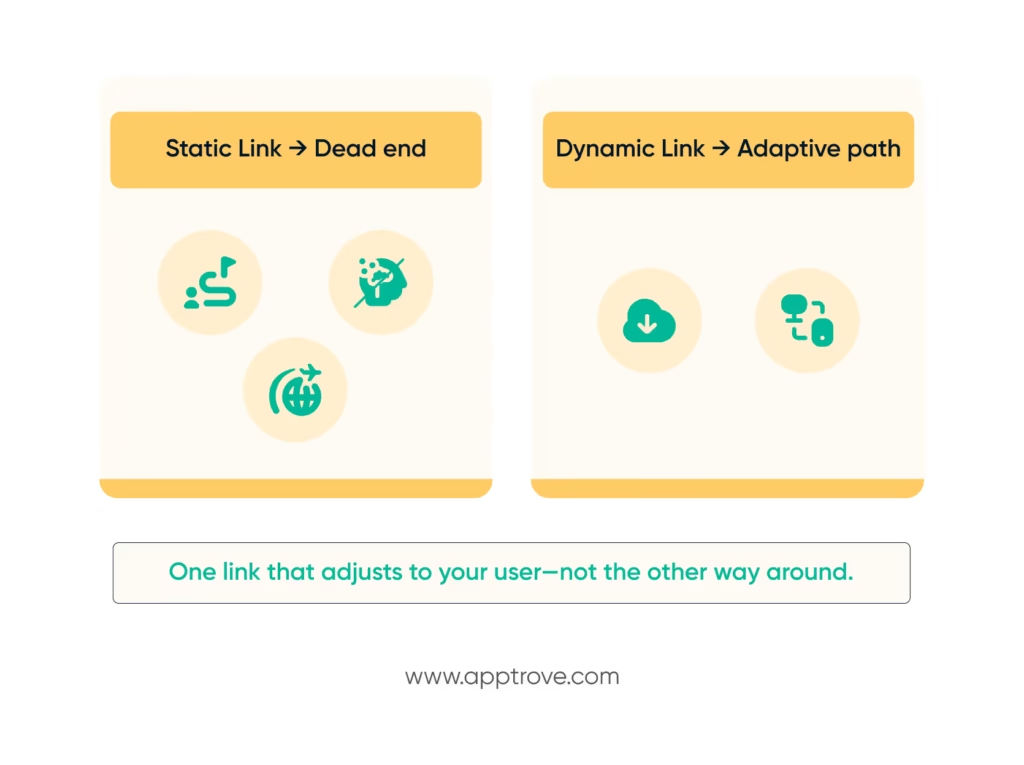
At Apptrove, Dynamic Links (Unilinks) are built to operate across platforms, devices, and time delays — ensuring your routing logic adapts to real-world user behavior rather than ideal assumptions. Instead of pointing users to a single, fixed destination, Dynamic Links respond to where the user is in their journey and the state of their device at that exact moment.
In practice, this means a Dynamic Link does not fail when the app is not installed. It redirects the user to the appropriate app store while preserving context — what was clicked, where the user came from, and what action they intended to take. Once the app is installed, the same link ensures the user lands directly on the intended in-app screen rather than a generic homepage. No repetition. No friction. The link works seamlessly across iOS, Android, mobile web, and even when users switch devices mid-journey.
Unlike a traditional URL, which assumes immediate action and a single-session experience, a Dynamic Link is designed around real behavior — pauses, delays, multi-device usage, and reconsideration. When traditional assumptions fail, users hit dead ends or irrelevant pages. Dynamic Links prevent that disruption.
What makes Apptrove’s implementation distinct is its flexibility. The routing logic can operate independently from attribution tracking. If your goal is simply intelligent redirection with contextual continuity, you can use Dynamic Links purely for that purpose. If you require install attribution, campaign mapping, and event tracking, those layers can be enabled within the same customizable panel. The infrastructure adapts to your measurement strategy rather than forcing a one-size-fits-all setup.
A Dynamic Link is therefore not limited by technical constraints; it is built around user behavior and business intent — delivering one continuous experience from discovery to installation and beyond.
The Complete App User Journey Through Dynamic Links
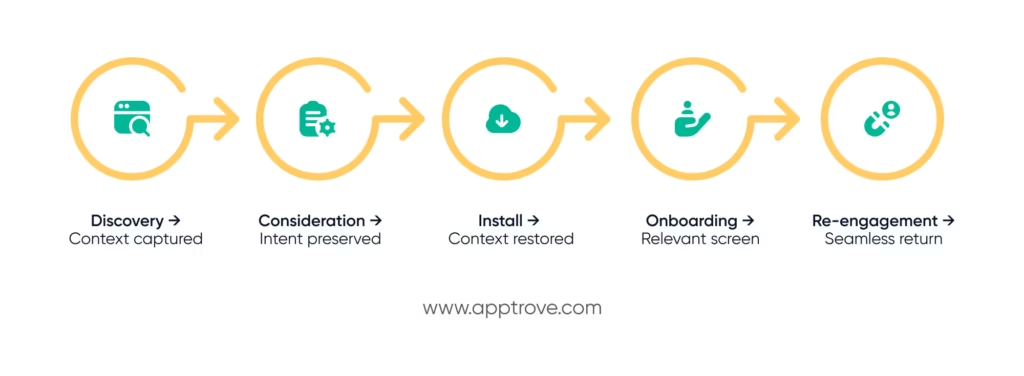
In today’s digital world, the app user journey is not linear; it is made up of pauses, switches, comparisons, and returns. Users discover your app through advertisements, content, or referrals. They save links for later. They delay installation. Even after installing, onboarding may not happen immediately, and re-engagement may occur days or weeks later.
Studies show that the average mobile app retains only about 28% of its users the day after installation, with long-term engagement dropping quickly thereafter. This fragmentation highlights a simple truth: intent is fragile, and continuity is critical.
Dynamic Links quietly connect these scattered moments. When a user first discovers your app, the link captures contextual information — where the interaction happened, what content was clicked, and what action was implied. If the user leaves and returns later to install, that context remains preserved. Once the installation is complete, the user does not start from zero; they continue from the point of interest that originally brought them there.
During onboarding, Dynamic Links can route users directly to the feature, product, or screen they showed interest in, reducing confusion and cognitive overload. When users return days or weeks later, the same intelligent routing ensures they are guided back to the appropriate section instead of being dropped at a generic entry point.
At Apptrove, this continuity layer can be configured differently depending on your objective. For example, you may choose to use Dynamic Links purely for journey continuity without enabling install attribution. In other cases, you may activate full attribution tracking to connect discovery touchpoints to installs and post-install events. Because the panel is fully customizable, different campaigns within the same app can operate under different tracking configurations — awareness campaigns can prioritize click-level reporting, while performance campaigns can enable deeper measurement.
Dynamic Links, therefore, do more than preserve intent. They allow you to build a structured yet flexible measurement foundation around that intent. Continuity transforms fragmented interactions into an integrated app experience — one that feels intuitive to users and measurable for growth teams.
The Importance of Dynamic Links for Deep Linking in the Mobile App Landscape

Deep linking for mobile applications is often understood as the ability to send users to a specific destination within a mobile application. However, traditional deep links assume the app is already installed. In reality, many users encounter your application for the first time before installation, which means a standard deep link alone may not function as intended.
This is where Dynamic Links form the foundation of real-world deep linking. They act as the connective layer that allows deep linking to function across installation gaps, device switches, and delayed decision-making. A Dynamic Link recognizes that a user’s journey may pause, resume, or shift devices — and maintains continuity through those interruptions.
This capability, known as deferred deep linking, has become essential in an environment where installs rarely occur in the same session as discovery. When a user clicks on a link, there is an implied destination. Deferred deep linking ensures that the destination remains consistent whether the user installs immediately, later, or on another device entirely.
At Apptrove, deferred deep linking is not isolated from the measurement strategy. It can operate purely as a continuity mechanism, or it can be paired with attribution tracking depending on your goals. Some teams require only seamless routing without install-level measurement. Others rely on full attribution to connect discovery touchpoints to post-install events. Because the system is modular, Dynamic Links can support deep linking independently or as part of a broader measurement framework.
By combining intelligent routing with configurable tracking layers, Dynamic Links create conditional yet cohesive user experiences. They ensure users arrive at their intended destination when they are ready — regardless of time, platform, or device — while allowing businesses to decide how deeply they want to measure that journey.
Enhancing User Engagement with Dynamic Links, While Not Using Personal Information
The mobile ecosystem is shifting toward a stronger emphasis on user privacy. As granular identifiers become limited and consent-based frameworks grow stricter, guiding users through an app can no longer rely on persistent tracking. Measurement models are increasingly based on actions and contextual signals rather than individual identity. This evolution strengthens the role of Dynamic Links as privacy-aligned infrastructure.
Instead of depending on personal data or persistent identifiers, Dynamic Links rely on contextual information tied to the moment of interaction — where the link was clicked, what content was viewed, and what action was implied. This context allows intelligent routing without creating user profiles or tracking individuals across sessions.
By aligning experience with intent rather than identity, Dynamic Links reduce friction without compromising privacy. Users arrive at the correct screen, resume journeys naturally, and experience continuity without feeling monitored or over-targeted.
From a strategic standpoint, this privacy-first foundation also allows flexibility in measurement. In privacy-sensitive environments, you may choose to use Dynamic Links purely for routing and contextual continuity, without enabling identifier-based attribution. In other cases, aggregated or consent-aligned attribution models can be layered on top within the same customizable panel. The ability to separate routing from attribution ensures that engagement strategies remain compliant while still measurable.
As platforms and regulations continue to evolve, connecting context with continuity becomes a sustainable way to build engagement. Dynamic Links are particularly valuable in privacy-first ecosystems where traditional attribution methods are constrained, allowing businesses to preserve intent even as identifiers fade.
What Happens When Your App Strategy Doesn’t Include Dynamic Links?
When your application does not incorporate Dynamic Links, failure rarely appears dramatic. Instead, it manifests as subtle friction points that slowly degrade the user experience. Users do not necessarily lose interest — they lose direction. Without continuity, the path forward becomes unclear.
One common example occurs when a user clicks on specific content, delays installation, and later returns only to land on a generic entry point with no preserved context. Without Dynamic Links, the original intent disappears. The user must search again for what initially caught their attention — and often, they simply stop.
Generic landing pages create another layer of friction. When every user is routed to the same destination regardless of why they clicked, relevance diminishes. The experience feels disconnected from intent, and engagement weakens.
Intent does not vanish — it stalls. Over time, these interruptions accumulate into measurable opportunity costs. Lower engagement, weaker onboarding completion, and reduced re-engagement are often not caused by poor content, but by broken continuity.
From a measurement perspective, the absence of Dynamic Links can also create blind spots. Without intelligent routing infrastructure, it becomes harder to understand where the intent originated and how it progressed. At Apptrove, configurable Dynamic Links help eliminate these gaps. Whether used purely for seamless routing or combined with attribution tracking, they create a structured framework that reduces friction and supports clearer performance insights.
Shifting your mindset from fixing drop-offs to designing continuity transforms fragmented interactions into purposeful journeys. Dynamic Links provide the infrastructure that makes that continuity scalable and measurable.
Strategic Use of Dynamic Links Across All Channels
Dynamic Links offer much more than channel-specific performance; they create a unified experience regardless of how a user enters your application. Each channel represents a different stage of discovery, and Dynamic Links ensure that every entry point connects to the same continuous journey rather than operating in isolation.
In paid advertising, Dynamic Links guide users from curiosity directly into contextual relevance. Instead of landing on a broad homepage, users arrive at the exact content promised in the advertisement. This seamless transition not only improves the experience but also strengthens campaign efficiency. Depending on campaign objectives, this setup can operate purely for intelligent routing or be paired with attribution tracking to measure installs and post-install events.
For emails and CRM communications, continuity becomes even more critical. Users often open emails hours or days later — sometimes on entirely different devices. Dynamic Links preserve relevance across time and device changes, ensuring that when the user clicks, they are taken to the intended in-app destination. For lifecycle campaigns where performance visibility is required, attribution layers can be enabled. For simple engagement flows, reporting can remain limited to link-level interaction data.
Dynamic Links also strengthen the connection between deep linking and install flows. Users who delay installation can resume their journey without disruption, maintaining intent across sessions. Because routing and measurement are configurable within Apptrove’s panel, different channels can operate under different tracking models without affecting the underlying infrastructure.
QR codes extend this continuity into offline environments. Whether scanned immediately or later, Dynamic Links bridge physical and digital interactions seamlessly. They ensure that discovery in the real world translates into contextual engagement within the app, with the flexibility to either measure performance deeply or maintain a lightweight reporting structure.
Across channels, the key advantage is consistency combined with configurability. Dynamic Links unify the experience while allowing businesses to determine how much measurement depth each channel requires.
Dynamic Links are Becoming the Primary Measurement Norms
As mobile measurement evolves, Dynamic Links are no longer confined to individual campaigns; they have become part of the foundational infrastructure beneath channels, creatives, and messaging. They operate quietly in the background, connecting user actions that unfold across time, platforms, and multiple moments of intent.
Dynamic Links provide the continuity required to understand how discovery transitions into engagement — even when installs are delayed or completed over multiple sessions. However, this measurement depth does not have to be uniform across every campaign. With Apptrove’s configurable framework, Dynamic Links can function strictly as routing infrastructure, or they can be layered with attribution logic to connect installs and post-install events to their source. This flexibility allows businesses to adapt measurement intensity based on objectives.
For onboarding intelligence, Dynamic Links clarify why a user arrives on a particular screen for the first time. By combining contextual signals with intelligent routing, the first experience becomes more relevant and less intrusive. Across the user lifecycle — acquisition, re-engagement, and retention — consistent Dynamic Link usage creates a stable routing backbone. As identifier-based tracking continues to decline, this backbone becomes increasingly important for maintaining measurement continuity without compromising privacy.
Looking ahead, mobile growth will rely less on isolated campaign metrics and more on interconnected user experiences. Dynamic Links support this transition by establishing a scalable, privacy-aligned measurement foundation that mirrors real user behavior — multi-session, multi-device, and context-driven. Future enhancements will continue to expand routing intelligence and configuration depth, ensuring the infrastructure evolves alongside changing platform standards and business requirements.
The Conclusion
Dynamic Links are not really meant to be thought of as links at all; rather, they are the connections along a customer’s journey that could otherwise feel disconnected from one another. They help preserve context, so that intent does not get lost simply because a user installed an application on one device but is trying to engage with that intent on another device later. Ultimately, Dynamic Links are “experience enablers” that take users exactly where they expect to go with zero friction, repetition, or confusion.
What you need is not just a whole bunch of links, but creative links that actually match what users are doing, as opposed to just linking to everything.
If you are looking for ways to build more connected, user-centric app experiences in a privacy-conscious manner, please reach out and let us work with you to find ways that Dynamic Links can be integrated into your overall app journey strategy.
FAQs
1. What makes a Dynamic Link different from a standard deep link?
Dynamic Link responds to the user’s check-in status, device type, and context to provide them with a relevant destination within the app instead of giving them nothing or sending them to a generic landing page or a broken experience.
2. Why are Dynamic Links important for the app user journey?
By preserving context through discovery, installation delays, onboarding, and re-engagement stages, you create a seamless user experience and help ensure your users do not re-do actions, need to look for items again, or restart their journey.
3. How do Dynamic Link work before an app is installed?
They collect click context, send users to the correct store based on those clicks, and, after the app has been installed, in order to provide a consistent experience to the user, return them to the original click context the first time they use the app.
4. When should you use Dynamic Link instead of static URLs?
You can utilize Dynamic Links if you expect your users to stall on installing your app, Change devices frequently, or journey between multiple channels, giving you the ability to maintain the flow of your users regardless of whether their activities are not instantaneous or in a non-linear manner.
5. How does Dynamic Link support privacy-first mobile strategies?
Dynamic Links utilize contextual cues rather than personal identifiers to facilitate seamless engagement by enabling routing through a consistent method with a changing set of data privacy regulations and platform-imposed restrictions on data usage, along with users’ expectations about what data will be used for.