Building an app is exciting. Growing it consistently is where the real challenge begins.
Most app teams do not struggle because they lack ambition or talent. They struggle because growth gets messy. Campaign data lives in one dashboard, user behavior sits in another, and performance decisions are often made with incomplete information. Teams end up spending more time stitching numbers together than actually improving results. And that is exactly why mobile marketing software has become essential for modern app businesses.
The right platform helps marketers bring acquisition, attribution, engagement, and retention into one connected system. Instead of reacting late, teams can move early. Instead of guessing, they can optimize with confidence.
At Apptrove, we work with app marketers who want clearer visibility, stronger campaign performance, and smoother user journeys through solutions like Unilink. Because sustainable growth rarely comes from doing more. It comes from doing the right things with the right infrastructure.
Let’s look at the growth principles high-performing apps rely on every day.
How Does Mobile Marketing Software Help Apps Grow?
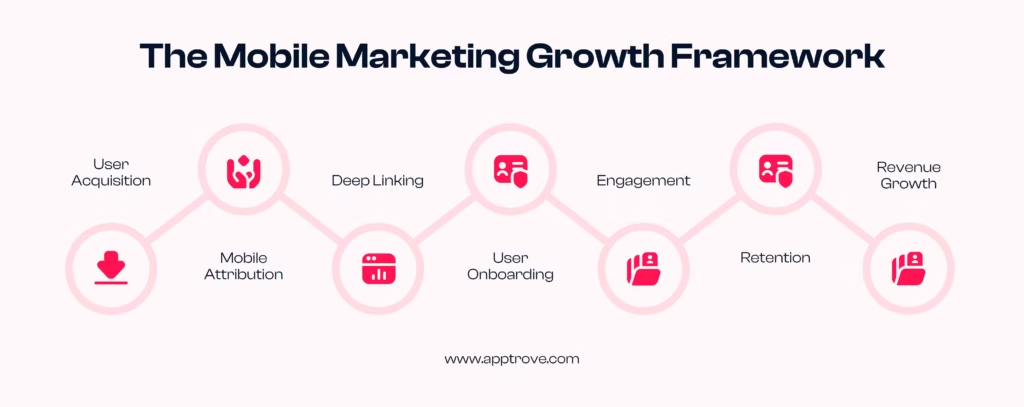
Mobile marketing software integrates all phases of user journey, covering areas of acquisition and attribution as well as engagement, retention, and revenue calculation. Rather than working with multiple uninformed tools, marketers use a single solution that provides an overall insight into campaign performance as well as customer behavior.
Modern mobile marketing software enables businesses to optimize marketing expenditure, personalize customer experience, improve onboarding processes, and make quicker data-based decisions. With the evolution of privacy laws and increasing margins of acquisition expenses, having the necessary infrastructure becomes imperative.
What Is Mobile Marketing Software?
Mobile marketing software is a platform that helps businesses grow mobile apps more efficiently. It gives marketers the tools to attract users, measure campaign performance, improve engagement, and retain valuable customers over time.
Instead of juggling disconnected tools, teams can manage growth with one smarter setup.
Why Is Mobile Marketing Software Important in 2026?
The mobile app industry has turned into a fierce battleground. With increasing costs of acquiring new customers, greater privacy laws, and modifications in users’ expectations, marketers require more than just tracking their campaign performance.
The ideal mobile marketing platform includes all necessary components such as attribution information, analytics, deep links, audience segmentation, fraud protection, and tracking performance reports.
Why Mobile Marketing Software Matters Right Now
App growth has changed dramatically over the last few years.
Competition has increased across almost every category. User acquisition costs have climbed. Privacy changes have made measurement more complex. At the same time, users expect fast, relevant, frictionless experiences from the moment they discover your app.
That means marketers can no longer rely on instinct alone. Without the right systems, growth teams often face:
- Rising CAC with no clear reason
- Unclear attribution data
- Wasted spend across channels
- Weak onboarding performance
- Poor retention rates
- Slow reporting cycles
The result is frustration disguised as “marketing challenges.” In reality, it is often an infrastructure problem.
What Challenges Does Mobile Marketing Software Solve?
When there is no proper measurement platform in place, growth teams frequently face problems with fragmented reporting, inconsistent attribution, slow optimization, and lack of clarity about customers’ journey.
Mobile advertising tools eliminate the issues mentioned by letting the marketing teams gather all campaign data in one place, simplifying the reporting process, enhancing attribution reliability, and providing efficient insights to make quick decisions.
10 Mobile Marketing Software Secrets High-Performing Apps Use
1. They Focus on User Quality, Not Just Install Volume
Many teams celebrate install spikes, only to realize later that those users never returned.
High-performing apps look beyond top-line numbers. They measure user quality through signals such as retention, purchase activity, subscription conversions, and long-term value. This allows them to invest in channels that create real business outcomes, not just temporary momentum.
The smartest marketers know an expensive user who stays can be far more valuable than a cheap user who disappears.
2. They Understand Which Channels Truly Drive Growth
It is easy to spread budget across multiple acquisition sources. It is much harder to know which ones deserve more investment.
Strong mobile marketing software helps marketers compare channels with clarity. Instead of judging performance only by installs, they can evaluate ROI, retention quality, conversion behavior, and revenue contribution.
That shift changes how budgets are allocated and how quickly growth compounds.
3. They Remove Friction After the Click
Many campaigns underperform for one simple reason: the post-click journey is weak.
A user taps an ad for a product, offer, or feature, then lands on a generic homepage or the wrong screen. Momentum disappears instantly.
That is where deep linking becomes valuable. With UniLink from Apptrove, marketers can guide users directly to the most relevant in-app destination, creating a smoother path to conversion.
Sometimes growth is not about better ads. It is about better handoffs.
4. They Treat Onboarding Like a Revenue Lever
The first few minutes inside your app often determine whether someone becomes a loyal user or an uninstall statistic.
High-growth apps refine onboarding continuously. They simplify sign-up flows, guide users toward first success quickly, and reduce friction at every step.
That may include:
- Fewer form fields
- Smarter permission timing
- Personalized welcome journeys
- Clear next actions
- Fast access to core value
The brands that win early usually keep users longer.
5. They Personalize Communication at Scale
Generic messaging rarely performs well anymore.
Users expect brands to understand context. A new user should not receive the same message as a loyal subscriber. Someone who abandoned a cart should not receive the same communication as a daily active user.
Strong segmentation allows marketers to tailor messaging based on:
- Geography
- Device type
- Source channel
- In-app behavior
- Purchase history
- Engagement frequency
Relevance builds response. Irrelevance builds silence.
6. They Make Decisions While Opportunities Still Exist
Delayed reporting is one of the most expensive hidden problems in growth marketing.
If a campaign underperforms on Monday but gets reviewed on Friday, budget has already been wasted. If a winning creative is discovered too late, momentum is lost.
That is why leading teams rely on real-time or near-real-time insights. Faster visibility helps them pause weak spend, scale winners sooner, and respond before trends cool down.
Speed is not just operational efficiency. It is competitive advantage.
7. They Obsess Over Retention, Not Just Acquisition
Acquiring users is important. Keeping them is where profitability lives.
Many apps pour resources into installs while ignoring the reasons users leave. High-performing teams know that even small retention gains can significantly improve lifetime value, return on ad spend, and referral potential.
Retention often improves through:
- Better onboarding
- Timely engagement campaigns
- Product education
- Relevant offers
- Continuous experience improvements
Growth becomes more sustainable when fewer users need replacing.
8. They Reduce Tool Chaos Before It Slows the Team
It is common for scaling apps to add tools every quarter. One for analytics, one for reporting, one for attribution, one for engagement.
Eventually, the stack becomes crowded and confusing.
Disconnected systems create conflicting numbers, slower reporting cycles, and unnecessary manual work. Stronger teams simplify wherever possible. They choose platforms that reduce complexity rather than multiply it.
More tools can feel productive. Better systems actually are.
9. They Prepare for a Privacy-First Future
Measurement has evolved. Marketers who still rely on outdated methods often find themselves reacting instead of leading.
Winning teams adopt platforms built for modern privacy environments so they can continue making informed decisions while respecting user expectations and industry standards.
Future-ready growth is about adaptability as much as performance.
10. They Build Repeatable Growth Systems
The biggest myth in marketing is that growth comes from one clever campaign.
Sustainable growth usually comes from systems: testing regularly, learning quickly, improving journeys, reallocating budgets intelligently, and repeating what works.
High-performing apps create processes that continue generating results long after one campaign ends.
That is how momentum becomes scale.
What to Look for in a Mobile Marketing Software
Choosing a platform should never be about who has the longest feature page. It should be about who helps your team grow smarter.
Accurate Attribution: You need confidence in what drives installs and revenue.
Deep Linking Tools: The post-click journey should feel effortless.
Clear Reporting: If insights are confusing, they are not useful.
Scalable Infrastructure: Your tool should support growth, not slow it.
Easy Adoption: The best platform is the one your team actually uses.
Responsive Support: Because campaign issues never wait politely.
In addition to these main features, it is also important for a company to look into how well the platform integrates with advertising networks, analytics, CRM, engagement tools, etc. Good integrations minimize manual work and provide a single source of truth in terms of campaign performance.
Another thing to consider is compliance with privacy requirements. As regulations change, your mobile marketing software should continue supporting privacy-first measurement while keeping attribution and reporting correct.
And, lastly, it is crucial to pick a platform that will be able to grow together with your business. Whether you are releasing your first app or working with millions of users, your software should continue working well, providing valuable insights, and being flexible while not increasing your operational complexity.
Conclusion
Mobile marketing software has advanced well beyond tracking campaigns. It’s now the basis for successful growth for apps by unifying attribution, analytics, deep links, engagement, and retention into one user experience.
Top-performing companies in the mobile app space make more than just investments in advertising—they improve measurement, are more efficient in optimizing, and provide a better user experience. By picking the mobile marketing software that’s right for your needs, marketers will reduce waste and improve their campaigns.
The right infrastructure fulfills goals by making growth predictable rather than a one-off event!
Frequently Asked Questions
What is mobile marketing software?
Mobile marketing software helps businesses acquire, measure, engage, and retain mobile app users through one unified platform.
What features should mobile marketing software include?
Look for attribution, deep linking, analytics, audience segmentation, fraud prevention, reporting, and campaign optimisation.
Why is mobile marketing software important?
It provides accurate attribution, campaign measurement, user analytics, and optimisation tools that improve marketing performance.
How does mobile marketing software improve user retention?
By helping marketers understand user behaviour, personalise engagement, and optimise onboarding and lifecycle campaigns.
Is mobile marketing software suitable for small businesses?
Yes. Businesses of all sizes benefit from better measurement, campaign visibility, and marketing automation.