Each journey a user takes through your website has a story. Some visitors come to the site, wander about, toss many items into their shopping basket, then vanish away like a disappearing magic show. Whereas those visitors who waltz right through the whole process and safely finish the whole process have been completely removed from the funnel. The ability to analyse each of these user journeys (funnel analysis) is where funnel analysis really starts to shine.
As of this writing, businesses of all kinds are overwhelmed with digital data. Whether it is website clicks, mobile app installs, session counts, sales results, registrations to services or app downloads – numbers are everywhere. However, when there is no direction for a number, it is meaningless – and numbers are just digital wallpaper. This is why funnel analysis has become one of the key methods for helping businesses understand user behaviour, increase conversion rates, and reduce user drop-offs.
Funnel analysis can be used by any type of business – including ecommerce stores, SaaS, fintech, recruitment platforms or streaming services. Funnel analysis will help you better understand how visitors navigate through each step of their journey, where they abandon the journey and what you can do to get them back on track.
In this guide, we will explain what funnel analysis is, how it works, the reasons for using it, and how to improve performance using funnel analysis tools with practical user behavioural insights.
What Is Funnel Analysis?
So what does funnel analysis entail?
Funnel analysis is a technique used to follow how users progress through the various steps that lead to a goal. A goal could be any of the following: purchase of an item, signup for a trial, onboarding completion, demo booking, or application submission.
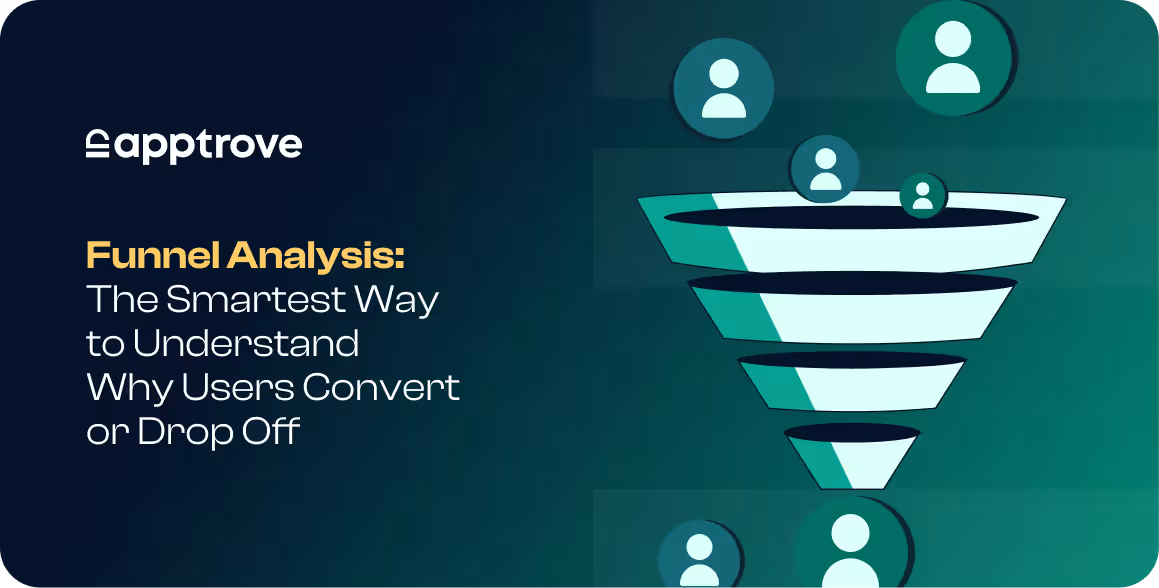
A funnel is a visual representation of how many users enter the process (top of the funnel) and how many drop out (throughout) at successive stages of the process, and thus, only a small percentage will complete the desired action by the time they get to the end of the funnel.
An example of a simple e-commerce funnel would be:
- User enters the site
- User views product
- User adds product to cart
- User begins checkout
- User completes payment
Using the funnel analysis, businesses can identify which step is causing the most significant drop-off. As a result, funnel analysis is one of the most important tools available for product analysis and business intelligence.
What Is a Funnel Analysis in Digital Products?
Many people are curious about what funnel analysis means regarding apps and other digital goods. Funnel analysis can provide a way of measuring how well users progress through various events in the digital product.
For example, a SaaS company would set up an onboarding funnel that looks like this:
1. User signs up
2. User confirms their email address
3. User creates their first project
4. User adds team members
5. User upgrades their membership.
If the overwhelming majority of users abandon the onboarding funnel after they confirm their email address, it indicates that the onboarding funnel is either too confusing or takes too long. This is where funnel analysis tools come into play.
Using a modern-day funnel analysis tool allows teams to do the following:
– Track user journeys
– Measure conversion rate
– Analyze how long it takes to convert
– Discover points of friction
– Compare users to each other
– Improve the customer experience
Without the use of funnel analysis, teams are essentially making educated guesses as to how they will drive conversions. With the use of funnel analysis, every decision has a solid foundation in user behaviour.
Why Funnel Analysis Matters for Businesses
Today’s customer journeys are complicated; customers traverse many devices, channels, websites, apps, and ads before they make their purchasing decisions. A customer can convert after they see a LinkedIn ad; another may return three days later via Google.
Details about customer journeys (the “funnel”) are crucial for understanding customers and where to improve conversion rates.
Funnel analysis provides value in the following ways:
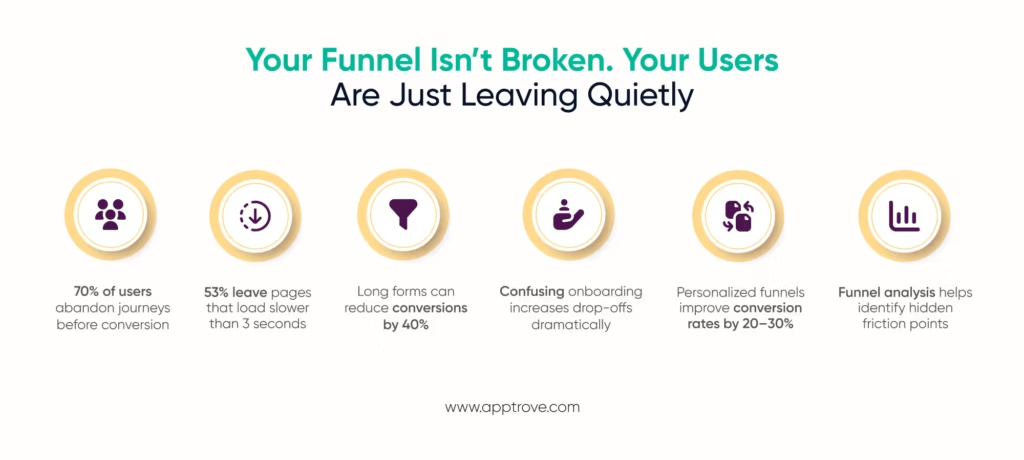
Increase conversion rates. The primary purpose of funnel analysis is to increase conversion rates. When businesses discover the specific points in the customer journey where a customer has left the funnel, they may improve that step to reduce friction for the customer at that point.
There are numerous ways in which businesses have improved customer experience and increased revenue.
Examples:
- Make checkout forms easier
- Reduce onboarding steps
- Improve CTA visibility
- Add trust signals
- Increase loading speed.
Even small changes at any one of the above steps can provide substantial revenue increases.
Understand customer behavior.
Negative quantitative data can lead to a positive quantitative conclusion or perspective regarding a pathway through the funnel by providing additional information about consumer behaviour along their purchase process.
A funnel analysis tool provides a business with the following pieces of information about the consumer:
- What source(s) have delivered the highest intent of the customer(s)?
- What web page(s) created confusion leading to customer(s)?
- What feature(s) are providing the best value to retain the customer(s)?
- Which marketing campaigns have resulted in converting customers?
By analysing the data derived from the funnel analysis tool, performance data that is considered passive becomes operational information via analytics.
Reducing drop-offs
Every instance of a drop-off can be attributable to a reason(s) not conducive to completing checkout:
- Lack of trust to provide payment on web page(s)
- The length of the sign-up form is too long.
- The onboarding process is overwhelming.
Funnel analysis will help identify all of the hidden friction points in a customer’s experience to eliminate or correct.
Aligning Customers with Product and Marketing Teams
The major benefit provided by funnel analysis-based tools is cross-functional visibility. Marketing teams can learn about the quality of their acquisition. Product teams can develop ways to create an improved consumer experience through the funnel. Growth teams can create an optimised pathway through the funnel. Leadership teams can develop tracking methods for revenue growth and the effects of any corrective activity.
All teams and companies start speaking the same language: conversion.
Key Metrics Used in Funnel Analysis
Tracking effective metrics is essential to any funnel analysis strategy’s success.
Businesses track several parameters as follows:
Conversion Rate
Measures how many users complete the desired action.
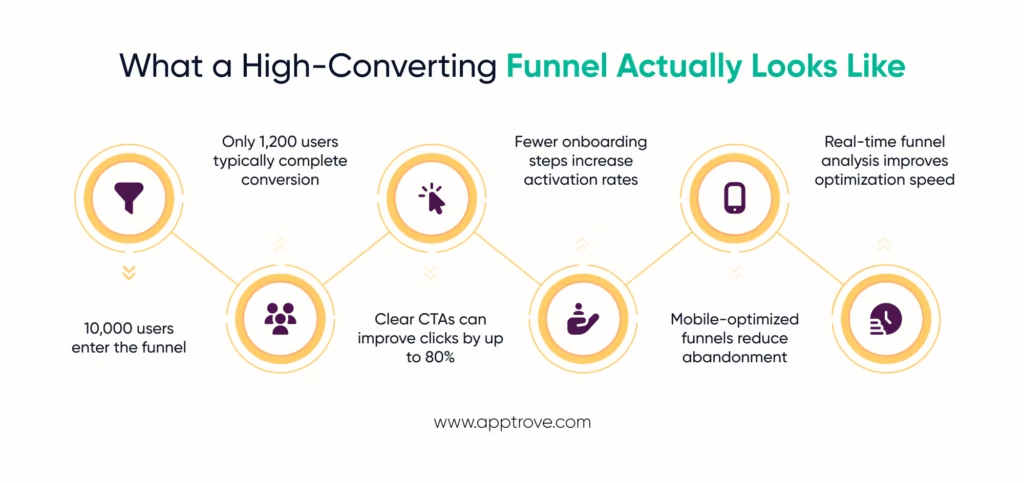
For instance, if 10,000 users enter the funnel, and 1,000 complete the checkout process, the conversion rate is 10%.
Drop-Off Rate
This indicates how many users abandon the process at any point.
When drop-off rates are high, this often indicates friction.
Time to Convert
Provides an indication of how long it takes users to move through the funnel.
Example:
- Delivery apps expect fast conversions.
- Financial app users may take longer to make decisions.
Event Frequency
Measures how many times users complete an event before converting. A funnel analysis tool can indicate if completing multiple events positively or negatively relates to conversion rates.
- User Segmentation
Segmenting funnels by any of the following is common practice for businesses:
- Geography
- Device
- Traffic Source
- Campaign
- User Cohort
- Subscription Plan
Segmenting users in a funnel allows you to identify the highest-performing user segments.
How a Funnel Analysis Tool Works
A funnel analysis tool tracks user events in sequence.
Every click, interaction, or conversion event becomes part of a behavioural flow.
The funnel analysis tool then visualizes:
- How many users entered each stage
- Where users dropped off
- How long users to convert
- Which segments converted better
- Which channels influenced performance
Popular platforms today offer advanced funnel analysis tool capabilities like:
- Behavioral cohorts
- Event segmentation
- Path analysis
- Retention analytics
- Real-time dashboards
- Multi-touch attribution
A strong funnel analysis tool helps businesses move from assumptions to measurable optimisation.
Funnel Analysis Examples Across Industries
One reason funnel analysis is so valuable is its flexibility.
Almost every industry uses funnel analysis differently.
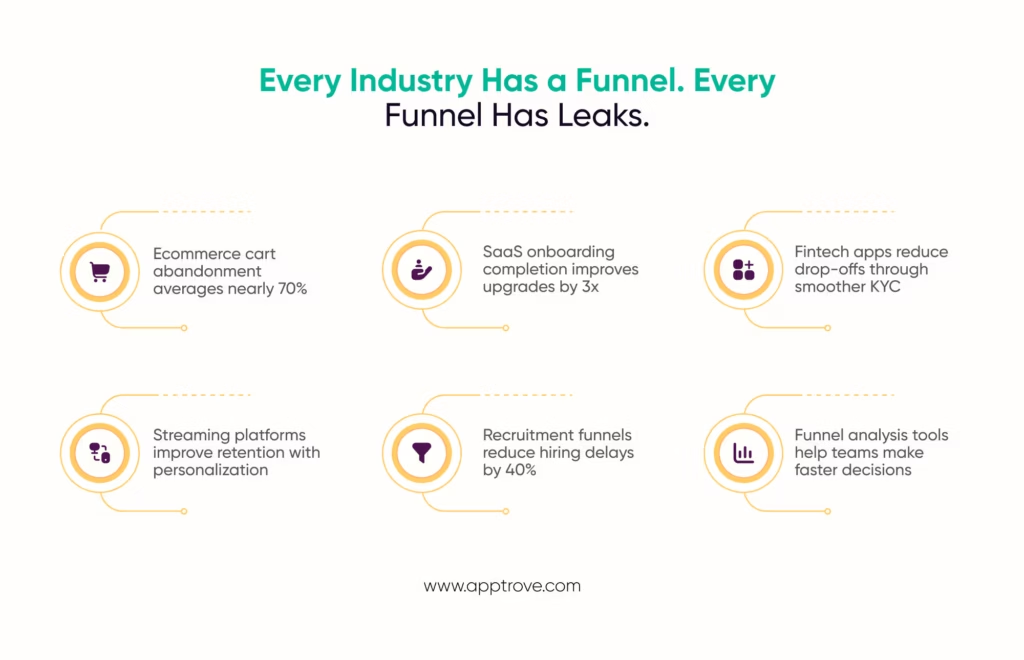
E-commerce Funnel Analysis
An e-commerce funnel may track:
- Product views
- Add-to-cart actions
- Checkout starts
- Payments completed
If users abandon carts frequently, brands may improve pricing visibility, shipping communication, or payment trust signals.
SaaS Funnel Analysis
A SaaS company may track:
- Signups
- Email verification
- Feature adoption
- Team invitations
- Subscription upgrades
This type of funnel analysis helps companies improve onboarding and activation.
Fintech Funnel Analysis
Financial apps often track:
- Account creation
- KYC completion
- Bank linking
- First transaction
- Repeat usage
A funnel analysis tool helps fintech brands reduce onboarding friction and improve trust.
Media and Streaming Funnel Analysis
Streaming platforms may analyze:
- App downloads
- Account signups
- Content searches
- Watch sessions
- Subscription upgrades
Funnel analysis reveals which content experiences increase retention.
What Is Funnel Analysis in Business Analytics?
Another common question is: what is funnel analysis in business analytics?
In business analytics, funnel analysis is used to measure how effectively users, customers, or leads progress toward business goals.
Business analysts use funnel analysis to:
- Improve customer acquisition
- Optimize conversion journeys
- Measure marketing effectiveness
- Analyze operational bottlenecks
- Forecast revenue opportunities
A funnel analysis strategy transforms raw behavioral data into measurable business decisions.
That’s why modern analytics teams heavily rely on funnel analysis for growth optimization.
Common Mistakes Businesses Make in Funnel Analysis
Even though funnel analysis is powerful, many companies still misuse it.
Tracking Too Many Events
Not every click matters.
Funnels should focus on meaningful conversion actions.
Ignoring User Intent
Different users behave differently.
A new visitor and returning customer should not always be analyzed together.
Focusing Only on Top-Level Metrics
A conversion drop is only the symptom.
The real value of funnel analysis comes from understanding why the drop happened.
Using the Wrong Funnel Analysis Tool
A poor funnel analysis tool can create incomplete insights.
Businesses should choose tools that support event tracking, segmentation, retention analysis, and customizable reporting.
How to Build a Better Funnel Analysis Strategy
To maximize conversion rates, you should build your funnel analysis upon the framework below:
Determine the conversion goal: Start by understanding what you want your visitors to do as the last step in your user journey.
User journey mapping: Identify every task your visitors will be expected to take before they convert to a customer.
Metrics that matter: Forget the vanity metrics– track what actions contribute to achieving your business goals.
Analyze abandonment points: Look to identify major points of abandonment during the conversion process.
Testing for improvements: Use A/B testing, user experience testing, and user personalization to test weak points.
Continuous cycle: Funnel analysis is not a one-time event. User behaviour continues to change, therefore you must continually update your funnels.
The Future of Funnel Analysis
Funnel analysis is evolving beyond simple linear journeys into a more complex set of actions that users may take before completing a conversion. This concept is called ‘customer journey fragmentation’.
Funnel analysis needs to continue evolving based upon the following items, to achieve true success:
- Cross-device tracking
- Artificial Intelligence (AI) powered insights
- Predictive analytics
- Real-time (or dynamic) personalization
- Behavioural segmentation
- Product intelligence
As digital experiences become more competitive, funnel analysis will continue to grow in importance as a critical business process for businesses who are focused on growth. Ultimately, growth is rarely defined as getting more people to visit your site. Understanding how to capitalise on the traffic you have already produces is key.
Conclusion
Funnel analysis is more than a reporting method. It’s a guide for making decisions.
Ecommerce brands, SaaS companies, fintech apps, recruitment platforms, and others use funnel analyses to optimise user interactions by identifying friction points in their processes.
The key to success using funnel analyses is to have a defined strategy to eliminate guessing and build an optimization framework. Additionally, with funnel analysis tools, organisations can consolidate disparate users’ behaviours and identify valued growth drivers.
Firms that succeed in today’s marketplace are not necessarily those accumulating the most data; rather, they are the organisations that are aware of their customers’ journeys and how to leverage them to deliver value.
FAQs
1. What is the definition of funnel analysis?
Funnel analysis is an approach for determining how users navigate from one stage of their journey to the next, ultimately reaching a goal (such as signing up, making a purchase, subscribing, etc.).
2. What is a funnel analysis method?
A funnel analysis method is designed to quantify conversion rates and drop-offs (users who do not complete an action) of all of the customers’ experiences across various stages of the customer journey.
3. What is funnel analysis in Business Analytics?
Funnel analyses in business analytics assist organisations in recognising where users experience hindrances to achieving business objectives and in identifying operational or conversion bottlenecks.
4. What is Funnel Analysis in Recruitment?
Funnel analyses in recruitment measure candidates’ movement through various stages of the employment process, including applying for jobs, interviewing for jobs, accepting an offer, etc.