The biggest challenge for app owners and growth teams in 2023 is no longer acquiring users. It is proving that they can acquire users who generate value to an app’s business model. This pressure has transformed the ROI campaign from an optional tactic into a survival requirement for sustainable growth. As of the end of 2025, mobile accounted for almost 78% of digital ad spending within India, and programmatic ad spending is expected to generate 85.2% of digital ad revenue by the year 2030. In Southeast Asia, mobile is expected to account for 65-68% of digital banner ad spending and social media spend by 2030, while 81.3% of digital ad revenue will be derived from programmatic advertising in the same region by the year 2030 (Statista).
The characteristics of this new mobile ecosystem require a new way of measuring ROI across multiple advertising media due to the number of touchpoints consumers have with brands before they convert into paying customers. Measuring ROI in isolation is problematic because each touchpoint contributes in different ways to ROI, so a mobile measurement partner (MMP) and demand side platform (DSP) will help advertisers realize their full potential. A DSP creates the scale needed to reach consumers largely with ads. An MMP ensures that scale produces a real defenseable ROI for app-focused businesses; MMPs link the DSPs’ acquisition and media performance to mobile measurement.
This blog examines the key DSP capabilities that consistently drive high-performing ROI Campaigns in India and SEA, and why mobile measurement serves as the connective layer that enables those campaigns to work effectively for app-focused businesses.
Why ROI Campaigns Matter More for App Businesses
The growth of apps is entirely dissimilar as compared to web-based marketing.
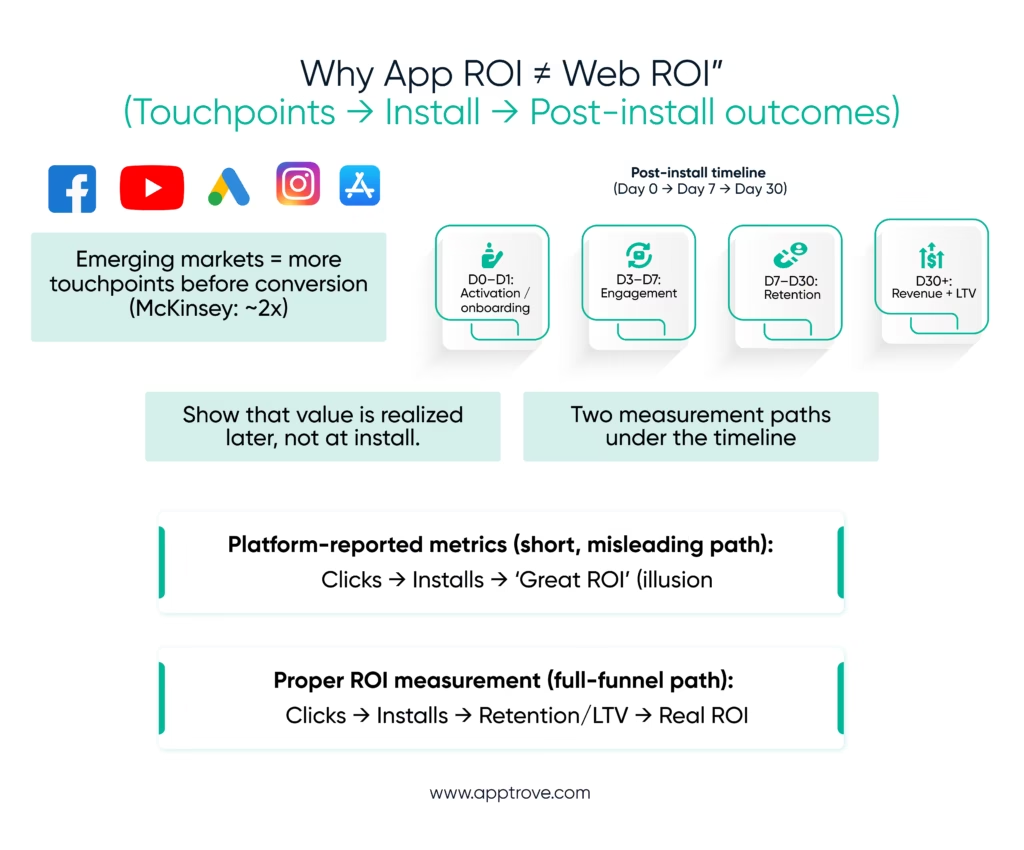
An install is not a success. The revenue, retention, engagement, and lifetime value are measured days or weeks after acquisition. This complicates and increases the importance of ROI Campaign measurement to both the app owners and marketers.
App discovery in India and Southeast Asia occurs through various touchpoints, and mishandled platform-reported metrics can result in illusions of elevated performance. McKinsey believes that mobile-first users in emerging markets touch twice as many digital touchpoints before converting, as compared to users in mature markets. In the absence of proper measurement, the app teams are likely to scale campaigns that seem to be effective, yet provide low-quality users.
ROI Campaign is not a budgeting exercise as such. It is a developing field that helps to match the efforts of acquisition with actual post-install results.
Where DSPs Fit Into the App Growth Equation
DSPs provide an opportunity for app marketers to programmatically purchase media on a channel, format, and geographic basis. They assist in accessing users on a large scale and optimizing real-time delivery.
Nevertheless, DSPs provide answers to only one question of the ROI: the place and method of ad delivery. They do not actually authenticate independently what occurs once a user installs an app or takes an action. Mobile measurement is charged with that responsibility.
DSPs and MMPs will have to collaborate in relation to app-focused ROI Campaigns. DSPs have the benefit of optimization of reach and bids, whereas MMPs verify whether the resulting users do indeed retain, engage, and monetize. In the absence of such cooperation, ROI will be directional and not conclusive.
Capability 1: Outcome-Based Optimization for App Events
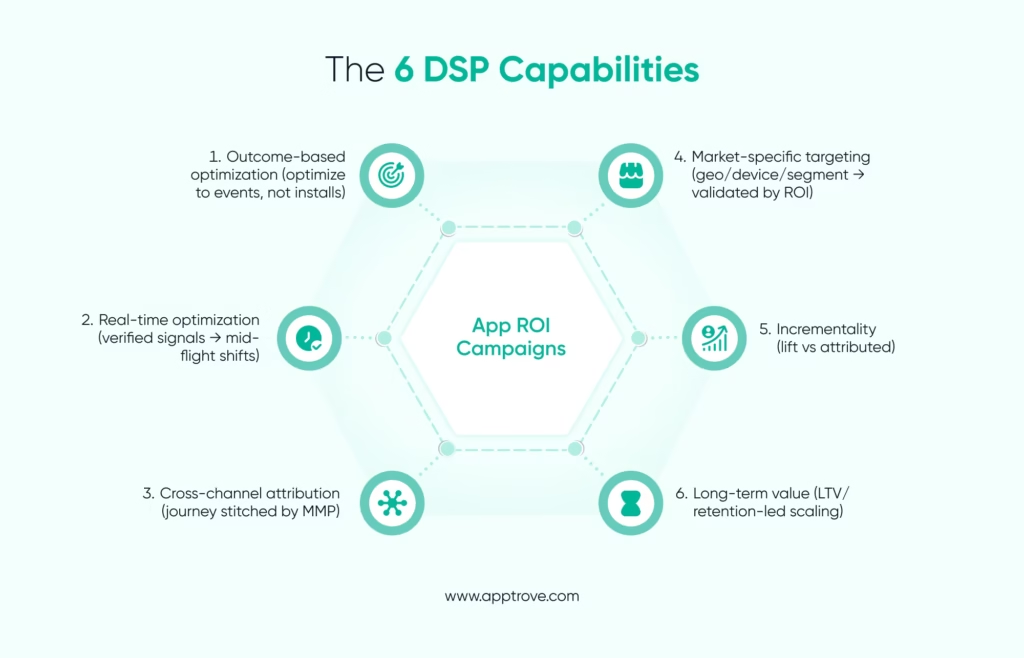
Optimization toward post-install, and not installs, is one of the most significant DSP capabilities in the case of app-led ROI Campaigns. To app marketers, success can be defined as onboarding, the first transaction, starting subscription, or repeated usage. The DSPs having the capability of digesting these signals, authenticated by an MMP, allow optimization to users who indicate actual intent.
This is the ability that pushes ROI Campaigns out of volume-based acquisition and instead grows based on value. In the long term, it saves wasted money on poor-quality installs and generally increases the efficiency of its campaign. For instance, an app like Apptrove provides the opportunity to integrate with various other applications. As one example, Apptrove has an in-app event tracking or post-install measurement app, which can be integrated with other apps.
Capability 2: Real-Time Optimization Backed by Verified Data
Speed is important in the marketing of apps. The behavior of a user evolves fast and poor campaigns have a way of burning the budget before one realizes the problem.
Real-time optimization is provided by DSPs, and only real-time decisions which are based on proven performance indicators can work. Under performance benchmarks of Google, dynamic campaigns in which the bids are varied during execution are more efficient on conversion compared to the fixed campaigns.
To app growth teams, the MMP data will serve as a feedback loop. It verifies who converts, who churns and who creates value. This gives DSPs the ability to redirect expenditure in the middle of the campaign, saving ROI even when the campaigns are still running.
Capability 3: Cross-Channel Attribution for App Journeys
App users rarely convert in a single step. They may see a video ad, click a display placement days later, and install through a different channel entirely.
DSPs enable cross-channel delivery, but attribution clarity comes from mobile measurement. Attribution is said to be important to their success by 91% of marketers, yet high confidence in current models is felt by only 31% of them.
For an app-focused ROI Campaign, understanding how channels assist each other is critical. MMP-led attribution connects these interactions into a single user journey, helping growth teams invest in channels that drive long-term value rather than just last-click installs.
Capability 4: Market-Specific Targeting for App Users
Southeast Asia and India are not homogenous markets. There is a considerable difference in the rates of app usage on cities, regions, and types of devices.
The granular targeting-based DSPs enable the app marketer to customize the campaigns to local behavior. Nevertheless, targeting will not ensure ROI. Measurement displays the segments that monetize and retain after acquisition.
The statistics provided by Statista indicate that the engagement behavior among metro and non-metro users of apps differs distinctively among Indians on mobile. ROI Campaigns that take such insights into consideration would always beat generic targeting campaigns.
Capability 5: Incrementality Measurement for App ROI
Evaluating ROI from mobile app campaigns often overlooks incrementality. Just because an install or conversion appears in a dashboard does not mean it was caused by the ad. Many users would have converted anyway through organic discovery, brand recall, or existing intent. This is especially relevant for apps with strong organic traffic or brand demand.
Controlled incrementality or lift studies run by major ad platforms consistently show that a portion of attributed conversions would have occurred without paid exposure, highlighting correlation rather than causation.
MMP-based incrementality testing helps isolate true ad-driven conversions, enabling app growth teams to measure real impact and avoid overspending on campaigns that merely capture existing demand instead of driving new growth.
Capability 6: Long-Term Value Measurement for Sustainable Growth
The best ROI Campaigns in apps marketing are those that do not focus on short-term installs or actions.
Success can be determined by lifetime value, retention, and repeat usage. McKinsey studies indicate that companies that maximize acquisition with long term value do better than short-term conversion companies.
DSP policies based on MMP-reported lifetime indicators enable the app owner to scale with confidence, whereby the current-day spending is added to the growth of the next day.
Apptrove may also think about creating a content that can be linked internally to LTV based optimization or retention analytics.
Why Mobile Measurement Is the Backbone of App ROI Campaigns
DSPs help you acquire users.
You get to know them with the help of Mobile Measurement Partners.
The failure to independently measure data exposes the app teams to making growth decisions based on incomplete or biased data. An MMP guarantees the congruence of attribution, validated results, as well as accurate ROI measurements across channels and markets.
This is what makes ROI Campaigns predictable growth engines rather than experimental spending to app owners and growth strategists.
Final Takeaway
ROI Campaigns have ceased to be optional to the owners of apps, their marketing team, and growth strategists. They provide the basis of sustainable growth. DSPs offer access and automation, whereas the mobile measurement offers veracity. The combination of the two allows measuring ROI, making it defensible and scalable, particularly in the rapidly developing markets such as India and Southeast Asia. This is the reason the new app growth tactics start with the measurement, rather than media.
FAQs
1. What is an ROI Campaign in app marketing?
An ROI Campaign focuses on the real business impact of marketing spend. It goes beyond installs and clicks. App teams track post-install actions like engagement, retention, or revenue. This approach ensures growth efforts create measurable value.
2. Why do app marketers need a Mobile Measurement Partner for ROI Campaigns?
A Mobile Measurement Partner provides independent attribution. It validates performance across channels and platforms. This prevents reliance on biased media reports. App marketers gain clear and trustworthy ROI insights.
3. How do DSPs and MMPs work together in app growth strategies?
DSPs manage media buying and optimization. MMPs track what users do after engagement. These insights feed back into campaign optimization. Together, they help scale ROI Campaigns efficiently.
4. Are ROI Campaigns harder to measure for apps compared to the web?
Yes, app journeys are longer and more complex. Conversions often happen days after acquisition. Users also interact across multiple channels. This makes accurate mobile measurement essential.
5. How should app teams evaluate the success of an ROI Campaign?
App teams should focus on verified outcomes. Retention, engagement, and long-term value matter most. Incrementality should also be measured. This ensures ROI reflects real growth.