If you’re a mobile marketer, an app owner, a growth lead, or someone handling acquisition, CRM, product analytics, campaign strategy, or retention, you are already aware of one fact: users are unpredictable. They download, vanish, re-emerge, purchase, churn, search and bounce. They swipe, scroll, accept, decline, reply to push, discard messages, have a binge session, or go idle. And behind all these patterns lies the single strategy that separates high-performing mobile brands from the average ones, behavioral segmentation.
No doubt you have heard it being used in marketing circles, but here is the truth; there is actually very little teams that know how to do it, there are less that have it properly implemented, and few have the infrastructure to operationalize it at scale. It is also the reason why most of the apps do not boost retention within the first 30 days. More than 77% of users end up uninstalling or abandoning an app in the first 3. When you do not know the behavior of the users, then you are not able to influence the user behavior, to make the user behavior optimized and personalized in a manner that will make the users come back.
This pillar content is your complete guide to behavioral segmentation, written for you, the mobile marketing professional who already knows the basics of user acquisition and engagement but wants to go deeper. You’re about to learn how to apply behavioral segmentation with precision, how to avoid the traps, how to use real variables instead of vanity metrics, and how to bring everything together into one cohesive system using a mobile measurement and analytics platform like Apptrove.
It is not aimed at bogging you down in technical terms and textbook explanations. Rather you are going to get answers that are natural, as you would speak to another marketer during a brainstorming session. You’ll also find analogies, real stats, real sources, practice-ready examples and frameworks that you can implement right away in your next campaign, product sprint or QBR roadmap.
This is your informative guide and by the end of it, you’ll not only understand behavioral segmentation, but you’ll also know exactly how to use it to outperform competitors who still operate on generic audience buckets and guesswork. Let’s begin with the foundation.
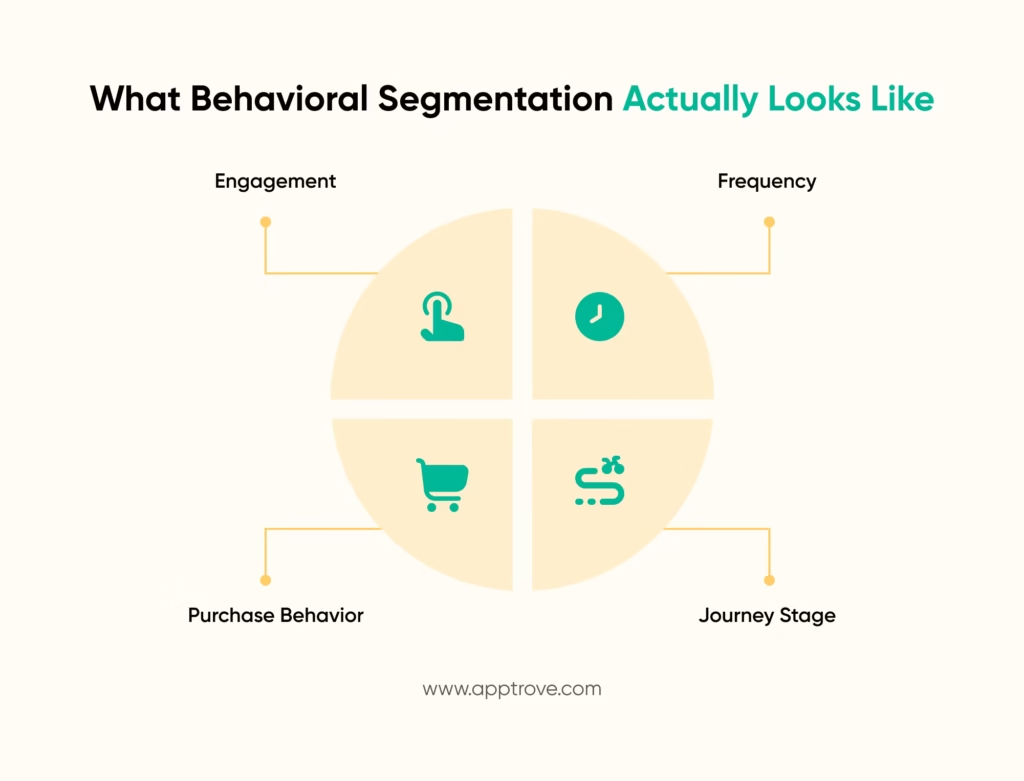
What Behavioral Segmentation Really Means (And Why Most People Misunderstand It)
When you search for “behavioral segmentation,” you’ll get a lot of definitions, but they all say the same thing in different ways. They tell you that behavioral segmentation is the process of grouping users based on their actions, what they do inside your app, how often they interact, what triggers them to convert, and what makes them churn.
Yet this is the more realistic, everyday version of this definition.
Behavioral segmentation is like watching customers walk around a supermarket, not to judge them, but to understand what they gravitate toward naturally. Two clients might be of the same age, same profession, same income bracket, yet one will be walking to the organic section, and another one would be searching the discount section. One person reads labels and the other discerningly throws stuff into the cart without thinking. One takes an hour to explore and the other takes a minute in and out.
That is behavior, so to speak in marketing. In the language of app marketing, that is all the way they open your app down to how fast they get dropped after they are installed.
Instead of leaving users in wide groups, which say “18-24, lives in California, male”, you begin to divide your users into groups based on such things as:
- opened three times a day
- only engages during weekends
- Added to cart but never purchased
- responds to discount notifications
- Binge-uses features but never converts
- opens once a month but spends high
This is the reason that behavior is stronger than demographics. It shows the desire of the users, not what you think they desire.
Salesforce put it simply by stating that behavioral segmentation focuses on “how and when a consumer decides to spend”. Qualtrics also notes that past behavior is among the best predictors of future behavior.
When you are a mobile marketer that is to say that you cannot afford not to take it seriously, since behavior is the best way to understand the intentions of your user.
The Mobile Marketing Shift: Why Behavior Matters Now More Than Ever
You could get away with demographic targeting alone, if it was 2016 or 2017. Because the cost of user acquisition was lower, there were fewer privacy regulations, attribution was easier, and the competition was not this intense. However, as of 2021, it is all different. Targeting based on demographics, as well as their devices, has become less trustworthy due to privacy frameworks such as ATT, GDPR, and heightened platform restrictions.
Behavior has thus been rendered to you, your most obedient, your most factual, your most precise segmentation.
Data supports this shift. McKinsey reported that customer behavioral insights help companies grow sales by up to 85% and gross margin by over 25% compared to their peers. Not a small lift, that is a revenue difference that is the difference that turns your app into an industry leader or an average one.
Behaviorally personalized emails increase transaction rates 6 times more. Although the given stat is based on an email, the same reasoning can be made in relation to push notifications and in-app messages. The moment you divide by behavior, your campaigns do not become generic.
Suppose we apply this same principle to:
- app onboarding flows
- conversion funnels
- retention journeys
- web-to-app transitions
- deep link personalization
- offer targeting
- feature adoption nudges
The outcome is enhanced user experience, as well as quantifiable revenue and retention lift.
When you look at the psychological aspect, behavioral segmentation also aligns with how humans make decisions. Habit, convenience, emotion, and context are the factors that make people make decisions. And all that is reflected in behavioral data. The person using your app at 2 PM daily of the workweek and never at night is a habituating behavior. Where a user is solely making purchases at flash sales, that is value-seeking behavior. That is an emotional behavior when a user spends three hours playing your game upon installing the game. Everything leaves clues.
This is why behavioral segmentation makes you a smarter marketer. Because you’re not guessing. You are just reading the figures that are already there.
Behavioral Segmentation Variables: What You Should Actually Track
Behavioral segmentation is built on variables, the measurable actions and patterns that define user behavior. These variables are the backbone of your app marketing strategy. If you choose the wrong variables, your segments become useless. If you choose the right variables, your targeting becomes unbelievably accurate.
It is to this extent that most marketers fall victim to. They either track too many variables or too few. They gather all, but they are not sure which ones are relevant. You cannot afford to follow 200 things, you must follow the right things.
Let’s walk through the variables.
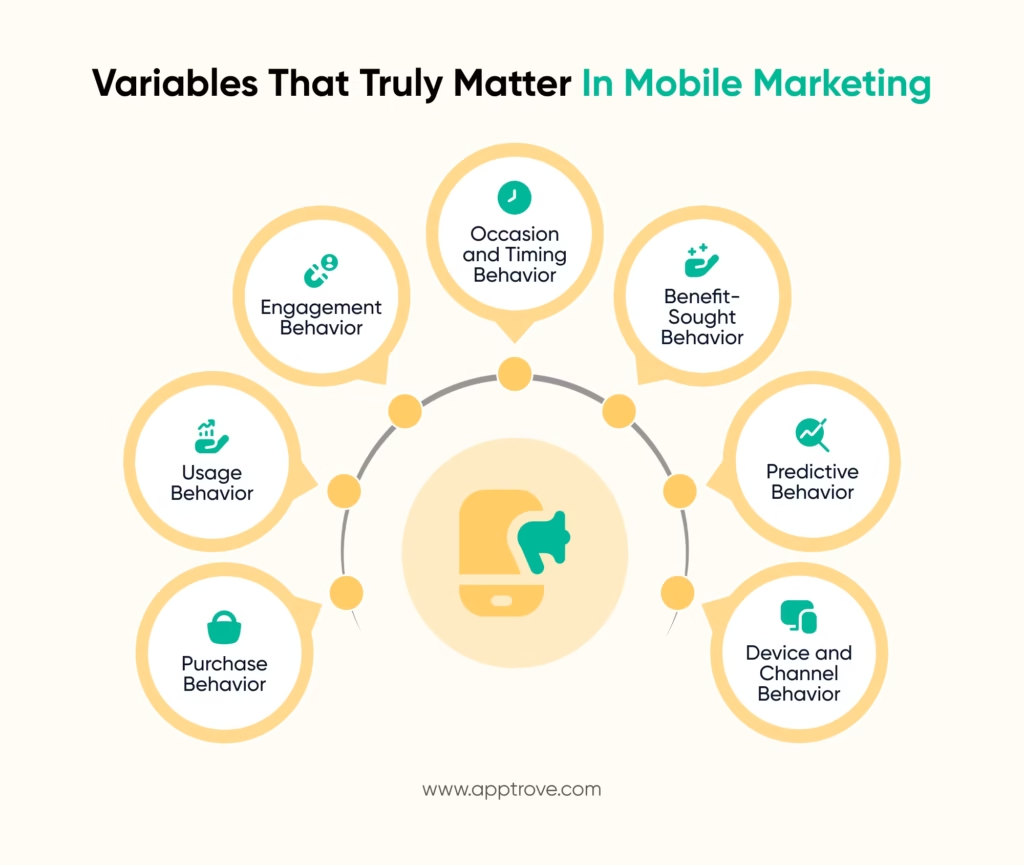
Purchase Behavior
One of the most obvious references to user intent and long-term value is purchase behavior. You begin to see segments emerge when you examine such patterns as purchase frequency, recency, and average order value. This could be in-app purchases such as subscriptions, in-app items, premium unlocks, virtual currency or transactional services in apps.
According to a report by Bain & Company, even a 5% rise in the number of repeat purchases can result to a growth of up to 75% in profits depending on the industry. This is due to the fact that the retention probability of repeat purchasers is large. They return without prodding.
When you apply behavioral segmentation to this, you can identify:
- users who buy frequently
- users who buy rarely
- users who buy only with offers
- users who buy immediately after installation
- users who buy after multiple sessions
That lets you tailor messages with far more precision.
Usage Behavior
The retention is usually most pronounced in usage behavior. Applications that have high daily active usage are more likely to monetize and have lesser churn. The most important metrics in this case include the frequency of sessions, length of sessions, depth of session, and feature usage.
Mobile Industry Benchmarks shows that the average global retention rate of D1 across apps is a low 26%. By D7, it drops to 11%. It implies that you will lose 89% of your users in a week unless you act to re-engage through segmentation.
Behavioral segmentation lets you identify usage patterns such as:
- users who engage deeply
- users who use only one feature
- users who log in at odd or specific hours
- users who use the app consistently but avoid conversion
When you start seeing these patterns, your product decisions improve, too.
Engagement Behavior
Engagement behavior reflects on user response to push notifications, SMS, emails, in-app popups, offers and updates. This will make you know whether your message is working or you are talking to no one.
Airship Mobile App Engagement Report (2024) states that dispatched push notifications can be 9x more engaging than general messages do. Behavioral segmentation makes this personalization possible.
- Users who open every push
- Users who open only specific types of push
- Users who ignore all push notifications
- Users who respond to offers but not reminders
These segments guide your messaging strategy.
Occasion and Timing Behavior
Timing behavior tends to provide context. To illustrate, food delivery apps understand that those individuals who place an order once a week, on Friday evenings, is predictable, that is, it is a behavior pattern. Travel applications understand that there are users who only search during long weekends. Finance apps are aware that there are users who look at balances each morning.
This has been dubbed as occasion based segmentation and it is very powerful.
Benefit-Sought Behavior
This variable is about what users want to get out of your app. Many users come to the same app for different reasons. For instance, in a fitness app:
- some want diet tracking
- some want workout plans
- some want daily motivation
Segment by the benefit the user seeks, and your app suddenly feels personalized.
Predictive Behavior
Foresight behavior is anticipatory segmentation. You study what is done in the past and what will happen next. For instance:
- users who skipped onboarding steps are likely to churn
- users who had long first sessions are likely to return
- users who responded to three pushes are likely to convert
When you combine predictive behavior with behavioral segmentation, your campaigns become proactive rather than reactive.
Device and Channel Behavior
The behavior of the devices is also significant in mobile marketing. Depending on the OS, the type of device, the connection speed, and the source of the acquisition, users act differently.
For instance:
- Paid users are not the same as organic users.
- Android users do not act the same as iOS users.
- Low-end device users might skip heavy features
This data isn’t technical, it’s behavioral.
Why Choosing the Right Variables Matters
Think of variables like ingredients. When you use the wrong ingredients in a dish, then it does not taste very good. If you choose variables unrelated to your business goals, your segmentation won’t create impact.
A good behavioral variable:
- is measurable
- is connected to an outcome
- is actionable
- is recent and dynamic
- helps you distinguish users meaningfully
The moment you start choosing better variables, your segments become sharper, your offers feel personalized, your notifications feel relevant, and your growth results start compounding.
Behavioral Segmentation Examples You Can Apply Immediately
Now that you understand the variables behind behavioral segmentation, let’s bring it to life with examples that feel real, relevant and immediately applicable in the mobile marketing world. You’ll see these examples happen every day across apps you use, even if you don’t notice them consciously. When you get to know them, you will start noticing behavioral types there everywhere, just like a chef who begins recognizing flavor notes in every dish.
Example 1: Identifying New Users Who Lose Interest After Day 1
Think of a person who has installed your application, opened it once, spent two minutes in it and vanished. It may seem natural however, behaviorally, this is one of the most important segments to have.
Approximately 70% of users churn within the first 24 hours upon installation. That is nearly 7 in 10 individuals who slush out of your funnel before they can even know what your product is.
In behavioral segmentation, the group of users who don’t return after day 1 becomes a powerful segment. You may create specialized onboarding follow-ups, personalized notices, deep links that lead to a feature they have not used yet, or a push notification that provides them with a small win. You are not addressing them as the general audience, you are addressing them on their particular early behavior.
Being a mobile marketer, this will inform you of the opportunity of drawing a person back before they are gone forever.
Example 2: Users Who Repeatedly Hit the Paywall but Don’t Subscribe
Imagine this section as the customers who continuously go to a shop, read the label, and place the item back. They are interested; they are curious; they can see the value; they just need the push in the right direction.
Subscription-based apps tend to overshadow this behavior pattern. When a user goes through your paywall 5 times in a week that is intent. When they take over 40 seconds to your pricing page that is by design. When they are scrolling down to feature-matching, that is no accident.
A behavioral segment such as heavy paywall explorers then allows you to customize an offer, limited time discounts or a trial extension to them. Other apps experience a 20-40% conversation boost just because they acknowledge the existence of this segment. A 2023 Sensor Tower study found that apps that personalize subscription offers based on behavior have as much as 29% better conversion rates compared to apps that do not.
Example 3: Users Who Add Items to Cart but Never Complete the Purchase
This is textbook behavioral segmentation used in ecommerce apps, D2C apps, grocery delivery apps and even travel apps.
A user visits, adds products, calculates delivery fees, examines payment options, perhaps even chooses a coupon, and leaves the application. The rate of abandonment in carts is so widespread that the mobile average is 70-75% in accordance with the Baymard Institute (2024).
Nevertheless, it is not merely a drop-off that is the abandonment behavior but a signal. A big one.
Such a cue is to inform you that the user is interested enough to do something but is hesitant to commit. Behavioral segmentation makes this segment visible so you can craft personalized messages:
- reminding them of the item
- sending a small discount
- showing product reviews
- offering free shipping
- reducing friction during payment
It is the high-intent group, and they should not be ignored as there is money on the table.
Example 4: Users Who Only Respond to Offers or Discounts
This group is well known to every marketer. They never buy full-price. They are waiting till it is announced such as Flat 40% off, Buy 1 get 1, or Special sale today.
This is highly prevalent in the mobile ecosystem. According to research conducted by RetailMeNot, 62 % of customers will wait to be offered a promotion before they can buy. It is to say that your discount driven segment is actual and their behavior is predictable.
When you break up users who do not convert without a discount, you can schedule your campaigns, sending exclusive offers or even maximizing the income, providing reduced but more frequent incentives.
This group becomes a profitable segment instead of a random audience scattered across your user base.
Example 5: Users Who Use Only One Feature in Your App
Nearly all apps have such users. Consider an application in the sphere of fitness, where an individual simply has the calorie tracker and never visits the training area. Or a finance app that people use to look at their balance and never delve into investments. Or a travelling app whereby a person does not book hotels but only flights.
Such behavior will assist you in knowing the benefit that the user seeks, why they initially installed your app in the first place.
Upon locating these single feature users, you are able to construct targeted actions, such as:
- nudging them to explore more features
- suggesting personalized recommendations
- introducing them to premium tools related to their preferred feature
- reducing friction in the feature they already love
This segment is not only excellent in terms of engagement but also in terms of product expansion.
Example 6: Users Who Have a Predictable Usage Rhythm
Some users behave like clockwork. They open your app:
- every morning
- every Friday night
- every payday
- every time there’s a cricket match
- every time they commute
These patterns display rhythmic patterns of life. Starbucks discovered a large number of customers came to visit the store at the same time every morning and used the knowledge to streamline staffing and promotions in the stores. It can be done with the help of apps through time-based behavior analysis.
By recognizing these patterns, you can deliver push notifications in the exact time that the user will open the app. They find it natural and right at the right moment.
Timing is a behavior. It is segmentation, after all.
Example 7: Users Who Are Close to Churning
Churn doesn’t happen suddenly. Users don’t wake up one day and decide never to return. Churn is a process. And the behaviors that lead up to churn are measurable.
- A user who drops from five sessions a week to one.
- A user whose session duration drops from minutes to seconds.
- A user who ignores three consecutive push notifications.
- A user whose last transaction was 60 days ago.
These patterns create a segment of “high-risk churn users.”
According to Mixpanel, apps that implement churn prediction models using behavioral segmentation reduce churn rate by up to 18-25% depending on the category (Mixpanel Data Science Report, 2023).
By identifying this segment early, you can craft re-engagement journeys before the user disappears.
Example 8: Users Who Have High Value But Low Engagement
This happens to be one of the most fascinating sections since it usually passes unnoticed. These are the ones that buy and subscribe but do not use your app frequently. They resemble gymnasium members who take out a one-year contract but only attend once a month or so.
This is a significant segment since although they are revenue generating, they are also highly churnable.
When you cut them sufficiently, you can concentrate on growing feature usage, onboarding depth and engagement to minimize churn in the future.
ProfitWell conducted a study which revealed that subscription applications lose a whole 32% of their users because they could not perceive the value of using the product that they have.
Behavioral segmentation helps you fix this proactively.
Example 9: Users Who Came From Specific Channels and Behave Differently
Behavior is affected by channels.
- Organic does not act the same as paid traffic.
- Influencer-based installs do not act as search-based installs.
- Referral traffic does not act as social traffic.
The likelihood of the user returning to the app within the first three days is 30% greater when they were acquired via influencer campaigns.
Channel-origin is a behavioral variable when paired with in-app behavior.
This lets you understand:
- what sources of acquisition have high-value users?
- which flow bring window-shoppers?
- which referral sources generate fast-churners?
Such insight into behavior can make you spend your budget wisely.
How Behavioral Segmentation Shapes Strategy Across Your App Funnel
Up until now, we’ve explored behavioral variables and realistic examples. Now, let’s shift the lens toward how behavioral segmentation shapes the strategy across your entire app funnel, from user acquisition to onboarding, engagement, conversions and retention.
Acquisition: Behavioral Segmentation Redefines What “Quality Users” Means
When people discuss acquisition, they say such terms as quality users, high-intent traffic, or high-converting audience. The fact is that quality is based on behavior. A user who posted on Meta Ads may be of a high quality until the behavioral information reveals that he/she installs and vanishes on the first day. At the same time, a YouTube user may have very few installs and a lot of engagement.
Behavioral segmentation helps you stop judging channels by surface metrics like install volume and start judging them by:
- post-install engagement
- session frequency
- feature adoption
- purchase likelihood
This assists you in moving budget to channels that attract users who operate as to long-term value.
Onboarding: Behavior Reveals Exactly Where Users Drop Off
When your onboarding completion rate is low, it will be reflected in behavior patterns.
- Users stop at step three.
- Users watch the tutorial but don’t perform the first action.
- Users skip permissions and then get stuck later.
- Users close the app when asked to create an account.
These patterns are behavior. Behavioral segmentation makes them visible.
Once visible, you can:
- redesign your onboarding
- optimize permissions timing
- add deep links to guide them
- create personalized welcome flows
One of the most impactful stages is onboarding because segmentation can turn your retention curve around.
Engagement: You Start Crafting Messages Users Actually Respond To
Engagement does not increase due to the increased number of push notifications. It is better when you express the appropriate message to the appropriate user at the appropriate time.
You send a push notification that says We added new features! One user who uses a single feature does not mind that. However, it could be of interest to a user that happened to experiment with several features. Likewise, a user who has not opened the app in days should receive a different message compared to a user who opens it on a daily basis.
Behavioral segmentation helps you identify what message feels natural to each user. This avoids generic communication that is spammy.
Conversion: Behavior Shows When the User is Ready to Buy
A user that makes five consecutive high-value products visits will be different to a user who visits randomly. Three minutes on your premium page would not be equal to a user who scrolls by it.
High purchase intent signs are provided by behavior. Segmentation regarding conversion gives you the time to act.
Retention: Segmentation Helps You React Before Churn Happens
Retention isn’t an accident. Users retain since an app remains useful within their lifecycles. Behavior segmentation assists you in identifying evidence of relevance decay.
- A user stops exploring features.
- A user’s session frequency drops.
- A user ignores multiple reminders.
- A user starts using a competitor.
These are not the things that are reflected in demographic information. They appear in behavior. And manner gives thee the chance to interfere.
Why Behavioral Segmentation Changes How You See Your Product
As soon as you begin to consider your app in terms of behavioral segments rather than generic audiences, your very product outlook changes.
- You start designing features for real usage patterns, not assumptions.
- You optimize your onboarding based on real drop-off behaviors, not guesswork.
- You time your campaigns based on when users naturally engage.
- You personalize experiences based on what users do, not what you hope they will do.
- You make data-driven decisions that feel natural instead of forced.
Essentially, you cease creating an app that is to be used by everyone and begin creating an app that is to be used by a particular group of users with a particular behavior pattern. That’s the real power of behavioral segmentation.
How Behavioral Segmentation Transforms Your Marketing Funnel
Everything becomes more evident when you begin applying behavioral segmentation in the full scope of your marketing funnel. You start to realize why some campaigns are successful and others fail. You find out why certain users turn into converts immediately, and others are not fast. You get to understand why certain users are churners and others are loyal as they are not supposed to be encouraged so much. Behavioral segmentation will transform your funnel into a breathing life engine.
We will step through each of the steps of your funnel and discuss the role of segmentation.
Top of Funnel: Acquisition
Marketers tend to be on the wrong foot when it comes to acquisition. They believe that when a channel offers them thousands of installs, it is that it is a good channel. But as you have already realized, the installs are not the end of the story. It begins there. It is only after installation that you begin to see the truth in behavior.
An app is technically an acquisition, but not a valuable one, when installed by a user who does not open it. Once a user opens and does not come back is also not a good user. Behavioral segmentation will assist you in monitoring that which most marketers overlook as components of the funnel.
When you segment users by post-install behavior, you can find patterns such as:
- Users acquired from Google App Campaigns have extremely strong onboarding completion rates.
- Users acquired from Instagram Reels ads often explore multiple features before disengaging.
- Users acquired from referral programs have higher average session durations.
- Users acquired from influencer content re-engage more frequently during weekends.
These trends provide you with the capability of maximizing the spending on those channels that can contribute to high-quality behaviors. The fact that the cost will be saved can dramatically increase your ROAS.
Middle of Funnel: Engagement and Onboarding
The place of behavioral segmentation begins to shine onboarding. The majority of marketers experiment with such superficial metrics as time to complete onboarding, drop at step 2 or 3, but segmentation allows going deeper.
You begin to understand questions like:
- Which types of users skip onboarding?
- Which users respond well to tooltips and which ones find them annoying?
- Which users click “Skip for now” and regret it later?
- Which users complete onboarding but still fail to perform core actions?
These behavioral observations inform you of two things, who to cultivate and what to grate. You are all at once creating onboarding journeys based on various behaviors.
As an example, a user who just downloads an app via a performance ad that has a call to action of trying it free may require a shorter onboarding than an organic user who found your app in search.
In a report published by Insider Intelligence, it was noted that apps that have the custom made onboarding experiences have a higher activation rate of up to 28% compared to the apps that follow the same onboarding to all people. That is the distinction of behavioral segmentation.
Lower Funnel: Conversion
Behavioral segmentation causes your application to sound intuitive with regards to conversions. You don’t need to guess. Users express their interests in the way they act way before they press the purchase button.
- A user who checks a premium feature multiple times.
- A user who frequently adds items to a wishlist.
- A user who repeatedly visits the pricing page.
- A user who scrolls deeper into product details.
- A user who abandons the process at the payment step.
Such actions assist you in perceiving purpose, indecisiveness, and desires. Conversion is no longer about persuasion, but timing and context.
A report released by Clevertap found that behavior-based personalization can increase your conversion rates 3.5x over generic messaging. That’s a massive multiplier.
Behavioral segmentation will design a more natural conversion path in which the user would not feel coerced. Instead, they have the feeling that they are understood and understanding is the ultimate currency in mobile marketing.
Post-Purchase Funnel: Retention
The retention is the area where most apps falter. You have likely observed such a curve in your data, huge decline between D1 and D7, another decline between D14 and D14, and then the curve levels off. The reason why this occurs is not even the attempt of most apps. However, when behavioral segmentation is used properly, all is quantifiable.
Here’s what behavior tells you:
- Users who complete at least one meaningful action after onboarding are more likely to stay.
- Users who explore three or more features within the first week have higher retention.
- Users who respond to the first two notifications are more likely to convert later.
- Users who receive irrelevant messages churn faster.
- Users who don’t experience an early “aha moment” disappear.
After knowing these, your retention strategy is more focused. You do not make sluggish Day 3, Day 7 or Day 14 campaigns anymore. You instead develop behavior-based campaigns that are personalized to the journey of engagement of the user.
Advanced Behavioral Segmentation Models You Should Know
Now that you understand the core of behavioral segmentation, let’s move into advanced territory. These models are used by high-performing mobile teams, large-scale apps, and data-driven growth organizations. You don’t need a full data science team to use them, you just need to understand how they work.
RFM Segmentation: Recency, Frequency, Monetary
RFM is one of the oldest and most reliable behavioral segmentation frameworks. Brands like Amazon, Netflix and Walmart use it heavily. In mobile apps, it’s equally powerful.
- Recency: When did the user last interact with your app?
- Frequency: How often do they perform actions?
- Monetary: How much value do they generate?
By combining these three, you can classify users into segments such as:
- Champions
- Loyal users
- Potential loyalists
- At-risk users
- About-to-churn users
- Lost users
- Big spenders
- Discount-dependent users
This model alone can transform your retention and CRM strategy. Apps using RFM-based targeting see up to 15–20% higher retention according to a CleverTap 2023 study.
Lifecycle Segmentation
Lifecycle segmentation is about grouping users based on where they are in their journey. Unlike demographic segmentation, lifecycle segmentation is fluid , users can move from one stage to another.
The classic lifecycle stages look like:
- New users
- Activated users
- Engaged users
- High-value users
- Dormant users
- Churned users
But mobile marketers often break this down further:
Install → Trial behavior → Feature exploration → Conversion → Loyalty → Decline
Behavior tells you exactly which stage a user is in, and more importantly, which stage they are stuck in.
Predictive Segmentation
Predictive segmentation uses behavioral data to determine what a user is likely to do next. It sounds futuristic, but it’s already standard in top mobile apps.
For example:
Which users are likely to churn in the next 7 days?
Which users are likely to convert based on their past behavior?
Which users are likely to explore premium features next?
Which users are likely to respond to discounts?
According to a 2023 Gartner report, apps using predictive segmentation witness up to 2.5× higher customer lifetime value compared to apps that rely only on historical data.
Event-Based Segmentation
Event-based segmentation is extremely useful for mobile apps because everything inside an app is an event:
- App open
- Button click
- Add to cart
- Scroll
- Share
- Wishlist
- Checkout
- Drop-off event
- Feature usage event
- Session start
- Session end
Segmenting users based on event combinations gives you deep behavior insights.
Example:
- Users who used the search feature three times but didn’t find relevant results.
- Users who added items to their wishlists but didn’t open the app for five days.
- Users who completed 80% of a task but dropped off at a specific step.
These segments help you fix UX problems and reduce friction in the journey.
Intent-Based Segmentation
Intent is behavior. When a user explores something repeatedly or interacts with certain features more than others, they reveal what they’re trying to achieve.
For example:
- A user checking job listings multiple times indicates career intent.
- A user reviewing product comparison tables indicates purchase intent.
- A user opening finance calculators frequently indicates money-planning intent.
- A user browsing travel deals indicates holiday intent.
Identifying intent lets you predict future actions accurately.
How Behavioral Segmentation Improves Personalization Without Feeling Creepy
Today, users are very concerned about the idea of over personalization being intrusive. That’s why behavioral segmentation eliminates that concern altogether because it does not require the collection of any personal information. Rather than relying on the user’s age and geographic location, it relies on what they actually do with your application – those actions are naturally taken by the user.
Therefore, behavioral segmentation is the most privacy-compliant method of providing personalized experiences, since the information that provides for personalized experiences comes from how the user interacts with your application, not the user’s identity. The questions used to create behavioral segments are, “How can we help you by identifying your behavior patterns?”
It is compliant with GDPR, CCPA and other privacy frameworks because the personalization comes from interaction patterns, not personal identities. Instead of asking, “What’s your age and where do you live?”, you’re asking, “How can I help you based on what you naturally do?”
Behavior is the cleanest data source you have. No privacy concerns. No user discomfort. No legal complications.
Why Behavioral Segmentation Is Easier With Apptrove
At this point, you’re probably thinking, all of this sounds powerful, but how do I actually execute it? That’s where Apptrove becomes relevant. Because behavioral segmentation only works when you can capture, segment, analyze and activate behavior in real time.
Here’s how Apptrove simplifies this entire ecosystem:
- Apptrove captures user events, actions, sessions, purchases and engagement patterns across your app without needing multiple tools.
- Apptrove allows you to create dynamic behavioral segments that update automatically as user behavior changes.
- Apptrove lets you activate those segments instantly through push, in-app, web-to-app, deeplinks and personalized journeys.
- Apptrove gives you analytics that show how each behavioral segment is performing, so you can optimize accordingly.
- Apptrove predicts users who are at risk of churn by analyzing behavior patterns, letting you act early.
Behavioral segmentation becomes far easier when everything is unified in one place instead of scattered across different platforms.
How to Implement Behavioral Segmentation in Your Mobile Marketing Strategy
If you have reached this point, you are likely familiar with what behavioural segmentation means in the world of contemporary mobile marketing. Simply understanding the theory does not equate to having the capability to use that theory, many of the tools will need to be developed and enhanced as mobile usage habits continue to evolve. Many users are split between using multiple applications, multiple media channels plus changing contexts.
By using the behavioural segmentation approach to developing a behavioural framework, you’ll instantly see a correlation between user behaviours and the predictions made on what they will do next. It is akin to driving a car on a foggy road; although you may not be able to see the entire road ahead, you will be able to make informed decisions that will compound over time.
The true beauty of behavioural-based segmentation comes to bear once you have implemented behavioural segmentation across the entire user funnel from acquisition to activation through retention and monetisation; all of which need to be examined through different lenses and all of which need slightly different nudges in order for users to experience the value through the lifecycle of their experience with your company. Instead of employing a broadcast approach to communicate with your users, you will be delivering the right message at the right time to the right person.
Let’s walk through exactly how that looks.
Building the Foundation: Understanding Your User’s Behavioral Journey
Before you start grouping users into segments in your app, you should take some time to fully understand how users navigate within your app. You should create a visual representation of how users go from discovering your brand to becoming loyal, revenue-generating customers. You will find that some users glide effortlessly through your app experience, while others will experience drop-offs during specific points in your app. Finally, you may have some users stay engaged longer than anticipated.
All apps (whether it is a food delivery app or a gaming app) experience the exact same phenomenon: users’ behaviors are very rarely linear. A user may download your app on a Monday and then visit your site on Wednesday, make a purchase on Friday, and then be gone for three weeks. Another user may visit your website immediately after they download the app and convert right away. Yet another user may download your app and continue to return repeatedly, but never buy anything.
Behavioral segmentation does not define these variations as either “good” or “bad”; it defines them as signals, or clues, about users’ journey and drives the way you think about and shape your marketing campaigns based on this information. As you begin to identify these patterns, the process of marketing will feel less like guessing and more like a deduction machine, with quantifiable outcomes.
Applying Behavioral Segmentation Across the Funnel
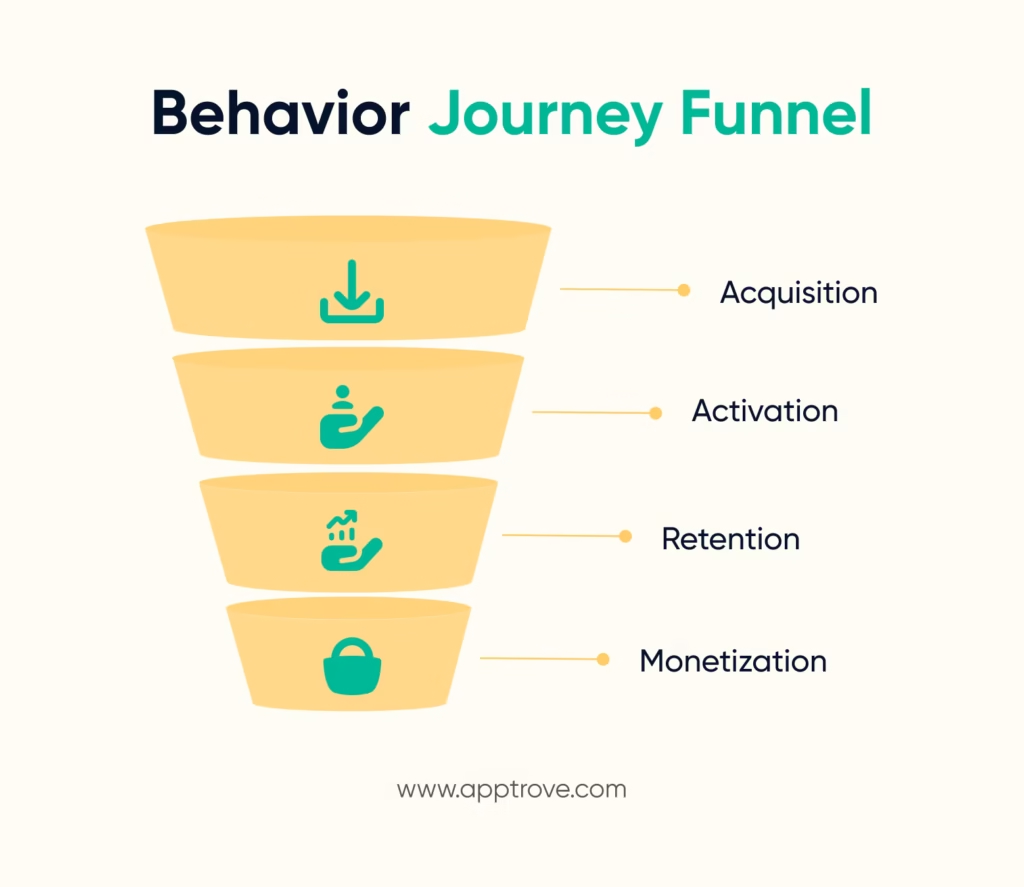
Now that you have behavioral patterns, the real work begins, applying them in a way that moves each segment closer to your business goals.
When you focus on user actions, you begin to see that every behavior, no matter how small, tells a story.
- A swipe
- A pause
- A search
- A revisit
- A skip
- A purchase
- A cart abandonment
Each action adds one sentence to that user’s story. Behavioral segmentation helps you read those sentences, interpret the story, and deliver something meaningful in return.
To give you a parallel example, think of streaming platforms like Netflix. They don’t just categorize you by age, region, or device. They observe what you binge, how fast you binge it, where you stop, when you return, and how your behavior compares to millions of similar users. Your viewing behavior becomes the blueprint for what you’re shown next.
Mobile marketers, especially app growth teams, can use the exact same principle.
Here’s how this translates into a real app:
- A user who opens your app five times a week without making a purchase isn’t “inactive”, they’re engaged but hesitant.
- A user who buys twice a month without browsing anything else isn’t “low intent”, they’re predictable and primed for targeted offers.
- A user who only interacts with push notifications on weekends isn’t “random”, they have a lifestyle pattern.
The deeper you understand these patterns, the easier it becomes to send communication that doesn’t feel like marketing. It feels personal. Relevant. Helpful.
That’s the goal.
The Role of Behavioral Segmentation Variables in Real-World Execution
When you’re working with behavioral segmentation variables, you have two primary responsibilities:
- Understanding what each variable means
- Using these variables to create experiences that feel natural
The most impactful variables in mobile marketing tend to revolve around:
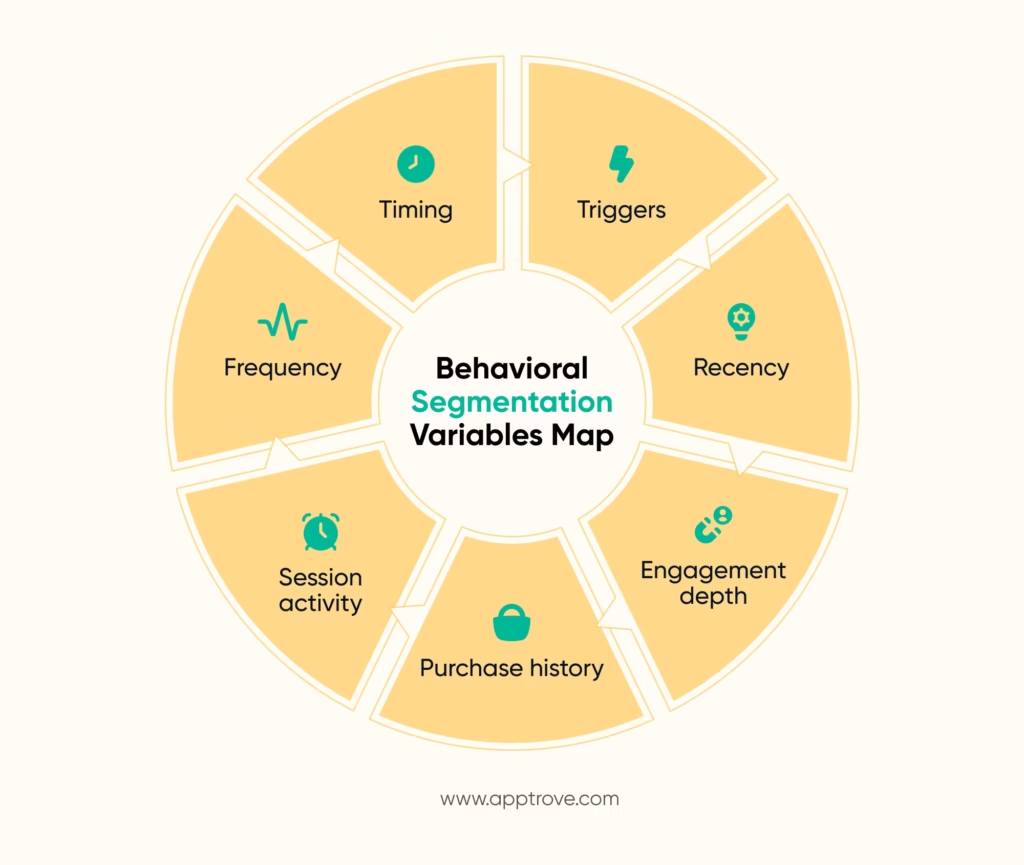
- Frequency
- Timing
- Triggers
- Recency
- Engagement depth
- Purchase behavior
- Session activity
But the part most marketers miss is the emotional interpretation behind each variable. A user’s behavior doesn’t exist in a vacuum, it’s influenced by context, motivation, and intent.
If a user checks out the same product five times but never buys it, the behavior isn’t telling you “they don’t want it.” It’s telling you “they’re interested but hesitant” or “the price isn’t right” or “they’re waiting for a better option.” The variable is just the clue. You interpret the motive.
Apps that excel in behavioral segmentation blend both the analytical and the emotional side. They see the numbers, but they also understand the psychology behind them.
Behavioral Segmentation Examples You Can Use Right Away
It is time now to make the concept tangible with some examples based on the mobile marketing rather than on the general theory of marketing. These illustrations provide a clear vision of the way apps employ behavior to comprehend what their users desire without even posing a question to them.
- A gaming application notices that when players finish three levels on a single session, there is a great chance that they will come the following day. This particular micro-pattern is the trigger: after level three, provide these players with an incentive or reward to reinforce the habit loop.
- An app that offers grocery delivery notes that the users who visit the offers sections first and then the standard ones follow suit are value-oriented. It is an individualized deal, cart nudge and limited time offer layer of segmentation.
- A travel app tracks that users who view hotel pages repeatedly without booking usually need reassurance, reviews, trust signals, flexible cancellation options. That behavior becomes a cue for a perfectly timed push or in-app banner.
- A subscription app recognizes the fact that those users who consume two pieces of premium content on a daily basis have a high probability of upgrading. That action is further used to create a subtle well-timed upsell prompt.
These are not hypothetical examples. These are precisely how the leading apps increase retention, decrease churn, and increase revenue based on the behavioral patterns as the north star.
Why Behavioral Segmentation Feels So Personal to the User
The second myth in the mobile marketing sector is; the users do not wish to be hunted and studied. But this isn’t true. People do not desire irrelevant messages, generic promotions, and forced targeting. However, they do enjoy personalization which is sensible, non-invasive, and considerate.
Behavioral segmentation is the practice that leads to personalization that makes it easier, as it is what users are already inclined to do. It merely pushes them in the right direction.
Here’s a simple analogy:
Imagine walking into your favorite café. The barista doesn’t ask your age, income, or job title. They remember your usual order because of repeated behavior. That’s what makes the experience delightful, not demographic guessing, but behavioral understanding.
Your app is the café. Behavioral segmentation is the barista. Your users are the regulars.
Challenges in Behavioral Segmentation (And Why Most Apps Struggle)
Behavioral segmentation is as potent as it is but has its own challenges that most apps do not realize. The largest of them is not the size of data, but the interpretation of the data in real time. User behavior changes fast. The trend of several months ago might not work today.
Many teams also struggle with:
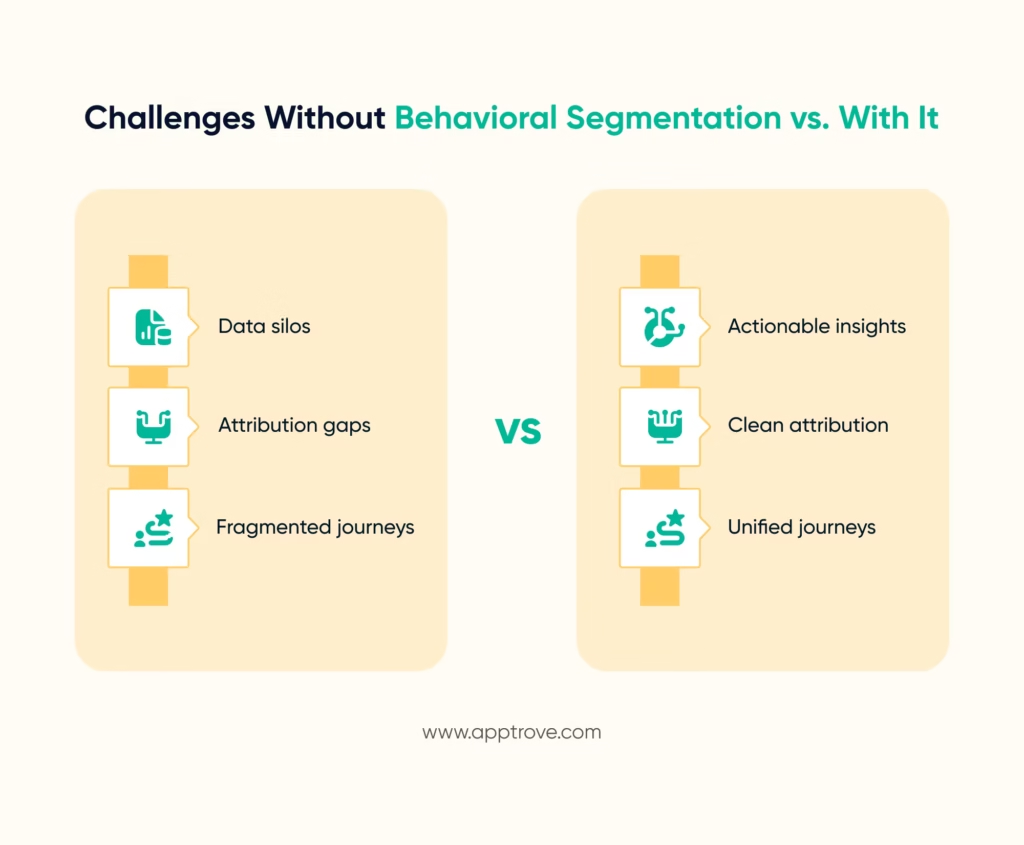
- Data silos
- Fragmented analytics
- Lack of cross-platform insight
- Attribution gaps
- Inconsistent tracking
- Privacy restrictions
- Poor audience hygiene
All these difficulties water-down your knowledge of the user behavior. And segmentation is a mere guesstwork unless we have clean and united data.
It is at this stage that you need a powerful mobile measurement partner and, preferably, one that has the capability to lend cross-platform journeys, tie touchpoints, clean your data and assist you in understanding user behavior without breaking privacy rules.
Where Apptrove Fits In
Although this pillar is not supposed to be sound sales-driven, it is also impossible to discuss behavioral segmentation without recognizing the pivotal role of precise tracking, attribution cleanness, and journeys of unified users. It is there that Apptrove can be fittingly considered as a part of the discussion.
It is only in the case that you can observe a behavior that you can segment users by the behavior. It is only in knowing what actions are what triggered meaningful communication that you can cause it to happen again. And the only way to individualize the journey is when you have the full picture of who you are doing business with rather than a piece meal of various gadgets and channels.
Apptrove gives you exactly that.
- Clear behavioral insights.
- Precision segmentation.
- Unified journeys.
- Actionable patterns.
- Reliable attribution.
- Smarter optimization.
Without it, behavioral segmentation cannot be implemented in its actual state since it is the basis of all mobile marketing.
Bringing It All Together
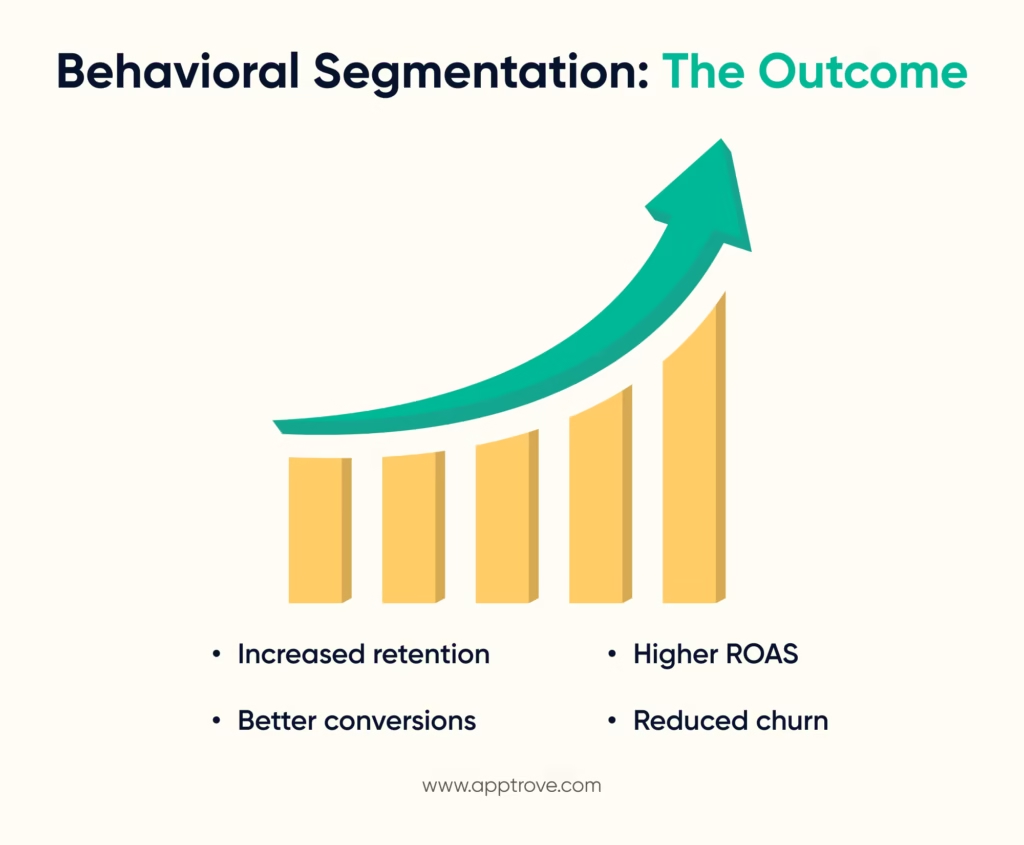
As soon as you start applying behavioral segmentation not as a reporting tool, but as a strategy driver, you are going to see a drastic change in the reaction of the users. Your campaigns are more natural. Your retention rises. Your acquisition improves. Your speech is clearer. The best is that your users are predictable.
Behavioral segmentation does not merely provide yourself with what users did. It makes you know what they shall do. And that is what makes it the foundation of the modern mobile marketing.
- You are no longer reacting.
- You are predicting.
- You are guiding.
- You are creating experiences that feel intentional, not automated.
FAQs
What is behavioral segmentation in mobile marketing?
Behavioral segmentation refers to the technique in which you group users by their behaviour within your app, e.g. how often they are active, their level of engagement, their buying habits, or their session behaviours. It assists you in providing experiences that are parallel to actual behaviour rather than speculations.
What are the most common behavioral segmentation variables?
Variables in this regard tend to be the frequency of engagement, the recentness of the activity, history of purchase, browsing, timing behavior, session depth, and feature usage. These variables can assist you to know what the users are really interested in and at what moment they are likely to take action.
Can you give behavioral segmentation examples used by mobile apps?
Yes. Viewers are frequently divided into targeted groups depending on the behavior of trial, onboarding, trigger purchase, drop-off, binge usage, or repeat browsing. The insights are useful in getting apps to tailor communication and enhance retention.
Why does behavioral segmentation improve app performance?
It makes your communication in tandem with the natural intent of the user. You do not go with irrelevant messaging but send what the user seeks and this will get more conversions, retention, and engagement.
How does Apptrove support behavioral segmentation?
Apptrove provides you with clean attribution, integrated user journeys, real-time data, audience data, and contextual behavioral data. This assists you in creating correct segments and mobilizing them smartly all through your whole mobile marketing strategy.