App promotion strategies in 2026 are no longer confined to purchasing ads, or enhancing App Store exposure. Rising user acquisition costs, privacy-driven environments, declining attention spans and increased competition have changed the way that mobile applications acquire and maintain their users.
The mobile app ecosystem in 2026 is more competitive than ever before. User expectations have changed, platform privacy policies have become stricter, and user acquisition costs continue to rise. Approximately $127 billion to $155 billion in consumer spending on apps and an increase in app installs in developing countries were seen during 2024.
Now brands need to use a combination of behavioral analytics, belongingness, ASO, deep linking, web-to-app journeys, personalisation, and unified attribution in order to increase the number of downloads for their apps and foster long-term retention.
Throughout this guide, we’ll review 7 of the highest impact app promotion strategies that are transforming how apps grow in 2026, and each is discussed with a contextual understanding of user journeys, analytics, attributes, deep linking, and behavior, all foundational elements in the Apptrove ecosystem.
What are App Promotion Strategies?
Methods of promoting applications typically involve tactics such as app store optimization (ASO), paid promotion, using deep links, leveraging influencers, personalizing, tracking attribution, and optimizing the transition from a web site to an application in order to create more visibility for applications, generate more downloads, keep users longer, and get the most from their overall value over time.
1. Use Behavioral Analytics to Improve App Promotion Strategies
Traditionally, acquisition was focused on the audience groups and demographic targeting, whereas in 2026, the situation is more complicated. The new approach of marketers is the behavior-based acquisition that focuses on how users learn about apps, what makes them install, and what behavior indicates long-term value.
Why Behavioral Insight Matters More Than Ever
Teams that study behavior rather than broad persona labels see clearer patterns. Globally, the average Day 1 retention rate across mobile apps is around 26%, and by Day 7, it drops to approximately 13%. Insights like these influence everything from landing page design to onboarding experiences.
Platforms like Apptrove help teams map these journeys, not by offering promotional shortcuts, but by ensuring data accuracy and clarity. Marketers can gain insight into the correct behavior and not assumptions; this will transform their acquisition of app users in the right direction.
2. Improve ASO and Play Store Optimization Continuously
App Store Optimization (ASO) and optimization of Google Play Store is still a basic component, but 2026 has changed the approach of marketers. Rather than periodic updates, now, it is all about continuous improvement – experimenting with keywords, reanimating creative resources, and studying store performance.
Narrative-Driven Store Listings Convert Better
Both the Apple App Store and Google Play Store have successful listings that are based on a storytelling approach. Instead of focusing on features, high-performing apps:
- Frame the core problem they solve
- Emphasize immediate user benefits
- Showcase social proof or credibility
The screenshots are organized in a way that creates a story other than a collection of UI pictures. In video ads, especially in Play Store, a video preview has become a conversion determinant as far as gaming, finance and commerce is concerned.
Localizing for Emerging Markets
Areas such as Brazil, Indonesia and Middle East have turned out to be high growth regions. Localized apps in the form of key word, visual, even value proposal apps experience much higher conversion rates – in many cases, without spending more money on organic visibility.
ASO and Play Store optimization also need strong measurement foundations. That’s where Apptrove’s role in tracking store behavior and connecting pre-install signals to in-app performance becomes relevant to marketers who want their mobile app marketing strategies to be guided by data.
3. Use Deep Linking to Increase App Downloads from Paid Campaigns
The necessary scale is still provided with the help of paid acquisition, yet the behavior of users towards advertisements is changed. Individuals are no longer content with being taken to the wrong screens. Once they have clicked on an advertisement about a product, offer, or feature, they would be hoping to be where they have promised.
Deep Linking Now Drives Paid Efficiency
Deep linking ensures that a user’s journey continues seamlessly from an ad to its intended in-app destination. Whether it comes from TikTok, Google UAC, Meta ads, or creators, deep linking:
- Reduces drop-offs
- Shortens conversion time
- Preserves user intent
- Improves downstream events
The intensive connection infrastructure that Apptrove has provides the context throughout paths. This is not advertisement, but an indication of how contemporary growth function is creating user experiences that are integrated rather than fragmented.
4. Optimize Web-to-App Journeys for Higher Mobile App Conversions
Mobile web is a high intention point of entry in most verticals. The product pages, blogs, FAQs, or advertisements that redirect to mobile sites are usually the first pages to be visited by the user and introduce them to a brand. The issue is that conventional web-to-app processes are easily broken.
Why Web-to-App Matters in 2026
An existing user that has already surfed your brand’s site has a motive. When such a transition to the app seems intuitive, when the user arrives on the same product or action they were considering, the conversion rates will skyrocket.
The experience is smooth with smart banners, fallback paths that are adaptable, and contextual scripts, which raise the chances of being installed and lowers the friction-inducing factors.
One of the app promotion strategies that are not fully exploited by marketers is known as web-to-app. By made flow preservative and stronger in-app actions through platforms such as Apptrove which allow routing and context-sensitive performance insights, teams can make flows and consequently perform better routing.
5. Strengthen Influencer Marketing with Attribution Tracking
Influencer marketing is no longer about reach, it’s about trust + trackability. The creators that the brand target are the ones whose communities are passionate about their recommendations, particularly in niches such as fintech, education, wellness, gaming, and D2C.
What Makes Creator Marketing Work in 2026
Authenticity stands out. When a creator uses a feature in real time during a video or live session, the impact is stronger than scripted endorsements. But beyond storytelling, teams now insist on transparent tracking.
Clean attribution shows:
- Which creators drive installs
- Which creators drive high-value users
- How influencer-driven cohorts behave long-term
Apptrove’s tracking and deep-linking layers help transform creators from “brand awareness drivers” into measurable acquisition partners, a shift many marketers struggled with in earlier years.
6. Personalize User Experiences to Improve Retention
Users expect personalization as a baseline, not an added benefit. Apps today are expected to adapt based on behavior, timing, interest, and context.
Personalization Beyond Push Notifications
Modern personalization blends multiple layers:
- Behavioral signals
- Feature usage patterns
- Frequency and timing
- Device context
- Past interactions
The goal is to make communication feel timely and relevant rather than promotional. For example, an app reminding a user about a saved cart at the hour they usually shop feels natural; a reminder at midnight feels intrusive. Similarly, productivity tools and time monitoring apps retain users far longer when nudge notifications align dynamically with individual daily schedules.
Apptrove’s real-time analytics and cohort insights help teams identify the right moments to engage, again, not as a pitch, but as part of the ecosystem enabling smarter mobile app marketing strategies.
7. Use Unified Measurement to Optimize Mobile App Marketing Strategies
The most powerful growth teams treat measurement as their foundation. Marketing today is no longer about following best practices blindly; it’s about validating what works through clear, real-time insight.
Why Unified Measurement Matters
Marketers that unify event tracking, attribution, web-to-app behavior, and channel performance in one lens optimize faster and spend smarter. They can see:
- True ROAS
- Channel-level profitability
- Funnel drop-offs
- Feature-level engagement
- Acquisition source quality
Fraud protection also plays a major role. With ad fraud evolving constantly, having systems that detect anomalies and filter invalid traffic ensures budgets are used effectively. Apptrove’s value emerges naturally here, accurate data enables growth teams to make decisions grounded in truth, not assumptions. This foundation supports every other strategy in this list.
Final Thoughts
Today’s best apps do not always have the largest advertising budgets; rather, they are focused on matching the user journey with actual user intent. Teams that invested time and resources to understand user behaviour, optimise App and Play Store presence, create smarter user acquisition funnels, openly collaborate with content creators, personalize user experience, and continuously measure everything thoroughly achieve superior results when compared to other competitive players.
By combining:
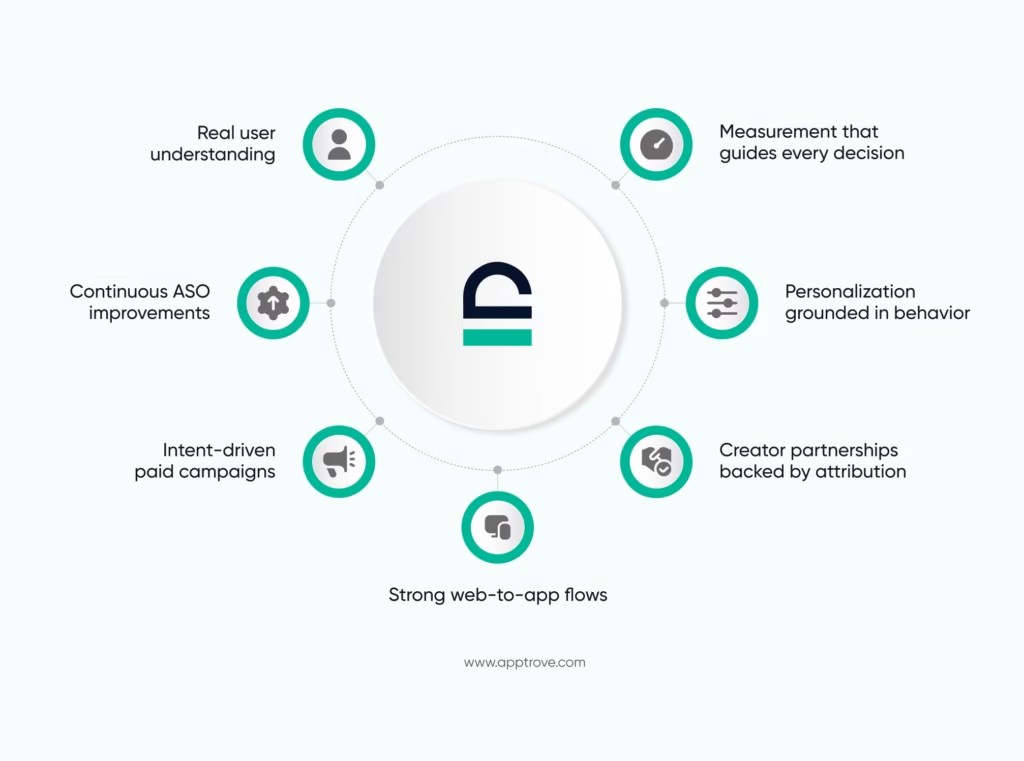
- Real user understanding
- Continuous ASO improvements
- Intent-driven paid campaigns
- Strong web-to-app flows
- Creator partnerships backed by attribution
- Personalization grounded in behavior
- Measurement that guides every decision
… businesses create systems of growth that are not reliant just upon luck or large advertising budgets; they rely instead upon clarity, contextual awareness, and continuous optimisation. Whether you are a marketer who is looking to strengthen your funnel or an app owner who wants to grow your business on a sustainable basis, these seven app promotional strategies provide a path to achieve long-term sustainable growth using techniques and insights that align naturally with what Apptrove does to help businesses understand user journeys and improve them, without ever needing to “sell” themselves.
FAQs
1. What are the most effective app promotion strategies in 2026?
The most effective app promotion strategies today combine behavioral insight, continuous App Store and Play Store optimization, deep-linked ad journeys, strong web-to-app flows, and unified measurement. Marketers who focus on user intent rather than just demographics consistently achieve better performance across acquisition and retention.
2. How do mobile app marketing strategies help increase app downloads?
Modern mobile app marketing strategies focus on creating seamless journeys from ads, content, or mobile web into the app. By aligning user intent with deep linking, optimizing store listings, and personalizing early engagement, brands significantly increase app downloads and drive higher-quality installs.
3. What role does ASO and Play Store optimization play in boosting app visibility?
ASO and Play Store optimization improve how users discover and evaluate your app. When keywords, screenshots, and video previews are continuously tested and localized, visibility and conversions rise organically. Combined with strong measurement, these optimizations strengthen long-term app promotion strategies without inflating paid budgets.
4. How does deep linking support mobile app marketing strategies?
Deep linking connects users directly to the most relevant in-app screen after they click an ad, a campaign banner, or a creator link. This reduces drop-offs, creates smoother experiences, and increases conversion rates. It’s now considered essential for effective mobile app marketing strategies and a reliable way to increase app downloads from paid and organic channels.
5. Why is unified measurement critical for successful app promotion strategies?
Without accurate attribution, event tracking, and fraud protection, it becomes difficult to understand which channels are driving true value. Unified measurement helps marketers identify high-intent sources, optimize budgets, and refine funnels. This clarity strengthens all other app promotion strategies, ensuring sustainable and data-driven growth.