Introduction
The way marketing performance is tracked has changed enormously, and it will continue to do so! Third-party cookie tracking is dying out; there are stricter regulations like GDPR, and there are constant updates to user privacy policies from all the major platforms. We have now fully entered the “privacy-first” era of marketing. In short, you cannot depend on tracking individual users for your marketing performance report or use them for future decisions. And, users are aware of this; 75% of consumers say they won’t purchase from organizations they don’t trust with their data . This is a huge deal.
The tricky thing is that you still need clear, actionable insights to continue improving your campaigns, spending your budget effectively, and maximizing your business growth. Previously, the majority of attribution models relied on user-level tracking, and given that it is not the same now, that level of visibility is not available.
Privacy-preserving measures of advertising will need to be employed. Advertisers will stop tracking their consumers at the individual level and switch to a focus on aggregated and anonymized data. By utilizing aggregate and anonymous data to track consumer behaviour, advertisers will continue to learn about the performance of their ads without violating consumers’ privacy. Marketers will have access to new tools (like Apptrove) that provide privacy-first solutions to allow them to adjust their advertising.
You will learn about what privacy-preserving ad measurement is, how it operates, and what you can do to ensure that you are ready for the transformation that is happening in advertising in the future.
The concept of Privacy-Preserving Ad Measurement and Its Significance Now
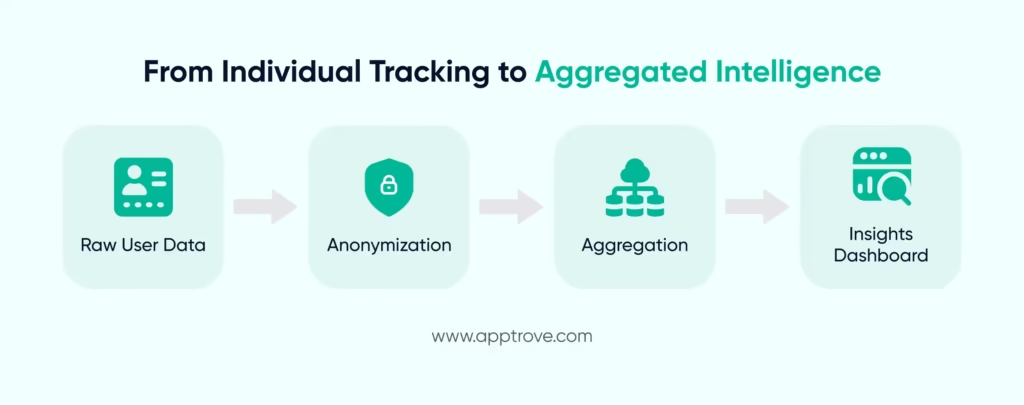
Privacy-preserving ad measurement is a more recent technique for monitoring campaign performance that does not use PII (personally identifiable information) about users. Rather than tracking users and devices across different sites and/or apps, Privacy-preserving ad measurement leverages data that has been aggregated and anonymized to find patterns and gain insights. This means that you are able to have an accurate understanding of how you are achieving results (and not), without crossing privacy boundaries.
Traditionally, advertisers relied on user-level tracking to get the right data for ad measurement. Each click, install, and conversion is linked back to individual users. Now marketers have access to very specific data to help them make decisions. However, as the privacy of consumer data has come into the spotlight (due to increased concerns over the inappropriate use of data and regulatory compliance), there is now a shift by marketers from a user-focused to a user-count-based method of ad measurement, providing a high-level but still valuable way to measure the performance of an ad.
The change to using user counts is no longer a choice for marketers; now, marketers must comply with stricter regulations (i.e., GDPR), continue to adjust based on changes from ad delivery platforms (i.e., Apple Privacy Changes), and account for increased public awareness of data privacy issues. Consumers have increasing expectations regarding privacy, wanting more transparency in how their data is used and greater control over when their data is used. As a result, companies that do not employ more consumer-centric methods for measuring ad performance risk losing both access to their customers’ data and losing trust and loyalty from customers.
The Reason Why Privacy-Preserving Ad Measurement Is The Future
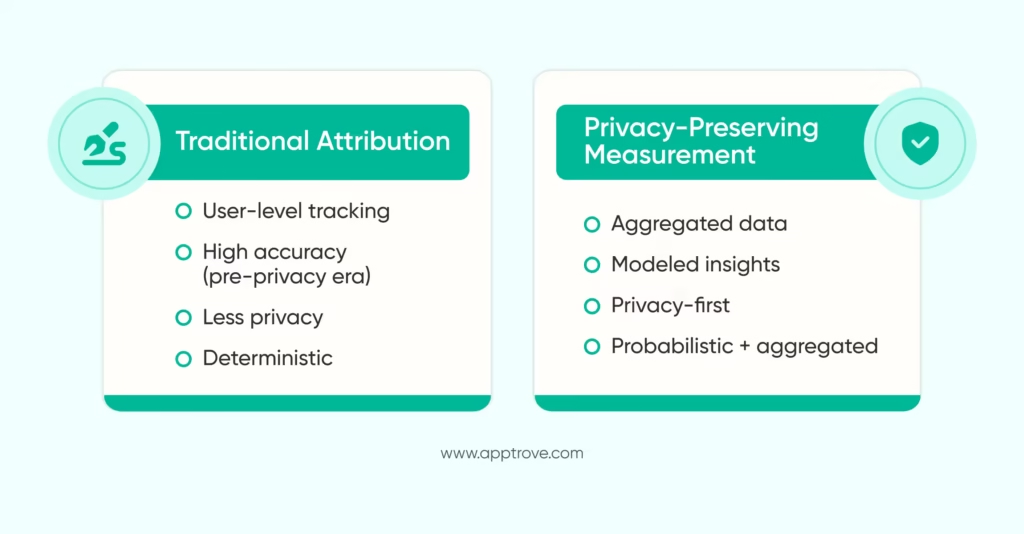
Conventional attribution models account for an ecosystem where it was relatively easy to track users across multiple destinations and types of devices; the use of third-party cookies, Device IDs, and deterministically matched data ensured that marketers would be able to follow a user through their entire customer journey with precision. This structure is breaking down, as limitations on third-party cookies, limits on unique identifiers (i.e., IDFA), and new privacy legislation are significantly increasing the amount of signal loss on users, thus making user-level tracking much less reliable than it has been in the past.
Attribution is changing because of this signal loss. Newer measurement models are incorporating probabilistic models and aggregated data to focus on identifying trends and patterns amongst groups of users rather than trying to understand every single user’s entire experience. You may believe that you’re losing detail from your attribution due to this evolution of measurement; however, developing your attribution capabilities using privacy-preserving measurement strategic approaches will actually measure performance in a more privacy-secure and future-oriented manner.
Furthermore, developing user privacy into your measurement strategy is just as critical to building trust with users. By developing your measurement strategy in a way that is respectful of user privacy, as well as being in line with the global guidelines set by the industry, you are not only compliant but you are also demonstrating to users that you operate with respect for their data. Privacy-Preserving ad measurement is not a passing trend; it is becoming the standard for determining performance with both the right outcomes and the right ethics.
Privacy-Preserving Ad Measurement In Today’s Mobile Ecosystem
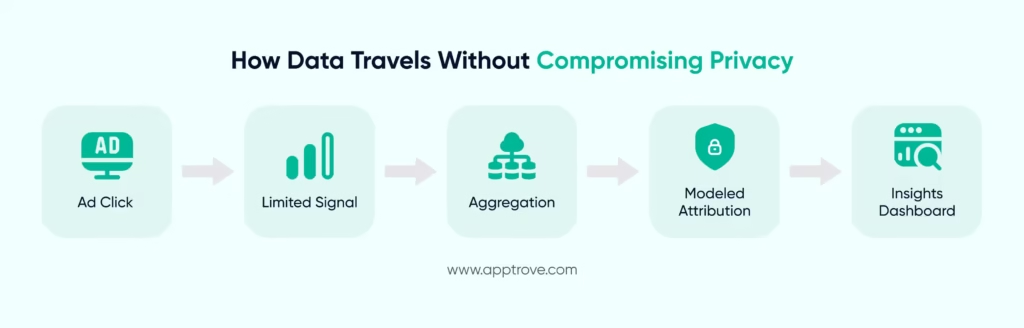
With the introduction of consumer privacy, companies are going to have to change how they measure their advertising/marketing efforts. However, companies will be able to maintain a level of insight into how their advertising is performing, and it may take a different approach than it did before, but companies will still be able to have a good idea of the advertising that is working.
One approach is the use of aggregated reports. Instead of measuring individual consumers’ tracks throughout their purchase path and using individual records in their analysis, you measure the performance of groups of consumers against each other. By this method, you will not have all of the detailed information about the purchases by any individual consumer, but you will be able to identify with certainty which campaigns are producing results across groups of consumers.
Another method that can be used is a delayed postback, and this is when you receive your conversion data sometime after the consumer registered as a conversion, as opposed to the next moment. Although you are not receiving immediate conversion data, and your data will be considerably limited due to the time window, this is an effective technique that will allow for some protection of your consumers’ personal identifying information, while still reporting performance data that will give you valuable information that you can use to maximize your advertising efforts.
Another critical factor is conversion modeling, where unsound or limited data are used to help you estimate how well your actions performed through statistical models that approximate what the results of these actions would have been without tracking.
Another best practice is event prioritization, which means only tracking and reporting on the most valuable actions, such as installs or purchases. This helps keep your performance measurement focused and efficient, and within privacy barriers.
Both of these strategies allow for performance measurement to be done effectively, using industry-approved methods that meet current privacy expectations.
The Key Technologies Behind Privacy-Preserving Ad Measurement
A handful of key technologies form the backbone of every privacy-focused measurement approach. While some of them may seem a bit technical to begin with, their ultimate purpose is to provide insight into performance while keeping user identities hidden.
The Use of Aggregated Data Models to Ensure Data Quality
Aggregated Data Models aggregate data from multiple users into aggregates of data instead of reporting on what an individual has done. Therefore, instead of determining who and where they are from, you will only determine patterns.
This still provides a reliable view of your performance; however, the actions that are contributing to these results can no longer be associated with an individual because your data has been aggregated. In this regard, it’s both an effective method of complying with your privacy requirements and providing you with valuable data to make informed decisions about your operations.
Measurement and Differential Privacy: How They Work Together
By adding noise (small amounts of randomness) into the data collected, differential privacy helps to provide additional protection to the individual behind that data. Therefore, it is nearly impossible for the data to be used to identify an individual, directly or indirectly. From your point of view, the data will still be accurate enough for you to analyze trends and performance, with significantly less risk associated with exposing sensitive information.
Utilizing Conversion Modeling to Fill Gaps in Your Data
If there isn’t enough direct tracking for all data points, there are always going to be missing pieces of information. This is where conversion modeling comes into play. By leveraging historical data and various statistical techniques, it will provide you with better estimates of your outcomes, thus filling the gaps in your data. You will now have a complete picture of your campaigns’ performance.
Together, these methods create reliable ways of measuring performance where it aligns with both performance metrics and current privacy standards.
You Should Use Privacy-Preserving Ad Measurement to Make Smart Budgeting Decisions
In the current world of privacy-first budgeting, it is not as easy to allocate a budget. If you are using old tracking systems, your data is most likely not complete or may be incorrect. By using privacy-preserving ad measurement as your measurement method instead of fragmented user-level tracking, you are able to find more reliable aggregate signals that can provide better results.
Even if there is no granular visibility, you will still have confidence when making optimization decisions. By analysing cohort-level trends and using converted models, you can get a better view of which channels, creatives, or campaigns are helping to drive business. This, in turn, will allow you to make better decisions for where to allocate your budgets without relying on outdated tracking methods.
In addition to helping future-proof your strategy, it also builds a measurement approach that is aligned with the evolving privacy standards rather than using potentially disappearing or restricted identifiers. This will help reduce ongoing adjustments to account for changes in regulations and platform updates.
You should also consider the trust factor. Nearly 50% of consumers have abandoned a purchase or switched brands due to concerns about how their data would be used. When you respect users’ privacy in your measurement approach, you will not only increase your performance, but you will also build better and more credible relationships with your audience.
How to Modify Your Strategy to Limit User Data Collection When Measuring Ads
When adapting to ways of measuring advertising that respect personal privacy,y you are making a change in not losing control of how you measure performance. Now, ow instead of trying to find exact tracking of each user, you will utilize signals of data that help inform you in making smart and effective decisions.
A first step would be to prioritize events; no longer do we need to track every single user interaction, but rather to determine what user interactions are truly important (e.g., install, buy, subscribe) and focus our measurements only on those behaviors. By measuring only these major events, we remain compliant with privacy regulations while still being able to capture enough data to make sound decisions about our business.
Next, you can analyze your users’ activity as a whole and not just on an individual basis. To do that will help determine how well you are doing on achieving retention, engagement, and conversions without relying on user-level data or PII.
Second, creative experimentation will be more important in this environment than ever before. With greater reliance upon performance being driven primarily by the creative, this will require you to run multiple creative types against one another to see what resonates with consumers, and then take that data (in aggregate) and analyze it to determine if that is indeed true.
Third, you should begin to utilize modeled data in your decision-making process because even though they are not as precise as traditional methodologies, they will often give you a better understanding of the overall performance of your advertising and will help you make more sustainable and informed decisions, without relying upon invasive measurement practices.
Obstacles Involved in Privacy-Preserving Ad Measurement
Although ad measurement that does not compromise user privacy is absolutely an option that allows marketers and advertisers to continue doing business over the next decade and beyond, there will certainly be some transitions involved as well.
For example, when implementing processes to measure your advertisement’s performance using privacy-preserving methodology, you are likely to encounter delays in data. Many metrics will be available to measure the performance of your advertisements, but due to privacy-preserving methodologies, these metrics will typically not be available until after a predetermined timeframe and therefore cannot be used to make rapid adjustments. With careful planning, however, you can still closely monitor your advertisement’s performance.
In addition to delays in receiving data to measure the success of your advertisement, there will be much less granular data that you can measure. Consequently, you will not be able to identify the user-level details of the individual steps within a given customer journey. That being said, however, measuring fewer metrics often allows you to make more intentional and strategic ads through the use of broader trends and patterns than would be possible from measuring many detail-oriented metrics together.
There will be some adjustments with regard to moving from a deterministic approach to aggregated and modeled insights. This new thought process may seem strange at the beginning, but after time has passed, interpreting and taking action upon these insights will be far more straightforward.
Additionally, there will be even more dependency on modelling. This may seem uncertain at first, but these models continue to evolve and are designed to provide consistent data-based insight, supplying you with a firm basis to confidently optimize your campaigns.
Friendly Advertising Measurement as the Future of Mobile Attribution
The shift to a privacy-first paradigm is far more than an immaterial trend and is changing the base of digital marketing. Tracking is becoming limited, measurement will continue, but measurement will be transforming into a more responsible and user-friendly way.
Privacy-preserving measurement can continue to provide continuous data-driven decision-making without needing any invasive tracking. Privacy-preserving measurement provides a shift in focus to more meaningful signals of success over the long-term, creating successful performance trends, while building both results and trust. Rather than looking at privacy as a constraint, it will be helpful to look at privacy as an opportunity to refine how we view success.
With the continuing change in the mobile landscape, you must be more adaptable than ever. If you want to implement a privacy-first type of measurement more successfully, connect with us so that we can assist you in working through this transition.
FAQs
1. What makes privacy-preserving ad measurement different from traditional analytics?
We will gather individual user data (via tracking) only using aggregated/anonymized data; this allows us to measure our effectiveness for a marketing campaign without violating any individual’s privacy and still remain in compliance with evolving governmental regulations on data use.
2. Why is privacy-preserving ad measurement important for mobile marketers today?
Because of the increased limitations on tracking due to stricter government regulations and the growing awareness of how companies misuse consumer data, there is an opportunity for you to continue to measure performance while creating confidence in the compliance of global data privacy laws.
3. How does conversion modeling improve measurement accuracy?
By employing statistical approaches to fill in any gaps in data, conversion models enable greater insight into how campaigns are functioning from a performance standpoint, particularly when there are issues with user-level tracking signal availability or completeness.
4. What challenges should you expect when implementing privacy-preserving measurement?
Due to delays in data reporting, there may be fewer details about your performance and a shift from analytical techniques to aggregated performance trends.
5. When should you start transitioning to privacy-preserving ad measurement?
If you want to ensure a smooth transition and to be able to avoid disruptions caused by changes in platform privacy regulations or when transitioning your user-level tracking campaigns, you need to get started as soon as possible.