Before we dive deep into the reasons for the difference in the data from the Analytics Platform (Google Play Store or App Store) and Mobile Marketing Platforms, let me first assure you that this dissimilarity is completely normal. However, marketers need accurate data to inform their decisions, so it falls upon them to address this discrepancy, but more importantly, find out how to minimize them.
You have come to the right place! In this article, we will explore how marketers can get ahead of this issue and use the collected data more profoundly and analytically.
What Are Mobile Marketing Platforms?
Mobile Marketing Platforms allow app marketers to track user acquisition, attribution, campaign efficiency, and app usage across multiple marketing channels. Unlike app stores that record downloads and installations, MMP measures real user activity post-opening the app.
Due to SDK integration and attribution algorithms, Mobile Marketing Platforms often report different installation counts than the Google Play Store or App Store. Understanding reasons for these discrepancies helps marketers make informed decisions on optimization, rather than thinking the numbers are faulty.
Why Mobile Marketing Platforms and App Stores Show Different Install Numbers?
While both app stores and mobile marketing platforms count the number of installs, their approaches are different in terms of methodology, attribution models, and reporting timeframe.
In general, app stores log the downloads and installs associated with user accounts, while mobile marketing platforms determine installs based on device behavior, SDK events, attribution windows, and engagement level after install, respectively. Hence, it is normal to see some discrepancies in reporting between the two sources of information, and this does not imply that the data is incorrect.
Let’s Start by Looking at the Reasons Why We Experience These Discrepancies
Usually, a mobile marketing platform counts an install when the app has been downloaded and opened on the user’s device. Whereas the App Stores count every install even if the user hasn’t even opened the app once. Wondering why the attribution platforms do not count every install? Well, it’s because platforms integrate SDK (Software Development Kit) into the app, which is the only source of information for third-party apps. SDK allows the platform to detect and track events in the app like registration and purchase. Now, if the user does not perform any activity on the app, it makes it difficult for the third-party platform to track it.
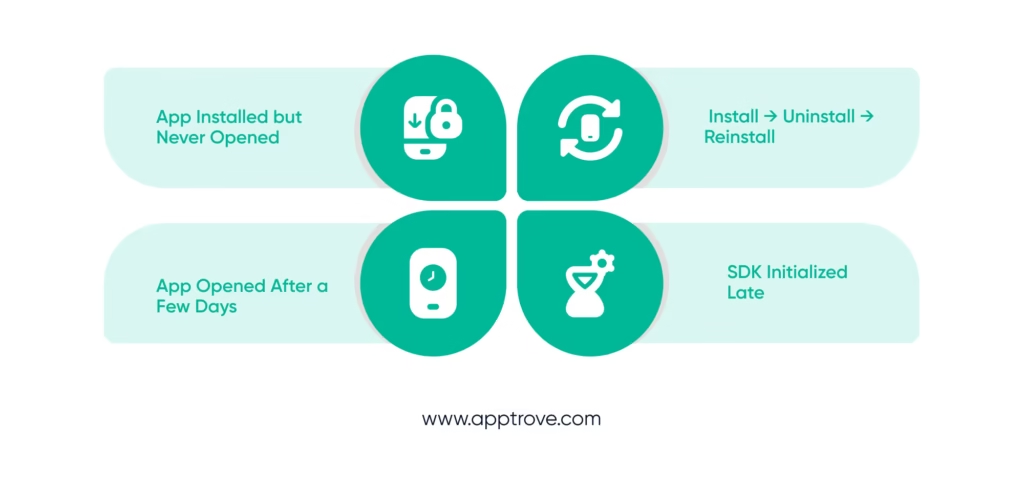
So when the next time you extract the acquisition data from both platforms and find a difference, know that the following reasons are behind the discrepancy:
- The application was installed by the user but was never opened.
- The user opened the app after a few days.
- They installed, uninstalled, and then installed the app again, making it difficult for the SDK to track it.
- The SDK was initialized after a few days when it noticed extra in-app behavior.
It’s important to note that when a user installs and reinstalls an app, it is considered as two installs by the app stores, but the attribution platforms would still consider it as one. It will give significance to the first launch made on the app. Adding to that is the difference in the time zones between both platforms. The App Stores display data as per the local time zone, and the mobile marketing platforms display according to the UTC±00:00 time zone. You can set the app-preferred time zone to reduce this discrepancy.
Furthermore, the number of installs may also vary depending on the account and devices a user has. As many of you would know, generally Google Play Console or iTunes Connect count the installs according to the user ID, while the attribution platforms count them as per the device ID. For instance, consider you have two different devices but the same account ID. Now, when you install the app on both devices, the Google Play Store will count that as one install, but the mobile marketing platforms will see it as two installs.
Even the tracking of data in some of the platforms varies. Google AdWords registers the data from the day a user clicks the ad and not after its installation, but the App Store starts reading the data when a person has installed the app.
Why Accurate Attribution Matters
According to Data.ai’s State of Mobile 2025, global consumers continue to spend record levels of time inside mobile apps, making accurate attribution and campaign measurement more important than ever.
By recognizing differences in reporting, marketers are able to make improved decisions regarding their campaigns regarding campaign optimisation and budget allocation. Companies must view attribution metrics together with retention rate, conversion rates, in-app activities, and customer lifetime value rather than simply measuring installation rates.
Modern Mobile Marketing Platforms provide insights on audience behaviour beyond merely installation rates, enabling teams to optimise their campaigns based on outcomes rather than figures used solely for status purposes.
How to Minimize These Discrepancies
By optimizing your attribution platform and studying the data across various platforms wisely.
Here are the tips that will help you!
1. Improve the User Journey to Reduce Under Attribution
Usually, there’s one launch in around 90% of the mobile app downloads. And this can vary significantly in different geos and verticals. So if your mobile marketing platforms show under attribution, work on improving the journey of the user from the day of ad click to the day of launch. This can be done through push notifications, reminders, offers, and more.
2. Use Longer Data Ranges for Accurate Reporting
Use longer periods of time as your queried data range so as to record the delayed launches and then evaluate installs in the mobile marketing platforms. This will help in minimizing the discrepancy between the number of ‘downloads’ recorded on play stores and the number of ‘launches’ on the marketing platforms.
3. Align Time Zones to Minimize Data Discrepancies
Set the app-preferred time zone on the attribution platform to avoid the ‘untimely’ discrepancies.
4. Set Reattribution Windows to Track Installs vs. Reinstalls
To record the clear number of installs and reinstalls of an app, set the reattribution window to 1 to 24 months as per your requirement. This will help you in differentiating what is a reinstall or a new install.
5. Deploy Anti-Fraud Tools Against Fake Installs
Use an anti-fraud solution installed on the platform to avoid recording the fraud ‘new installs’ of the app on other devices when there is just one user.
6. Account for Out-of-Store Downloads in Data Records
Sometimes the user downloads an app from out-of-store markets. Well, App Stores do not count it but the attribution platform does. To clearly distinguish this in the data records, set up the correct program as listed in the documentation of the platform.
These are just a few tips and tricks to optimize your mobile marketing platforms and evaluate the data with ease and clarity. If you have something more to add, do write to us in the comments below. We will be more than happy to hear or answer any of your queries.
Best Practices for Reducing Attribution Discrepancies
Even though disparities in reporting cannot be completely avoided, marketers can lower these discrepancies by ensuring consistent SDK usage, checking attribution windows routinely, aligning reporting time zones, watching out for fraud, and confirming campaign results through different trustworthy data sources.
The aim is not to have the same numbers on all platforms, but to comprehend the underlying reasons for these variances while using each platform accordingly.
Conclusion
Differences between Mobile Marketing Platforms and app stores are a normal part of mobile attribution. Since both platforms measure installs differently, marketers should focus less on matching numbers perfectly and more on understanding the context behind the data.
By implementing proper attribution settings, maintaining accurate SDK integrations, aligning reporting configurations, and analysing performance holistically, businesses can make more confident marketing decisions and maximise campaign effectiveness.
FAQs
1. Why do data discrepancies occur between App Stores and Mobile Marketing Platforms?
App Stores count every instance of install, even for unopened apps, while attribution platforms’ metrics use the SDK and only account for installs after the first launch. In addition, there will also be discrepancies due to time zones, devices IDs and reinstalls.
2. How does SDK Spoofing affect mobile marketing platforms?
SDK Spoofing sends fake install or event data that misleads mobile marketing platforms. This inflates reports and can waste ad spend. Anti-fraud tools help detect and block such fraudulent activity.
3. Why is LTV important when analyzing discrepancies?
LTV (Lifetime Value) looks at user quality – not the amount of installs. No matter the numbers being different, measuring LTV will help marketers determine which users are more likely to cause a greater long-term ROI.
4. Do geos and verticals influence discrepancies?
Absolutely. In certain geos, some users can delay launching the app after install; however, in verticals like gaming, frequent reinstalls can also create discrepancies. Both of these create a gap in attribution between the tracking platform and the app store.
5. How can marketers reduce discrepancies?
Set preferred time zone; Allow longer reporting ranges; Create reattribution windows; Use fraud protection against SDK spoofing; Track LTV to better align data between the app store and tracking platform.